IN THE UNITED STATES DISTRICT COURT
FOR THE EASTERN DISTRICT OF TEXAS
MARSHALL DIVISION
HEADWATER RESEARCH LLC, §
§ §
Plaintiff,
§ §
v.
§ CIVIL ACTION NO. 2:23-CV-00103-JRG-RSP §
SAMSUNG ELECTRONICS CO., LTD.,
§
and SAMSUNG ELECTRONICS
§
AMERICA, INC.,
§
§
Defendants. §
MEMORANDUM ORDER
Before the Court is Defendants’ Renewed Motion to Stay Pending Inter Partes Review. Dkt. No. 119. Samsung seeks to stay this action pending a series of IPRs it filed against the asserted patents. Id. The Court DENIES the Motion as provided below.
I. BACKGROUND
Samsung has filed a series of IPRs as to the asserted patents. Samsung summarizes its filings and the Board’s institution decisions in the below chart:
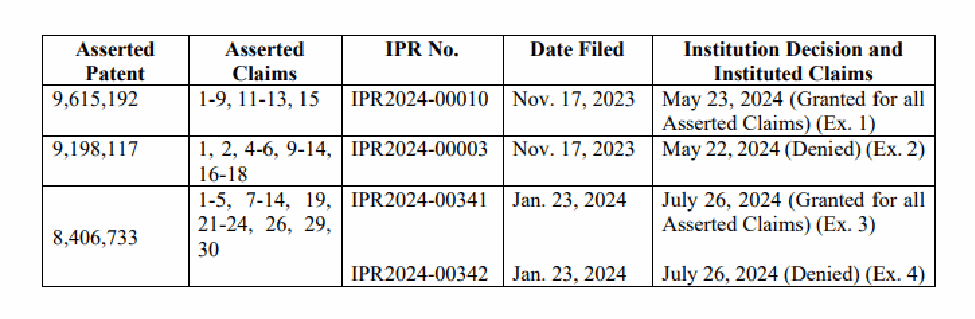
2Of note is that the Board has not instituted IPRs for all the asserted patents.
II. APPLICABLE LAW
“The party seeking a stay bears the burden of showing that such a course is appropriate.” Peloton Interactive, Inc. v. Flywheel Sports, Inc., No. 218-cv-390-RWS-RSP, 2019 WL 3826051, at *1 (E.D. Tex. Aug. 14, 2019) (quoting Realtime Data, LLC v. Hewlett Packard Enter. Co., No. 6:16-cv-86-RWS-JDL, 2017 WL 3712916, at *3 (E.D. Tex. Feb. 3, 2017)); accord Landis v. N. Am. Co., 299 U.S. 248, 255 (1936). “The decision of whether to extend a stay falls solely within the court’s inherent power to control its docket.” Pers. Audio LLC v. Google, Inc., 230 F. Supp. 3d 623, 626 (E.D. Tex. 2017) (citing ThinkOptics, Inc. v. Nintendo, No. 6:11-cv-455-LED, 2014 WL 4477400, at *1 (E.D. Tex. Feb. 27, 2014)); accord Clinton v. Jones, 520 U.S. 681, 706 (“The District Court has broad discretion to stay proceedings as an incident to its power to control its own docket.”) (citing Landis, 299 U.S. at 254).
District courts typically consider three factors when deciding whether to stay litigation pending IPR of the asserted patent(s): “(1) whether the stay will unduly prejudice the nonmoving party, (2) whether the proceedings before the court have reached an advanced stage, including whether discovery is complete and a trial date has been set, and (3) whether the stay will simplify issues in question in the litigation.” Trover Grp., Inc. v. Dedicated Micros USA, No. 2:13-CV-1047-WCB, 2015 WL 1069179, at *2 (E.D. Tex. Mar. 11, 2015) (collecting cases). “The party seeking a stay bears the burden of showing that such a course is appropriate.” Peloton Interactive, Inc. v. Flywheel Sports, Inc., No. 218-cv-390-RWS-RSP, 2019 WL 3826051, at *1 (E.D. Tex. Aug. 14, 2019) (quoting Realtime Data, LLC v. Hewlett Packard Enter. Co., No. 6:16-cv-86-RWS-JDL, 2017 WL 3712916, at *3 (E.D. Tex. Feb. 3, 2017)); accord Landis v. N. Am. Co., 299 U.S. 248, 255 (1936). “The decision of whether to extend a stay falls solely within the court’s inherent3 power to control its docket.” Pers. Audio LLC v. Google, Inc., 230 F. Supp. 3d 623, 626 (E.D. Tex. 2017) (citing ThinkOptics, Inc. v. Nintendo, No. 6:11-cv-455-LED, 2014 WL 4477400, at *1 (E.D. Tex. Feb. 27, 2014)); accord Clinton v. Jones, 520 U.S. 681, 706 (“The District Court has broad discretion to stay proceedings as an incident to its power to control its own docket.”) (citing Landis, 299 U.S. at 254).
III. ANALYSIS
A. PREJUDICE
Samsung argues that Headwater will not be unduly prejudiced because Headwater is a non-practicing entity that does not make any products or practice the patented technology, thus money damages will be sufficient to compensate Headwater, and a stay will not affect Headwater’s damage recovery, just delay it.1 Dkt. No. 119 at 3.
Headwater disputes Samsung’s characterization of it as an NPE. Dkt. No. 128 at 4. Headwater notes that it had a sister organization that developed tools that implemented its patented technology and contends Samsung’s infringement now thus is harmful to Headwater’s business. Id. Headwater further argues that its status as a non-practicing entity should not influence the Court’s analysis of prejudice. Id. at 4.
The Court finds this factor weighs against stay. All parties have an interest in the timely vindication of their patent rights, regardless of their practicing status.
B. STAGE OF LITIGATION
“Usually, the Court evaluates the stage of the case as of the time the motion was filed.” Peloton Interactive, 2019 WL 3826051, at *5 (quoting Papst Licensing GMBH & Co., KG v. Apple, Inc., 6:15-cv-1095-RWS, slip op. at 7 (E.D. Tex. June 16, 2017)) (citing VirtualAgility, 7594 F.3d at 1317). The Motion was filed on August 23, 2024.2 At that point, a trial date had been set, Dkt. No. 63, fact discovery was almost complete, Dkt. No. 113 (“Deadline to Complete Fact Discovery–September 10, 2024), eight depositions had been conducted, Dkt. No. 128 at 7, and the Court issued a Claim Construction Order, Dkt. No. 118. Samsung’s assertion that the case was at an early stage at the time of its Motion is unavailing.
C. SIMPLIFICATION
Whether a stay “will result in simplification of the issues before a court is viewed as the most important factor when evaluating a motion to stay.” Uniloc USA, 2017 WL 2899690, at *3 (citing Intellectual Ventures II LLC v. Kemper Corp., No. 6:16-cv-81-JRG, 2016 WL 7634422, at *2 (E.D. Tex. Nov. 7, 2016); NFC Tech., 2015 WL 1069111, at *4). “Simplification of the issues depends on whether the PTAB decides to grant the petition.” Id. (citing Trover, 2015 WL 1069179, at *4; Loyalty Conversion Sys. Corp. v. Am. Airlines, Inc., No. 2:13-cv-655-WCB, 2014 WL 3736514, at *2 (E.D. Tex. July 29, 2014)).
Here, the PTAB decided to deny institution on one of the IPRs for the ’733 patent and denied institution for the ’117patent. Dkt. No. 119; Dkt. No. 128. As such, even an ultimate finding in favor of Samsung invalidating all claims of the patents in the instituted IPRs would leave material disputes for the Court to decide. This factor weighs against a stay.
5IV. CONCLUSION
The factors decidedly weigh against a stay, and thus the Court DENIES Samsung’s motion as provided above.
Footnotes
- ↩ 1 Samsung further argues that it would be prejudiced if a stay is not granted as Samsung would incur significant litigation expense in defending itself. Dkt. No. 119 at 3. The Court rejects this argument. This factor focuses on the non-moving party, and having to defend oneself is not unduly prejudicial, nor are the normal expenses of litigation.
- ↩ 2 Samsung originally filed a Motion to Stay Pending IPR on January 25, 2024. Dkt. No. 70. The Court denied that Motion because the Board had not instituted for any of the patents. Dkt. No. 83. The Court does not believe that the original Motion should play a role in this analysis.