IN THE UNITED STATES DISTRICT COURT
FOR THE EASTERN DISTRICT OF TEXAS
MARSHALL DIVISION
LIONRA TECHNOLOGIES LTD., §
§
Plaintiff, §
v. § CIVIL ACTION NO. 2:22-cv-0322-JRG-RSP § (Lead Case)
FORTINET, INC., §
§
Defendant. §
REPORT AND RECOMMENDATION
Before the Court is Defendant Fortinet’s Motion for Summary Judgment of NonInfringement (Dkt. No. 260). After consideration, the motion should be DENIED.
I. APPLICABLE LAW
Summary judgment should be granted “if the movant shows that there is no genuine dispute as to any material fact and the movant is entitled to judgment as a matter of law.” Fed. R. Civ. P. 56(a). Any evidence must be viewed in the light most favorable to the nonmovant. See Anderson v. Liberty Lobby, Inc., 477 U.S. 242, 255 (1986) (citing Adickes v. S.H. Kress & Co., 398 U.S. 144, 158–59 (1970)). Summary judgment is proper when there is no genuine dispute of material fact. Celotex v. Catrett, 477 U.S. 317, 322 (1986). “By its very terms, this standard provides that the mere existence of some alleged factual dispute between the parties will not defeat an otherwise properly supported motion for summary judgment; the requirement is that there be no genuine [dispute] of material fact.” Anderson, 477 U.S. at 247–48. The substantive law identifies the material facts, and disputes over facts that are irrelevant or unnecessary will not defeat a motion for summary judgment. Id. at 248. A dispute about a material fact is “genuine” when the evidence is “such that a reasonable jury could return a verdict for the nonmoving party.” Id.
2The moving party must identify the basis for granting summary judgment and evidence demonstrating the absence of a genuine dispute of material fact. Celotex, 477 U.S. at 323. If the moving party does not have the ultimate burden of persuasion at trial, the party ‘must either produce evidence negating an essential element of the nonmoving party’s claim or defense or show that the nonmoving party does not have enough evidence of an essential element to carry its ultimate burden of persuasion at trial.’” Intellectual Ventures I LLC v. T Mobile USA, Inc., No. 2:17-CV-00577-JRG, 2018 WL 5809267, at *1 (E.D. Tex. Nov. 6, 2018) (quoting Nissan Fire & Marine Ins. Co., Ltd. v. Fritz Cos., Inc., 210 F.3d 1099, 1102 (9th Cir. 2000)).
II. ANALYSIS
The parties’ dispute is focused on the arrangement of three limitations: “packet engine,” “intrusion detection system,” and “cryptographic core.” In particular, they dispute whether a packet flow from “packet engine” to “cryptographic core” to “intrusion detection system” infringes. The Asserted Claims at issue require “an intrusion detection system coupled between the cryptographic core and the packet engine.” The Court construed “intrusion detection system,” “cryptographic core,” and “packet engine” to be hardware and rejected the proposal that they must be “distinct, separate hardware.”
Fortinet argues that Lionra’s logical “coupled between” theory fails as a matter of law. Fortinet argues that this theory follows packet flow, but packets flow from “packet engine” to “cryptographic core” to “intrusion detection system.” Since there is no showing the “intrusion detection system” is in between the “cryptographic core” and “intrusion detection system” Fortinet argues there is no infringement. Fortinet argues this is particularly true regarding the flow of unencrypted packets since they do not undergo decryption and thus a security processor receiving them would not be a cryptographic core.1
3Fortinet argues that the same is true of Lionra’s physically “coupled between” theory. Fortinet contends there is no showing that the “intrusion detection system” is physically coupled between the other two. Fortinet points to the relevant portion of Lionra’s expert’s report where he provides a block diagram which does not show the “intrusion detection system” “in between.” Fortinet argues that the expert never contends otherwise. Fortinet further argues that Lionra’s theories point to a single chip as satisfying multiple of the “intrusion detection system,” “cryptographic core,” and “packet engine” roles and thus cannot be physically “in between” itself.
Lionra responds that the Court’s Claim Construction Order explained “coupled and interposed do not necessarily refer to physical relationships but rather can be understood as also encompassing processing relationships and communication relationships.” Lionra argues there is no claim language that requires packet flow from “packet engine” to “intrusion detection system” then to “cryptographic core.” Lionra points to Figure 3 of the patents showing one embodiment where the intrusion detection system is not immediately between the engine and core such that there is no other path between the engine and core. Lionra contends that because Fortinet’s restrictive construction is counter to the Figure, and its infringement theory aligns with it, Fortinet’s motion should be denied.
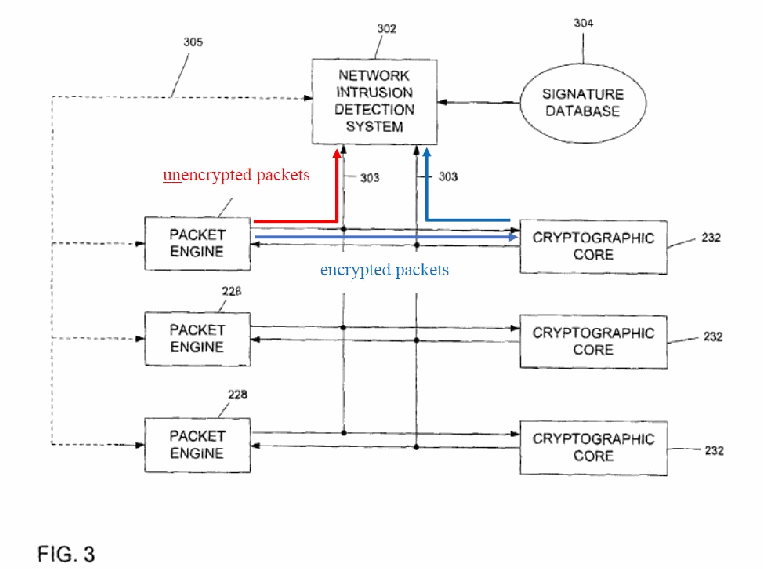
4The Court finds Fortinet’s construction of “coupled between” is too narrow. As the Court previously provided for “coupled” and “interposed,” “coupled between” does not necessarily refer to physical relationships but rather can be understood as also encompassing processing relationships and communication relationships. For example, Figure 3 shows such a relationship with communication directly from and to the “packet engine” and “cryptographic core” where the “intrusion detection system’s” role is not that of an interceder. As such, the Court finds “coupled between” does not impose a requirement that packets flow from “packet engine” to “intrusion detection system” then to “cryptographic core.”
III. CONCLUSION
The Court recommends that Fortinet’s Motion be DENIED. A party’s failure to file written objections to the findings, conclusions and recommendations contained in this report within 14 days bars that party from de novo review by the District Judge of those findings, conclusions, and recommendations and, except on grounds of plain error, from appellate review of unobjected-to factual findings and legal conclusions5 accepted and adopted by the district court. FED. R. CIV. P. 72(b)(2); see also Douglass v. United Servs. Auto. Ass’n, 79 F.3d 1415, 1428–29 (5th Cir. 1996) (en banc). Any objection to this Report and Recommendation must be filed in ECF under the event “Objection to Report and Recommendation [cv, respoth]” or it may not be considered by the District Judge.
Footnotes
- ↩ 1 The asserted claims provide a “cryptographic core” “provide[s] encryption and decryption processing for packets received from and sent to the packet engine.”