IN THE UNITED STATES DISTRICT COURT
FOR THE EASTERN DISTRICT OF TEXAS
MARSHALL DIVISION
§
HEADWATER RESEARCH LLC,
§
Plaintiff, §
§
v.
§
Case No. 2:23-cv-00352-JRG-RSP VERIZON COMMUNICATIONS INC.,
§
CELLCO PARTNERSHIP d/b/a VERIZON
§
WIRELESS, and VERIZON CORPORATE
§
SERVICES GROUP, INC.,
§
Defendants. §
MEMORANDUM ORDER
Before the Court is Defendants’ Daubert Motion and Motion to Strike Opinions and Testimony of Dr. Richard Wesel, filed by filed by Defendants Verizon Communications Inc., Cellco Partnership d/b/a Verizon Wireless, and Verizon Corporate Services Group, Inc.. Dkt. No. 176. For the reasons discussed below, the Motion is GRANTED as to Dr. Wesel’s opinions regarding Defendants’ knowledge, intent, state of mind, and willful blindness. The Motion is otherwise DENIED.
I. APPLICABLE LAW
An expert witness may provide opinion testimony if “(a) the expert’s scientific, technical, or other specialized knowledge will help the trier of fact to understand the evidence or to determine a fact in issue; (b) the testimony is based on sufficient facts or data; (c) the testimony is the product of reliable principles and methods; and (d) the expert has reliably applied the principles and methods to the facts of the case.” Fed. R. Evid. 702.
Rule 702 requires a district court to make a preliminary determination, when requested, as to whether the requirements of the rule are satisfied with regard to a particular expert’s proposed testimony. See Kumho Tire Co. v. Carmichael, 526 U.S. 137, 149 (1999); Daubert v. Merrell Dow2 Pharm., Inc., 509 U.S. 579, 592-93 (1993). District courts are accorded broad discretion in making Rule 702 determinations of admissibility. Kumho Tire, 526 U.S. at 152 (“the trial judge must have considerable leeway in deciding in a particular case how to go about determining whether particular expert testimony is reliable”). Although the Fifth Circuit and other courts have identified various factors that the district court may consider in determining whether an expert’s testimony should be admitted, the nature of the factors that are appropriate for the court to consider is dictated by the ultimate inquiry—whether the expert’s testimony is sufficiently reliable and relevant to be helpful to the finder of fact and thus to warrant admission at trial. United States v. Valencia, 600 F.3d 389, 424 (5th Cir. 2010).
Importantly, in a jury trial setting, the Court’s role under Daubert is not to weigh the expert testimony to the point of supplanting the jury’s fact-finding role; instead, the Court’s role is limited to that of a gatekeeper, ensuring that the evidence in dispute is at least sufficiently reliable and relevant to the issue before the jury that it is appropriate for the jury’s consideration. See Micro Chem., Inc. v. Lextron, Inc., 317 F.3d 1387, 1391-92 (Fed. Cir. 2003) (applying Fifth Circuit law) (“When, as here, the parties’ experts rely on conflicting sets of facts, it is not the role of the trial court to evaluate the correctness of facts underlying one expert’s testimony.”); Pipitone v. Biomatrix, Inc., 288 F.3d 239, 249-50 (5th Cir. 2002) (“‘[t]he trial court’s role as gatekeeper [under Daubert] is not intended to serve as a replacement for the adversary system.’ . . . Thus, while exercising its role as a gate-keeper, a trial court must take care not to transform a Daubert hearing into a trial on the merits,” quoting Fed. R. Evid. 702 advisory committee note). As the Supreme Court explained in Daubert, 509 U.S. at 596, “Vigorous cross-examination, presentation of contrary evidence, and careful instruction on the burden of proof are the traditional and appropriate3 means of attacking shaky but admissible evidence.” See Mathis v. Exxon Corp., 302 F.3d 448, 461 (5th Cir. 2002).
II. ANALYSIS
Defendants raise a number of issues with the report of Plaintiff’s technical expert, Dr. Wesel. The Court will take up each issue in turn.
A. Whether Dr. Wesel Introduces New Infringement Theories
In the Motion, Defendants argue that Dr. Wesel introduces new infringement theories in his report which are not found in Plaintiff’s infringement contentions. Dkt. No. 176 at 1. Specifically, Defendants allege that Plaintiff provided no contentions of any kind regarding claims 79 and 83 of the asserted U.S. Patent No. 8,589,541, with the entirety of the infringement contentions for these claims being as follows:
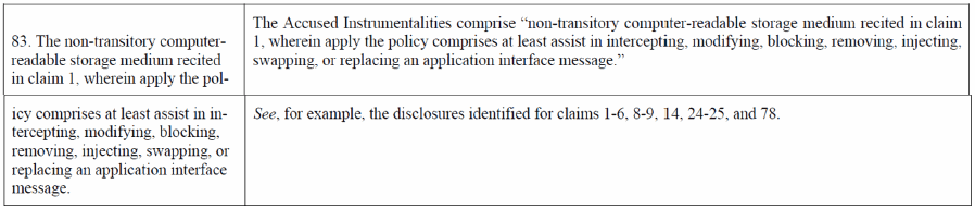
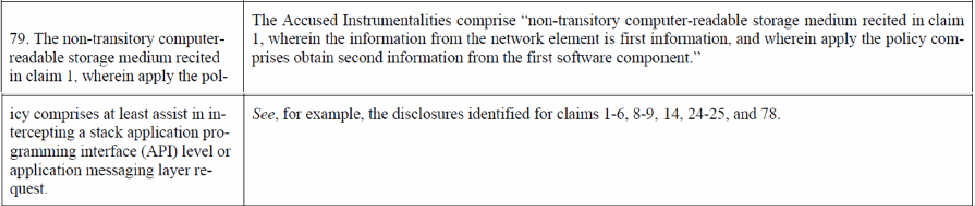
Id. at 1-2 (citing Dkt. No. 176-2 at 130-132). Defendants assert that, for both asserted claims, the sources cited to are in support of other claims, none of which contain the limitations found in claims 79 and 83. Id. at 2.
4This issue was the subject of a Motion to Strike (Dkt. No. 72), for which the Court heard oral argument at a hearing on September 16, 2024 (Dkt. No. 95). In support of their above argument, Defendants point in particular to the following statement from the hearing: “[The Court is] expecting to see there is the additional limitation in Claim 5 is X. X is performed by, you know, Y. And you can incorporate reference to the evidence that you provided above on some other page of the contentions, that's fine. But you have to at least make clear how it is you're contending that the additional limitation is met.” Dkt. No. 95 at 53: 2-8. Defendants assert that this same issue is present in asserted claims 79 and 83. See Dkt. No. 176 at 3.
In response, Plaintiff argues that it served amended infringement contentions which addressed the issues Defendants complained of in their Motion to Stike (Dkt. No. 72) by “mapping intercepting an application interface message, as claimed in dependent claims 79 and 83, to indicating a response to an API request” which, therefore, gave Defendants proper notice of its infringement theories. See Dkt. No. 214 at 4.
The Court, at this juncture, finds that Dr. Wesel’s opinions regarding dependent claims 79 and 83 of the ’541 Patent should not be excluded. As a preliminary matter, we take note of Plaintiff’s amended contentions which are as follows1:
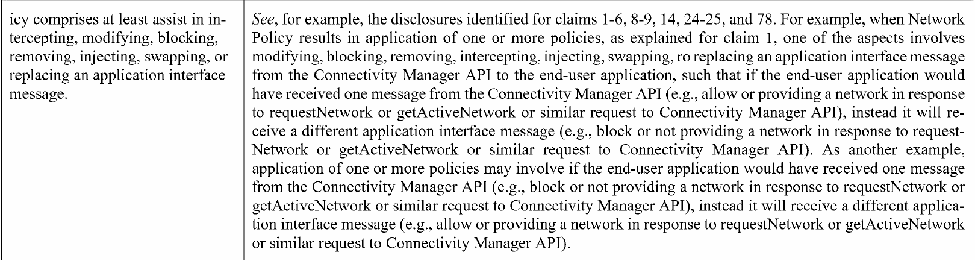
5Dkt. No. 214-15 at 173-175.
Dkt. No. 214-3 at 130-132. Plaintiff articulates its theory of infringement in the top-right boxes for both asserted claims – (e.g., for claim 79): “The Accused Instrumentalities comprise “non-transitory computer-readable storage medium recited in claim 1, wherein the information from the network element is first information, and wherein apply the policy comprises obtain second information from the first software component.” Dkt. No. 214-15 at 173; Dkt. No. 214-3 at 130. Defendants spend much of their Motion arguing that Plaintiff never articulated any theory of infringement, but as just discussed above, this is not the case.2 Further, this is not even the6 relevant inquiry. The correct question here is whether the theories articulated by Dr. Wesel in his report exceeded the theories in Plaintiff’s contentions. Having reviewed his report, the Court is satisfied that they did not.
As to Defendants’ invocation of the Court’s statements at the September 16, 2024 motion hearing, these were directed to a different patent (U.S. Patent No. 8,924,543) than the one at issue (the ’541 Patent). Dkt. No. 95 at 46: 7. Accordingly, Defendants’ Motion on this basis is DENIED.
Defendants offer additional arguments more targeted towards specific accused products. Dkt. No. 176 at 4-7. For the Apple accused products, Defendants assert that “[f]or the very first time, via Dr. Wesel, Headwater now attempts to put forward a theory of infringement for claims 79 and 83” by contending “that a ‘BackgroundTask API assists in intercepting an application’s Background App Refresh task request,’ when the API returns an ‘error’ that Background App Refresh is ‘unavailable,’ that removing a task from the Background App Refresh ‘queue’ constitutes removing an application interface message, and that an action by the ‘DAS scheduler’ constitutes injecting an application interface message.” Dkt. No. 176 at 4 (emphasis omitted) (quoting Wesel Report at ¶¶ 1548–1569).
In response, Plaintiff argues that “[b]ecause of the language in claims 79 and 83 (“wherein apply the policy comprises intercepting…”) and the antecedent basis in claim 1[e], claims 79 and 83 can only map to the same “apply the policy” accused for claim 1[e]. The Apple charts map claim 1[e] (“apply the policy”) to the response to an API request from the Background App Refresh Background Tasks API.” Dkt. No. 214 at 2-3 (citing Dkt. No. 176-3 at 1 (“Background Refresh Status: Indicates whether the app can refresh content when running in the background”), 39-44 (1[e]) (“Apple’s Background App Refresh and Low Power Mode settings apply the policy to background service usage activity” and accusing iOS Background App Refresh “background7 tasks”). (emphasis added by Plaintiff)). Plaintiff asserts that “[t]here is also no dispute that the Apple contentions for claims 79 and 83 incorporate by reference to claim 1.” Id. at 3 (citing Dkt. No. 176-3 at 130-132 (reciting “See, for example, the disclosures identified for claim 1.”)).
In reply, Defendants argue that, regardless of the above, “claim . . . 83 [has] specific requirements about what must be done to apply ‘the policy’” but that Plaintiff identifies nothing in this regard. Dkt. No. 236 at 2 (emphasis in original).
The Court is not persuaded. As a preliminary matter, we agree with Plaintiff that the contentions for claims 79 and 83 do incorporate by reference the relevant contentions for claim 1. And for the same reasons discussed above, we find that Dr. Wesel’s theories do not exceed the ones articulated in Plaintiff’s operative infringement contentions. In other words, the Background App Refresh in within the notice given by the theories seen in the contention charts on pages 4 and 5 above.3 Accordingly, the Motion to Strike on this basis is DENIED as to Dr. Wesel’s opinions regarding claims 79 and 83 with respect to the accused Apple products.
Defendants next argue that “Headwater’s infringement contentions for the accused Android products do not even allege infringement for claim 79—not even a bare assertion” and that “Dr. Wesel’s report is the first disclosure of any theory as to how Android allegedly infringes claim 79.” Dkt. No. 176 at 5. For the same reasons discussed above, the Motion to Strike on this basis is DENIED.
Defendants’ penultimate argument on this topic is that, with respect to the accused Android products, Dr. Wesel introduces a new ‘firewall’ theory for claim 83 that should be stricken. Dkt. No. 176 at 6. Specifically, Defendants concede that Plaintiff added language mapping the8 Connectivity Manager API found in Android products, but that Dr. Wesel then goes beyond that single disclosed theory by introducing a new one based on intercepting by one or more “firewalls” within a different part of Android. Id. Defendants assert that this new firewall theory “should be stricken because it was not disclosed in Headwater’s contentions, and in any event, was abandoned by Dr. Wesel at his deposition.” Id. (citing Dkt. No. 176-8 at 107:13–108:13).
Plaintiff responds, arguing as before, that the contentions of claim 1 were incorporated by reference for claim 83, and that claim 1 “explicitly disclosed that the Android accused products utilize ‘feature-specific firewalls / netd to apply policies,’” See Dkt. No. 214 at 6-7 (quoting Dkt. No. 176-3). Plaintiff further argues that, contrary to Defendants’ assertions, Dr. Wesel never ‘abandoned’ his firewall theory, pointing to the very next section of his deposition which covers the firewall theory. Id. at 7 (citing Dkt. No. 176-8 at 108).
Again, the Court is not persuaded. As a preliminary matter, the Court finds that, as Plaintiff asserts, Dr. Wesel never abandoned his firewall theory, with the surrounding context of his deposition making this clear. As to the firewall theory allegedly being new, for the same reasons discussed with respect to the Apple products, Dr. Wesel’s report does not exceed the operative infringement contentions.4 Accordingly, the Motion to Strike on this basis is DENIED as to Dr. Wesel’s opinions regarding claim 83 with respect to the accused Android products.
Finally, Defendants argue that the court should strike Dr. Wesel’s opinions relying on Android and iOS source code in violation of paragraph 3 of the discovery order. Dkt. No. 176 at 7. Specifically, they assert that “[t]hroughout his opening report, Dr. Wesel relies on Android and9 iOS source code as evidence of infringement” but that “[t]he Android source code was publicly available to Headwater since before the complaint was filed, and the iOS source code was produced November 6, 2024.” Id. (citing Dkt. No. 176-11). The problem, Defendants argue, is that “[t]he Discovery Order requires that ‘30 days after source code for each Accused Instrumentality is produced … the party claiming patent infringement shall identify, on an element-by-element basis for each asserted claim, what source code of each Accused Instrumentality allegedly satisfies the software limitations of the asserted claim elements.’” Id. (quoting Dkt. No. 39 at ¶ 3 (emphasis added by Defendants)). Defendants claim that Plaintiff never served infringement contentions with source code citations, let alone on an element-by-element basis. Id.
In response, Plaintiff argues that it did not violate the Discovery Order because source code is not required in contentions (Dkt. No. 214 at 7 (citing Local Patent Rule 3-1)), and because the “Discovery Order includes an optional provision where the patentee may elect to delay disclosure for ‘software limitation[s]’ until 30 days after code is produced (Id. (emphasis added by Defendants) (quoting Dkt. No. 39 at ¶ 3)). Plaintiff contends that it did not elect said optional provision and was, therefore, not required to provide source code citations in contentions. Id. at 8.
Plaintiff is correct. Paragraph 3(a)(i) of the Discovery Order is optional. Where a party does not invoke this provision, it is required to chart its contentions as part of the standard Local Patent Rule 3-1 disclosures in the ordinary case (as opposed to having an additional 30 days after source code has been made available). Here, Plaintiff did not invoke the provision. Thus, it was not required to identify, on an element-by-element basis for each asserted claim, what source code of each Accused Instrumentality allegedly satisfies the software limitations of the asserted claim elements. Accordingly, the Motion to Strike on this basis is DENIED.
10B. Dr. Wesel’s Technical Benefits Opinions
In the Motion, Defendants argue that Dr. Wesel’s technical benefits opinions should be excluded. Dkt. No. 176 at 8.
First, Defendants argue that Dr. Wesel’s technical benefits opinions do not apportion the incremental benefits of the asserted claims. Id. They claim that he instead attributed all the data savings obtained from the accused features as a whole to the claimed inventions, but that the accused features incorporate prior-art and other non-infringing technologies which also save data. See id. at 8-9. For example, Defendants point to (the now disclaimed) claim 1 of the ’541 Patent and argue that, since it is free to use, Dr. Wesel was required to show what incremental value accrues from using the narrower approaches claimed in the asserted dependent claims. Id. at 9.
In response, Plaintiff argues that “[f]or apportionment, Dr. Wesel designed his testing to quantify the incremental improvement of the claimed inventions compared to the alleged non-infringing alternatives proposed by Defendants, including, for example, devices running ‘legacy’ or ‘prior art’ versions of Android, or an ‘otherwise identical device’ running a version of Android without the patented features” (Dkt. No. 214 at 9 (citing Wesel Report at ¶ 2589)): “As Dr. Wesel explains, such devices ‘lack a control policy for disallowing cellular radio access to applications that are performing “background” activity,’ (as required by ’541 patent, claims 79 and 83), and ‘such devices lack a control policy for controlling cellular radio access for applications classified as not interacting with the user in the device user interface foreground’ (as required by ’613 patent)” (Id. at 9-10 (citing Wesel Report at ¶ 2589)). As to disclaimed claim 1, Plaintiff contends that “Dr. Wesel did analyze the incremental value from the asserted claims’ additional feature of ‘intercepting,’ ‘blocking,’ or ‘denying’ not recited in ’541 claim 1 and not enabled by the proposed alternatives. For example, for claims 79 and 83 of the ’541 patent, which recite ‘intercept’ API11 requests or application interface messages, Dr. Wesel opines ‘the ’541 patent teaches blocking applications from accessing the network in the application layer, such as through an API indicating whether or not the application’s request to access a network is allowed, so that applications know what is going on and do not get confused or waste resources without an understanding of which network is available to them. This reduces traffic in the network and preserves battery life and limits data usage in the device.’” Id. at 10-11 (citing Wesel Report at ¶¶ 2483, 2485 (emphasis added by Plaintiff)). By contrast, claim 1 does not require intercepting or the like; it merely recites controlling. Id. at 11. Plaintiff further argues that claim 1 does not actually require saving any data at all. Id.
The Court finds that striking is inappropriate here. Dr. Wesel’s apportionment is sufficiently present in his report in, for example, the sections that Plaintiff points to, and Defendants’ concerns are best addressed with vigorous cross examination. Defendants’ other arguments are similarly unpersuasive. Accordingly, the Motion to Strike on this basis is DENIED.
Next, Defendants argue that opinions regarding data savings from Background App Refresh should be stricken. Dkt. No. 176 at 12. They assert that “[i]t is undisputed that Background App Refresh is ‘on’ by default. It is also undisputed that when Background App Refresh is on, apps are permitted to send data in the background. Thus, the default ‘on’ setting means no background data is blocked, and no data savings accrue. Id. (emphasis in original) (citing Wesel Report at ¶¶ 260, 2650; Dkt. No. 176-9 at 428: 22 – 429: 2). Defendants go on to argue that, in calculating the data savings allegedly achieved by the accused Apple devices, Dr. Wesel assumed that the average data savings he estimated for a single device should be multiplied by the total number of Apple devices on the network—100% of iOS devices—because the per-device data12 savings “is experienced by all iOS devices using default settings.” Id. (citing Wesel Report at ¶ 2535 (emphasis added by Defendants)).
Plaintiff responds, arguing that “[w]hile it is ‘undisputed’ that when Background App Refresh is on, apps may be permitted to refresh data in the background, this does not compel the conclusion that Defendants advance in their brief, which is that ‘the default “on” setting means no background data is blocked, and no data savings accrue.’ Defendants are absolutely wrong about this, as shown by the Apple documents and testimony cited in Dr. Wesel’s report. As Dr. Wesel explains, when it is enabled, Background App Refresh may allow certain apps to refresh, but it uses the patented technologies to save data that would otherwise be consumed by limiting how often apps are permitted to refresh and denying refresh opportunities to rarely used apps, also denying refreshing to most apps until the device is connected to Wi-Fi and plugged in.” Dkt. No. 214 at 13-14 (citing Wesel Report at ¶¶ 2533-2534). “Thus,” asserts Plaintiff, “when it is ‘on,’ there is a lot of background data being blocked by Background App Refresh.” Id. at 14 (citing Wesel Report at ¶¶ 2533-2534).
As Plaintiff correctly points out, Dr. Wesel has opined that even on default settings, there are still data savings with the Background App Refresh on and that, therefore, there is still infringement. Defendants will be free to cross examine Dr. Wesel on this point at trial. Accordingly, the Motion to Strike on this basis is DENIED.
Finally, Defendants argue that Dr. Wesel’s application of his data saver/power saving test results to doze mode and app standby should be excluded. Dkt. No. 176 at 12. Specifically, Defendants assert that “Dr. Wesel’s data savings opinions for Android devices are . . . fatally flawed, because he applied his Power Saving and Data Saver test results to Doze Mode and App Standby, which he admits do not operate in the same manner or prevent data consumption to the13 same extent.” Id. They contend that Dr. Wesel actually tested the data savings from only two accused Android features: (1) Power Saving/Battery Saver (two names for one feature) and (2) Data Saver, but that, rather than test the remaining accused Android features, he simply applied his Power Saving test results to Doze Mode and App Standby with no explanation of why it was reasonable to do so. Id. (citing Wesel Report at ¶¶ 2509, 2513). Defendants argue that “Dr. Wesel’s assumption that Doze Mode and App Standby provide the same amount of data savings as the features he tested lacks any factual foundation . . . .”
In response, Plaintiff disputes that Dr. Wesel merely applied the test results from one set of features to another set of features with no explanation. Dkt. No. 214 at 14. Instead, Plaintiff contends, “Dr. Wesel provided detailed analysis supporting his use of test results for one feature to calculate the benefits from others.” Id. (citing Wesel Report at ¶ 2512). Specifically, Plaintiff asserts that “Dr. Wesel performed on/off testing of Power Saving and Data Saver modes, and then he used those tests to calculate the average per-app data consumption by background applications, as well as the average per-app data savings from a feature that blocks background data.” Id. (citing Wesel Report at ¶¶ 2509-2511). Once he determined the per-app figures, “Dr. Wesel then calculated the amount of data savings attributable to Doze Mode and App Standby based on the unique attributes of these features. As he explains, while Power Saving or Data Saver blocks all background cellular data, App Standby and Doze place such severe network restrictions only on applications which are rarely used, while still allowing frequently used apps to refresh in the background.” Id. at 14-15. “Therefore,” Plaintiff continues, “Dr. Wesel does not opine that Doze Mode and App Standby provide the same benefits as the other features, and instead he calculates a benefit specific to the number of apps restricted by these features and the extent of use of these features.” Id. at 15 (citing Wesel Report at ¶ 2512).
14Defendants’ arguments go toward the weight of the evidence, not its admissibility. Dr. Wesel offers sufficient analysis (as seen in the portions of his report that Plaintiff points to) such that his methods are sufficiently reliable. Accordingly, the Motion to Strike on this basis is DENIED.
C. Opinions Regarding Defendants’ Alleged Knowledge, Intent, and State of Mind In the Motion, Defendants argue that Dr. Wesel’s opinions regarding Defendants’ alleged knowledge, including of ItsOn, Headwater or the asserted patents, and Defendants’ alleged intent, beliefs, and state of mind should be excluded. Dkt. No. 176 at 14-15. Defendants contend that “[i]t is undisputed that it is improper for an expert to opine as to the subjective belief or intent of a corporate entity.” Id. at 14 (quoting Gree, Inc. v. Supercell Oy, No. 2:19-cv-71-JRG-RSP, 2020 WL 4059550, at *2 (E.D. Tex. July 20, 2020) (emphasis in original)). Further, Defendants point out that Dr. Wesel was retained as a technical expert on infringement, and his expertise is in the field of electrical engineering. Id. at 15. Therefore, Defendants assert, his opinions regarding Defendants supposed knowledge or willful blindness to the asserted patents are not within the realm of his expertise. See id. (citing Robroy Indus.-Tex., LLC v. Thomas & Betts Corp., No. 2:15-cv-512-WCB, 2017 WL 1319553, at *9 (E.D. Tex. Apr. 10, 2017) (It is not sufficient for an expert to bring “no expertise to the enterprise other than the ability to read and to copy what [he] has read”)). Related to this issue, Defendants argue that “Dr. Wesel’s recitation of Headwater’s versions of the facts to support his improper opinions is also not helpful to the jury . . . .” because an expert cannot simply parrot evidence proffered by the party that hired him. Id. (citing Robroy Indus. Tex., 2017 WL 1319553, at *9–10).
In response, Plaintiff argues that Dr. Wesel is permitted to opine “on the underlying facts that may show a party’s state of mind” and is merely precluded from “opin[ing] as to the ultimate15 issue of intent reserved for the factfinder.” Dkt. No. 214 at 15. (quoting Gree, No. 2:19-cv- 71-JRG-RSP, 2020 WL 4059550, at *2 (internal citations omitted)). Plaintiff contends Dr. Wesel will not testify that the evidence at issue means that Defendants are intentionally infringing; at the most, he says that Defendants “would have been aware of, or at least willfully blinded [themselves] to” one or more of the asserted patents. Id. (quoting Wesel Rpt. at App’x A ¶ 4).
The Court finds that Dr. Wesel’s opinions in Appendix A to his report regarding Defendants’ alleged knowledge of the patents are not proper because they are not helpful to the jury. Robroy Indus.-Texas, LLC v. Thomas & Betts Corp., No. 2:15-CV-512-WCB, 2017 WL 1319553, at *9 (E.D. Tex. Apr. 10, 2017).
Here, a review of the relevant sections of Appendix A reveals that Dr. Wesel is recounting Plaintiff’s proffered evidence and then offering an opinion on whether Defendants knew or were willfully blind to the asserted patents. As Plaintiff’s technical expert with a background in electrical engineering, there is nothing that prevents Dr. Wesel from reviewing evidence if it supports a relevant opinion. However, his opinion on knowledge, intent, and state of mind is not helpful to the jurors, who can reach their own conclusions on Defendants’ alleged knowledge or willful blindness of the asserted patents using common sense.
Regarding Plaintiff’s assertion that an expert is permitted to opine “on the underlying facts that may show a party’s state of mind,” while true, this is only through an opinion that is still within the realm of their expertise. See Gree, 2020 WL 4059550, at *2. For example, it would be improper for an expert to opine that a defendant had a good-faith belief that it did not infringe and thus could not induce infringement. However, it would be proper for the expert to opine that the defendant does not induce infringement because, in his expert opinion, he does not believe the defendant directly infringes (for which he relies on underlying facts).
16.
Accordingly, the Motion to Strike on this basis is GRANTED. Therefore, it is ORDERED that the opinions on knowledge, intent, state of mind, and willful blindness, including those in Section I.A to Appendix A to Dr. Wesel’s report and paragraph 164 of that report, are hereby STRICKEN. The motion is otherwise denied.
SIGNED this 3rd day of January, 2012.
SIGNED this 15th day of June, 2025.
ROY S. PAYNE
UNITED STATES MAGISTRATE JUDGE
Footnotes
- ↩ 1 There is one set of contentions for accused Android products (the first set shown) and one set for accused Apple products (the second set shown).
- ↩ 2 To the extent that Defendants take umbrage with alleged insufficiency of Plaintiff’s operative contentions, that is not the issue before the Court. The time for this has now passed as this case is on the eve of trial. Dkt. No. 281 at 1 (Docket Control Order, setting jury selection for June 23, 2025).
- ↩ 3 As to Defendants’ argument regarding the contentions not articulating what must be done to apply the policy, the Court reiterates that arguments regarding the sufficiency of the contentions are not the relevant inquiry here and that the time for objecting to the sufficiency of the contentions has passed. See supra 2 n.2.
- ↩ 4 Further, as before, the Court finds that the contentions for claim 83 incorporate by reference the relevant contentions for claim 1, which do include the use of firewalls. Dkt. No. 176-3 at 72. As to the limitation unique to claim 83, it is clear that the language added to the amended infringement contentions includes the Android-specific Connectivity Manager API. In light of all of the above, the Court is satisfied that this was sufficient to put Defendants on notice as to Plaintiff’s infringement theories. Thus, Defendants’ underlying issue with the sufficiency of the contentions also is without merit.