NOTE: This disposition is nonprecedential. United States Court of Appeals
for the Federal Circuit
WHEREVERTV, INC.,
Plaintiff-Appellant
v.
COMCAST CABLE COMMUNICATIONS, LLC,
Defendant-Cross-Appellant
2023-2098, 2023-2150
Appeals from the United States District Court for the Middle District of Florida in No. 2:18-cv-00529-WFJ-NPM, Judge William F. Jung.
Decided: July 28, 2025
ADAM COOPER SANDERSON, Reese Marketos LLP, Dallas, TX, argued for plaintiff-appellant. Also represented by BRETT ROSENTHAL.
ROBERT NILES-WEED, Weil, Gotshal & Manges LLP, New York, NY, argued for defendant-cross-appellant. Also represented by MARK ANDREW PERRY, Washington, DC; DAVID LISSON, ASHOK RAMANI, Davis Polk & Wardwell LLC, Menlo Park, CA.
2Before TARANTO, STOLL, and STARK, Circuit Judges.
WhereverTV, Inc. sued Comcast Cable Communications, LLC for patent infringement in the United States District Court for the Middle District of Florida, and the case proceeded to a jury trial on infringement of claim 1 of U.S. Patent No. 8,656,431. After the close of evidence but prior to a jury verdict, however, the district court granted Comcast’s motion for judgment of noninfringement as a matter of law under Rule 50(a) of the Federal Rules of Civil Procedure. WhereverTV appeals the district court’s JMOL, alleging that it rests on erroneous constructions of two terms in claim 1. As an alternative ground for affirmance, Comcast argues that it is entitled to JMOL based on what it asserts is the correct interpretation of a separate claim term, and it cross-appeals the district court’s determination that claim 1 is not indefinite under 35 U.S.C. § 112. Because we agree with WhereverTV that the district court erred in its claim construction, and we reject Comcast’s alternative grounds for affirmance as well as its argument that claim 1 is indefinite, we vacate the district court’s JMOL of noninfringement and remand for proceedings consistent with this opinion.
BACKGROUND
The ’431 patent discloses “[a] system and device . . . that employs a global interactive program guide [(‘IPG’)] to receive, access, manage, and view digital entertainment services such as live television, television on demand, and pre-recorded video and audio programming from one or more content sources, via an internet-enabled device, anywhere in the world.” U.S. Patent No. 8,656,431 Abstract. The content sources include not only cable operators but also independent content providers. The ’431 patent states that its “goal is to shift the control of content availability, organization, and access from MSO’s [(i.e., multi-system operators)], which is today’s cable television model, to a3 new user-centric model where the user can choose whether or not to purchase content from a content consolidator or directly from independent content providers.” Id. at col. 6 ll. 39–44. The specification explains that, at the time of the invention, there was “no application or interface that [would] allow[] a user to manage multiple subscriptions from multiple content owners in an easy to use format.” Id. at col. 2 ll. 36–38.
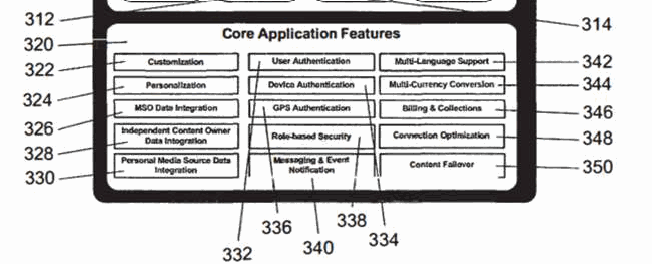
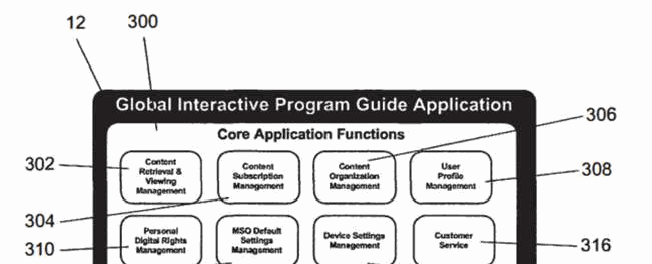
As explained below, the district court relied on patent Figures 4 and 8 in construing claim 1 at JMOL. Figure 4 (reproduced below) is a graphical representation of the functions of an IPG that is “comprised of eight Core Application Functions 300 and fifteen Core Application Features 320, which may be used in whole, or in parts, to present content to the user.” Id. at col. 11 ll. 17–21; see also id. at col. 11 l. 22–col. 13 l. 7. Figure 8 is a flow chart that illustrates the logic undertaken by a user to add new content to the IPG. See id. at col. 15 l. 13–col. 16 l. 7.
Id. Fig. 4.
4The sole asserted claim, independent claim 1, reads: 1. A content manager device comprising: a server resident on a network containing descriptive program data about video content available from one or more multiple cable system operators (MSOs) and one or more non-MSOs; a device capable of establishing and maintaining a connection with the network via a communications link; and an interactive program guide application installed on the device that provides user-configurable interactive program guide (IPG) listing at least one channel of video content available from each of the one or more MSOs and each of the one or more non-MSOs and descriptive program data from the server for the video content available on each of the channels, wherein each of the channels is selectable for receiving only or virtually entirely streaming video programming from its respective MSO or non-MSO source via the communications link and the network; wherein the server is distinct from at least one of the one or more MSOs and one or more non-MSOs, and wherein the application allows for the IPG to be configured by a user with respect to adding or deleting channels from any of the one or more MSOs or the one or more non-MSOs.
Id. at col. 16 ll. 32–54 (emphases added to emphasize limitations at issue).
WhereverTV accused Comcast’s entertainment platform known as the Xfinity X1, which allows users to access video content from both their cable provider and streaming providers through a cloud-based system, of infringing claim 1 of the ’431 patent. The X1 system includes the XRE receiver, which is an application located on the X1 set-top box (or “STB”) device, and the cloud-based XRE server.5 Comcast’s documentation illustrates the division of its system:
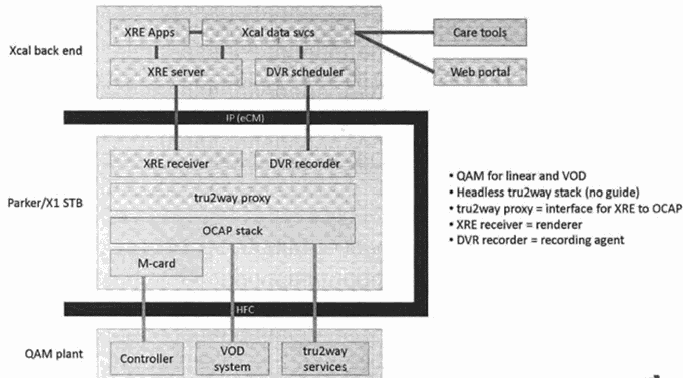
J.A. 15921. The same document describes the division of the XRE receiver and server:
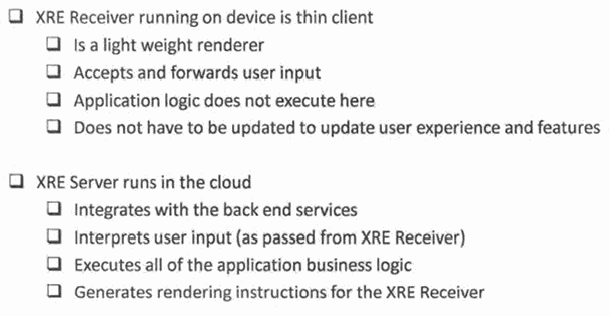
J.A. 15922.
At the claim construction stage before the district court, the parties disputed seven terms: (1) “multiple cable system operators (MSOs)”; (2) “non-MSOs”; (3) “wherein the server is distinct from at least one of the one or more MSOs and one or more non-MSOs”; (4) “only or virtually entirely streaming video programming”; (5) “wherein each of the channels is selectable for receiving only or virtually entirely streaming video programming”; (6) “interactive6 program guide”; and (7) “adding or deleting channels from any of the one or more MSOs or the one or more non-MSOs.” See WhereverTV, Inc. v. Comcast Cable Commc’ns, LLC, No. 2:18-cv-529-FTM-NPM, 2020 WL 13823257, at *3 (M.D. Fla. Nov. 13, 2020) (“Claim Construction Order”). The district court construed “multiple cable system operators (MSOs)” to mean “a cable, satellite, or Internet television content consolidator that receives and then broadcasts channels of video content,” and “non-MSOs” to mean “a video content provider that does not act like an MSO because it does not receive and then broadcast channels of video content.” Id. As for the remainder of the disputed terms, the district court determined that “[n]o further construction is necessary.” Id.
Comcast also contended that the term “only or virtually entirely streaming video programming” was indefinite under 35 U.S.C. § 112. But the district court determined that “these words can be understood by those skilled in the art, particularly since Comcast itself was able to propose a construction for [‘wherein each of the channels is selectable for receiving only or virtually entirely streaming video programming,’] which contains the same language.” Id. Specifically, Comcast proposed interpreting “wherein each of the channels is selectable for receiving only or virtually entirely streaming video programming” as: “wherein each of the channels is configured such that, in immediate response to selection of its assigned channel number, and without further searching, video programming is only or virtually entirely transmitted over the Internet . . . and made available for viewing while the transmission is occurring.” Id. The district court thus determined that Comcast had not met its burden to show that the term was indefinite by clear and convincing evidence.
At the summary judgment stage, the district court recognized that the parties still disputed the scope of the limitation “wherein the server is distinct from at least one of the one or more MSOs and one or more non-MSOs.” The7 district court explained that “[WhereverTV] conceptualize[d] such distinctness in terms of the tasks and processes of the server and the MSO and non-MSO, while Comcast conceptualize[d] the distinctness in terms of a business entity’s ownership or control of the MSO and server.” J.A. 11460. To resolve this dispute, the district court ordered a supplementary evidentiary hearing that included the presentation of exhibits and expert testimony concerning the construction of the limitation.
After considering intrinsic and extrinsic evidence, the district court determined that “the meaning of ‘distinct from,’ in context, is best read to pertain to functional differences between the server and the MSO(s) and non-MSO(s), rather than differences with respect to control.” J.A. 11467–68. Based on this determination, the court construed the term to mean “wherein the server is functionally distinct from at least one of the one or more MSOs and one or more non-MSOs.” J.A. 11468.
The case proceeded to a jury trial. At the close of WhereverTV’s case-in-chief, Comcast moved for a directed verdict of noninfringement on the “adding or deleting” limitation (“wherein the application allows for the IPG to be configured by a user with respect to adding or deleting channels from any of the one or more MSOs or the one or more non-MSOs”), as well as the “IPG application” limitation (“an interactive program guide application installed on the device that provides user-configurable interactive program guide (IPG)”). The district court granted JMOL after the close of evidence.
In its written order, the district court first addressed the adding or deleting limitation and reaffirmed its plain and ordinary meaning construction of this term. The district court then determined that “[a]t no point during trial did [WhereverTV] introduce evidence that an X1 user could subscribe to a channel that was not already offered on the accused X1’s IPG, thereby increasing the number of8 channels offered on the IPG.” WhereverTV, Inc. v. Comcast Cable Commc’ns, LLC, No. 2:18-cv-529-WFJ-NPM, 2023 WL 3819123, at *5 (M.D. Fla. June 5, 2023) (“JMOL Order”). “Nor did [WhereverTV] introduce any evidence that a user who unsubscribed from a particular app—such as Netflix—could remove that app from the X1’s IPG entirely such that . . . the app would not be displayed on the IPG.” Id. The district court faulted WhereverTV for “encouraging the jury to accept that subscribing is adding and unsubscribing is deleting,” which the court viewed as “a departure from the plain and ordinary meaning of these terms.” Id. The district court held that “[WhereverTV] may not assert literal infringement based on the theory that unsubscribing from an app . . . is conceptually similar to deleting that app simply because both actions create impediments for the user who wants to watch content offered by the app.” Id. at *6. The district court further explained that “the rigidity of the X1’s IPG display and the immutability of the channel listings provided by Comcast,” as testified to by both parties’ witnesses, “is in no way identical to the customizable and restriction-free invention described in the [’]431 Patent’s specification.” Id. at *7. The district court also determined that, “[w]hile the [’]431 Patent allows users to increase the number of channels available to them—true to the plain and ordinary meaning of ‘adding’—the X1 only allows users to log in and out of channels that Comcast, and only Comcast, chose irrevocably to emplace on the IPG.” Id.
The district court next addressed the IPG application limitation, again noting that it was maintaining a plain and ordinary meaning construction despite recognizing that the “term’s plain and ordinary meaning is not readily apparent.” Id. The district court then held that there was “uncontested evidence” that the IPG application is not installed on the accused device because the XRE guide application is on the server and not the STB. Id. at *8. The district court also found that the XRE guide application9 provides the “brains” for the IPG. Id. The district court further determined that it was “undisputed that the cloud-based XRE server, and not the XRE receiver, provides ‘the data necessary for the . . . IPG.’” Id. at *9 (omission in original) (emphasis removed) (citation omitted). As to WhereverTV’s argument that the XRE receiver on the STB is the IPG application, the district court determined that “the [’]431 Patent’s specification does not support this conclusion,” in view of Figures 4 and 8. Id. at *8. The district court, in considering WhereverTV’s expert testimony that the XRE receiver is a “thin client” capable of rendering and signaling, found that this did not show that an IPG application was installed on the STB. Id. at *8–9 (citation omitted).
WhereverTV appeals and Comcast cross-appeals. We have jurisdiction under 28 U.S.C. § 1295(a)(1).
DISCUSSION
On appeal, WhereverTV primarily argues that the district court’s JMOL rests on erroneous constructions of both the “IPG application” and “adding or deleting” limitations. For its part, Comcast presents two issues. First, Comcast introduces an alternative ground to affirm the district court’s JMOL, contending that the district court misconstrued the limitation “wherein the server is distinct from at least one of the one or more MSOs and one or more non-MSOs.” Finally, Comcast cross-appeals the district court’s determination that the limitation “selectable for receiving only or virtually entirely streaming video programming” is not indefinite.
We review a district court’s grant of JMOL under the standard of the regional circuit, Cyntec Co., Ltd. v. Chilisin Elecs. Corp., 84 F.4th 979, 984 (Fed. Cir. 2023), here the Eleventh Circuit, which reviews the grant of JMOL de novo. Pickett v. Tyson Fresh Meats, Inc., 420 F.3d 1272, 1278 (11th Cir. 2005). Substantive patent law issues are reviewed under the law of our own circuit. Accenture Glob.10 Servs., GmbH v. Guidewire Software, Inc., 728 F.3d 1336, 1340 (Fed. Cir. 2013). We review claim construction based on intrinsic evidence de novo and review factual findings about extrinsic evidence for clear error. SpeedTrack, Inc. v. Amazon.com, 998 F.3d 1373, 1378 (Fed. Cir. 2021) (citing Teva Pharms. USA, Inc. v. Sandoz, Inc., 574 U.S. 318, 331–32 (2015)). “Whether a claim complies with the definiteness requirement . . . is a matter of claim construction.” Noah Sys., Inc. v. Intuit Inc., 675 F.3d 1302, 1311 (Fed. Cir. 2012).
We review in turn each issue raised by the parties.
I
WhereverTV contends that the district court erred in holding, as a matter of law, that Comcast’s accused product does not satisfy claim 1’s IPG application limitation—an “interactive program guide application installed on the device that provides user-configurable interactive program guide (IPG).” We agree.
The district court legally erred by not construing this limitation using the claim construction framework set forth in Phillips v. AWH Corp., 415 F.3d 1303 (Fed. Cir. 2005). While the district court held that the plain and ordinary meaning of the limitation applies, it also stated that the plain and ordinary meaning is “not readily apparent” and never clarified what it viewed as the plain and ordinary meaning. JMOL Order, at *7. Moreover, the parties clearly disputed the scope of this term. In O2 Micro International Ltd. v. Beyond Innovation Technology Co., we held that where the parties dispute the scope of a claim limitation, the district court is to construe the claims at least to the extent necessary to resolve the dispute. 521 F.3d 1351, 1360 (Fed. Cir. 2008); see also id. at 1361 (“A determination that a claim term . . . has [a] ‘plain and ordinary meaning’ may be inadequate . . . when reliance on a term’s ‘ordinary’ meaning does not resolve the parties’ dispute,” in which case “claim construction requires the court to11 determine what claim scope is appropriate in the context of the patents-in-suit.”). We have also held that a district court should not construe claims in light of an accused product and should instead analyze the claim language, specification, and prosecution history, if relevant. See Wilson Sporting Goods Co. v. Hillerich & Bradsby Co., 442 F.3d 1322, 1330 (Fed. Cir. 2006) (“[C]laims may not be construed with reference to the accused device.” (citation omitted)).
The district court’s JMOL cannot stand under the proper construction of this limitation. We begin with the claim language: “interactive program guide application installed on the device that provides user-configurable interactive program guide (IPG).” See Phillips, 415 F.3d at 1314 (emphasizing importance of claim language). The parties primarily dispute what it means for the IPG application to “provide” a user-configurable IPG. Comcast asserts that the limitation’s use of the word “provides” means that the claimed IPG application alone must provide the functionality of the user-configurable IPG. See Cross-Appellant’s Br. 45–46, 56. But the term “provides” is commonly understood to have a broader meaning,1 and neither party suggests that it is a technical term with a more limited meaning in the relevant field of art. Used alone, “provides” does not require that the IPG application do all the work to make the IPG operable.
This understanding of “provides” is also consistent with the entire claim limitation, which requires an “interactive program guide application installed on the device that provides user-configurable interactive program guide (IPG) listing at least one channel of video content available from each of the one or more MSOs and each of the one or12 more non-MSOs and descriptive program data from the server.” Claim 1 itself contemplates that the server provides descriptive program data. The claim is also open-ended, using the transitional phrase “comprising,” which allows for the use of an additional IPG application in the server. AFG Indus., Inc. v. Cardinal IG Co., Inc., 239 F.3d 1239, 1244–45 (Fed. Cir. 2001) (“When a claim uses an ‘open’ transition phrase, its scope may cover devices that employ additional, unrecited elements. We have consistently held that the word ‘comprising’ is an open transition phrase.” (citation omitted)). In addition, as discussed in more detail below, claim 1 recites that the IPG application “allows for the IPG to be configured by a user with respect to adding or deleting channels.” The broad language “allows for” is consistent with the view that the IPG application need not provide all the functionality for operation of the IPG.
Turning to the specification, we conclude that the district court improperly read additional requirements into claim 1 based on the embodiments shown in Figures 4 and 8 of the ’431 patent, including that the IPG application “‘procures digital rights via stored profile,’ ‘locates and authenticates’ new content sources, and ‘downloads and synchronizes content metadata from new content sources.’” JMOL Order, at *8 (citation omitted). In particular, the district court held that the accused device’s XRE receiver is not an IPG application as required by the claims because it does not “offer[] any of the functions or features illustrated in Figures 4 or 8.” Id. But none of these functions or features are recited in claim 1, let alone recited as being performed by the IPG application. Moreover, the specification does not define an IPG application as limited to the embodiments in Figures 4 and 8. Nor does it disclaim placing some of the functionality in Figures 4 and 8 in a server and other functionality in a receiver. We are not inclined to read the functionality from Figures 4 and 8 into the claim in such a limiting manner absent lexicography or13 express disclaimer. See GE Lighting Sols., LLC v. AgiLight, Inc., 750 F.3d 1304, 1308–09 (Fed. Cir. 2014) (“[C]laim terms must be construed in light of the specification and prosecution history . . . . However, the specification and prosecution history only compel departure from the plain meaning in two instances: lexicography and disavowal. . . . [Here,] while the specification[] only disclose[s] a single embodiment of [the claimed term] in Figure 6, [it] do[es] not disavow or disclaim the plain meaning of [the term] or otherwise limit it to that embodiment.” (citation omitted)).
Based on the claim language and the specification,2 we agree with WhereverTV’s interpretation that the language “interactive program guide application installed on the device that provides user-configurable interactive program guide (IPG)” does not require that all the functionality of the IPG must reside in the claimed IPG application. In other words, it is sufficient that the IPG application provide an IPG in coordination with the server.
II
The parties also disputed the meaning of claim 1’s adding or deleting channels limitation—i.e., “wherein the application allows for the IPG to be configured by a user with respect to adding or deleting channels.” WhereverTV asserts that channels can be added by subscribing and14 deleted by unsubscribing, whereas Comcast asserts that adding a channel is limited to making the channel appear on the IPG user interface and deleting a channel is limited to making the channel no longer appear on the IPG user interface. The district court purported to use the plain and ordinary meaning of the limitation,3 which in its view excluded the broader understanding that WhereverTV asserted. See JMOL Order, at *4–5. We adopt WhereverTV’s broader construction.
Again, we begin with the claim language. Claim 1 requires listing at least one MSO channel and at least one non-MSO channel, wherein “each of the channels is selectable” and “the application allows for the IPG to be configured by a user with respect to adding or deleting channels from any of the one or more MSOs or the one or more non-MSOs.” The claim language does not say “adding or deleting channels” to or from the IPG user interface.4 Rather the claim recites adding or deleting channels from the MSOs or non-MSOs. In addition, the claim focuses on15 channels that are “selectable for receiving,” suggesting that adding or deleting could relate to making channels selectable or non-selectable. In light of the overall language of the claim, we understand “adding or deleting channels” as including adding a channel either by adding it to the user interface or making it selectable and deleting a channel either by removing it from the user interface or by making it non-selectable. Indeed, the claims do not specify what is meant by adding or deleting, and the language is broad enough to encompass either changing the ability to select the channel or changing the user interface. Had the patentee intended to limit the claims to modifying the display to include a new channel not previously displayed, it could have included language in the claims to that effect.5
Turning next to the specification, it appears that the specification treats subscribing to channels interchangeably with adding channels in at least one embodiment of the patented invention, despite Comcast’s arguments to the contrary. In describing Figure 8, the specification states at one point that the figure is “a flow chart of the method for subscribing to new content using the global IPG of the instant invention.” ’431 patent col. 8 ll. 58–59 (emphasis16 added). The specification goes on to also describe Figure 8 as “a flow chart that illustrates the logic undertaken by a user to add a new content source at Step 800.” Id. at col. 15 ll. 13–14 (emphasis added). Figure 8 and the specification’s description of it thus lend support to WhereverTV’s broader reading of the adding or deleting channels limitation. Moreover, Comcast does not point to anything in the specification that explicitly limits the step of adding or deleting channels to exclude subscribing and unsubscribing.
Based on the claim language and the specification, we agree with WhereverTV’s interpretation that “wherein the application allows for the IPG to be configured by a user with respect to adding or deleting channels” encompasses making the channel selectable and non-selectable on the IPG through subscribing and unsubscribing.
III
We have also considered Comcast’s assertion that the district court erred in its construction of the limitation “wherein the server is distinct from at least one of the one or more MSOs and one or more non-MSOs” in claim 1. We disagree and adopt the district court’s construction.
Comcast proposes that this limitation “reflects the invention’s goal of freeing users from the ‘traditional cable-television, content aggregation model where the MSO, rather than the user, is in control of what content is available,’” Cross-Appellant’s Br. 58 (quoting ’431 patent col. 2 ll. 41–43), and should be construed to mean that the limitation requires a server that is “distinct from” Comcast itself. Id. at 58–59. But this proposal improperly imports unclaimed limitations into the term. Comcast seeks to import the overarching goal of the patented invention into the term “distinct from.” But if the patentee had wanted to claim a server that was not controlled by a cable company, the patentee could have used language to that effect. Comcast further seeks to import into this limitation that MSO17 means a cable company as a business entity.6 Comcast makes this argument despite (1) Comcast not explicitly disputing on appeal the district court’s separate construction of MSO that defines the term in a functional sense—i.e., as “a cable, satellite, or Internet television content consolidator that receives and then broadcasts channels of video content,” Claim Construction Order, at *3 (emphasis added); and (2) the specification also referencing MSOs with respect to functionality, see, e.g., ’431 patent col. 7 ll. 46–51; see also J.A. 11464. We agree with the district court that, in the context of the ’431 patent, “[t]o say that an MSO is a cable company simply because an MSO is a part of a cable company appears to be an invalid syllogism distorting the plain meaning of the terms in question.” J.A. 11464. We are thus unpersuaded that the district court erred in reaching its underlying factual findings and ultimate construction of the “distinct from” term based on the language in the claims, the prior constructions by the district court that Comcast has not challenged, the specification, and the extrinsic evidence in the form of dictionary definitions and expert testimony.
18IV
Finally, we reject Comcast’s indefiniteness argument raised on cross-appeal. Comcast asserts that the phrase “only or virtually entirely” in the limitation “wherein each of the channels is selectable for receiving only or virtually entirely streaming video programming” is indefinite. We agree with the district court and WhereverTV that this limitation “can be understood by those skilled in the art.” Claim Construction Order, at *3.
Reading the limitation in the context of claim 1 as a whole supports our holding. The limitation recites: “wherein each of the channels is selectable for receiving only or virtually entirely streaming video programming from its respective MSO or non-MSO source via the communications link and the network.” Comcast itself proposed that the limitation be interpreted as “wherein each of the channels is configured such that, in immediate response to selection of its assigned channel number, and without further searching, video programming is only or virtually entirely transmitted over the Internet . . . and made available for viewing while the transmission is occurring.” Id. Thus, the parties appear to agree that streaming means transmission over the Internet. See Appellant’s Reply Br. 45; Construction Order, at *3. And despite its arguments on appeal, Comcast also appeared to agree at claim construction that “only or virtually entirely” modifies streaming of video programming, such that the claim requires “only or virtually entirely” steaming video programming. See Construction Order, at *3. In this context, we agree with the district court that the limitation is not indefinite. In the context of this claim, the term “virtually”— similar to terms like substantially, about, and nearly—is simply a term of degree that modifies entirely. It does not render the claim indefinite. See One-E-Way, Inc. v. Int’l Trade Comm’n, 859 F.3d 1059, 1067 (Fed. Cir. 2017) (“While we note that ‘virtually’ is a term of degree, one that slightly expands the scope of the term . . . ,[] the inclusion19 of ‘virtually’ in these claims does not render them indefinite.” (citation omitted)).
Comcast agrees that “virtually” is a term of degree, but suggests that the patent fails to provide any “standard for measuring that degree.” Cross-Appellant’s Br. 66–67 (citation omitted). But our case law does not foreclose the use of terms of degree in claims, and as discussed, here the inclusion of “virtually” slightly expanded the scope of the claim from receiving only streaming video programming data to also include receiving effectively or almost entirely streaming video programming data, the bounds of which a skilled artisan would be informed of.
- * * *
In light of the proper construction of claim 1’s IPG application limitation and adding or deleting channels limitation, as well as our decisions on Comcast’s alternative arguments, we remand WhereverTV’s infringement allegations to the district court for trial to determine infringement based on the correct construction of the claim terms. See Rambus Inc. v. Infineon Techs. Ag, 318 F.3d 1081, 1095 (Fed. Cir. 2003) (“In sum, the district court erred in its construction of each of the disputed terms. In light of the revised claim construction, this court vacates the grant of JMOL of noninfringement and remands for the district court to reconsider infringement.”).
CONCLUSION
We have considered Comcast’s remaining arguments and find them unpersuasive. For the foregoing reasons, we vacate the district court’s JMOL of noninfringement and20 remand for further proceedings consistent with this opinion.7
VACATED AND REMANDED
COSTS
Costs to Appellant.
Footnotes
- ↩ 1 For example, I can provide dinner for my kids whether I am cooking a meal from scratch or ordering a pizza for delivery.
- ↩ 2 On appeal, neither party relies on the prosecution history of the ’431 patent for this term, and the only extrinsic evidence cited that is unconnected to a comparison between the claim language and the accused product is the uncontested definition of “application” from WhereverTV: a “program designed to assist in the performance of a specific task, such as word processing, accounting, or inventory management.” Appellant’s Br. 20 (citing J.A. 15665).
- ↩ 3 The district court’s plain and ordinary meaning analysis focused on dictionary definitions, but extrinsic evidence cannot take precedence over the intrinsic record in a court’s claim construction analysis. See Phillips, 415 F.3d at 1317 (“[W]hile extrinsic evidence can shed useful light on the relevant art, we have explained that it is less significant than the intrinsic record in determining the legally operative meaning of claim language.” (quotation marks and citation omitted)).
- ↩ 4 Comcast’s vague contention that WhereverTV should be estopped from making this argument on appeal is underdeveloped and unpersuasive. Accordingly, we do not address this contention further. See, e.g., In re Killian, 45 F.4th 1373, 1386 (Fed. Cir. 2022) (explaining appellants “forfeit[] any argument on appeal . . . by failing to present anything more than a conclusory, skeletal argument”).
- ↩ 5 Comcast’s arguments on claim differentiation are unpersuasive. Comcast points to various dependent claims, none of which use the term “subscribing,” but instead claim a “digital rights management module that obtains viewing rights for at least one of the channels” (claim 3), an IPG that further “assists the user in managing rights to receive the streaming video programming” (claim 15), or “automatically authenticat[es] the user to one or more of the MSO or non-MSO sources” (claim 26). Cross-Appellant’s Br. 25 (citation omitted). These terms can all be fairly interpreted as adding further limitations to an independent limitation, even if that limitation encompasses subscribing.
- ↩ 6 As the district court acknowledged, importing into the term that the claimed MSO is Comcast would be to import not just Comcast’s ability to consolidate and broadcast video content, but its entire business, including its “billing, accounting, legal, HR, and IT departments” and any other services it provides, like “internet and phone services.” J.A. 11463. As WhereverTV crystalized on appeal, to say that a server is distinct from a corporation like this would create a claim term that falls outside the understanding of a person of ordinary skill and would instead concern legal questions over who controls said server. See Appellant’s Reply Br. 31–32. We see no reason in either the intrinsic or extrinsic record here to read in such a meaning to this claim limitation.
- ↩ 7 At oral argument, Comcast represented that there was another validity defense apart from the indefiniteness challenge resolved in this appeal that is still live and will need to be resolved on remand based on the correct construction of the claim terms. See Oral Arg. at 31:50–32:07, https://oralarguments.cafc.uscourts.gov/default.aspx?fl=23 -2098_02042025.mp3.