NOTE: This disposition is nonprecedential. United States Court of Appeals
for the Federal Circuit
PRECISION PLANTING LLC,
Appellant
v.
MASCHIO GASPARDO S.P.A.,
Appellee
2025-1809
Appeal from the United States Patent and Trademark Office, Patent Trial and Appeal Board in No. IPR2024-00008.
Decided: October 30, 2026
SCOTT R. BROWN, Hovey Williams LLP, Overland Park, KS, argued for appellant. Also represented by MATTHEW B. WALTERS.
PETER AKAWIE MAZUR, Devlin Law Firm LLC, Wilmington, DE, argued for appellee. Also represented by NEIL A. BENCHELL, TIMOTHY DEVLIN.
2Before MOORE, Chief Judge, DYK and TARANTO, Circuit
Judges.
Precision Planting LLC (Precision) appeals a Patent Trial and Appeal Board (Board) final written decision (FWD) holding claims 1–5, 7–14, and 16 of U.S. Patent No. 8,770,121 not unpatentable. Specifically, Precision challenges the Board’s determination that Precision failed to show claims 1–3, 7–12, and 16 (the disputed claims) would have been obvious. For the following reasons, we vacate the Board’s determination and remand for further proceedings.
BACKGROUND
Maschio Gaspardo S.p.A. (Maschio) owns the ’121 patent, which relates to technology used in precision pneumatic seed drills for controlling the distribution of seeds along a sowing track. ’121 patent at Abstract, 1:15–23. The ’121 patent discloses a seed-distribution element (1) that includes a housing (10) with a movable portion (12) and a fixed portion (11) that can be closed against each other, a seed-collection chamber (15) defined in the fixed portion (11), and a pneumatic suction chamber (17) defined in the movable portion (12). Id. at Abstract, 4:13–40, Figs. 1–2 (reproduced below). The seed-distribution element (1) also includes a motor-driven sowing disc (16) located between the fixed and movable portions and containing selector holes (23) so that the pressure differential between the opposed surfaces of the disc (16) causes seeds (4) to be held by the sowing disc (16) and released in a controlled manner. Id. at Abstract, 1:19–23, 3:3–20, 4:13–40, Figs. 1–2. Important to this appeal, the disclosed seed-distribution element (1) also includes a seal (24) on the movable portion (12) and a thrust-bearing element (26) that is “supported rotatably in the movable portion [(12)]3 in order to withstand at least some of the axial load produced by the disc [(16)] on the seal [(24)].” Id. at Abstract, 4:13–40, Figs. 1–2.
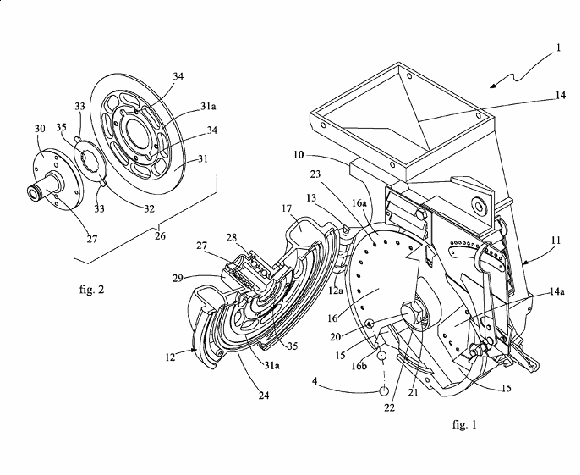
Claim 1 is representative:
1. A seed distribution element for precision pneumatic seed drills, comprising:
a sowing disc which is rotated by a motor-driven transmission drive shaft at controlled speed, a housing with a fixed portion and a portion which is movable relative to the fixed portion and can be closed against the fixed portion, a seed collection chamber being defined in the fixed portion, a pneumatic suction chamber being defined in the movable portion,
4the sowing disc being interposed between the fixed and movable portions and having opposed surfaces delimiting the chambers, the sowing disc having at least one ring of selector holes extending between the opposed surfaces, and a seal which is arranged on the movable portion and is capable of sliding contact with the facing surface of the disc when the fixed and movable portions are closed against one another,
wherein a pressure differential is provided between the opposed surfaces in the region of a circumferential segment of the ring of holes, wherein the seed distribution element further comprises a thrust-bearing element of the sowing disc, which thrust-bearing element is supported rotatably in the movable portion in order to withstand at least some of the axial load produced by the disc on the seal.
Id. at 4:13–40 (emphasis added).
After being sued by Maschio for patent infringement, Precision petitioned the Board for inter partes review (IPR) of claims 1–5, 7–14, and 16 of the ’121 patent, asserting four unpatentability grounds. J.A. 70–162. The Board instituted IPR and held all the challenged claims not unpatentable. J.A. 1–60; J.A. 271–309. Precision appeals, challenging only the Board’s determination that the 5disputed claims would not have been obvious in view of Amazone1, Fiorido2, VenHuizen3, and applicant-admitted prior art (Ground 4). We have jurisdiction under 28 U.S.C. § 1295(a)(4)(A).
DISCUSSION
“[I]n an appeal from an IPR, we review the Board’s legal determinations de novo and its factual findings for substantial evidence.” Corephotonics, Ltd. v. Apple Inc., 84 F.4th 990, 1001 (Fed. Cir. 2023). “Obviousness is a legal question based on underlying findings of fact.” Id. at 1003 (quoting Fleming v. Cirrus Design Corp., 28 F.4th 1214, 1221 (Fed. Cir. 2022)). What the prior art discloses and whether a skilled artisan would have been motivated to combine prior-art references are questions of fact we review for substantial evidence. Id. We review de novo, however, “[w]hether the [Board’s] decision on review rests on a failure to apply the correct legal standards” in its obviousness analysis. Axonics, Inc. v. Medtronic, Inc., 73 F.4th 950, 957 (Fed. Cir. 2023).
On appeal, Precision argues there is no substantial evidence supporting the Board’s findings that (1) Fiorido does not disclose a thrust-bearing element and (2) a skilled artisan would not have been motivated to combine Amazone with Fiorido to arrive at the claimed invention. Precision also argues the Board legally erred by applying an overly rigid motivation-to-combine test. Because we agree with Precision that the Board’s finding regarding Fiorido’s disclosure is unsupported by substantial evidence, we vacate the Board’s decision and remand for further proceedings6 without reaching the merits of Precision’s challenges to the Board’s motivation-to-combine analysis.
I. Fiorido’s Disclosure
Starting with Precision’s challenge regarding Fiorido’s disclosure, we agree there is no substantial evidence supporting the Board’s finding that Fiorido fails to disclose the thrust-bearing element claimed in the ’121 patent. This issue hinges on the parties’ dispute over whether Fiorido’s driving disk (31)—a component of the alleged thrust-bearing element—is in contact with disk (13)—the alleged sowing disc. See, e.g., J.A. 2748–49 (Figs. 2 and 3 of Fiorido, reproduced below with the driving disk (31) shown in red and the disk (13) shown in blue).
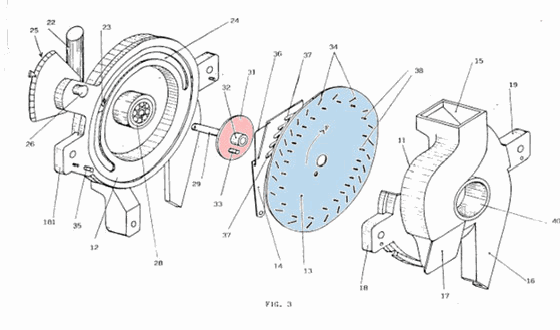
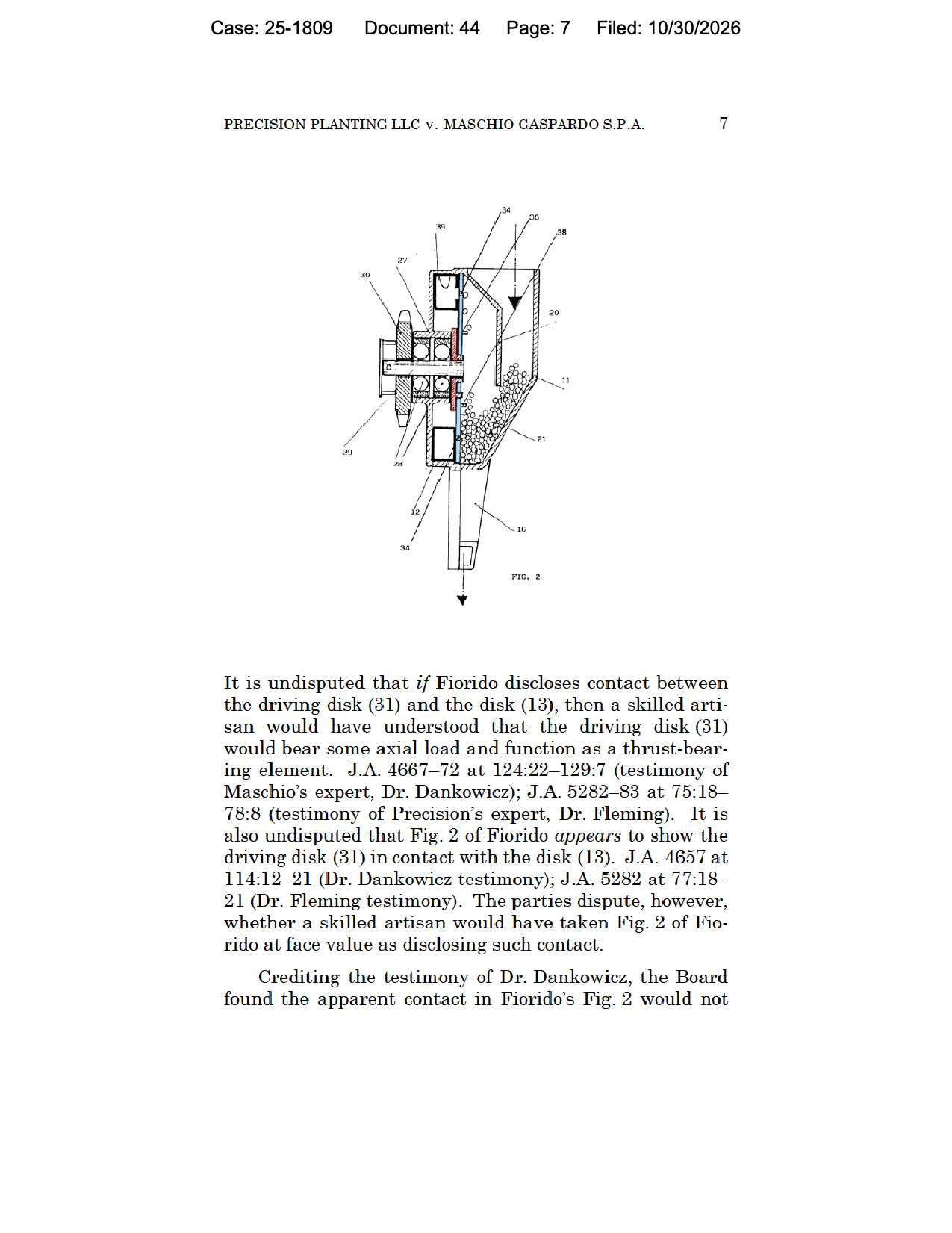
8“have been sufficient, at the time of the invention, to teach or suggest to one of ordinary skill in the art that Fiorido’s drive structure functioned as a thrust-bearing element.” J.A. 53. We conclude this finding is unsupported by substantial evidence.
To support its finding, the Board first noted that “Fiorido does not expressly teach that driving disk (31) is ‘in contact’ with disk (13).” Id. The Board acknowledged Fiorido teaches that the “shaft (29) is connected to disk (13) via driving disk (31)[,] centering dowel (32), and driving pin (33).” Id. (citing J.A. 2745 at 5:51–55 (parentheses added)). But the Board noted that contact between the driving disk (31) and the disk (13) was not required to fulfill the stated purpose of this embodiment. Id. This observation, of course, does not preclude contact between the driving disk (31) and the disk (13). And it certainly does not negate the existence of such contact when it is clearly depicted in Fiorido’s Fig. 2. Cf. In re Mraz, 455 F.2d 1069, 1072 (CCPA 1972) (citing In re Bager, 47 F.2d 951 (C.C.P.A. 1931)) (explaining that “the teachings of patent drawings, even as to features unexplained by the specification” can prove “dispositive” in an obviousness analysis). The Board’s observation about Fiorido’s written description, therefore, does not amount to substantial evidence to support the Board’s finding that Fiorido does not disclose a thrust-bearing element.
The Board next observed that Fiorido’s Fig. 2 also shows apparent contact between the sealing ring (39) and the disk (13), and it includes disclosure that these elements are provided to “ensure correct positioning . . . and an effective sealing effect.” J.A. 53–54. Because of this apparent contact and disclosure, the Board reasoned that “in the absence of any disclosure in Fiorido that driving disk (31) plays any role in absorbing axial load from the sowing disk, it is at least as likely that one of ordinary skill in the art would have understood all of the axial load from the sowing disk to be taken up by the seal as it would have been for9 one of ordinary skill in the art to appreciate that axial load is being shared between the seal and driving disk (31).” Id. at 54 (parentheses added). The Board’s reasoning is flawed, however, because the additional contact shown between the sealing ring (39) and the disk (13) does nothing to disprove the contact shown between the driving disk (31) and the disk (13). And the parties do not dispute that if Fiorido discloses contact between the driving disk (31) and the disk (13), then a skilled artisan would have understood that the driving disk (31) would bear some axial load. J.A. 4667–72 at 124:22–129:7; J.A. 5282–83 at 75:18–78:8. The contact between the sealing ring (39) and the disk (13), therefore, is irrelevant to whether a skilled artisan would have understood Fiorido’s driving disk (31) to be a thrust-bearing element, and it does not amount to substantial evidence supporting the Board’s finding.
Finally, the Board found Dr. Dankowicz’s deposition testimony provided “little support to the notion that one of ordinary skill in the art, at the time of the invention and viewing Fiorido’s disclosure in its entirety, would have appreciated that Fiorido’s disk driving structure functions as a thrust-bearing element.” J.A. 54–55. We see nothing in Dr. Dankowicz’s testimony, however, that “a reasonable mind might accept as adequate” to disregard the apparent contact shown in Fig. 2 between the driving disk (31) and the disk (13). Urias-Orellana v. Bondi, 607 U.S. 537, 544 (2026) (quoting Biestek v. Berryhill, 587 U.S. 97, 103 (2019)) (defining substantial evidence). For example, Dr. Dankowicz suggested that Fiorido’s Fig. 2 should not be taken at face value because although it appears to show contact between the perforated hub (27) and the driving disk (31), he would assume there was no contact between these components because such contact would introduce undesirable friction. See J.A. 4654–55, 4657. He provided no similar rationale, however, for why a skilled artisan would have second-guessed the apparent contact shown between the driving disk (31) and the disk (13). Moreover,10 Dr. Dankowicz testified that, because Fiorido discloses the driving disk (31) could be inserted from the opposite side of the mechanism (i.e., where no thrust-bearing element is needed), there is no reason to believe the driving disk (31) is bearing any thrust, and he would have to revisit any conclusion that there is contact shown in Fig. 2. See J.A. 4669–70. But the mere disclosure of an alternative embodiment where the driving disk (31) may not function as a thrust-bearing element cannot suffice to counteract the depicted embodiment where it does.
“[W]e must disregard the testimony of an expert that is plainly inconsistent with the record,” including testimony that is “clearly at odds with . . . the written record of the patent.” Homeland Housewares, LLC v. Whirlpool Corp., 865 F.3d 1372, 1378–79 (Fed. Cir. 2017) (omission in original) (internal citations omitted). In similar cases, where experts have tried to dispute what is clearly shown in the figures, we have held that “conclusory testimony of an expert witness . . . cannot create an issue of fact if none otherwise exists.” Krippelz v. Ford Motor Co., 667 F.3d 1261, 1269 (Fed. Cir. 2012). Because “[t]here is no question that a person of ordinary skill, reviewing [Fiorido’s] figures, would understand them to show” contact between the driving disk (31) and the disk (13), we decline to accept Dr. Dankowicz’s contrary testimony as substantial evidence supporting the Board’s finding. Id.
Seeing no substantial evidence to support the Board’s finding that Fiorido does not disclose a thrust-bearing element, we (1) vacate the Board’s determination that Precision failed to show claims 1–3, 7–12, and 16 are obvious (Ground 4) and (2) remand for the Board to reconduct an11 obviousness analysis based on Fiorido’s disclosure of a thrust-bearing element.4
II. Precision’s Challenges to the Board’s Motivation-
to-Combine Analysis
Because we remand to the Board for a new obviousness determination, we do not reach Precision’s remaining challenges to the Board’s motivation-to-combine analysis. Specifically, we do not reach Precision’s challenge to the Board’s finding that a skilled artisan would not have been motivated to combine Amazone with Fiorido because the Board’s analysis on this point was premised on its unsupported finding about the scope of Fiorido’s disclosure. See, e.g., J.A. 55 (finding no motivation to “incorporate one component of Fiorido’s seed meter in Amazone’s seed meter” only after failing to recognize said component of Fiorido as a thrust-bearing element); Oral Arg. at 28:45–29:36 (Precision conceding the Board did not address whether there is a motivation to combine if Fiorido teaches a thrust-bearing12 element). Nor do we reach Precision’s argument that the Board applied an overly rigid motivation-to-combine test. We simply instruct that, on remand, the Board conduct its obviousness analysis in accordance with the principles stated in KSR International Co. v. Teleflex Inc., 550 U.S. 398 (2007)—the same principles correctly espoused by the Board in its FWD. See J.A. 8.
CONCLUSION
We have considered the parties’ remaining arguments and find them unpersuasive. For the foregoing reasons, we (1) vacate the Board’s determination that Precision failed to show claims 1–3, 7–12, and 16 are obvious in view of Amazone, Fiorido, VenHuizen, and applicant-admitted prior art and (2) remand for further proceedings consistent with this opinion.
VACATED AND REMANDED
COSTS
Costs to Precision.
Footnotes
- ↩ 1 Amazone Operator’s Manual for “ED” models of Precision Airplanters. J.A. 3267–438.
- ↩ 2 European Patent Pub. No. 0 536 543 A1. J.A. 2742–50.
- ↩ 3 U.S. Patent No. 7,228,807. J.A. 2726–41.
- ↩ 4 To the extent Precision urges us to reverse the Board’s decision based on an alternative obviousness theory that does not rely on Fiorido’s disclosure of a thrust-bearing element, see Appellant’s Br. 65–66, we do not understand this argument to have been made before the Board. Precision points to testimony from its expert, Dr. Fleming, as allegedly making this point. Oral Arg. at 10:28–12:56 (discussing J.A. 4456–57). This testimony, however, addresses the motivation to combine Amazone with Fiorido because “Fiorido teaches a thrust-bearing element in the form of [a] driving disk.” J.A. 4456 (emphasis added). It does not present a motivation to combine Amazone with a modified embodiment of Fiorido to supply a missing thrust-bearing element. Precision’s alternative obviousness theory was thus forfeited, and we decline to consider it for the first time on appeal. See Netflix, Inc. v. DivX, LLC, 84 F.4th 1371, 1378 (Fed. Cir. 2023).