NOTE: This disposition is nonprecedential. United States Court of Appeals
for the Federal Circuit
IN RE: HBN SHOE, LLC,
Appellant
2025-1672
Appeal from the United States Patent and Trademark Office, Patent Trial and Appeal Board in No. 18/117,309.
Decided: March 6, 2026
NORMAN P. SOLOWAY, Hayes Soloway PC, Tucson, AZ, for appellant. Also represented by NICHOLAS BIELAT.
MONICA BARNES LATEEF, Office of the Solicitor, United States Patent and Trademark Office, Alexandria, VA, for appellee John A. Squires. Also represented by OMAR FAROOQ AMIN, NICHOLAS THEODORE MATICH, IV.
Before DYK, REYNA, and TARANTO, Circuit Judges.
HBN Shoe, LLC filed with the Patent and Trademark Office a patent application containing claims to a cleated athletic shoe that permits plantarflexion and eversion of2 the wearer’s foot while the wearer is engaged in weight-bearing exercise. A patent examiner at the Office rejected pending claim 1 of the application for obviousness over a combination of prior-art references, and the Office’s Patent Trial and Appeal Board affirmed the rejection. See Ex Parte Howard Dananberg & Brian G.R. Hughes, No. 2025-000103, 2025 WL 570062, at *1 (P.T.A.B. Feb. 19, 2025) (Board Decision). On HBN’s appeal, we affirm.
I
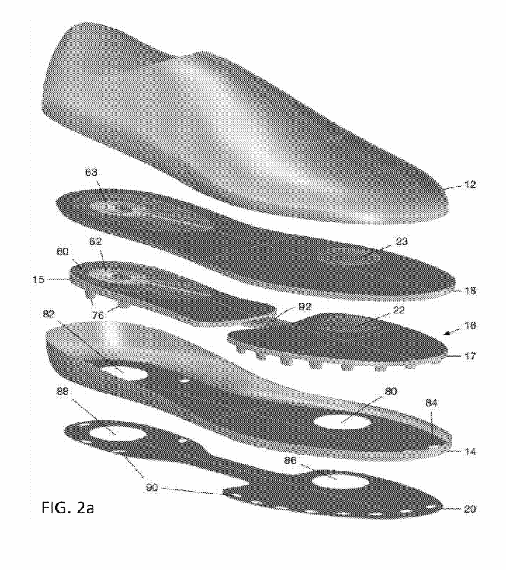
HBN filed U.S. Patent Application No. 18/117,309 on March 3, 2023. J.A. 43–64; see J.A. 20. The HBN application claims cleated athletic shoes that contain two cleat “plates” along the sole of the shoe: a forefoot cleat plate and a heel cleat plate. J.A. 49. Attached to the forefoot cleat plate, on the shoe’s exterior, are “a plurality of radially disposed cleats . . . configured from in front of the big toe of the wearer and along the outside lateral edge of the shoe.” J.A. 50. In the top surface of the forefoot cleat plate (the surface opposite the cleat studs, which protrude from the bottom surface), there is a concave depression underlying the wearer’s first metatarsal head (a bone forming part of the big toe metatarsophalangeal joint). J.A. 49. The purpose of the concave depression is to allow the first metatarsal head to plantarflex and evert “under load,” meaning the wearer’s toes can point and the wearer can rotate the sole outward even while the wearer engages in weight-bearing exercises such as running. J.A. 45; see Board Decision, at *4. The depression extends as a convex surface below the bottom of the forefoot cleat plate. J.A. 46–47. Figure 2(a), excerpted below, depicts the cleat plates (marked as items 15 and 17) and a concave depression underlying the first metatarsal head (marked as items 22 and 23) from an overhead view. J.A. 58; see J.A. 49.
3Claim 1 of the HBN application recites: 1. A cleated shoe comprising a forefoot cleat plate having a plurality of cleats extending therefrom, and a heel cleat plate having a plurality of cleats extending therefrom, wherein the forefoot cleat plate includes a foot supporting surface configured to underlie heads of the second, third, fourth and fifth metatarsal bones of a foot of a wearer, a concave depression relative to a remainder of the forefoot cleat plate extending downward from a top of the forefoot cleat plate and configured to underlie a head of the first metatarsal bone of the foot of the wearer and configured to permit the head of the first
4metatarsal bone of the wearer to plantarflex and evert while under load, wherein the depression extends as a convex surface below a bottom of the forefoot cleat plate, and wherein the forefoot cleat plate includes a central cleat configured to extend from the convex surface under the head of the first metatarsal bone of the foot of the wearer.
J.A. 2096 (emphases added).
On June 4, 2024, the assigned patent examiner rejected claims 1, 3–7, 10, 11, and 13–19 over a combination of prior art references. J.A. 1855–80. Relevant to this appeal, the examiner determined that the subject matter of representative claim 1 (the only independent claim) was unpatentable for obviousness over U.S. Patent Application Publication No. 2012/0180343 (Auger) and U.S. Patent Application No. 2018/0343979 (Yoshida). J.A. 1858; see J.A. 2215, J.A. 2251. The examiner found that Auger discloses most of claim 1’s structural limitations, including, relevantly, a concave depression. J.A. 1858 (citing J.A. 2233– 34 ¶ 41). Auger does not expressly locate the concave depression beneath the first metatarsal head, in a position that permits the head to plantarflex and evert under load, but the examiner found those limitations to be taught by Yoshida.1 J.A. 1858–59 (citing J.A. 2263 ¶ 9, J.A. 2264 ¶ 15, J.A. 2233 ¶ 35 (Auger)).
The examiner determined that it would have been obvious to a relevant artisan to “modify the position of the protruding portions of Auger configured to underlie a head of the first metatarsal bone of the foot of the wearer as taught by Yoshida” to create a cleated shoe with a concave depression underlying the first metatarsal head. J.A.5 1859. According to the examiner, the modified Auger-Yoshida shoe would “enhance [the] ground-gripping capability of the outsole . . . and allow[] the joints of the forefoot (especially the metatarsophalangeal joints) to be bent flexibly during exercise.” Id. The examiner further concluded that the two “configured to” limitations of claim 1 (“configured to underlie a head of the first metatarsal bone of the foot of the wearer and configured to permit the head of the first metatarsal bone of the wearer to plantarflex and evert while under load”) are met. Specifically as to the latter limitation (now at issue), the examiner reasoned that it stated an intended use of the invention, and the prior-art structures, besides meeting the structural limitations of the claim, meet this intended-use limitation because they permit the intended plantarflexion and eversion in a cleated shoe. J.A. 1859–60. In later answering HBN’s argument on appeal to the Board, the examiner added: “[I]t is obvious [to a relevant artisan at the relevant time] to realize that the modified structure Auger-Yoshida also [would] perform the functional language ‘permit the head of the first metatarsal bone of the wearer to plantarflex and evert while under load.’” J.A. 2105.
HBN appealed to the Board, and in February 2025, the Board affirmed the rejection of claims 1, 3–7, 10, 11, and 13–19. Board Decision, at *1. In its decision, the Board addressed several matters now at issue before us. The Board concluded that it did not need to decide whether the “configured to permit [the identified bone] to plantarflex and evert” limitation recited “a functional limitation,” as HBN argued, or “merely a statement of intended use” because the examiner appropriately found that the modified Auger-Yoshida structure satisfies the limitation under either characterization. Id., at *5. The Board reasoned, in particular, that claim 1 does not require the concave depression to be of any particular size and that “[a] person of ordinary skill in the art would recognize that a concave recess of any size in a component made of pliable material”6 (like that of Yoshida) “would facilitate some amount [of] plantarflex and evert movement.” Id. Moreover, the Board rejected HBN’s argument that Yoshida teaches only shoe flexibility, not foot flexibility; the Board cited Yoshida’s disclosure of a “deformable soft resin material” that “allows the metatarsophalangeal joints to bend flexibly during exercise.” Id., at *6 (citing J.A. 2263 ¶ 9, J.A. 2264 ¶ 11).
The Board was unpersuaded by HBN’s other arguments, including: (1) that Yoshida does not disclose “a concave depression that is capable of isolating support for the first metatarsal head from the second, third, fourth, and fifth metatarsal bones”; (2) that the examiner’s rejection was impermissibly based on hindsight; and (3) that the examiner improperly ignored a declaration from Dr. Howard Dananberg, one of the two named inventors. Id., at *6–7. First, the Board concluded that the claims do not require isolated support for the first metatarsal head, and therefore, HBN’s argument was “not commensurate with the scope of the claims.” Id., at *6. Second, the Board determined that the examiner did not base the rejection on impermissible hindsight and instead provided a “cogent reason” to combine the teachings of the prior-art references—“namely, to enhance ground gripping capability of the outsole and allow the joints of the forefoot to bend during exercise.” Id. Third, the Board explained that the Dananberg declaration was not “ignored” by the examiner; instead, the examiner found it to be unpersuasive because it was offered by a named co-inventor and conflicted with that inventor’s earlier published work. Id., at *6–7. Accordingly, the Board affirmed the examiner’s rejection. Id.
HBN timely appealed. J.A. 2191. We have jurisdiction under 28 U.S.C. § 1295(a)(4)(A).
II
HBN asks us to reverse the Board’s obviousness holding. Whether claimed subject matter is unpatentable for obviousness is a question of law to be answered based on7 underlying facts. See St. Jude Medical, LLC v. Snyders Heart Valve LLC, 977 F.3d 1232, 1238 (Fed. Cir. 2020). “We review the Board’s legal determinations de novo and the Board’s factual findings for substantial-evidence support.” Yita LLC v. MacNeil IP LLC, 69 F.4th 1356, 1363 (Fed. Cir. 2023). Substantial evidence is “such relevant evidence as a reasonable mind might accept as adequate to support a conclusion.” Consolidated Edison Co. of New York v. National Labor Relations Board, 305 U.S. 197, 229 (1938). We conclude that the Board’s decision is legally sound and supported by substantial evidence.
A
Substantial evidence supports the Board’s determination of obviousness over Auger and Yoshida. In its decision, the Board found that Auger teaches all of claim 1’s structural limitations and that Yoshida teaches locating a concave depression under the head of the first metatarsal bone. Board Decision, at *5. The Board cited numerous disclosures from Auger and Yoshida to support those findings, see id., at *2–6, and it also determined that it would have been obvious to a relevant artisan to combine those references to produce a cleated shoe capable of gripping the ground while allowing the joints of the forefoot to flexibly bend during exercise, id., at *6.
HBN’s primary argument on appeal focuses on the second of the two parallel “configured to” phrases—“configured to underlie a head of the first metatarsal bone of the foot of the wearer and configured to permit the head of the first metatarsal bone of the wearer to plantarflex and evert while under load.” J.A. 2096 (emphasis added). HBN argues that the Board adopted an erroneous claim construction, invoking cases that indicate that, at least sometimes, an “[apparatus] configured to [perform a function]” phrase can require something more than a capability to perform the specified function—something having to do with the (subjectively or objectively) intended design of the8 apparatus. HBN Opening Br. at 21–25 (relying on Aspex Eyewear, Inc. v. Marchon Eyewear, Inc., 672 F.3d 1335, 1349 (Fed. Cir. 2012), and In re Gianelli, 739 F.3d 1375, 1379 (Fed. Cir. 2014)). But the Board committed no error along these lines.2
Nothing in the Board’s opinion rejects any intended-design, Aspex-based claim construction of “configured to” or discusses any decisions about that phrase standing alone. That is not surprising, because HBN did not request any such construction. See J.A. 2010–35 (HBN’s brief to the Board). HBN made a quite different argument—namely, that the “configured to permit . . .” phrase at issue is not “merely a statement of intended use” but, in fact, “defines physical characteristics that are structurally different from the applied prior art.” J.A. 2024–25 (emphases in original); see id. at 2025 (repeating this point). And in support of that argument, HBN specifically used the language of capability, arguing that “the prior-art structures taught by Auger and Yoshida are incapable of performing the intended use,” partly because the recess in Yoshida “is much too small.” J.A. 2025; see also J.A. 2024 (making same point). Thus, the asserted claim-construction error is not present in the Board’s decision.
Moreover, the Board’s finding that there is no structural difference between HBN’s claimed concave depression and the modified Auger-Yoshida depression is9 supported by substantial evidence. The Board considered Auger and Yoshida’s disclosures of concave depressions and evaluated all of HBN’s arguments. It found that HBN’s “arguments regarding the location and size of the concave depression” were not supported by the record, see Board Decision, at *4–5 (citing J.A. 2233–34 ¶¶ 35, 36, 38, 39, 41, 43, J.A. 2238–39, ¶ 86, J.A. 2264 ¶ 11, J.A. 2265 ¶¶ 27, 33, 38, 39), and additionally, that the examiner’s proposed Auger-Yoshida structure itself meets “the limitation directed to permitting plantarflex and evert,” id., at *5 (emphasis added).
B
HBN’s other arguments are similarly unpersuasive. HBN argues that the Board did not properly consider the Dananberg declaration and “impermissibly relied on its own understanding of cleated shoe mechanics.” HBN Opening Br. at 32–36. The Board considered the Dananberg declaration but reasonably decided not to credit it. The Board reasonably explained that the declaration was offered by a named co-inventor and that Dr. Dananberg’s earlier work (applied by the examiner in rejecting another claim) made contrary disclosures regarding the location and size of the depression underlying the first metatarsal head, namely, that a “relatively small amount” of depression underlying the first metatarsal head provides “a profound effect of rotating the first metatarsal head into eversion.” Board Decision, at *6–7 (quoting J.A. 2280 col. 3, lines 50–60). The Board clearly weighed the evidence in making an express credibility determination and finding the evidence entitled to little weight. “We defer to the Board’s findings concerning the credibility of expert witnesses,” and we see no reason to disturb the Board’s determination here. Yorkey v. Diab, 601 F.3d 1279, 1284 (Fed. Cir. 2010).
HBN additionally argues that the Board failed to address its assertion that Yoshida discloses rigid material10 (beneath the key depression) that would prevent plantarflexion and eversion. HBN Opening Br. at 36–38. But the Board considered and rejected that assertion, finding that neither the cleat studs nor the material of the outsole component disclosed by Yoshida would prevent performance of the claimed plantarflexion and eversion functions. Board Decision, at *4 (citing J.A. 2263 ¶ 9, J.A. 2264 ¶ 11, J.A. 2265 ¶¶ 33, 38, 39). Relatedly, HBN argues that, in considering Yoshida, the Board conflated flexibility of the wearer’s foot with flexibility of the material of the wearer’s shoe. See HBN Opening Br. at 38–40. But the Board clearly recognized the difference between flexible shoe material and flexion of the foot, see Board Decision, at *4 (citing J.A. 2263 ¶ 9, J.A. 2264 ¶ 11) (“An area that includes metatarsophalangeal joints is made of a deformable soft resin material that allows the metatarsophalangeal joints to bend flexibly during exercise”), and the difference between “deformable . . . material” and flexible bending of joints during exercise, see id. Having recognized the distinction at issue, the Board could reasonably find that the claimed foot flexibility would have been obvious, given its rejection of the sole basis to which HBN now points, namely, Dr. Dananberg’s declaration. See HBN Opening Br. at 38–39.
HBN accuses the Board of relying on hindsight in concluding that a relevant artisan would have been motivated to combine Auger and Yoshida. See HBN Opening Br. at 40–48. We are not persuaded. The Board relied on two prior-art references and agreed with the examiner’s identification of a “cogent reason” (grounded in the prior-art references themselves) a relevant artisan would have been motivated to make the combination at the time of invention—“to enhance ground gripping capability of the outsole and allow the joints of the forefoot to bend during exercise.” Board Decision, at *6.
Moreover, HBN’s related argument that the Auger-Yoshida combination would require substantial redesign to11 teach the claims of the HBN application is without merit. See HBN Opening Br. at 42–45. HBN’s redesign argument addresses the size of the concave depression, which, as the Board expressly noted, is not a requirement of claim 1: “[N]o limitation in claim 1 . . . requires the depression underlying the head of the first metatarsal bone to be any particular size.” Board Decision, at *5.
Finally, HBN argues that the Board erroneously determined that the combination of Auger, Yoshida, and a third reference (U.S. Patent No. 8,166,674) teaches all the requirements of claim 1. HBN Opening Br. at 48–52. But as the Board recognized, the examiner did not rely on the third reference to reject claim 1, and the Board cited it simply as “evidence of the background knowledge” of a relevant artisan at the time of the invention. Board Decision, at *7; J.A. 1858. The examiner relied on the third reference in rejecting other claims, see J.A. 1873–74, but in this court HBN argues only about claim 1 and does not independently challenge the rejection of any other claims. See HBN Opening Br. at 3 n.1.; J.A. 1873–74. We therefore do not address HBN’s arguments about this third reference.
III
The decision of the Board is affirmed. The parties shall bear their own costs.
AFFIRMED
Footnotes
- ↩ 1 Yoshida refers to “recesses,” which the Board understood to disclose “depressions” as that term is used in the pending claims. See Board Decision, at *5.
- ↩ 2 The government in this court incorrectly asserts (Appellee’s Brief at 23) that “Aspex . . . expressly recognized that ‘configured to’ can also ‘be used in a broader sense to mean “capable of”’ depending on the context. Aspex, 672 F.3d at 1349.” We did not say that in Aspex. Rather, we said that the phrase “adapted to” can mean either “capable of” or something narrower, and we used the phrase “configured to” to identify such a narrower meaning. 672 F.3d at 1349.