NOTE: This disposition is nonprecedential. United States Court of Appeals
for the Federal Circuit
ROBERT BOSCH LLC, MERCEDES-BENZ USA,
LLC,
Appellants
v.
WESTPORT FUEL SYSTEMS CANADA INC.,
Appellee
2025-1455, 2025-1456
Appeals from the United States Patent and Trademark Office, Patent Trial and Appeal Board in Nos. IPR2023-00292, IPR2023-00293.
Decided: August 18, 2026
MELANIE L. BOSTWICK, Orrick, Herrington & Sutcliffe LLP, Washington, DC, argued for all appellants. Appellant Robert Bosch LLC also represented by KATHERINE M. KOPP; BAS DE BLANK, Menlo Park, CA; JOSEPH RAYMOND KOLKER, New York, NY.
MIRANDA Y. JONES, Winstead PC, Dallas, TX, argued for appellee. Also represented by CODY MACJACKSON CARTER, DAVID WILLIAM HIGER.
2CELINE JIMENEZ CROWSON, Hogan Lovells Cadwalader US LLP, Washington, DC, for appellant Mercedes-Benz USA, LLC. Also represented by JOSEPH JAMES RAFFETTO, NICHOLAS ROTZ.
Before CHEN, CUNNINGHAM, and STARK, Circuit Judges.
Westport Fuel Systems Canada Inc. (“Westport”) is the owner of U.S. Patent Nos. 6,298,829 (the “’829 patent”) and 6,575,138 (the “’138 patent”), which relate to “an injection valve . . . which includes a passive hydraulic link.” J.A. 94 (’829 pat. 1:12-17), J.A. 111 (’138 pat. 1:16-21). Robert Bosch LLC and Mercedes-Benz USA, LLC (together “Bosch”) filed petitions for inter partes review (“IPR”) of various claims of the ’829 and ’138 patents. In two final written decisions, the Patent Trial and Appeal Board (“Board”) found that Bosch failed to prove that any of the challenged claims would have been obvious. Bosch now appeals, and we affirm.
I
The ’829 and ’138 patents share a title, “Directly Actuated Injection Valve,” and a materially identical specification.1 Both relate generally to fuel injector valves for an internal combustion engine. Figure 1, reproduced below, is a cross-section view of a preferred embodiment. J.A. 97 (8:23-24).
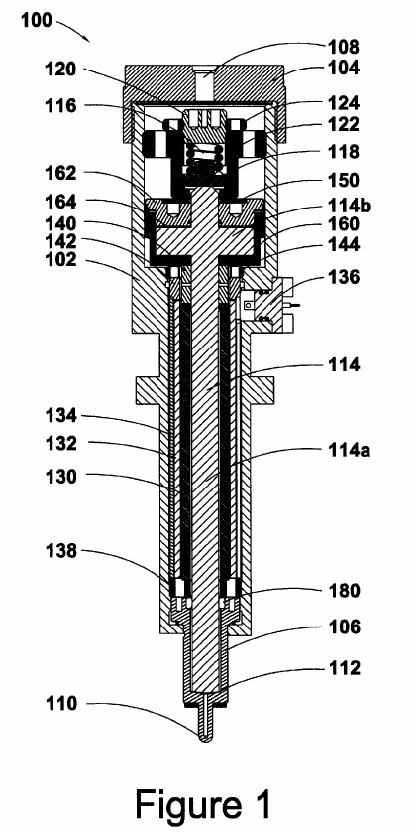
3J.A. 89. Fuel exits the valve through valve tip 106. J.A. 97 (8:45-49). Needle spring 116 exerts a closing force when the system is at rest, preventing any fuel from exiting the valve. J.A. 98 (9:16-34). During actuation, by contrast, an opening force is generated by the magnetostrictive actuator (the combination of elements 130, 132, and 134), which “provides an opening force in opposition to the closing force of the spring assembly.” J.A. 98 (9:45-10:8). That opening4 force overcomes the closing force, allowing fuel to exit the valve. J.A. 98 (9:36-38).
The opening force is transmitted through the hydraulic link assembly, which includes hydraulic cylinder 160, containing a “viscous hydraulic fluid.” J.A. 98-99 (10:62-11:6). The hydraulic fluid preferably “acts as an incompressible solid when activation of the actuator assembly” occurs, thereby allowing “a valve opening force to be quickly transmitted through the hydraulic fluid.” J.A. 99 (11:21-26). In this respect, then, “hydraulic fluid 164b acts as a solid and transfers the movement . . . to valve needle 114,” resulting in the valve opening. J.A. 99 (12:57-64).
Claim 1 of the ’829 patent is representative for purposes of this appeal. Only limitation 1(e) is in dispute. It recites:
a hydraulic link assembly comprising a passive hydraulic link having a hydraulic fluid thickness through which said opening and closing forces are transmitted, whereby said hydraulic fluid acts substantially as a solid with said thickness being substantially constant while said actuator assembly is activated and wherein said thickness of said hydraulic link is adjustable while said actuator is not activated in response to changes in the dimensional relationship between components of said injection valve to maintain a desired valve needle lift upon activation of said actuator assembly.
J.A. 102 (17:32-43) (emphasis added).
Bosch contended in its petition that claim 1 would have been obvious over a combination of prior art references5 Wirbeleit2 and Klügl.3 The Board understood that Bosch relied on Klügl to teach a hydraulic link that “acts substantially as a solid with said thickness being substantially constant while said actuator assembly is activated.” J.A. 10-11. Specifically, Bosch relies on the embodiment depicted in Klügl’s Figure 1, reproduced below.
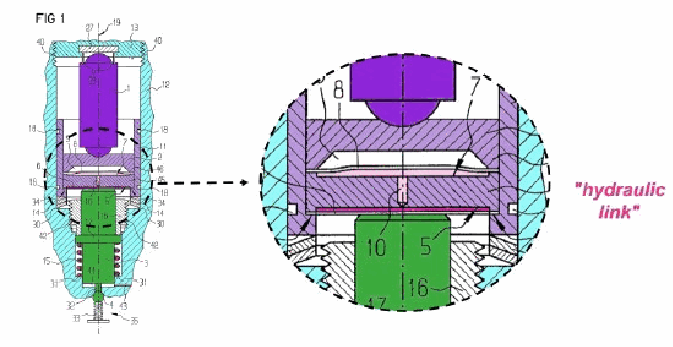
J.A. 11 (annotated by Bosch). The Board was persuaded by Bosch that Klügl’s pressure chamber 5 (pink) is filled with a hydraulic fluid of “low compressibility,” which is “defined and sealed by a membrane 6.” J.A. 11-12. It was undisputed, therefore, that Klügl discloses “a hydraulic fluid thickness through which said opening and closing forces are transmitted.” Bosch further argued that “the dimensions of chamber 5 – including its thickness – remain constant so that the movement of the actuator results in the same amount of movement of the piston.” J.A. 12 (citing J.A. 169). The Board rejected this contention, finding instead that “Klügl expressly teaches that membrane 6 is ‘flexible.’” J.A. 15-16 (first quoting J.A. 1393 (7:45-47)6 (“[F]lexible membranes 6, 8, 26 . . . have a progressive characteristic curve of the spring force in relation to the spring deflection.”); and then quoting J.A. 1393 (7:68-9:31) (referring to “first flexible element (6)” and “first flexible membrane (6)”)). The Board reasoned that because membrane 6 is flexible, it will flex during actuation. Thus, in the Board’s view, Bosch failed to prove that Klügl satisfies limitation 1(e)’s requirement that the hydraulic fluid “acts substantially as a solid with said thickness being substantially constant.” J.A. 16.
Bosch appeals the Board’s determination that it failed to prove the challenged claims obvious. We have jurisdiction under 28 U.S.C. § 1295(a)(4)(A) and 35 U.S.C. § 141(c).
II
We “review the Board’s legal determinations de novo and its factual findings for substantial evidence.” Campbell Soup Co. v. Gamon Plus, Inc., 10 F.4th 1268, 1275 (Fed. Cir. 2021). “Obviousness is a question of law based on underlying facts.” Id. Factual findings underlying an obviousness conclusion include “[w]hat a reference teaches.” In re Cuozzo Speed Techs., LLC, 793 F.3d 1268, 1280 (Fed. Cir. 2015). “In an inter partes review . . . the petitioner shall have the burden of proving a proposition of unpatentability by a preponderance of the evidence.” 35 U.S.C. § 316(e).
III
The only issue on appeal is whether the Board had substantial evidence to support its finding that Klügl does not disclose limitation 1(e).4 The disputed limitation requires,7 among other things, that “the hydraulic fluid acts substantially as a solid,” which the Board found Klügl does not disclose, since Klügl’s membrane 6 is “flexible,” meaning the fluid will change shape as the membrane flexes, which is inconsistent with the behavior of a solid. J.A. 16 (emphasis added).
Substantial evidence, relied on by the Board, supports the Board’s finding. See, e.g., J.A. 17 (“Westport provides ample evidence in the form of credible expert testimony that Klügl only ever specifies and describes membrane 6 as a flexible membrane or element, and, thus, the membrane will tend to deform longitudinally upward where it contracts the drive piston and bulge outward where unconstrained in the annular area . . . between the edge of the drive piston 3 and the wall of transmission module 2.”) (internal quotation marks omitted). Klügl explicitly describes membrane 6 as a “flexible membrane.” J.A. 1393 (7:44-46). Nowhere does Klügl limit this description only to certain embodiments. To the contrary, Klügl specifically refers to “Fig[ure] 1 or 3” when explaining the “advantages with flexible membrane 6,” providing support for the Board’s reading of Klügl as disclosing a flexible membrane in both its Figure 1 and 3 embodiments. J.A. 1393 (7:34-47) (emphasis added).
Bosch attempts to make much of the fact that Klügl’s Figure 1 depicts a device “without stroke translation,” while its Figure 3 embodiment operates “with stroke translation.” J.A. 1390 (1:41-46). According to Bosch, “stroke translation” refers to a change in the amount of movement from the actuator to the opening of the valve, such that if there is “no stroke translation” (as in Klügl’s Figure 1) the hydraulic fluid is required to achieve a constant thickness.8 Yet the only evidence Bosch produced in support of its definition of stroke translation was the declaration of its expert, Dr. Quinlan, see J.A. 293, which the Board found was “undermined by incomplete and contradictory opinions,” J.A. 23; see also J.A. 68 (’138 patent final written decision) (“Dr. Quinlan’s testimony in many instances . . . is substantively incomplete and fraught with contradictions that undermine the weight of his testimony.”); J.A. 71 (finding Dr. Quinlan to be “contradicted by Klügl’s express disclosure”).5 The Board did not abuse its discretion in making this credibility assessment. See Sierra Wireless, ULC v. Sisvel S.p.A., 130 F.4th 1019, 1024 (Fed. Cir. 2025) (asserting that Board’s credibility determinations are reviewed for abuse of discretion).
Bosch argues in the alternative that even if membrane 6 of Klügl is flexible, the Board lacked substantial evidence to find that membrane 6 flexes during activation (also referred to as “actuation”), as is required of limitation 1(e). Bosch predicates this contention on Klügl’s discussion of movement of membrane 6 “in the rest position without being actuated.” J.A. 1391 (3:63-4:10). A reasonable mind could accept the Board’s logical determination that if Klügl’s membrane 6 is flexible and actually flexes when not actuated, then it remains flexible and will flex when actuated as well. J.A. 15; J.A. 66-68; see also Consol. Edison Co. v. Nat’l Lab. Rels. Bd., 305 U.S. 197, 229 (1938) (defining substantial evidence as “such relevant evidence as a reasonable mind might accept as adequate to support a conclusion”).
9Bosch’s additional arguments are also unpersuasive. Bosch insists that “nothing in Klügl shows that membrane 6 can (let alone must) flex to such a degree that it meaningfully changes the thickness of the hydraulic fluid during actuation.” Open Br. 50. We agree, instead, with the Board, which characterized this contention as nothing more than “conclusory attorney argument, lacking any citation to the record or meaningful explanation.” J.A. 17. Bosch also argues that a skilled artisan would “readily be able to design Klügl’s injector” to minimize or avoid flexing altogether. However, as the Board pointed out, this contradicts Klügl’s repeated teachings that its membrane is flexible. J.A. 21-22. Finally, we see no merit to Bosch’s multiple allegations of procedural error.
IV
We have considered Bosch’s remaining arguments and find them unpersuasive. Accordingly, the judgment of the Board is affirmed.
AFFIRMED
Footnotes
- ↩ 1 Because there are no material differences between the patents with respect to the issues presented in this appeal, we cite only to the ’829 patent and the final written decision relating to it, unless otherwise noted.
- ↩ 2 U.S. Patent No. 5,479,902.
- ↩ 3 Certified translation of German Patent No. 19708304.
- ↩ 4 To the extent Bosch is attempting on appeal to rely on Wirbeleit as teaching limitation 1(e), it fails to show any abuse of discretion in the Board’s finding that, in its petition, Bosch relied solely on Klügl for this limitation. See Netflix, Inc. v. DivX, LLC, 84 F.4th 1371, 1377 (Fed. Cir. 2023) (“The Board is entitled to discretion in how it interprets petitions.”).
- ↩ 5 The Board found, for example, that despite using certain terms like “stroke amplification” in his declaration, Dr. Quinlan could not explain their meaning, instead admitting he had not “taken the time to do a formal analysis on what amplification means.” J.A. 25 (citing J.A. 2799 (34:3-12)).