United States Court of Appeals
for the Federal Circuit
GOOGLE LLC,
Appellant
v.
DDC TECHNOLOGY, LLC,
Appellee
2025-1315, 2025-1316, 2025-1330
Appeals from the United States Patent and Trademark Office, Patent Trial and Appeal Board in Nos. IPR2023-00707, IPR2023-00709, IPR2023-00711.
Decided: November 5, 2026
NATHAN K. KELLEY, Ashurst Perkins Coie LLP, Washington, DC, argued for appellant. Also represented by ANDREW DUFRESNE, Madison, WI; TARA LAUREN KURTIS, Chicago, IL.
CORTNEY ALEXANDER, Kent & Risley LLC, Alpharetta, GA, argued for appellee. Also represented by TIMOTHY J. HALLER, Haller Law PLLC, Naples, FL.
Before REYNA, HUGHES, and STARK, Circuit Judges.
Google LLC appeals from three final written decisions of the United States Patent Trial and Appeal Board, which determined that Google failed to prove that certain claims of U.S. Patent Nos. 9,420,075, 10,528,199, and 11,093,001 were unpatentable as obvious. We affirm.
BACKGROUND
I.
With the proliferation of smartphones came the opportunity for development of hand-held virtual reality (“VR”) viewers that leveraged smartphones’ software and hardware to provide a VR experience. J.A. 249, 1:32–36. Some early VR viewers comprised a housing into which a user would place their smartphone. Id., 1:37–39, 44–47. The viewers would typically include one or more optical lenses to facilitate a three-dimensional viewing experience when the user peered into the housing. Id., 1:48–51. These viewers suffered from the drawback that the housing impeded the user from accessing and interacting with the touch-sensitive display of the smartphone. Id., 1:56–59. As a result, the VR viewers’ range of use was limited.
The patents at issue, U.S. Patent Nos. 9,420,075 (“’075 patent”), 10,528,199 (“’199 patent”), and 11,093,001 (“’001 patent”), sought to overcome this drawback. They disclose a VR viewer configured for use with a wide variety of conventionally available smartphones. Id., 2:11–15.1 The VR viewer comprises a housing for receiving a smartphone and an input mechanism that a user can manipulate from outside the housing. Id., 2:22–31. The input mechanism, when actuated, contacts the smartphone’s touchscreen,
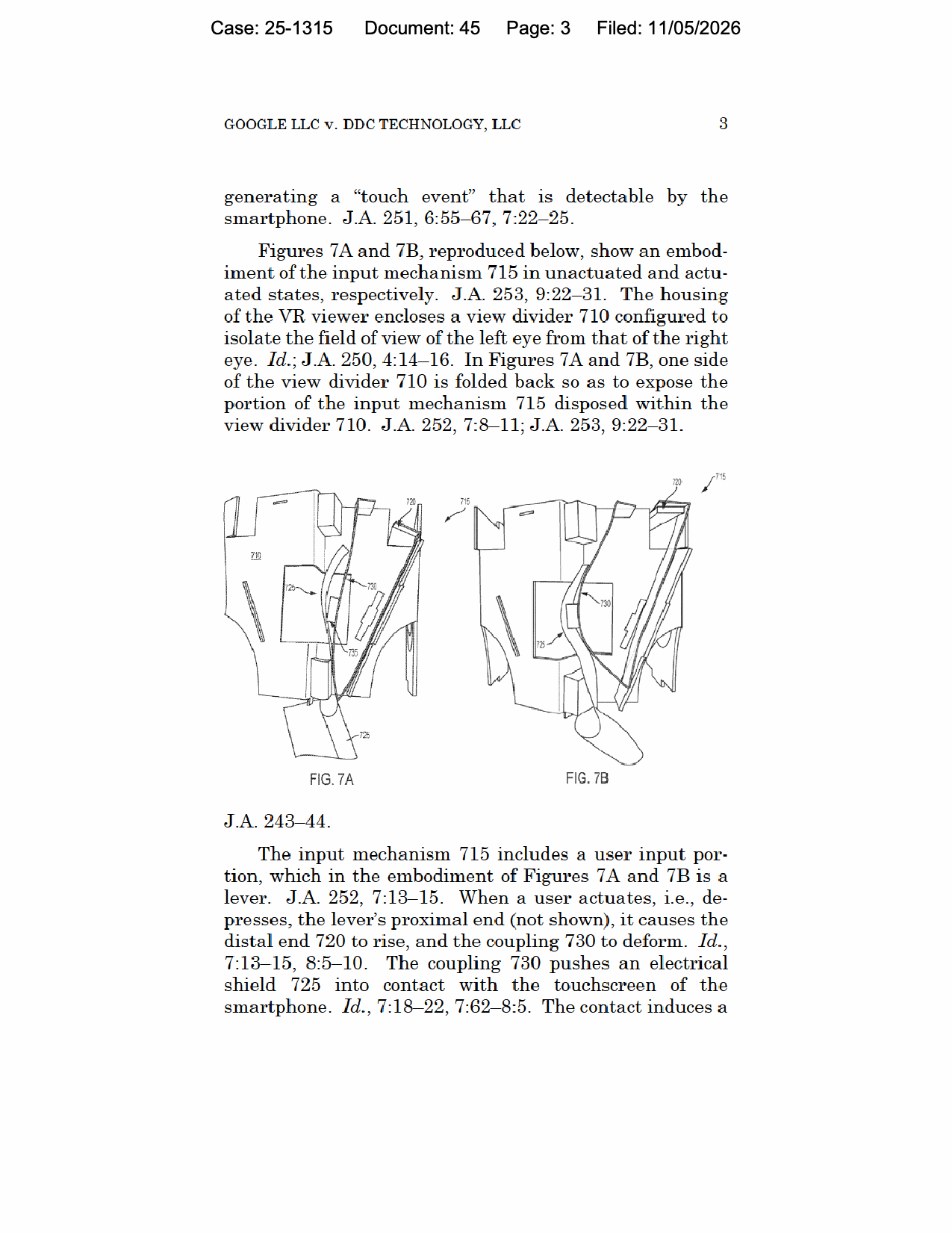
4touch event that is electrically detectable by the smartphone. Id., 7:22–25.
As an example, claim 1 of the ’075 patent recites: 1. A virtual reality viewer for use with a mobile electronic device having a touch-screen, the viewer comprising: a housing configured to receive the mobile electronic device, wherein the housing is configured to hold the mobile electronic device such that the touch-screen is generally centered in a horizontal direction and directly in a user’s field of view when looking into a generally hollow interior of the housing through a side opposite the touch-screen; an input mechanism that is accessible from an exterior of the housing and is moveable within the interior between at least a first position and an extended position, the input mechanism comprising:
an electrical shield having a surface, wherein only a portion of the surface of the electrical shield is configured to contact a central region of the touch-screen of the mobile electronic device when the input mechanism is in the extended position.
J.A. 254, 12:25–42.
II.
Appellant Google LLC (“Google”) petitioned for inter partes review (“IPR”) of the ’075, ’199, and ’001 patents, all of which are assigned to Appellee DDC Technology, LLC (“DDC”). Google challenged various claims of the three patents in IPR Nos. 2023-00707, -00709, and -00711, respectively.
5Google asserted the same combination of prior art references, Japanese Patent Publication JP 3176588 (“Kondo”) and U.S. Patent Application Publication No. 2013/0082963 (“Chu”), against all challenged claims in all three IPRs.
Kondo describes an “attachment” into which a user can place a smartphone to view “a three-dimensional stereoscopic image.” J.A. 5150, [0022]. Kondo explains that because the smartphone is stowed inside the attachment, “it is not possible to input an operation to the [smartphone’s] touch panel as-is.” Id. Kondo therefore equips the attachment with “a remote touch circuit that enables remote operation input to the touch panel from the outside.” Id.
Chu describes “an actuator mechanism for actuating a capacitive touch screen of a digital device held in a waterproof housing.” J.A. 5186, [0002]. In one embodiment, Chu discloses an actuator mechanism 12 having a press button 16 that can be “pushed downwards/inwards by a finger of a user” such that a “probe head 18 is touching the capacitive touch screen 20.” J.A. 5188, [0040]–[0041]. As a result, “electric charge E can be transferred between the finger of the user and the capacitive touch screen 20 through the press button 16, the actuator shaft 14 and the probe head 18.” Id. In another embodiment, an actuator mechanism 12′ includes an adaptor 28′ that connects an actuator shaft 14′ to a probe head 18′ such that the probe head 18′ is “disposed at an off-center position away from the center axis X of the actuator shaft 14′.” J.A. 5189, [0050]–[0051].
In each IPR, Google asserted obviousness theories over the combination of Kondo and Chu that entail replacing Kondo’s remote touch circuit with an embodiment of Chu’s actuator mechanism. Following are six disputes the parties presented to the PTAB below.
First, for claims 1 of the ’075 and ’199 patents, DDC disputed Google’s proffered motivation to combine Kondo6 and Chu, and Google disputed DDC’s showing of objective indicia of nonobviousness. The Board determined that the Kondo-Chu combination teaches each limitation, and that an ordinarily skilled artisan would have been motivated to combine Kondo and Chu with a reasonable expectation of success. The Board also determined, however, that DDC’s objective indicia weighed in favor of nonobviousness. Specifically, the Board found that DDC established copying by Google, which the Board weighed “heavily” in favor of non-obviousness. J.A. 70; J.A. 141; see also J.A. 58 (“[W]e are persuaded that Patent Owner’s evidence of copying is strong evidence of nonobviousness.”); J.A. 129. The Board also found that DDC established industry praise, which the Board gave “moderate weight.” J.A. 70; J.A. 141. The Board determined that, “[o]n balance, [DDC’s] evidence tending to show nonobviousness outweighs [Google’s] evidence of obviousness.” J.A. 70; J.A. 141. The Board therefore concluded that Google had not shown by a preponderance of the evidence that claims 1 of the ’075 and ’199 patents, and the claims depending therefrom, would have been obvious.
Second, for claim 18 of the ’075 patent, the parties disputed the meaning of the term “disposed on.”2 Google argued that “disposed on” must include indirect connections, otherwise the claim would be indefinite. Google argued that components that were “far removed” from one another could still meet this limitation. J.A. 1111–12. The Board “disagree[d] that ‘disposed on’ includes indirect connections that are far removed.” J.A. 25.
7Third, the parties disputed the meaning of the term “lever” in claim 20 of the ’075 patent.3 Google argued that “lever” should be construed broadly as “a projecting piece by which a mechanism is operated or adjusted.” J.A. 1035–36. DDC argued that the proper construction is “a stiff body pivoted on a fulcrum.” J.A. 1328. The Board adopted DDC’s construction.
Fourth, the parties disputed whether Google showed that the Kondo-Chu combination taught or suggested or rendered obvious the “guide” limitation of claim 20 of the ’075 patent.4 DDC argued that Chu’s biasing member 40 does not “guide” movement of the probe pad, instead it resists movement of the probe pad 30. J.A. 1354. The Board agreed and determined Google did not establish that claim 20 would have been obvious.
Fifth, the parties disputed whether Google established that Chu teaches the limitation of claim 27 of the ’001 patent reciting a “linkage element . . . made from a flexible material.” J.A. 317, 14:30–31. Google’s petition relied on both Chu’s biasing member 40 and shaft 14 as teaching this limitation. J.A. 4087–88; J.A. 4091. Google argued: “Chu’s8 biasing member 40, part of the linkage element, is a spring. So, it is flexible.” J.A. 4091. But Google did not make any assertion regarding shaft 14. See id. In its institution decision, the Board invited additional argument and evidence on claim 27. J.A. 4196 (“We welcome additional argument and evidence on [claims 27 and 28] at trial.”). Google did not further address claim 27 in its Petitioner’s Reply. See J.A. 218–19. In its final written decision, the Board determined that Google failed to carry its burden because Google relied on two components, i.e., Chu’s biasing member 40 and shaft 14, for the claimed “linkage element . . . made from a flexible material” but only asserted that one of the two components (biasing member 40) was made from a flexible material. J.A. 219. The Board stated:
Although we agree with Petitioner that Chu’s biasing member 40 is a spring and is flexible, Petitioner does not assert that the other part of the other component of the linkage element, that is, Chu’s shaft 14, is made from a flexible material. Claim 27 explicitly recites that “the linkage element is made from a flexible material,” and does not state that only a part of the linkage element is made from flexible material. Thus, because Petitioner has not demonstrated that Chu’s shaft 14, which is a part of the linkage element under Petitioner’s assertions (Pet. 80), is made from flexible material, we find that Petitioner has not carried its burden of proof for claim 27.
J.A. 219 (citation modified).
Sixth, the parties disputed whether Google established that Chu teaches the limitation in claim 28 of the ’001 patent that recites “a memory material coupled to the linkage element.” J.A. 317, 14:32–33. Google relied on a single component, Chu’s biasing member 40, for both the “memory material” and the “linkage element.” J.A. 4091. In its institution decision, the Board indicated that9 Google’s reliance “appears inconsistent with the language of the limitation which requires that the memory material be coupled to the linkage element.” J.A. 4195–96 (emphasis added). The Board invited additional argument and evidence on claim 28, J.A. 4196, but Google did not further address claim 28 in its reply. See J.A. 220. In its final written decision, the Board concluded that Google “d[id] not reconcile how biasing member 40 is part of the linkage element, but is also coupled to the same linkage element.” Id.
Ultimately, the Board determined that Google proved unpatentability for certain of the challenged claims but failed to prove unpatentability for claims 1–12, 14, and 18–20 of the ’075 patent; claims 1, 2, 4–6, and 17–26 of the ’199 patent; and claims 27 and 28 of the ’001 patent (collectively, the “surviving claims”).
Google appeals the Board’s judgment as to the surviving claims. We have jurisdiction to review the Board’s final decisions under 28 U.S.C. § 1295(a)(4)(A).
STANDARD OF REVIEW
We review the Board’s claim construction determinations based on intrinsic evidence de novo and its subsidiary factual findings based on extrinsic evidence for substantial evidence. Dionex Softron GmbH v. Agilent Techs., Inc., 56 F.4th 1353, 1358 (Fed. Cir. 2023).
Obviousness is a question of law based on underlying factual findings. B/E Aerospace, Inc. v. C&D Zodiac, Inc., 962 F.3d 1373, 1379 (Fed. Cir. 2020). We review the Board’s ultimate determination of obviousness de novo and its underlying factual determinations for substantial evidence. Steuben Foods, Inc. v. Nestle USA, Inc., 884 F.3d 1352, 1355 (Fed. Cir. 2018). The ultimate determination of obviousness takes into account evidence of obviousness, such as the scope and content of the prior art and the 10motivation to combine references, as well as evidence of non-obviousness. Ancora Techs., Inc. v. Roku, Inc., 140 F.4th 1351, 1357 (Fed. Cir. 2025). The scope and content of the prior art and the motivation to combine references are factual determinations. Id.
An analysis of any individual objective indicia requires two determinations from the factfinder: (1) the factfinder must determine whether the evidence demonstrates the indicia, for example, commercial success, copying, etc., and (2) if so, the factfinder must determine how strongly the indicia weighs in favor of nonobviousness. Each determination is a factual finding that we review for substantial evidence. Fleming v. Cirrus Design Corp., 28 F.4th 1214, 1222 (Fed. Cir. 2022) (“The existence and weight assigned to any objective indicia of nonobviousness are factual considerations that we review for substantial evidence.”); see also Hafeman v. Google LLC, 177 F.4th 1191, 1202 (Fed. Cir. 2026) (“We review the weight given to evidence of secondary considerations for substantial evidence.”).
We review de novo the Board’s compliance with the Administrative Procedure Act (“APA”). In re NuVasive, Inc., 841 F.3d 966, 970 (Fed. Cir. 2016).
DISCUSSION
As previewed above, Google raises six issues on appeal. First, Google contends the Board’s findings as to claims 1 of the ’075 and ʼ199 patents regarding DDC’s proffered objective indicia were not supported by substantial evidence and its determination of nonobviousness for those claims was legally erroneous. Appellant Br. 32–45. Second, Google argues that the Board’s determination that it failed to establish unpatentability for claim 18 of the ’075 patent rested on an incorrect construction of claim 18’s “disposed on” limitation. Appellant Br. 45–50. Third, Google argues that the Board’s determination that it failed to establish unpatentability for claim 20 of the ’075 patent rested on the11 Board’s erroneous construction of claim 20’s “lever.” Appellant Br. 50–56. Fourth, Google contends that the Board’s finding that the prior art does not teach or suggest claim 20’s “guide” limitation was unsupported by substantial evidence. Appellant Br. 56–60. Fifth, Google argues that the Board’s determination that it failed to establish unpatentability for claim 27 of the ’001 patent violates the APA because the Board provided a surprise implicit construction for the phrase “made from a flexible material” in its final written decision, and that, in any case, the Board’s determination for claim 27 is unsupported by substantial evidence. Appellant Br. 61–64. Sixth, Google argues that the Board’s determination that it failed to establish unpatentability for claim 28 of the ’001 patent rested on an implicit construction of the term “coupled to” that is inconsistent with the specification. Appellant Br. 65–66. We address each argument in turn.
I. Claims 1 of the ’075 and ’199 patents
Google challenges the Board’s determination that it failed to show claims 1 of the ’075 and ’199 patents would have been obvious for three separate reasons. Specifically, Google argues that the Board’s copying analysis, industry praise analysis, and ultimate obviousness determination are each prejudicially flawed.
A. Copying
Google argues that the Board’s copying analysis was legally flawed. Specifically, Google argues that the Board separately compared Google’s GCV2 VR viewer product and DDC’s allegedly copied products—the DODOcase5 VR12 1.2 viewer and Mr. Buckley’s prototype—to the challenged claims rather than to each other. Appellant Br. 4. Google’s argument is without merit.
“Not every competing product that arguably falls within the scope of a patent is evidence of copying.” Iron Grip Barbell Co. v. USA Sports, Inc., 392 F.3d 1317, 1325 (Fed. Cir. 2004). “Otherwise every infringement suit would automatically confirm the nonobviousness of the patent. Rather, copying requires the replication of a specific product.” Id. Thus, as Google notes, the correct comparison is not between the devices at issue and the challenged claims but between the alleged patented devices and the alleged copied product. See id. Copying may be demonstrated either through “internal documents,” “direct evidence such as disassembling a patented prototype, photographing its features, and using the photograph as a blueprint to build a virtually identical replica,” or “access to, and substantial similarity to, the patented product (as opposed to the patent).” Id. (emphasis added).
But contrary to Google’s position, here, the Board did not compare Google’s product and DDC’s allegedly copied products to the challenged claims. Rather, in its final written decision, the Board provided detailed comparisons of Google’s GCV2 VR viewer to the DODOcase VR 1.2 viewer and Mr. Buckley’s prototype. See J.A. 55–57. Thus, there is no legal error.
Google also argues that the Board’s copying finding is unsupported by substantial evidence because the Board disregarded differences between the input mechanisms of the DODOcase VR 1.2 viewer and Google’s GCV2 VR viewer. Appellant Br. 34–35. We disagree.
The Board considered the products’ respective input mechanisms, identifying their similarities and differences. J.A. 55–56 (comparing, with pictures and descriptions, input mechanisms of the DODOcase VR 1.2 viewer and Google’s GCV2 VR viewer); J.A. 57 (comparing the input13 mechanisms of Mr. Buckley’s prototype and Google’s GCV2 VR viewer). The Board identified two differences between the input mechanisms of the DODOcase VR 1.2 viewer and Google’s GCV2 VR viewer, which it characterized as “minor, non-material modifications,” and it concluded that those differences “change the input mechanism’s method of attachment and materials, but neither alters its fundamental features.” J.A. 56–57. We have affirmed the Board under similar circumstances. In Medtronic, we affirmed a Board’s finding of substantial similarity where the Board acknowledged differences but found that “these differences were not so significant as to preclude substantial similarity and the corresponding inference that [Appellants] copied.” Medtronic, Inc. v. Teleflex Innovations S.a.r.l., 70 F.4th 1331, 1341 (Fed. Cir. 2023). We do the same here.
For these reasons, we affirm the Board’s finding that DDC demonstrated copying.
B. Industry Praise
Google next argues that the Board’s finding that DDC’s proffered evidence demonstrates industry praise is unsupported by substantial evidence. Appellant Br. 40. We disagree.
DDC presented evidence of industry praise in the form of emails from three Google engineers responding to an email from Mr. Buckley, a prospective business partner. J.A. 6768. Mr. Buckley’s email shared videos of a prototype viewer, to which the engineers responded via email, “That button is genius.”, “That’s an ingenious button!”, and “That button looks really neat!”. Id. The Board found this praise was a direct result of the unique characteristics of the claimed invention, namely the claimed input mechanism. J.A. 59–60.
Google argues these emails cannot demonstrate industry praise because they were biased “compliments” provided in the context of a business partnership. Appellant14 Br. 40–41; see also Appellant Br. 41 (“At the time of the cited email comments, Google was neither an impartial third party nor a competitor.”). Google relies on two cases in which we affirmed discounting of evidence of industry praise in the form of “self-serving statements” by researchers about their own work or by a party’s own president. Appellant Br. 41 (citing In re Cree, Inc., 818 F.3d 694, 702 (Fed. Cir. 2016); Geo M. Martin Co. v. All. Mach. Sys. Int’l LLC, 618 F.3d 1294, 1305 (Fed. Cir. 2010)). This case is different. Here, Google’s engineers were responding to a third party about a non-Google prototype viewer. Thus, the Board was not compelled to be persuaded by Google’s effort to discount these emails as self-serving.
Further, the Board’s final written decision shows that it considered and accounted for any lack of impartiality in the three email messages. As Google acknowledges, the Board discounted one response—“That button looks really neat!”—as a polite response rather than praise. Appellant Br. 40–41 (citing J.A. 60). For the other two messages, the Board noted that “[t]he compliments were provided directly to Mr. Buckley, and at the time, there was an on-going and evolving business relationship between [Google] and DODOcase.” J.A. 60. The Board further explained that “[Google’s] employees had interpersonal and business reasons for responding positively to Mr. Buckley’s email, making the emails somewhat less probative of the type of praise that shows nonobviousness.” Id. Ultimately, the Board found the complimentary nature of the other two responses was “somewhat offset by the context in which they were made.” J.A. 61.
We conclude that the Board’s determination that these emails constitute industry praise is supported by substantial evidence.
C. Ultimate Determination of Obviousness
Finally, Google contends that even if the Board correctly found copying and industry praise, “the Board15 err[ed] in weighing DDC’s evidence of secondary considerations against Google’s largely unrebutted obviousness case to conclude the claims were not proven unpatentable for obviousness.” Appellant Br. 4, 42–45. Google contends that its “strong prima facie case easily outweighs DDC’s secondary-considerations evidence.” Appellant Br. 42. For the below reasons, we conclude that the Board did not legally err in determining that Google failed to show the obviousness of claims 1 of the ’075 and ’199 patents by a preponderance of the evidence. See J.A. 79; J.A. 147.
In Graham, the Supreme Court laid out a four-factor framework for analyzing obviousness—a requirement for patentability codified by Congress fourteen years prior. Graham v. John Deere Co. of Kansas City, 383 U.S. 1 (1966). The Court explained that under 35 U.S.C. § 103, courts are to (1) determine the scope and content of the prior art, (2) ascertain differences between the prior art and the claims at issue, (3) resolve the level of ordinary skill in the pertinent art, and (4) consider secondary considerations of nonobviousness. Id. at 17–18. The Court noted that “secondary considerations” can “give light to the circumstances surrounding the origin of the subject matter sought to be patented.” Id. These secondary considerations “may also serve to guard against slipping into use of hindsight, and to resist the temptation to read into the prior art the teachings of the invention in issue.” Id. at 36 (citation modified).
In the decades since Graham, we have repeatedly held that evidence of secondary considerations “must always when present be considered en route to a determination of obviousness.” Stratoflex, Inc. v. Aeroquip Corp., 713 F.2d 1530, 1538 (Fed. Cir. 1983) (emphasis added); see also Simmons Fastener Corp. v. Illinois Tool Works, Inc., 739 F.2d 1573, 1575 (Fed. Cir. 1984) (“The section 103 test of nonobviousness set forth in Graham is a four part inquiry comprising, not only the three familiar elements . . . , but also evidence of secondary considerations when such evidence16 is, of course, present.”); In re Cyclobenzaprine Hydrochloride Extended-Release Capsule Pat. Litig., 676 F.3d 1063, 1079 (Fed. Cir. 2012) (“[F]act finders must withhold judgment on an obviousness challenge until [they] consider[] all relevant evidence, including that relating to the objective considerations.”); WBIP, LLC v. Kohler Co., 829 F.3d 1317, 1328 (Fed. Cir. 2016) (“[T]he strength of each of the Graham factors must be weighed in every case and must be weighted en route to the final determination of obviousness or non-obviousness.”).
Indeed, we have emphasized that “evidence of secondary considerations may often be the most probative and cogent evidence in the record.” Stratoflex, 713 F.2d at 1538. Additionally, the argument that “objective considerations of non-obviousness can never overcome a strong prima facie case of obviousness” is contrary to law. WBIP, 829 F.3d at 1328. “Indeed, we have repeatedly stressed that objective considerations of non-obviousness must be considered in every case,” regardless of the purported strength of the showing of obviousness. Id. “This requirement is in recognition of the fact that each of the Graham factors helps to inform the ultimate obviousness determination.” Id. (emphasis added).
As an initial matter, Google’s challenge is premised not on the Board’s characterizations of the evidence, but on its own characterization of the evidence of obviousness and nonobviousness. Specifically, Google argues that (1) its “strong” and “overwhelming” evidence of obviousness outweighs (2) DDC’s “marginal” objective indicia evidence. Appellant Br. 42–43. These characterizations must be taken with a grain of salt. The Board made no finding that Google’s evidence was “strong” or “overwhelming.”
The Board likewise never found that DDC’s objective indicia evidence was “marginal.” To the contrary, the Board expressly determined that evidence of copying was “strong” and that the weight given evidence of industry17 praise was “moderate.” J.A. 58; J.A. 61. The weight the Board afforded to the objective indicia evidence is a factual determination that we give deference. Fleming, 28 F.4th at 1222 (“The existence and weight assigned to any objective indicia of nonobviousness are factual considerations that we review for substantial evidence.”). Google does not challenge the weight afforded to these findings. See Appellant Br. 33–42; Oral Arg. at 9:43–54. Thus, we do not disturb the Board’s assignment of weight as to copying and industry praise.
Per Google’s challenge, we review only the Board’s ultimate legal conclusion that Google failed to show that certain of the surviving claims would have been obvious. At oral argument, Google’s counsel explained this legal analysis with hypothetical reference to the case at hand:
So you have to prove obviousness with facts supported by substantial evidence. So the substantial evidence supports the facts and then you have all the facts on the table. . . . Whether that all gets you to obviousness or not, that’s a legal question. And that’s a question for this court.
Oral Arg. at 10:57–11:24.6 Undertaking this analysis, we conclude that the Board did not err in its ultimate determination of nonobviousness.
The concept of a “prima facie case of obviousness” most naturally relates to patent prosecution. Specifically, “[t]he prima facie case is a procedural tool of patent examination, allocating the burdens of going forward as between examiner and applicant.” In re Oetiker, 977 F.2d 1443, 1445 (Fed. Cir. 1992); see also In re Brandt, 886 F.3d 1171, 1176 (Fed. Cir. 2018). “The term ‘prima facie case’ refers only to the initial examination step.” In re Oetiker, 977 F.2d at18 1445. “[T]he examiner bears the initial burden, on review of the prior art or on any other ground, of presenting a prima facie case of unpatentability,” and “[i]f that burden is met, the burden of coming forward with evidence or argument shifts to the applicant.” Id. “This burden-shifting framework makes sense during patent examination because an examiner typically has no knowledge of objective considerations, and those considerations may not be available until years after an application is filed.” In re Brandt, 886 F.3d at 1176 (citation modified). To the extent that there is an implication that such burden shifting occurs under Graham, “we have emphatically rejected any formal burden-shifting framework in evaluating the four Graham factors.” OSRAM Sylvania, Inc. v. Am. Induction Techs., Inc., 701 F.3d 698, 709 (Fed. Cir. 2012); see also In re Magnum Oil Tools Int’l, Ltd., 829 F.3d 1364, 1375 (Fed. Cir. 2016) (recognizing that the “burden-shifting framework does not apply in the adjudicatory context of an IPR”).
While it is true that “[a] strong case of prima facie obviousness . . . cannot be overcome by a far weaker showing of objective indicia of nonobviousness,” Tokai Corp. v. Easton Enters., Inc., 632 F.3d 1358, 1371 (Fed. Cir. 2011); see also Ecolochem, Inc. v. S. Cal. Edison Co., 227 F.3d 1361, 1376 (Fed. Cir. 2000), that is not the case here. Here, the Board determined that there was evidence weighing in favor of obviousness, i.e., that the prior art references disclosed each limitation of claims 1 of the ’075 and ’199 patents and that there was a motivation to combine the prior art references. J.A. 34–45. However, the Board arrived at the motivation to combine finding only after rejecting two other motivation to combine rationales proffered by Google, and after a contested trial on this issue. J.A. 38–45. Nor did DDC concede that there was a motivation to combine the prior art references. Contrast with Ecolochem, 227 F.3d at 1376 (arriving at ultimate legal conclusion of obviousness based on a “conceded” showing of obviousness, which outweighed evidence of objective indicia). The Board19 never characterized Google’s evidence of obviousness as “strong.”
The Board did determine, however, that there was “strong” evidence of copying and gave “moderate” weight to evidence of industry praise. J.A. 58; J.A. 61. To quote Google’s counsel, putting all of these “fact[ual findings] on the table,” the Board then weighed this evidence and legally determined that “[o]n balance, Patent Owner’s evidence tending to show nonobviousness outweighs Petitioner’s evidence of obviousness.” J.A. 70. We see no legal error in this determination. Based on this record, we cannot say as a matter of law that Google’s evidence of obviousness is strong enough to outweigh DDC’s evidence of nonobviousness.
We therefore affirm the Board’s determination that Google failed to establish that claims 1 of the ’075 and ’199 patents are unpatentable as obvious by preponderant evidence.
II. Claim 18 of the ’075 patent
Google argues that the Board’s determination that it failed to show claim 18 of the ’075 patent would have been obvious was premised on an incorrect construction of claim 18’s “disposed on” limitation. Appellant Br. 45–50. Specifically, Google argues that the Board erroneously construed this limitation to require direct contact. Appellant Br. 45. We affirm the Board’s construction, which did not require direct contact.
When construing claim terms, we look to the intrinsic evidence, including the claims, the specification, and the prosecution history. Sunovion Pharms., Inc. v. Teva Pharms. USA, Inc., 731 F.3d 1271, 1276 (Fed. Cir. 2013). We begin with the language of the claims themselves, which provides substantial guidance as to the meaning of particular claim terms. Phillips v. AWH Corp., 415 F.3d 1303, 1314 (Fed. Cir. 2005). We then look for context in the20 specification, which we have hailed as “the single best guide to the meaning of a disputed term.” Vitronics Corp. v. Conceptronic, Inc., 90 F.3d 1576, 1582 (Fed. Cir. 1996). When the meaning of the claim term is ambiguous from the intrinsic record, extrinsic evidence such as dictionaries and treatises can also be useful. Phillips, 415 F.3d at 1317–18. In the end, “[t]he construction that stays true to the claim language and most naturally aligns with the patent’s description of the invention will be, in the end, the correct construction.” Renishaw PLC v. Marposs Societa’ per Azioni, 158 F.3d 1243, 1250 (Fed. Cir. 1998).
Google’s argument constructs a strawman. It contends that the Board legally erred by misconstruing “disposed on,” as recited in claim 18, to require direct contact. But the Board never concluded that the term requires direct contact. Rather, it “disagree[d] that ‘disposed on’ includes indirect connections that are far removed.” J.A. 25 (emphasis added). The Board offered no further construction, finding that it “need not further construe th[e] claim to resolve the disputes in this proceeding.” J.A. 26.
We interpret Google’s challenge as being directed to the Board’s construction insofar as it excludes connections that are “far removed.” We have held that a claim’s structural limitations help define the scope of the claim. See Panduit Corp. v. Dennison Mfg. Co., 810 F.2d 1561, 1576 (Fed. Cir. 1987) (rejecting erroneous construction where lower court “improperly dismissed the novel structural claim limitations that defined the disposition, positioning, relationship, and operation of the elements in the claims”). Here, the claim identifies four elements: a first portion, a second portion, a first surface, and a second surface. J.A. 255, 14:42–55 (reciting “an input device including, a first portion that is accessible from an exterior of the housing, and an elongate second portion disposed within the interior of the housing . . . ; [and] an electric shield, wherein a first surface of the electric shield is disposed on the first portion and is electrically coupled to a second surface of the electric21 shield, wherein the second surface is disposed on the second portion” (emphases added)). The claim pairs the first portion with the first surface, reciting a first structural relationship between the elements: the “first surface . . . is disposed on the first portion.” Id., 14:51–52. The claim similarly pairs the second portion with the second surface, reciting a second structural relationship between the elements: “the second surface is disposed on the second portion.” Id., 14:54–55. The most logical reading of the claim would exclude a construction allowing one of these claimed elements, such as the second portion, to separate two paired elements, such as the first portion and the first surface. But Google’s “far removed” construction asks us to allow just that. See J.A. 1112 (depicting Google’s proposed Kondo-Chu combination wherein the second portion separates the first surface from the first portion). The claim’s structural limitations persuade us to reject Google’s interpretation, which ignores the structural elements of the claim, as overbroad. Panduit, 810 F.2d at 1576 (“The ignored claim limitations, however, define crucial structural elements of the invention as a whole, and clearly distinguish . . . the whole claimed device from those in prior patents.”).
The specification further supports a narrower construction of “disposed on.” As the Board recognized, see J.A. 25 n.12, the specification uses the word “disposed” as a synonym for “located.” Compare J.A. 251, 5:2–4 (“In this particular exemplary configuration, the touchscreen inputs (26a-26d) are disposed on the distal surface 22 of the view divider 20.”), with J.A. 251, 6:26–28 (“Moreover, it can be further appreciated that any number of touchscreen inputs (e.g., 26a-26d) can be located on the distal end 22 and in any orientation or configuration.”). As the Board did, we regard the phrase “located on” to be inconsistent with Google’s proposed construction. Google’s construction, permitting the first surface to be “far removed” from the first22 portion yet still “disposed on” the first portion, is not supported by the specification’s use of the word “disposed.”
We conclude that the Board’s construction of “disposed on” did not require a direct connection, and we reject as erroneous a construction of this term that would encompass connections that are “far removed.” We therefore affirm the Board’s construction.
III. Claim 20 of the ’075 patent
Google argues that the Board’s determination that it failed to show claim 20 of the ’075 patent would have been obvious was premised on an incorrect construction of the claim term “lever.” Specifically, Google argues that it was error for the Board to construe “lever” as requiring “a stiff body pivoted on a fulcrum.” Appellant Br. 50. We disagree and affirm the Board’s construction.
Claim 20 recites in relevant part: 20. A virtual reality viewer . . . comprising: a housing . . . formed to define a cut-out through an exterior side of the housing; an input mechanism . . . comprising: a lever that is accessible through the cut-out; . . . a flexible linkage coupled to the lever and the housing, wherein the linkage is configured to deform in response to actuation of the lever and thereby guide the portion of the surface between the first position and the extended position . . . .
J.A. 256, 15:10–29 (emphasis added).
The Board construed “lever” in claim 20 to require “a stiff body pivoted on a fulcrum.” J.A. 19. Contrary to Google’s position, this construction is supported by intrinsic and extrinsic evidence.
23First, in the embodiment in Figures 7A–7E, the proximal end of the lever is accessible to a user and “actuation (e.g., movement) of the lever at the proximal end translates to mechanical movement of the distal end.” J.A. 253, 10:23–25. Figures 7C and 7E demonstrate that the housing acts as a fulcrum for the rigid lever such that when the user depresses the proximal end of the lever, the distal end rises. See J.A. 245; J.A. 247. Thus, the embodiment of Figures 7A–7E supports the Board’s construction.
Second, the Board credited DDC’s submission of a definition from a mechanical engineering dictionary, Oxford Dictionary of Mechanical Engineering, defining “lever” as “[a] stiff rod or beam pivoted about a fulcrum with a load at some point along the lever being moved by a force (effort) at a third point.” IPR2023-00707, Ex. 2051 at 3; J.A. 20. Although the parties submitted other definitions from general purpose dictionaries, the Board found this technical dictionary to be the “most probative of the ordinarily skilled artisan’s understanding of this term.” J.A. 20. We conclude that the Board’s finding with respect to this extrinsic evidence is supported by substantial evidence and further supports its construction.
For these reasons, we agree with the Board that the proper construction of “lever” is “a stiff body pivoted on a fulcrum.” Because Google’s obviousness argument hinges on its erroneous construction of “lever,” we hold that the Board’s finding that Google failed to establish unpatentability of claim 20 is supported by substantial evidence.7
IV. Claim 27 of the ’001 patent
Google argues the Board committed prejudicial error with regard to claim 27 for two reasons. First, Google argues the Board implicitly construed claim 27’s limitation of “made from a flexible material” to mean “made only from a flexible material,” and that such construction violated the APA because the Board “spr[ang] that definition on Google in the final written decision.” Appellant Br. 3, 61–64. Second, Google argues that the Board’s determination that it failed to show claim 27 would have been obvious was based on an unsupported finding as to Chu, i.e., that Chu’s shaft 14 was not made from a flexible material. Appellant Br. 64. We are not persuaded by Google’s arguments.
A.
First, we address Google’s APA argument. Google argues that the Board violated the APA by implicitly construing a “linkage element . . . made from a flexible material” to mean a linkage element that is “made only from a flexible material” without affording Google an opportunity to respond. Appellant Br. 3, 61. According to Google, this claim term allows for a linkage element that is made partially from flexible material. Appellant Br. 63. Under this interpretation, Google’s assertion that Chu’s biasing member 40 is made from a flexible material would suffice, even though Google never made any assertion about the flexibility of Chu’s shaft 14. We disagree that the Board committed an APA violation.
Regardless of whether the Board implicitly construed claim 27’s “linkage element” limitation in its final written decision, such a construction was not an unexpectedly different construction that would constitute an APA violation.25 See SAS Inst., Inc. v. ComplementSoft, LLC, 825 F.3d 1341, 1351 (Fed. Cir. 2016), rev’d on other grounds sub nom. SAS Inst., Inc. v. Iancu, 584 U.S. 357 (2018). Our decision in SAS is particularly instructive. There, we noted that the APA violation was “not that the Board adopted a construction in its final written decision, as the Board is free to do, but that the Board changed theories in midstream.” Id. (citation modified). In SAS, we held that the Board’s change in claim constructions between its institution decision and its final written decision was erroneous under the APA because neither party could “anticipat[e] that already-interpreted terms were actually moving targets, and it [was] thus unreasonable to expect that [the parties] would have briefed or argued, in the alternative, hypothetical constructions not asserted by their opponent.” Id.; see also Qualcomm Inc. v. Intel Corp., 6 F.4th 1256, 1263 (Fed. Cir. 2021) (holding that the Board violated the APA when it strayed from the parties’ agreed-upon construction of a claim term because it would be “difficult to imagine either party anticipating that this agreed-upon matter of claim construction was a moving target”).
That is not what occurred here. Unlike the petitioner in SAS, who could not have anticipated the Board’s construction would be a moving target and thus was unfairly surprised by the Board’s different construction in its final written decision, Google did not face such undue surprise. To the contrary. Google knew that the Board’s position on claim 27 was potentially a moving target. Here, the Board provided no construction in its institution decision of claim 27’s “linkage element . . . made from a flexible material,” and it provided Google with clear notice that further argument and evidence as to this claim limitation was needed. See J.A. 4195–96. Specifically, the Board recognized Google’s position that claim 27’s “linkage element” need not26 be made exclusively from flexible material. Id.8 But, the Board made clear that it did not accept that understanding and instead “welcome[d] additional argument and evidence on these claims [including claim 27] at trial.” J.A. 4196. Google did not respond to the Board’s invitation for more argument and evidence as to claim 27 and rather failed to “further address this claim” after institution. J.A. 219. Thus, unlike the petitioner in SAS, who faced an unexpected claim construction for the first time in the Board’s final written decision, Google did not. Rather, Google had the opportunity to develop its position on claim 27 during the IPR proceeding, including presenting any proposed construction of this claim term to the Board, but failed to do so. The Board cannot be faulted under the APA for Google’s failure to develop its position as to claim 27.
B.
We now address Google’s argument that even accepting the Board’s allegedly implicit construction of claim 27, the Board’s finding that Chu’s shaft 14 is not flexible and thus does not meet the “linkage element . . . made from a flexible material” limitation is unsupported by substantial evidence. Appellant Br. 64. Google mischaracterizes the Board’s decision. The Board never found that Chu’s shaft 14 is made from inflexible material but rather found that Google simply failed to show that it is made from a flexible material. J.A. 219 (“Petitioner does not assert that . . . Chu’s shaft 14[] is made from a flexible material. . . . Thus, because Petitioner has not demonstrated that Chu’s shaft 14 . . . is made from flexible material, we find that Petitioner has not carried its burden of proof for claim 27.” (citation modified)). Google does not challenge the Board’s27 determination on its failure of proof, and we therefore do not disturb this determination.
V. Claim 28 of the ’001 patent
Google challenges the Board’s analysis in its final written decision of the term “coupled to” in claim 28 of the ’001 patent. Appellant Br. 65–66. Claim 28 recites: “The apparatus of claim 21, further comprising a memory material coupled to the linkage element, the memory material configured to bias the linkage element toward the first position.” J.A. 317, 14:32–35 (emphasis added). Google contends the Board incorrectly implicitly construed the term “coupled to” to require the claimed “memory material” and “linkage element” to be entirely distinct components. Appellant Br. 65.9 We reject Google’s challenge.
In its petition, Google relied on Chu’s biasing member 40 for the claimed “memory material,” and Google relied on Chu’s biasing member 40 and Chu’s shaft 14 for the claimed “linkage element.” J.A. 4087–88; J.A. 4091. Under Google’s mapping, therefore, claim 28 would read “a [biasing member 40] coupled to the [biasing member 40 and shaft 14].”
The Board identified in its institution decision the shortcoming with this position, noting that it “appears inconsistent with the language of the limitation which requires that the memory material be coupled to the linkage element.” J.A. 4195–96. In other words, the Board noted a concern with the position that Chu’s biasing member 40, as the memory material, would be “coupled to” itself, since Google argued that Chu’s biasing member 40 also served as the linkage element. See id. The Board thus “welcome[d] additional argument and evidence on these claims28 [including claim 28] at trial.” J.A. 4196. However, Google failed to further address claim 28 after institution. J.A. 220.
In its final written decision, the Board once again rejected Google’s position as to claim 28, noting that “[Google] does not reconcile how biasing member 40 is part of the linkage element, but is also coupled to the same linkage element.” J.A. 220. Google had an opportunity to clarify and develop its argument as to claim 28 before the Board issued its final written decision and failed to do so. Thus, Google’s attempt on appeal to argue for a specific construction of claim 28’s “memory material coupled to the linkage element” is forfeited for failure to present such arguments to the Board below in the first instance. See Netflix, Inc. v. DivX, LLC, 84 F.4th 1371, 1378 (Fed. Cir. 2023) (“Any argument not raised to the Board is forfeited, and we decline to consider it for the first time on appeal.”). In sum, we affirm the Board’s determination that Google failed to establish obviousness of claim 28.
CONCLUSION
We have considered Google’s remaining arguments and find them unpersuasive. For the reasons stated above, we affirm the Board’s judgments regarding the surviving claims.
AFFIRMED
Footnotes
- ↩ 1 The three patents share a common specification. We cite to the ’075 patent specification when discussing the common specification.
- ↩ 2 Claim 18 recites “disposed on” in two instances. The first instance recites, “wherein a first surface of the electric shield is disposed on the first portion.” J.A. 255, 14:51–52. The second instance recites, “wherein the second surface is disposed on the second portion.” Id., 14:54–55.
- ↩ 3 Claim 20 recites in relevant part: A virtual reality viewer . . . comprising: a housing . . . formed to define a cut-out through an exterior side of the housing; an input mechanism . . . comprising: a lever that is accessible through the cut-out; an electrical shield, . . . a flexible linkage coupled to the lever and the housing, wherein the linkage is configured to deform in response to actuation of the lever and thereby guide the portion of the surface between the first position and the extended position . . . . J.A. 256, 15:10–32.
- ↩ 4 See claim language quoted supra note 3.
- ↩ 5 DODOcase, in addition to being a product name, is the name of an entity that is a predecessor in interest of the ’075, ’199, and ’001 patents. Patrick Buckley is the named inventor of the patents at issue and the founder of DODOcase.
- ↩ 6 Available at https://www.cafc.uscourts.gov/oral-arguments/25-1315_06022026.mp3.
- ↩ 7 Google argues the Board’s determination that it failed to show claim 20 would have been obvious was also premised on a separate error, i.e., the Board’s finding that Chu lacks the “guide” limitation of claim 20. Appellant Br. 56–60. However, because we affirm the Board’s construction of “lever,” which resulted in the Board’s determination that the prior art lacked the “lever” limitation of claim 20, we need not address this argument.
- ↩ 8 Google argued in its petition that Chu met claim 27’s “linkage element” limitation because Chu’s biasing member 40 constituted a “part of the linkage element” and that biasing member 40 is flexible. See J.A. 4091.
- ↩ 9 Unlike with claim 27, Google does not argue that the Board’s implicit construction of claim 28 in its final written decision constitutes an APA violation.