NOTE: This disposition is nonprecedential. United States Court of Appeals
for the Federal Circuit
SPACETIME3D, INC.,
Appellant
v.
APPLE INC., GOOGLE LLC,
Appellees
2025-1083, 2025-1084
Appeals from the United States Patent and Trademark Office, Patent Trial and Appeal Board in Nos. IPR2023-00343, IPR2023-00344, IPR2023-00578, IPR2023-00579.
Decided: August 31, 2026
TODD FITZSIMMONS, Fitzsimmons IP Law, Gardena, CA, argued for appellant. Also represented by GREGORY S. CORDREY, Stradling Yocca Carlson & Rauth LLP, Newport Beach, CA.
JAYSEN CHUNG, Gibson Dunn & Crutcher LLP, San Francisco, CA, argued for all appellees. Appellee Apple Inc. also represented by ALLEN KATHIR, BRIAN ROSENTHAL, New York, NY; JULIA G. TABAT, YEEPAY AUDREY YANG, Dallas, TX.
2ERIKA ARNER, Finnegan, Henderson, Farabow, Garrett & Dunner, LLP, Washington, DC, for appellee Google LLC. Also represented by CORY C. BELL, Boston, MA; JOSEPH MICHAEL SCHAFFNER, DANIEL C. TUCKER, Reston, VA.
Before PROST, REYNA, and STARK, Circuit Judges.
SpaceTime3D, Inc. (“SpaceTime3D”) is the owner of U.S. Patent Nos. 9,304,654 (the “’654 patent”) and 9,696,868 (the “’868 patent”), which relate to graphical user interfaces that allow a user to switch between applications by displaying images of applications in a three-dimensional space and, upon selection of an image, displaying the corresponding application in a two-dimensional space. Apple Inc. and Google LLC (together, “Apple”) filed petitions for inter partes review challenging claims 1-19 of the ’654 patent and claims 1-20 of the ’868 patent as obvious under 35 U.S.C. § 103. In two final written decisions, the Patent Trial and Appeal Board (“Board”) determined that Apple proved all challenged claims would have been obvious. SpaceTime3D now appeals, and we affirm.
I
A
The ’654 patent, entitled “System and Method for Displaying a Timeline Associated with a Plurality of Applications,” and the ’868 patent, entitled “System and Method3 for Providing Three-Dimensional Graphical User Interface,” share a materially identical specification.1 Both generally relate to graphical user interfaces (“GUIs”) for navigating among multiple applications using two-dimensional (“2D”) and simulated three-dimensional (“3D”) spaces.
The specification explains that conventional GUIs display application output in windows drawn on a finite 2D desktop. As additional windows are opened, they may overlap one another, making it more difficult for a user to locate and return to a particular window. The patents seek to address this problem by allowing a user to navigate among images corresponding to applications in a simulated 3D space and to switch between that display and corresponding application objects in a 2D space. The specification further explains that in the 3D space, depth may represent time, thereby creating “a visual history of the end user’s computing sessions.” J.A. 214 at 2:18-26; see also J.A. 216 at 5:6-21.
Claim 1 of the ’654 patent is representative for purposes of this appeal. Only limitations [1c-2] and [1d-2] are in dispute. Limitation [1c-2] concerns the ordering of images in the 3D space and recites:
displaying said plurality of images in a three-dimensional space on said display device in an order based on a last time that said user one of (i) opened said first application and interacted with said first object, (ii) opened said second application and interacted with said second object, and (iii) opened said third application and
1 Because there are no material differences between the patents with respect to the issues presented in this appeal, we cite only to the ’654 patent and the final written decision relating to it, unless otherwise noted.
4interacted with said third object, such that a first one in said order is displayed in a foreground of said three-dimensional space, a second one in said order is displayed in a background of said three-dimensional space, behind at least said first one in said order, and a third one in said order is displayed in a background of said three-dimensional space, behind at least said second one in said order . . .
J.A. 232 at 38:5-18 (emphasis added).
Limitation [1d-2] concerns switching from the images displayed in the 3D space to a corresponding object in the 2D space and recites:
replacing said plurality of images within said three-dimensional space with one of said first, second, and third objects corresponding to said one of said plurality of applications within a two-dimensional space in response to said first interaction . . .
J.A. 232 at 38:25-29 (emphasis added).
B
Apple Inc. petitioned for inter partes review of the challenged claims, contending they would have been obvious over a combination of prior art references Anthony2 and Hanggie.3 Google filed substantially identical petitions, and the Board consolidated the proceedings.
2 U.S. Patent Pub. No. 2005/0091596. 3 U.S. Patent Pub. No. 2005/0088447.
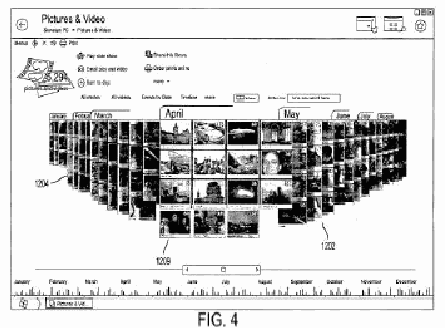
5Anthony discloses a graphical user interface providing “[a] three-dimensional (3D) view of a data collection.” J.A. 1528 Abstract; see also J.A. 1541 ¶ 11. Anthony arranges those objects according to a shared attribute and, in one embodiment, orders them chronologically using their dates of creation or date of last modification. Figure 4, reproduced below, depicts that embodiment, in which visual representations of data objects are displayed along a dynamic timeline in 3D space.
J.A. 1532.
Hanggie discloses a compositing desktop window manager that uses “advanced textures, lighting, and 3D transformations” to render application windows. J.A. 1515 ¶ 12. Hanggie’s Figure 3, reproduced below, depicts an application window containing, among other features, control buttons that permit a user to restore, maximize, minimize, or close the window. J.A. 1520 ¶ 58.

6J.A. 1510.
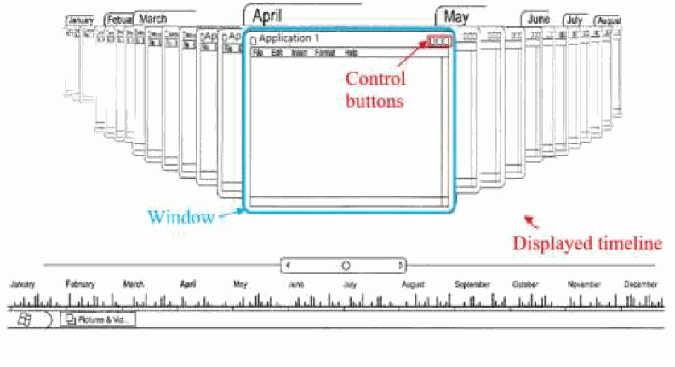
Apple proposed combining the references by replacing the windows displayed in Anthony’s 3D timeline with application windows like the one depicted in Hanggie’s Figure 3. An illustration of Apple’s proposed combination is reproduced below.
J.A. 1340.
The Board determined that the Anthony-Hanggie combination teaches both disputed limitations. As to limitation [1c-2], the Board found that Anthony’s chronological ordering using creation or edit dates teaches the claimed ordering of images based on when the corresponding applications are opened or interacted with. As to limitation [1d-72], the Board found that the combination’s 3D application windows teach the claimed “plurality of images” and that maximizing a selected window to display it in 2D teaches replacing those images with the corresponding object in a 2D space. The Board concluded that Apple had proven the challenged claims unpatentable as obvious.
SpaceTime3D filed a timely appeal. We have jurisdiction under 28 U.S.C. § 1295(a)(4)(A) and 35 U.S.C. § 141(c).
II
Claim construction is a question of law we review de novo when, as here, it is based solely on intrinsic evidence. See Arendi S.A.R.L. v. Google LLC, 882 F.3d 1132, 1133 (Fed. Cir. 2018); Trs. of Columbia Univ. v. Symantec Corp., 811 F.3d 1359, 1362 (Fed. Cir. 2016) (“The construction of claim terms based on the claim language, the specification, and the prosecution history are legal determinations.”). We review the Board’s ultimate determination of obviousness de novo and its underlying findings of fact for substantial evidence. See Medtronic, Inc. v. Teleflex Innovations S.A.R.L., 70 F.4th 1331, 1336 (Fed. Cir. 2023).
III
SpaceTime3D challenges the Board’s construction of limitations [1c-2] and [1d-2]. We address each in turn.
A
SpaceTime3D argues that the Board erred in construing limitation [1c-2], which requires displaying images in an order based on a last time that the user performed one of three enumerated opening-and-interacting events. According to SpaceTime3D, the limitation requires separate determinations of “when an application was opened” and “whether it was subsequently interacted with.” Open. Br. 36; see also J.A. 794. Apple responds that SpaceTime3D’s construction is inconsistent with the claim language.
8We agree with Apple that SpaceTime3D’s argument lacks merit. The claim language requires the system to determine an order based on a last time the user performed “one of” three enumerated events: (i) “opened said first application and interacted with said first object,” (ii) “opened said second application and interacted with said second object,” and (iii) “opened said third application and interacted with said third object.” J.A. 232 at 38:5-18. The claim, thus, identifies three possible events for determining the pertinent order. SpaceTime3D’s construction, by contrast, disaggregates each enumerated event into two separate actions and then requires an independent timing determination for both actions of each event, effectively requiring the system to determine the timing of six actions rather than three events. Nothing in the claim language requires this result. “[O]ne of” simply introduces the three events; it does not require the system to separately determine when each action within those events occurred. Nor does SpaceTime3D identify anything in the specification that persuades us a person of ordinary skill in the art would read the claim language as containing such a requirement. We agree with the Board’s construction.
SpaceTime3D challenges the Board’s factual findings regarding limitation [1c-2] only under its preferred construction. Because we reject that construction, no independent basis remains for disturbing the Board’s finding that Anthony teaches limitation [1c-2]. We therefore affirm the Board’s determination as to limitation [1c-2].
B
SpaceTime3D raises three purported claim construction challenges concerning limitation [1d-2], relating to: (1) the meaning of “said . . . object[];” (2) the distinction between “images” and “objects;” and (3) the relationship between the claimed three-dimensional and two-dimensional spaces.
91
SpaceTime3D argues that “said . . . object[]” requires replacement with the same previously generated object, including its application-specific data, such that the user returns to the application as it previously existed. SpaceTime3D urges us to apply the same construction the Board adopted for different claim language in a separate inter partes review proceeding concerning SpaceTime3D’s U.S. Patent No. 8,881,048 (the “’048 patent”), even though limitation [1d-2] does not recite the “said rendered first webpage” limitation found in certain claims of that patent.
We reject SpaceTime3D’s attempt to import that construction into limitation [1d-2]. As we explain in our concurrently issued decision in Apple Inc. v. SpaceTime3D, Inc., Appeal No. 25-1022, at 11-12 (Fed. Cir. Aug. 31, 2026), the construction of the “rendered first webpage” term does not govern differing terms used in other claims in this patent family, which lack the explicit rendering step and antecedent basis of claim 1 of the ’048 patent. Here, limitation [1d-2] recites replacing the plurality of images with “one of said first, second, and third objects,” not with a previously “rendered” object or an object in a particular prior state. J.A. 232 at 38:25-29. Although “said” refers back to the objects previously generated in limitation [1b], nothing in the claim language requires those objects to be rendered in the precise state in which they previously existed. J.A. 232 at 37:50-58, 38:25-29.
At oral argument, SpaceTime3D conceded that if we concluded, as we have, that the limitation does not impose its proposed requirement concerning “said object” or “said application-specific data,” “then . . . the decision with respect to that feature would stand with respect to what the Board found with respect to what the prior art does teach.” Oral Arg., SpaceTime3D, Inc. v. Apple Inc., No. 25-1083, at 7:54-8:20 (Fed. Cir. July 6, 2026), https://www. cafc.uscourts.gov/oral-arguments/25-1083_07062026.mp3.10 Because we reject SpaceTime3D’s proposed construction, we affirm the Board’s finding as to this aspect of the limitation.
2
SpaceTime3D next argues that the Board failed to give distinct meaning to “images” and “objects,” even though these items are structurally and functionally different from one another. For example, a user interacts with an “image” to replace the 3D display, whereas the user’s interaction with an “object” modifies application-specific data. Apple responds that, although images and objects are distinct claim elements, nothing in the claims requires images to be noninteractive or otherwise imposes the mutually exclusive functionality SpaceTime3D proposes.
We agree with Apple. The claims distinguish “images” from “objects,” but they also contemplate interactions and overlap between them, without collapsing the distinction. As the Board correctly observed, nothing in the intrinsic record requires the mutually exclusive functionality SpaceTime3D seeks to impose. The claims expressly require “receiving a first interaction . . . with one of said plurality of images” before replacing those images with the corresponding object. J.A. 232 at 38:23-29. The specification likewise describes images in the 3D environment as permitting user interaction or selection.
SpaceTime3D’s challenge to the Board’s finding that Anthony-Hanggie teaches this aspect of limitation [1d-2] is largely predicated on its proposed construction. To the extent SpaceTime3D argues that, even applying the Board’s construction, the Board erred in finding that Anthony-Hanggie teaches distinct “images” and “objects,” we disagree. The Board relied on Hanggie’s disclosure that application windows are represented in the three-dimensional environment by textured optical counterparts, while the underlying two-dimensional application windows remain the corresponding objects. That evidence supports11 the Board’s finding that the asserted combination discloses distinct three-dimensional images and corresponding two-dimensional objects.
We affirm the Board’s determination as to this aspect of limitation [1d-2].
3
SpaceTime3D also contends that the Board relied on an erroneous claim construction when it determined that switching between 3D and 2D views can satisfy limitation [1d-2]’s replacement of images within a 3D space with applications within a 2D space. But the Board adopted the parties’ agreed constructions of “3D space” and “2D space,” J.A. 20-21, and SpaceTime3D identifies no error in those constructions. Its argument, rather, concerns whether the Anthony-Hanggie combination satisfies the limitation under these agreed constructions, presenting a factual question we review for substantial evidence.
Substantial evidence supports the Board’s finding. Based on the express language of the prior art references as well as supporting expert testimony, the Board found that Anthony-Hanggie’s selection and maximization of a window displayed in 3D replaces the 3D timeline with the corresponding application window displayed in 2D. We affirm the Board’s determination as to this final disputed aspect of limitation [1d-2].
IV
We have considered SpaceTime3D’s remaining arguments and find them unpersuasive. Accordingly, the judgment of the Board is affirmed.