NOTE: This disposition is nonprecedential. United States Court of Appeals
for the Federal Circuit
HONGJIA WANG,
Appellant
v.
VIKING DRILL & TOOL, INC.,
Appellee
2024-2301, 2024-2302
Appeals from the United States Patent and Trademark Office, Patent Trial and Appeal Board in Nos. IPR2023-00473, IPR2023-00474.
Decided: September 30, 2026
KELLY W. CUNNINGHAM, Ervin Cohen & Jessup LLP, Beverly Hills, CA, argued for appellant. Also represented by ELLIOT ZHONGMING CHEN.
J. DEREK VANDENBURGH, Carlson, Caspers, Vandenburgh & Lindquist, P.A., Minneapolis, MN, argued for appellee. Also represented by KATHERINE CHEN, IAIN A. MCINTYRE, MITCHELL WILLIAMS.
2Before REYNA, CHEN, and STOLL, Circuit Judges.
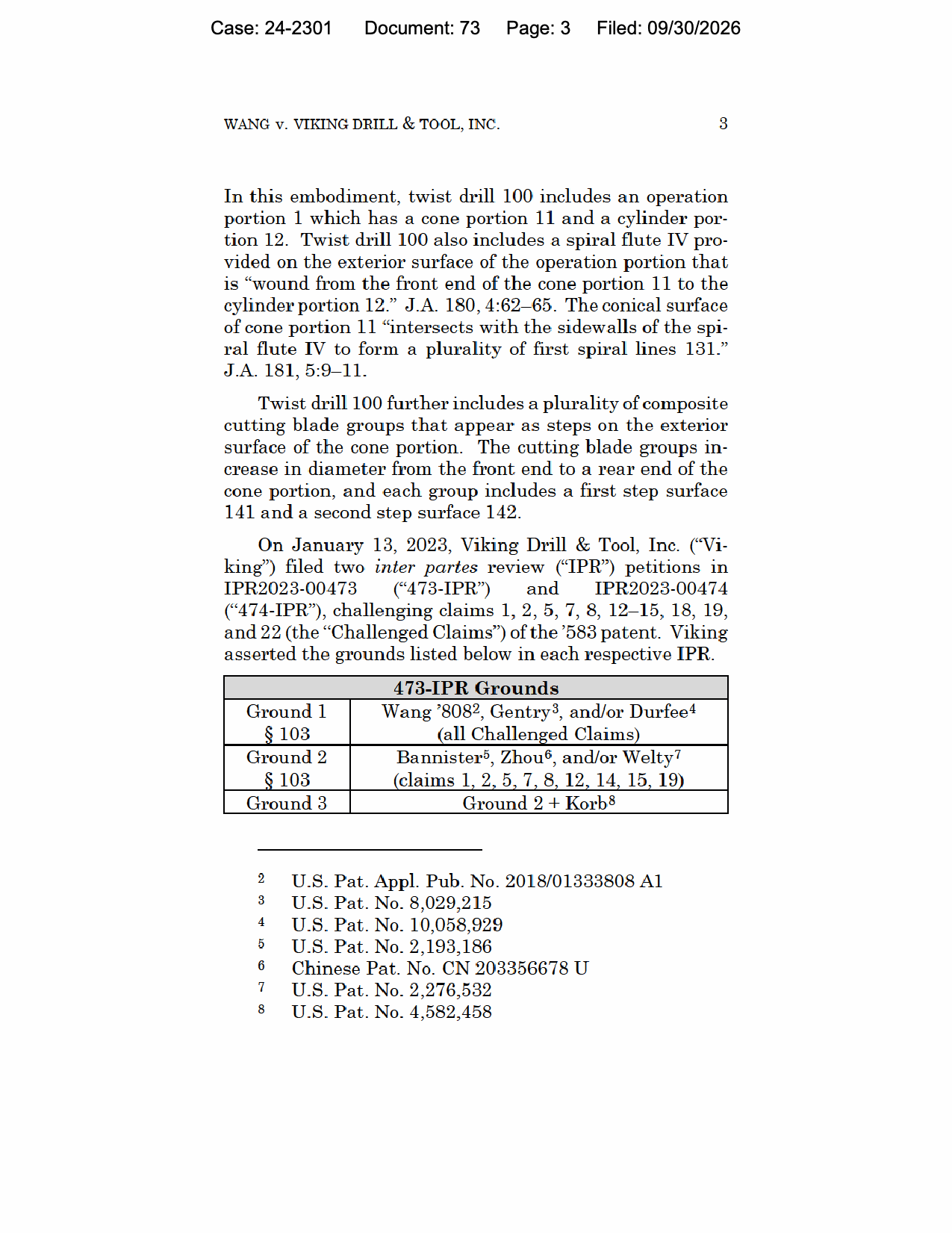
Hongjia Wang appeals from two final written decisions of the Patent Trial and Appeal Board determining all challenged claims of U.S. Patent No. 11,007,583 are unpatentable. For the following reasons, we affirm.
BACKGROUND
Hongjia Wang (“Wang”) owns U.S. Patent No. 11,007,583 (the “’583 patent”) 1, directed to a twist drill. An embodiment of Wang’s twist drill is shown in Figure 3, reproduced below. J.A. 174.

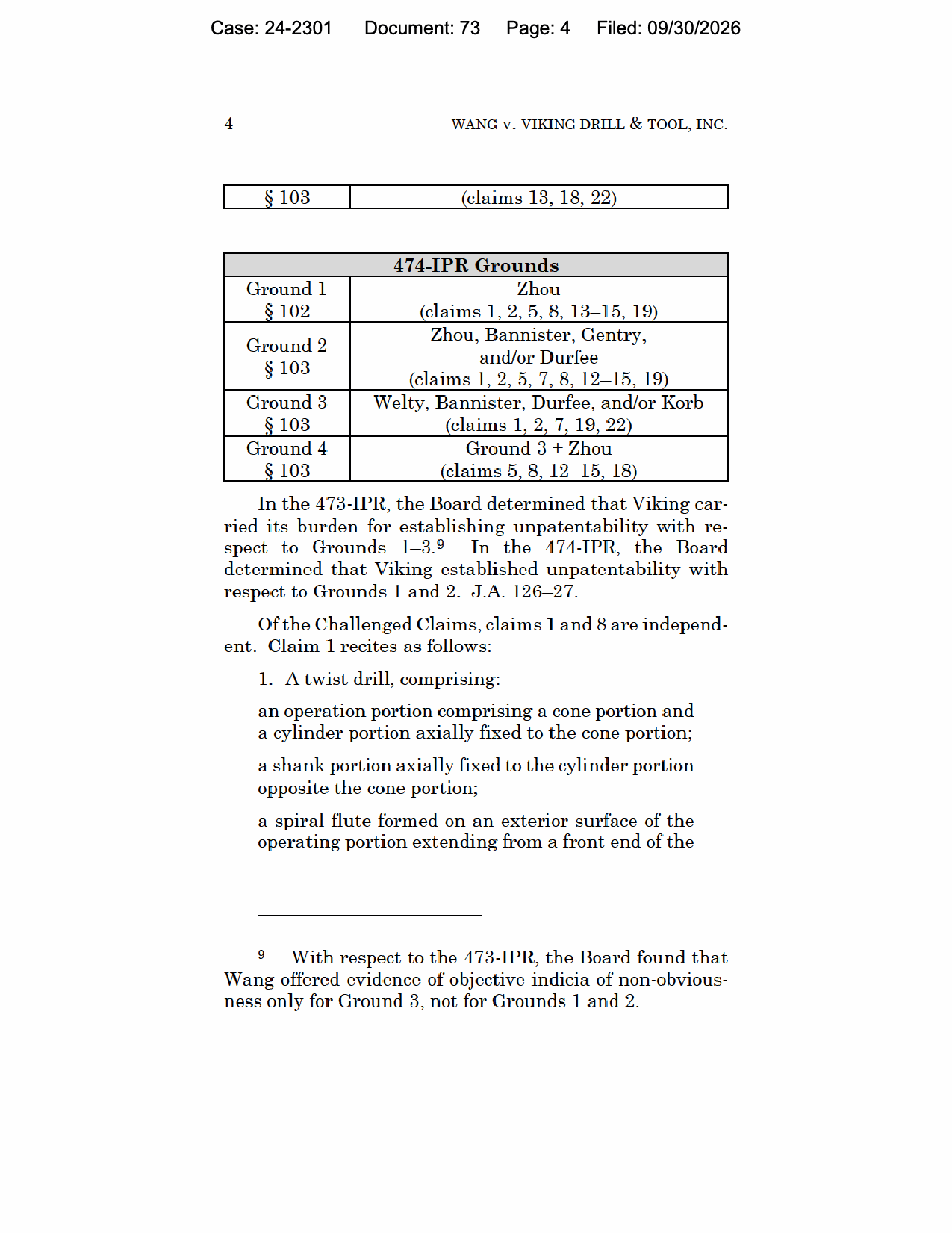
5cone portion and at least partway up the cylinder portion, the spiral flute having a sidewall; a plurality of composite cutting blade groups formed sequentially and spirally on a cone portion exterior from a front end of the cone portion to a rear end of the cone portion, each of the plurality of composite cutting blade groups comprising: a conical first step surface; a cylindrical second step surface adjacent to the conical first step surface; a major cutting edge defined by the intersection of the conical first step surface and the sidewall of the spiral flute; a minor cutting edge defined by the intersection of the cylindrical second step and the and the [sic] sidewall of the spiral flute; a cutting tip defined by the intersection of the major cutting edge, the minor cutting edge, and the sidewall of the spiral flute; and a top blade provided on the front end of the cone portion; wherein a diameter of each of the plurality of composite cutting blade groups increases sequentially from the front end of the cone portion to the rear end of the cone portion; and each of the plurality of composite cutting blade groups is configured to crush cutting chips into finer chips and the spiral flute is configured to shunt the finer chips; and wherein at least one cylindrical second step surface is immediately adjacent to a conical first step surface of a next composite cutting blade group; and the diameter of the last composite cutting blade group located at the rear end of the cone portion
6immediately adjacent to the cylinder portion is equal to the cylinder portion diameter.
J.A. 183, 10:2–43 (emphasis added to highlight limitation at issue on appeal). Claim 8 further recites certain other limitations not relevant here.
Wang appealed the Board’s determinations for each ground the Board determined rendered the Challenged Claims unpatentable. We have jurisdiction under 28 U.S.C. § 1295(a)(4)(A).
DISCUSSION
As summarized above, the Board found the Challenged Claims of the ’583 patent unpatentable over multiple independent grounds presented across Viking’s two IPRs. Because we affirm the Board’s determination of unpatentability for Ground 1 of the 473-IPR (hereinafter “Ground 1”) for all Challenged Claims, we do not reach Wang’s arguments for Viking’s other asserted grounds in the 473-IPR or 474-IPR.
The parties dispute only one issue with respect to Ground 1. Specifically, the parties dispute whether Wang ’808 qualifies as prior art to the ’583 patent because that reference lacks sufficient written description support for the claim term “formed . . . spirally.” We begin by recounting the relevant background from the IPR proceeding below and then analyze Wang’s arguments on appeal.
I. Priority Dispute Before the Board
The Board determined for Ground 1 that all Challenged Claims are unpatentable over Wang ’808 in view of Gentry and/or Dufree. As a precursor to reaching this determination, the Board found that Wang ’808 was available as prior art because the ’583 patent lacked a valid claim of priority to the application which published as Wang ’808.
The ’583 patent claims priority as a continuation-in-part to Wang’s own prior application, Application7 No. 15/847,900 (the “’900 Application”). J.A. 170, Cover. The ’900 Application published as Wang ’808. Viking disputed this claim of priority in its Petition. Wang argued in its Patent Owner Response that the priority claim is valid and therefore Wang ’808 is not available as prior art to the ’583 patent.
To obtain the benefit of the filing date of an earlier-filed application, the earlier-filed application must “provide[] support for the claims of the later[-filed] application, as required by 35 U.S.C. § 112.” See PowerOasis, Inc. v. T-Mobile USA, Inc., 522 F.3d 1299, 1306 (Fed. Cir. 2008). This means that the earlier-filed application “must convey with reasonable clarity to those skilled in the art that, as of the filing date sought, [the inventor] was in possession of the invention” of the later-filed application. See id. (citation modified).
Applying that principle here, if Wang ’808 would have expressly or inherently disclosed to a skilled artisan, as of its filing date, each and every limitation of the Challenged Claims, the ’583 patent could claim priority to Wang ’808, and Wang ’808 would not be available as prior art to the ’583 patent. The parties’ dispute before the Board centered on whether Wang ’808 provides support for the limitation “composite cutting blade groups formed sequentially and spirally on a cone portion exterior,” as recited in independent claims 1 and 8. More particularly, the parties disputed whether Wang ’808 discloses cutting blade groups that are “formed . . . spirally.”10
8The construction of “formed spirally” sheds light on the parties’ dispute. Viking proposed that “formed spirally” means that the cutting blade groups have “axial relief.” J.A. 18; J.A. 349–50. Axial relief refers to the angling of cutting blades relative to a plane perpendicular to a drill’s axis such that a leading edge of the cutting blade is located axially forward of a trailing edge of the cutting blade. This angling or slant is labeled “A” in the exemplary figure below.

J.A. 2510. Wang agreed with Viking’s construction, interpreting it to mean that “the cutting blades are not perpendicular to the drill bit’s rotational axis, but rather have a ‘slant’ creating axial relief behind the cutting edges.” J.A. 19.
The Board construed “formed spirally” “in the manner requested by the parties.” Id. In particular, the Board construed “formed spirally” to mean that “the trailing surfaces of the cutting blade groups are not perpendicular to the rotational axis of the drill bit,” or as “requiring ‘slanted’ cutting blade groups, or as requiring that the cutting blade groups are provided with axial relief.” J.A. 19–20; see also J.A. 22 (“The parties agree that ‘formed spirally’ means that the cutting teeth have axial relief, i.e., that they are9 formed non-perpendicularly to the rotational axis of the drill bit.”).
Using this construction, the Board determined that Wang failed to establish that Wang ’808 provides written description support for “formed spirally,” and therefore Wang ’808 was available as prior art to the ’583 patent. J.A. 37–38. The Board considered and rejected Wang’s argument that the italicized clause in the following sentence from Wang ’808 discloses axial relief:
The flutes11 of the present disclosure may be arc-shaped flutes adapted to a radian of the flank surface, or the connecting lines of the flutes form a spiral structure.
J.A. 2507, ¶35 (emphasis added). Wang contended that the “connecting lines of the flutes” refer to the lines that separate each flute, designated by the red annotations in modified Figure 5 of Wang ’808 shown below. Wang argued that10 this clause specifically refers to an alternative embodiment to the perpendicular cutting blade groups shown in Figure 5, one where the connecting lines of the flutes are no longer parallel and are therefore formed spirally. The Board reasoned that Wang’s proposed “connecting lines” are not connecting lines at all but are instead dividing lines that “do not even connect the flutes, they merely touch two of them.” J.A. 30.

The Board agreed with Viking and its expert, Dr. Schmid, that the “connecting lines” in this sentence more logically describes “the angular positions of the flutes.” Id. Connecting lines under this interpretation are illustrated, for example, in red annotation in Figures 6 and 7 of Wang ’808 below. J.A. 357.


Ultimately, the Board determined that Viking’s interpretation was consistent with all of Wang ’808, including Wang ’808’s other uses of the term “connecting lines” throughout its specification, J.A. 30, whereas Wang’s interpretation “requires us to believe that this sentence sets out a new invention not otherwise described,” J.A. 33.
The Board also rejected Wang’s argument that, because axial relief “is old and well-known in the art,” Wang ’808 need not disclose that feature. J.A. 24;11 J.A. 36–37. The Board agreed with Viking’s legal argument that “the knowledge of a person of ordinary skill in the art cannot make up for the absence of disclosure in an alleged priority document.” J.A. 25 (citing Lockwood v. Am. Airline, Inc., 107 F.3d 1565, 1571–72 (Fed. Cir. 1997)). It also found irreconcilable Wang’s position taken during prosecution that “formed spirally” was a distinguishing point of novelty with its position in the underlying IPR that a skilled artisan would “readily infer [axial relief] or assume it.” J.A. 26–27 (citations omitted).
In sum, the Board found that “[b]ecause axial relief is neither explicitly nor inherently taught in Wang [’808], the axial relief recited and claimed in the ’583 patent is not supported by the written description of Wang [’808].” J.A. 37–38. It therefore found that Wang ’808 was available as prior art and determined that Wang ’808 in view of Gentry and/or Dufree renders obvious all Challenged Claims of the ’583 patent.
II. Priority Dispute on Appeal
The Board’s determination of priority is a question of fact that we review for substantial evidence. Araujo v. Framboise Holdings, Inc., 99 F.4th 1377, 1380 (Fed. Cir. 2024) (citations omitted). Whether the Board applied the correct legal standard for analyzing written description is a question of law we review de novo. See Royal Crown Co., Inc. v. Coca-Cola Co., 892 F.3d 1358, 1364 (Fed. Cir. 2018).
As in the IPR below, the parties dispute on appeal for Ground 1 is confined to the Board’s finding that Wang ’808 fails to provide written description support for the “formed spirally” limitation recited in independent claims 1 and 8. Wang raises four primary arguments concerning the Board’s finding. We address each in turn.
First, Wang argues that the Board erred by applying the wrong legal standard for written description. As we noted above, the standard for written description support12 for purposes of priority is whether an earlier-filed application “convey[s] with reasonable clarity to those skilled in the art that, as of the filing date sought, [the inventor] was in possession of the invention.” PowerOasis, 522 F.3d at 1306 (emphasis added). Wang contends that the Board applied a standard that “did not properly account for the education and experience of [a skilled artisan].” Appellant Br. 64. Had the Board done so, Wang argues, it would have required lesser detail in Wang ’808’s specification because the subject matter at issue pertains to “predictable arts.” Appellant Br. 64, 66. We disagree that the Board used the wrong standard.
The Board expressly described the analysis it was undertaking as what Wang ’808 “reasonably conveys to those skilled in the art.” J.A. 24. The Board identified the level of skill in the art as an “individual educated in mechanical engineering with a bachelor’s degree and at least one or two years of experience in the development of drill bits,” as proposed by Viking and not disputed by Wang. J.A. 17. We see nothing in the Board’s final written decision that suggests the Board deviated from the proper standard, which views written description through the lens of a skilled artisan. See PowerOasis, 522 F.3d at 1306. Thus, we conclude that the Board did not legally err in this regard.
Further to this point, Wang also argues that, had the Board applied the proper written description requirement, it would have found that a skilled artisan would have “readily infer[red]” axial relief because “it was undisputed that axial relief was conventional, ubiquitous, and required for drill bits to properly function.” Appellant Br. 66. We reject this argument. Even assuming axial relief was conventional and ubiquitous, as Wang argues, this is not sufficient to provide written description support. Written description support requires either express or inherent disclosure. PowerOasis, 522 F.3d at 1306–07 (“[T]he written description [must] actually or inherently disclose the claim element.”); see also Lockwood v. Am. Airline, Inc., 107 F.3d13 1565, 1571–72 (Fed. Cir. 1997) (“Entitlement to a filing date does not extend to subject matter which is not disclosed, but would be obvious over what is expressly disclosed. It extends only to that which is disclosed.”). Further, Wang points to no record evidence that demonstrates axial relief was a required feature of drill bits and therefore would have been inherent in Wang ’808.
Second, Wang argues that the Board’s determination that Wang ’808 fails to disclose “formed spirally” (construed as requiring axial relief) is not supported by substantial evidence. While Viking bears the burden of persuasion on unpatentability, which never shifts to Wang, it is Wang who bears the burden of establishing that the claims of the ’583 patent are entitled to an earlier priority date. See Parus Holdings, Inc. v. Google LLC, 70 F.4th 1365, 1371 (Fed. Cir. 2023).
As he did in the IPR below, Wang relies on the portion of the sentence in Wang ’808 that states “the connecting lines of the flutes form a spiral structure” as disclosing axial relief. Appellant Br. 68. Wang argues that the Board improperly rejected his interpretation of “the connecting lines of the flutes” as “the lines where the conical surface of one flute 4 intersects the cylindrical surface of the next flute 4.” Appellant Br. 71. Wang further argues that a skilled artisan “would never construe” the connecting lines in this sentence as “forming the spiral line of the helical flute,” as the Board found. Appellant Br. 75. We disagree.
14After review of the record, we conclude that substantial evidence supports the Board’s finding that the red lines that Wang drew on Figure 5 of Wang ’808, reproduced again below, are not the connecting lines referred to in the sentence Wang relies on, but instead show lines that divide the flutes. J.A. 29–30 (“[Wang’s] red lines do not denote some sort of structure connecting the various flutes. They only denote borders. They do not even connect the flutes, they merely touch two of them.”). The Board’s finding that this sentence is better read to mean “some sort of structure connecting the various flutes” is supported by Viking’s expert, Dr. Schmid’s, testimony that this sentence refers to a line connecting the angular positions of the flutes. J.A. 29.
The Board’s interpretation is also supported by Wang ’808 itself. As the Board reasonably found, Wang’s interpretation is inconsistent with how Wang ’808 uses the term “connecting lines” throughout the specification. J.A. 30 (citing J.A. 2506–07, ¶¶6, 9, 31–32, J.A. 2500, Fig. 8). As the Board emphasized, in other instances, Wang ’808 “draws a connecting line by drawing a line through the structures.” J.A. 30–31 (emphasis in original). The Board then noted that a line connecting the cutting15 edges of each of the flutes together in Wang ’808, as Viking proposes Wang ’808’s sentence means, would form a spiral as the sentence Wang relies on discloses. Ultimately, the Board reasonably concluded that Viking’s interpretation was more consistent with Wang ’808’s full disclosure, as opposed to “set[ting] out a new invention not otherwise described.” J.A. 33. Thus, we conclude that the Board’s determination that Wang ’808 fails to provide written description support for “formed spirally” is supported by substantial evidence.12
Third, Wang argues that the Board abused its discretion by relying on Dr. Schmid’s testimony. Wang contends that Dr. Schmid does not qualify as a skilled artisan under the Board’s definition, which requires “at least one year of experience in the development of drill bits.” Appellant Br. 75–76. We conclude that Wang’s argument is forfeited, because Wang never moved to exclude Dr. Schmid’s testimony in the proceeding below. See Netflix, Inc. v. DivX, LLC, 84 F.4th 1371, 1378 (Fed. Cir. 2023) (“Any argument not raised to the Board is forfeited, and we decline to consider it for the first time on appeal.”). For that reason, we find no abuse of discretion in the Board’s reliance on Dr. Schmid’s testimony.
Fourth, Wang argues that the Board’s priority determination is predicated on an “overly narrow interpretation of the ‘formed spirally’ limitation.” Appellant Br. 79. Wang argues that the Board improperly excluded “radial relief”16 from the definition of “formed spirally.” Id. In other words, Wang contends that, even if Wang ’808 does not disclose axial relief, its disclosure of radial relief also meets the “formed spirally” limitation. See id. at 81–82. We reject Wang’s argument.
The Board adopted the construction of “formed spirally” that was agreed to by the parties, i.e., as requiring that “the cutting blade groups are provided with axial relief.” J.A. 19–21. Wang points to nothing in the record where it argued to the Board that “formed spirally” should be construed to mean requiring radial relief, and we therefore conclude that this argument is forfeited. See Netflix, 84 F.4th at 1378; see also J.A. 35 (“This argument appears to offer a claim construction different from the one that [Wang] agreed to and that we have adopted in this Decision, and thus fails.”).
Thus, we affirm the Board’s finding that Wang ’808 fails to provide written description support for the claim limitation “formed spirally,” and relatedly its determination that Ground 1 renders obvious every Challenged Claim of the ’583 patent.13
CONCLUSION
We have considered Wang’s remaining arguments and find them unpersuasive. For the reasons provided, we affirm.
AFFIRMED
Footnotes
- ↩ 1 The ’583 patent refers to originally-issued U.S. Patent No. 11,007,583 B3 as well as U.S. Patent No. 11,007,583 C1, ex parte reexamination certificate confirming the patentability of original claims 1–14 and adding claims 15–22.
- ↩ 10 As the Board did, we hereinafter refer to the claim phrase “formed . . . spirally” as “formed spirally.” J.A. 18.
- ↩ 11 As the Board noted, Wang ’808 uses the term “flutes” to describe the “removed portion of the drill bit that defines the cutting teeth.” J.A. 24, n.8.
- ↩ 12 Even if Wang’s interpretation of “connecting lines of the flutes” in Wang ’808 is one of multiple reasonable interpretations, that still does not provide written description support. See Hyatt v. Boone, 146 F.3d 1348, 1354 (Fed. Cir. 2001) (“It is insufficient as written description, for purposes of establishing priority of invention, to provide a specification that does not unambiguously describe all limitations of the [claim].”).
- ↩ 13 As we note above, the Board found that Wang offered no evidence of objective indicia of nonobviousness for Ground 1 in the 473-IPR. J.A. 38–39, n.17. Wang does not challenge this finding on appeal, and therefore we do not reach the question of objective indicia for this ground.