NOTE: This disposition is nonprecedential. United States Court of Appeals
for the Federal Circuit
LIFE SPINE, INC.,
Appellant
v.
GLOBUS MEDICAL, INC.,
Appellee
2024-2167
Appeal from the United States Patent and Trademark Office, Patent Trial and Appeal Board in No. IPR2022-01434.
Decided: June 4, 2026
JAMES M. GLASS, Quinn Emanuel Urquhart & Sullivan, LLP, New York, NY, argued for appellant. Also represented by QUINCY LU, Seattle, WA; DAVID A. NELSON, BRIANNE MCNICHOLAS STRAKA, Chicago, IL; GEORGE CHRISTOPHER BECK, Foley & Lardner LLP, Washington, DC; MICHAEL ROBERT HOUSTON, Chicago, IL; SARAH E. RIEGER, Milwaukee, WI.
STEPHEN D. ZINDA, Cabello Hall Zinda PLLC, Houston,
2TX, argued for appellee. Also represented by JAMES H. HALL.
Before TARANTO, CUNNINGHAM, and STARK, Circuit
Judges.
Life Spine, Inc. (“Life Spine”) appeals from a Final Written Decision of the Patent Trial and Appeal Board (“Board”) in an inter partes review that held claims 10-14 of Globus Medical, Inc.’s (“Globus”) U.S. Patent No. 8,845,731 (“’731 patent”) not unpatentable.1 Life Spine’s challenge rests entirely on its disagreement with the Board’s construction of the claim term “complementary with one another.” We agree with Life Spine’s proposed construction. Since it is undisputed that the challenged claims are obvious under this construction, we reverse the Board.
I
Globus owns the ’731 patent, entitled “Expandable Fusion Device and Method of Installation Thereof.” ’731 pat. at 1:1-2. The patent is directed to an implant that may be placed between a patient’s vertebrae to assist in spinal fusion surgeries by ensuring the vertebrae are properly spaced apart before the surgeon sets them in place. A purportedly novel aspect of the device is that it is “expandable.” Id. at 1:6-10, 52-56. Unlike static counterparts, the expandable vertebral implant may be adjusted after being3 inserted into the patient’s spinal column, thereby making installation easier.
To accomplish expandability, the claimed implant has two endplates, between which are two sets of “ramped portions” (or wedges) that “are complementary with one another.” Id. at 22:24-26. This feature is claimed in independent claim 10 of the ’731 patent, which recites, in pertinent part:
An intervertebral implant comprising: a first endplate comprising an upper side, a lower side, a ramped surface, the ramped surface extending from the lower side, wherein the first endplate includes a first side portion, the first side portion including a first ramped portion; [and] a second endplate comprising an upper side, a lower side, a ramped surface, the ramped surface extending from the lower side, wherein the second endplate includes a second side portion, the second side portion including a second ramped portion, wherein the first ramped portion of the first endplate and the second ramped portion of the second endplate are complementary with one another . . . .
Id. at 22:13-26 (emphasis added). Claims 11-14 depend from claim 10.
At the Board, the parties disputed the meaning of the term “complementary with one another.” Life Spine proposed that the plain and ordinary meaning of the term was broad enough to “encompass ramps having angles that mirror each other,” J.A. 28 (internal quotation marks and alterations omitted), which its expert explained means that, when placed over one another, the two ramps “would yield the same angle relative to the common plane between them” and “interact in a generally identical, symmetrical way.” J.A. 942; see also J.A. 76-77. By contrast, Globus agreed with the preliminary construction proposed by the4 Board in its Institution Decision, which required the first ramped portion of the first endplate and the second ramped portion of the second endplate to “complet[e] one another.” J.A. 38, 459, 594-97.
The Board sided with Globus, maintaining its preliminary construction, and was not persuaded that “the plain and ordinary meaning of this claim term must encompass surfaces that have angles that mirror one another.” J.A. 43. Life Spine timely appealed. We have jurisdiction pursuant to 28 U.S.C. § 1295(a)(4)(A) and 35 U.S.C. §§ 141(c), 319.
II
“The Board’s ultimate claim constructions and any underlying determinations based on intrinsic evidence [are] review[ed] de novo.” Polaris Innovations Ltd. v. Brent, 48 F.4th 1365, 1372 (Fed. Cir. 2022). “Claim terms are generally given their plain and ordinary meaning, which is the meaning one of skill in the art would ascribe to a term when read in the context of the claim, specification, and prosecution history.” Apple Inc. v. MPH Techs. Oy, 28 F.4th 254, 259 (Fed. Cir. 2022).
III
More than two decades ago, in Phillips v. AWH Corp., we explained:
Because the meaning of a claim term as understood by persons of skill in the art is often not immediately apparent, and because patentees frequently use terms idiosyncratically, the court looks to those sources available to the public that show what a person of skill in the art would have understood disputed claim language to mean. Those sources include the words of the claims themselves, the remainder of the specification, the prosecution history, and extrinsic evidence concerning relevant
5scientific principles, the meaning of technical terms, and the state of the art.
415 F.3d 1303, 1314 (Fed. Cir. 2005) (en banc) (emphasis added; internal quotation marks and citations omitted).
Here, our de novo consideration of the claim language, specification, and prosecution history of the ’731 patent persuades us that a person of ordinary skill in the art would understand the scope of “complementary with one another” to include ramps having angles mirroring each other, as proposed by Life Spine.
A
“Claim construction must begin with the words of the claims themselves.” In re Power Integrations, Inc., 884 F.3d 1370, 1376 (Fed. Cir. 2018) (internal quotation marks and alteration omitted). The claim language at issue, if considered alone, would favor the construction proposed by Globus.
“[I]n determining the ordinary and customary meaning of the claim term as viewed by a person of ordinary skill in the art, it [can be] appropriate to consult a general dictionary definition of the word for guidance,” especially when “[t]he patent specification does not assign or suggest a particular definition to the term.” Comaper Corp. v. Antec, Inc., 596 F.3d 1343, 1348 (Fed. Cir. 2010). “[H]eavy reliance on the dictionary divorced from the intrinsic evidence,” however, “risks transforming the meaning of the claim term to the artisan into the meaning of the term in the abstract, out of its particular context, which is the specification.” Phillips, 415 F.3d at 1321. Bearing that in mind, “we do not . . . preclude the appropriate use of dictionaries[,] . . . [which] are often useful to assist in understanding the commonly understood meaning of words.” Id. at 1322.
The ordinary, general-language meaning of “complementary” is captured in a dictionary definition relied on by6 the Board: “forming or serving as a complement; completing.” J.A. 38 (quoting J.A. 2164; internal alteration omitted). That same dictionary defines a “complement” as “[s]omething that completes, makes up a whole, or brings to perfection,” and explicitly applies that notion to angles: “[a]n angle related to another so that the sum of their measures is 90 degrees.” J.A. 2164.
Moreover, the precise term in dispute is “complementary with one another.” ’731 pat. at 22:26 (emphasis added). That language reinforces the idea that the two pertinent ramps should in some way complete one another to form a whole – perhaps, but not necessarily, by having some degree of engagement, interaction, or contact.
In these ways, the claim language supports Globus’ proposal that the ramps must “complete one another,” and detracts from Life Spine’s proposal, which encompasses pairs of “mirrored” ramps irrespective of whether they engage with or complete one another (even when the device is fully compressed).
B
But we do not consider the claim language in isolation. “[T]he specification is always highly relevant and is often the best guide to the meaning of a disputed term.” Trs. of Columbia Univ. in City of New York v. Symantec Corp., 811 F.3d 1359, 1365 (Fed. Cir. 2016) (internal quotation marks and emphasis omitted). The disputed term, “complementary with one another,” is not used anywhere in the ’731 patent other than in the claims. The word “complementary” is used by itself once in the specification, as follows: “The lower surfaces [of the artificial endplates] have complementary texturing or engagement features on their surfaces to engage with the texturing or engagement features on the upper endplate (14) and the lower endplate (16) of the fusion device (10).” Id. at 8:36-40 (emphasis added). Globus contends that this sentence, and the specification in general, supports the Board’s construction.7 We conclude, instead, that the specification of the ’731 patent provides strong support for Life Spine’s construction.
As one of ordinary skill in the art would understand, the specification’s lone use of “complementary” relates to the “surfaces” of the artificial endplates, not the “ramped portions” of the upper and lower endplates. Id.; see also id. at 2:61-63 & Fig. 17. Indeed, even Globus concedes that “‘complementary’ is not used in the specification to specifically refer to ‘ramped portions.’” Globus Br. at 46. Hence, other than vaguely suggesting that “complementary” is used to refer to some aspect of “texturing or engagement,” which arguably provides some minimal support to Globus’ construction,2 the specification’s sole use of “complementary” says essentially nothing about what the inventor meant by the “ramped portions” of the endplates being “complementary with one another.”
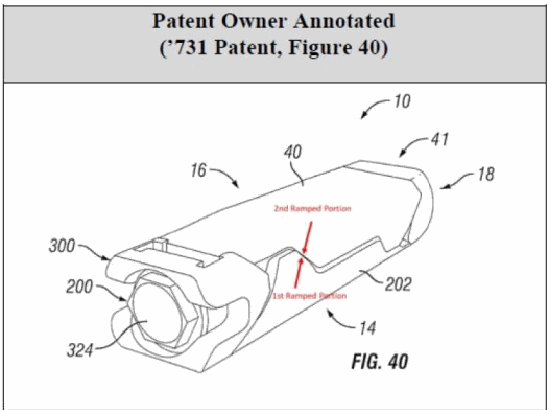
Other portions of the specification are far more instructive, and they support Life Spine’s construction. Most particularly, the patent discloses, in words and figures, an embodiment that would be excluded from the claims under Globus’ construction. Specifically, the embodiment depicted in Figure 40 (as well as related Figures 41-44) shows the pertinent first ramped portion of the first endplate and the second ramped portion of the second endplate having mirrored angles, which would not be within the scope of the8 claims if those components are required to “complete one another,” as Globus’ construction demands.3
Figure 40, reproduced immediately below, depicts “an expandable fusion device shown in an unexpanded position.” ’731 pat. at 4:1-4.

The specification expressly identifies the Figure 40 embodiment as illustrating a “first ramped portion[] 306” and9 a “second ramped portion[] 310.” Id. at 13:28-38.4 Elements 306 and 310 are not labeled in Figure 40. But they are shown in Figure 43, “a side exploded view of the expandable fusion device of FIG. 40.” Id. at 4:11-12.5
Figure 43 is shown below, as annotated by Life Spine to point out the pertinent first and second ramped portions, 306 and 310, respectively.
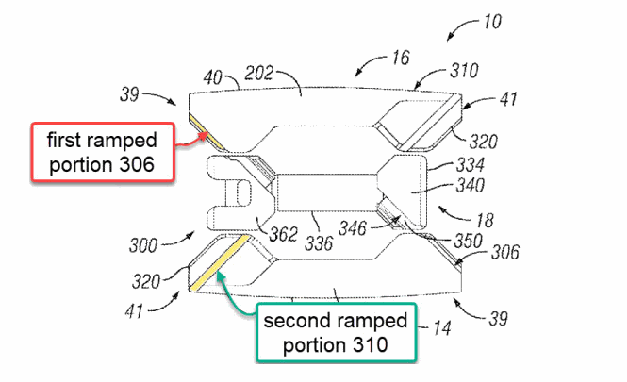
Open. Br. at 32 (Life Spine’s annotation of Fig. 43).
10Returning to Figure 40, we can now identify the pertinent first and second ramped portions:

Open. Br. at 33 (Life Spine’s annotation of Fig. 40).
As a person of ordinary skill in the art would understand, the first ramped portion of the first endplate (306) and the second ramped portion of the second endplate (310), while mirroring one another, do not complete one another in this embodiment. Globus attempts to undermine the weight to be accorded to this by contending that another portion of Figure 40, the “bridge portion (314),” contains components that happen to “complete one another.” This is shown below in a version of Figure 40 Globus annotated:
11J.A. 40; see also ’731 pat. at Fig. 42 (depicting “bridge portion” labeled (314)).
The problem for Globus is that whether the bridge portions “complete one another” is not relevant to the claim construction dispute before us. The claim limitation at issue requires not merely that there be some features that are “complementary with one another,” but, rather, that the “first ramped portion of the first endplate” and the “second ramped portion of the second endplate” be so. ’731 pat. at 22:24-26. Thus, the Board’s finding that the red arrows in Globus’ annotated Figure 40 (above) identify the “first ramped portion” and the “second ramped portion” of the endplates is not supported by substantial evidence – and is not even defended by Globus on appeal. See Oral Arg. at 16:45-17:00 (Globus counsel: “We annotated Figure 40 . . . and we acknowledge, Your Honor, that’s not called a ‘ramped portion’ in the specification.”).
“We normally do not interpret claim terms in a way that excludes embodiments disclosed in the specification.” Oatey Co. v. IPS Corp., 514 F.3d 1271, 1276 (Fed. Cir. 2008). There is no support in the ’731 specification for12 reading the challenged claims as excluding the expresslydisclosed and depicted embodiment of Figure 40. Thus, because the embodiment of Figure 40 presented in the specification would be excluded from the claims under Globus’ construction of “complementary with one another,” which requires “completing one another,” yet would be within the scope of the claims under Life Spine’s broader “mirrored angles” construction, the specification provides strong support for Life Spine’s proposed construction.
C
Additional support for Life Spine’s construction is found in the prosecution history of the ’731 patent. See Malvern Panalytical Inc. v. TA Instruments-Waters LLC, 85 F.4th 1365, 1372 (Fed. Cir. 2023) (“[T]he prosecution history can often inform the meaning of the claim language by demonstrating how the inventor understood the invention and whether the inventor limited the invention in the course of prosecution.”) (internal quotation marks omitted). In particular, the examiner’s view of the claim scope, which accords with our own, is entitled to some weight. See Convolve, Inc. v. Compaq Computer Corp., 812 F.3d 1313, 1322-23 (Fed. Cir. 2016) (“In determining the scope of the claims, we apply the traditional claim construction principles . . . paying particular attention to the examiner’s focus in allowing the claims after amendment.”) (internal quotation marks omitted).
Throughout the prosecution of the ’731 patent, the examiner viewed the claims’ use of “complementary with one another” as including mirrored angles, and as not being limited to ramped portions that complete one another. See, e.g., J.A. 1169 (“Biedermann discloses [an] intervertebral implant . . . where the first and second ramped portions are compl[e]mentary with each other, wherein the angle of inclinations are the same.”) (emphasis added); J.A. 1209-10 (“”Olmos discloses an intervertebral implant . . . where the first and second ramped portions are13 compl[e]mentary with each other, wherein the angle of their slants are compl[e]mentary.”) (emphasis added). Consistent with this understanding, the examiner initially rejected the claims in view of prior art references that taught mirrored angles, and continued to reject the claims even after they were amended to require the ramped portions to be complementary with one another. It was only after the applicant amended the claims further to add limitations having nothing whatsoever to do with “complementary” or with the ramped portions of the endplates that the claims were allowed, confirming that the examiner understood “complementary with one another” to include mirrored angles.
Notably, during prosecution, the applicant explicitly directed the examiner to the embodiment of Figure 40 as illustrative of the “complementary” ramped portions of the amended claims. J.A. 1347 (“The claimed amendments cover, for example, the embodiment illustrated in Fig 40 of the present application . . . and described in its associated disclosure.”). As we have already explained, however, Figure 40 depicts a device with mirrored first and second ramped portions that do not “complete one another.” A skilled artisan would not expect a patent applicant to point an examiner to a particular embodiment disclosed in the specification, purportedly illustrating the proposed amended claims, if that applicant somehow intended for that embodiment not to be within the scope of the amended claims.
In urging a different result, Globus points to several prior art references cited during prosecution that use the term “complementary” to refer to components that “complete one another.” See, e.g., J.A. 1437 ¶ 88 (Olmos [(U.S. Patent App. Pub. No. 2008/0140207 A1)] disclosing “the complementary retention structures can engage the retention structures of the inner member”); J.A. 1457 ¶ 30 (Baynham [(U.S. Patent App. Pub. No. 2007/0270968 A1)]14 disclosing two sections that “move along the complementary inclined plane”). While Life Spine has not identified any prior art reference that uses the term “complementary” to refer to “mirrored angles,” Life Spine’s construction does not exclude components that “complete one another.” See Oral Arg. at 1:15-30 (Life Spine counsel: “We certainly don’t disagree that it includes angles that . . . mate with one another, like a puzzle piece. Our construction does not exclude that.”); id. at 11:13-20 (“Again, we are not saying that the term excludes angles that mate with one another and complete one another.”). The uses of “complementary” to which Globus points us are consistent with both Globus’ proposed construction and Life Spine’s, and do not undermine our conclusion that the prosecution history, overall, favors Life Spine’s construction.
D
Considering the intrinsic evidence as a whole, we agree with Life Spine that “complementary with one another,” as used in the claims of the ’731 patent, would be understood by a person of ordinary skill in the art to have a meaning sufficiently broad to include a first ramped portion of a first endplate at an angle that mirrors that of the second ramped portion of a second endplate. Such an artisan would not view the claims as limited to embodiments in which those pertinent ramped portions complete one another (although such embodiments are also within the scope of the claims as properly construed). Therefore, we disagree with the Board’s construction and adopt Life Spine’s.
IV
We have considered Globus’ remaining arguments and find they lack merit. Accordingly, as we are persuaded that Life Spine’s construction of “complementary” as including mirrored angles is correct, and, further, as Globus has made no argument that claims 10-14 of the ’731 patent are15 nonobvious under Life Spine’s construction, we reverse the judgment of the Board.
REVERSED
Footnotes
- ↩ 1 In the same Final Written Decision, the Board held claims 1-9 and 15 of the ’731 patent to be unpatentable. Neither party has challenged that determination on appeal.
- ↩ 2 If, as Globus argues, “complementary” requires some amount of texturing or engagement, then the phrase “complementary texturing or engagement” is redundant. Generally, “a construction that introduces redundancy into a claim is disfavored.” VLSI Tech. LLC v. Intel Corp., 53 F.4th 646, 653 (Fed. Cir. 2022).
- ↩ 3 Globus asks us to ignore Life Spine’s Figure 40 arguments because they were supposedly not made to the Board. As Life Spine correctly observes, however, “[t]he doctrine of waiver does not preclude a party from supporting its original claim construction with new citations to intrinsic evidence of record.” Seabed Geosolutions (US) Inc. v. Magseis FF LLC, 8 F.4th 1285, 1289 (Fed. Cir. 2021); see also Medytox, Inc. v. Galderma S.A., 71 F.4th 990, 997 (Fed. Cir. 2023) (“We have held that arguments that are based on a specification in evidence and that are in support of an existing claim construction are not barred by the doctrine of waiver for the sole reason that they were not first presented to the trial court.”) (internal quotation marks omitted).
- ↩ 4 As discussed in more detail below, Globus also argued explicitly during prosecution that the Figure 40 embodiment and its associated description disclosed “complementary” ramped portions, as described in claim 10. J.A. 1347.
- ↩ 5 The patent is explicit that Figures 40-44 depict the same embodiment, in differing stages of use and from different perspectives. See ’731 pat. at 12:47-48 (“Referring now to FIGS. 40-44, an alternative embodiment of the expandable fusion device 10 is shown.”).