NOTE: This disposition is nonprecedential. United States Court of Appeals
for the Federal Circuit
DK CROWN HOLDINGS INC., FKA DRAFTKINGS
INC.,
Appellant
v.
AG 18, LLC,
Appellee
2024-2078
Appeal from the United States Patent and Trademark Office, Patent Trial and Appeal Board in No. IPR2022-01446.
Decided: May 6, 2026
ELIOT DAMON WILLIAMS, Baker Botts LLP, Washington, DC, argued for appellant. Also represented by JAMIE ROY LYNN, THOMAS CHISMAN MARTIN, ANDREW DAVID WILSON; LORI DING, Houston, TX; GEORGE HOPKINS GUY, III, Palo Alto, CA. JONATHAN IRVIN TIETZ, Perkins Coie LLP, Washington, DC, argued for appellee. Also represented by ANDREW
2DUFRESNE, Madison, WI; PATRICK JOHN MCKEEVER, San Diego, CA.
Before CHEN, HUGHES, and STOLL, Circuit Judges.
This is an appeal of an inter partes review (IPR) final written decision by the Patent Trial and Appeal Board (Board), which found that most of the challenged claims of U.S. Patent No. 9,978,205 (’205 patent)—claims 1–17 and 19–30—are unpatentable as either anticipated or rendered obvious by the asserted prior art. DraftKings Inc. v. AG 18, LLC, No. IPR2022-01446, 2024 WL 1075310, at *41 (P.T.A.B. Mar. 12, 2024) (Decision). For challenged claim 18, however, the Board found that the IPR petitioner, DK Crown Holdings Inc., fka DraftKings, Inc. (DK), failed to prove that claim’s unpatentability and declined to consider a late-raised ground not contained in DK’s petition. DK appeals as to claim 18. For the reasons below, we affirm.
BACKGROUND
The ’205 patent is titled “Location Based Restrictions on Networked Gaming” and generally relates to “peer-to-peer” gaming systems that restrict a player’s online gaming activity based on the player’s location.
Relevant to this appeal is claim 18, the only challenged claim not found unpatentable by the Board. Claim 18 depends from independent claim 12 and its dependent claims 15, 16, and 17. Claim 18 reads:
The gaming system of claim 17, wherein the limits on wagers changes wagering to non-monetary based wagering and compensating the player with the player winnings is compensating the player with no monetary winnings.
3’205 patent col. 17 ll. 45–48 (emphases added).
In its IPR petition (Petition), DK asserted three relevant grounds of unpatentability. “Grounds 1 and 2” relied on Bryson1 alone, while “Ground 3” relied on Bryson in view of Schlottmann.2 DK challenged claim 18 only under Grounds 1 and 2. Its Ground 3 challenge was directed only at claims 15–17. J.A. 288.
After the Board instituted inter partes review, DK, in a footnote to its petitioner’s reply (Reply), requested the Board to now analyze claim 18 under Ground 3 “instead of Grounds 1/2.” J.A. 830 n.5.
In its Decision, the Board found all claims from which claim 18 depends unpatentable; independent claim 12 was anticipated by Bryson, and dependent claims 15–17 were rendered obvious in view of Bryson and Schlottmann. 2024 WL 1075310, at *41. For its claims 15–17 analysis, the Board found that a skilled artisan would have been motivated to combine Bryson with Schlottmann with a reasonable expectation of success. In addition, the Board found claim 10, which claims similar “non-monetary limitations” to claim 18, unpatentable under 35 U.S.C. § 103. Id.; see also ’205 patent col. 16 l. 66 – col. 17 l. 3.
The Board, however, rejected DK’s request to analyze claim 18 under Ground 3 (Bryson and Schlottmann) “instead of Grounds 1/2” (Bryson alone). The Board explained that DK’s request “exceed[ed] the proper scope of a Petitioner Reply” because DK “improperly s[ought] to add a new prior art reference against claim 18 (i.e., Schlottmann) to fill a prima facie gap in the Petition as to claim 18.” Decision, 2024 WL 1075310, at *13 (citing Netflix, Inc. v. DivX, LLC, 84 F.4th 1371, 1376–78 (Fed. Cir. 2023)). In4 other words, although DK’s petition relied on Schlottmann as disclosing certain limitations in claims 15–17, DK’s petition did not do the same for its challenge to claim 18, which depends from claims 15–17. Because the claim elements recited in claims 15–17 are necessarily limitations of claim 18, and DK’s claim 18 challenge in its petition (Bryson alone) never made a case for why Bryson teaches or suggests the limitations of claims 15–17, the Board found that DK failed to prove claim 18 was unpatentable. Id. at *20. And because DK’s petition did not assert Schlottmann against claim 18, the Board concluded that DK’s Reply footnote seeking to add Schlottmann to its claim 18 challenge exceeded the proper scope of a reply. Id. at *13.
Thereafter, DK filed a Request for Director Review of the Board’s refusal to analyze claim 18 under Ground 3, which the Director denied.
DK timely appealed. We have jurisdiction under 28 U.S.C. § 1295(a)(4)(A).
DISCUSSION
On appeal, DK argues that the Board abused its discretion by failing to analyze claim 18 under Ground 3 when it otherwise made all factual findings necessary to determine claim 18 unpatentable. Specifically, DK asserts that its petition contained a “clerical error” by failing to assert Ground 3 against claim 18, and, because it is “obvious” that DK attempted to assert Ground 3 against claim 18 in its Petition, the Board’s refusal to correct that error was itself reversible error. Appellant Br. 2. DK also asserts that claim 18 is unpatentable under collateral estoppel. We disagree with both arguments.
We review the Board’s rejection of a new argument on reply for abuse of discretion. See Yita LLC v. MacNeil IP LLC, 69 F.4th 1356, 1365 (Fed. Cir. 2023).
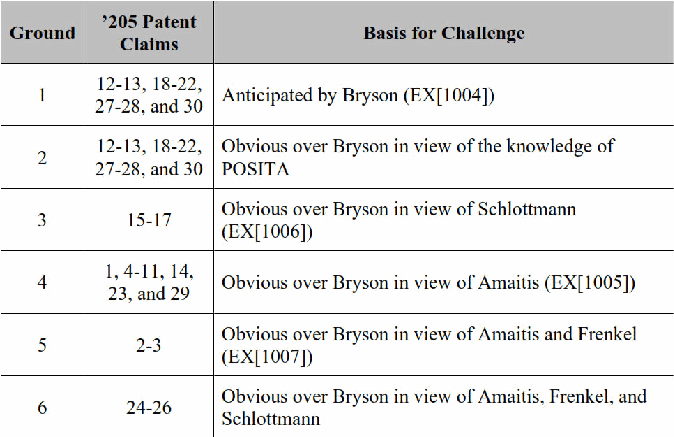
5As to DK’s first argument, we agree with the Board that DK asserted a new ground of unpatentability in its Reply footnote against claim 18 by seeking to add Schlottmann to its challenge. That much is clear from reviewing the content of DK’s petition, including its summary scorecard of its petitioned-for grounds:
J.A. 288.
Our case law explains that the Board cannot entertain theories absent from the petition. See, e.g., Netflix, 84 F.4th at 1377. That DK could have relied on Schlottmann as part of an unpatentability challenge against claim 18 does not mean that its petition must be read in such a manner. Given our repeated warnings to the Board to not stray from the grounds of the petition, it was no abuse of discretion to reject DK’s footnote request. Indeed, DK asserted its new argument after institution. Moreover, DK did not move to amend its Petition to correct its oversight. DK’s footnote is also not responsive to any argument in AG 18’s patent owner response. And the footnote fails to explain why the Board should entertain a new ground against6 claim 18 after institution. We therefore find no abuse of discretion.
DK counters that, under Voice Tech Corporation v. Unified Patents, LLC, it did not present a “new theory” of unpatentability in its Reply footnote and that its Petition “fully raised” Ground 3 against claim 18. Appellant Br. 22– 23 (citing 110 F.4th 1331 (Fed. Cir. 2024)). Voice Tech, however, is inapposite. Although Voice Tech involved typographical errors in the petition, the petition there identified, via cross-reference, the substantive argument the petitioner intended to assert. 110 F.4th at 1338. In contrast to Voice Tech, DK’s analysis of claim 18 in its Petition references no other argument. Indeed, the Petition fails to indicate anywhere that DK intended to assert Ground 3 or Schlottmann against claim 18.
DK’s collateral estoppel argument also fails. Specifically, DK argues that because the Board invalidated other claims, i.e., claims 10, 12, 15, 16, and 17, which, in the aggregate, contain all the limitations of claim 18, it follows that claim 18 is invalid under collateral estoppel. We disagree. As an initial matter, DK’s analysis does not meet its burden to prove collateral estoppel applies based on claim 18’s similarity to an invalidated claim, as required under our precedent. See Ohio Willow Wood Co. v. Alps South, LLC, 735 F.3d 1333, 1342–43 (Fed. Cir. 2013). This court, moreover, has never applied collateral estoppel in the manner DK suggests—by cobbling together limitations from disparate claims to replicate another claim. Based on DK’s arguments, we see no persuasive reason to do that here.
CONCLUSION
We have considered DK’s remaining arguments and find them unpersuasive. For the foregoing reasons, we affirm.