NOTE: This disposition is nonprecedential. United States Court of Appeals
for the Federal Circuit
TESLA, INC.,
Appellant
v.
CHARGE FUSION TECHNOLOGIES, LLC,
Appellee
2024-2015
Appeal from the United States Patent and Trademark Office, Patent Trial and Appeal Board in No. IPR2023-00063.
Decided: March 31, 2026
KRISTA MARIE CARTER, Tesla, Inc., Palo Alto, CA, argued for appellant. Also represented by PAUL ISAAC MARGULIES, Washington, DC; DAVID A. CAINE, Arnold & Porter Kaye Scholer LLP, Palo Alto, CA.
BRADLEY D. LIDDLE, Cozen O'Connor, Dallas, TX, argued for appellee. Also represented by MICHAEL CLAYTON POMEROY; FREDERICK A. TECCE, Altima Advisors/Attorneys, LLC, Philadelphia, PA.
2Before DYK, REYNA, and CHEN, Circuit Judges.
Tesla, Inc. appeals from a final written decision of the United States Patent and Trademark Office’s Patent Trial and Appeal Board, which found that Tesla failed to prove that the challenged claims of U.S. Patent No. 10,819,135 were invalid as obvious. Because the Board improperly construed a limitation of one independent claim but not of other independent claims, we affirm in part, reverse in part, vacate in part, and remand.
BACKGROUND
I.
Charge Fusion Technologies, LLC (“Charge Fusion”) owns U.S. Patent No. 10,819,135 (“’135 patent”). The ’135 patent is directed to an electric charging system for intelligently charging battery-powered vehicles. In one embodiment, a user “may safely leave a pet in a parked vehicle by establishing and/or setting charging parameters designed to keep the A/C on to maintain a cool vehicle and/or to keep the heat on to maintain a warm vehicle.” ’135 patent, 15:50–53.
Independent claims 1, 8, and 14 are at issue in this appeal. Although the independent claims include similar limitations, the final limitation of claim 1 meaningfully differs from that of claims 8 and 14. The independent claims at issue state in relevant part:
1. A non-transitory computer readable storage medium storing instructions that, when executed by a processor, cause the processor to: . . . [1h] operate a climate control mechanism of the electric vehicle while the vehicle is in a parked state and in accordance with the selected mode of operation for a duration of time until the amount of
3charge residing in the battery reaches a predetermined level.
’135 patent, 29:16–18, 43–47 (emphases added).
8. A method comprising: . . . [8i] operating an A/C mechanism of the electric vehicle in accordance with the selected mode of operation for a duration of time until it is determined that the selected mode of operation cannot be maintained by the amount of charge residing in the battery for more than a threshold amount of time.
Id., 30:1, 34–39 (emphases added).
14. A method comprising: . . . [14g] receiving, via the user interface, an indication of an activation of the selected mode of operation of the electronic vehicle and operating a climate control mechanism of the electric vehicle in accordance with the selected mode of operation, [14h] wherein the mode of operation defines (i) a stored temperature at which to maintain the interior of the electric vehicle and (ii) a minimum battery charge level required to maintain the stored temperature for a threshold amount of time.
Id., 30:56, 31:12–20 (emphases added). The parties refer to limitations [1h], [8i], and the italicized portions of [14g] and [14h] as the “Climate Control Limitations.”
II.
Tesla, Inc. (“Tesla”) petitioned for inter partes review of claims 1–5, 7–11, and 14–16 of the ’135 patent. Tesla argued that the claims would have been obvious in light of Japanese Patent Application No. JP H10-55496 (“Hibi”) and other prior art references not at issue on appeal.
4On institution, the Board encouraged the parties to address the meaning of the Climate Control Limitation of claim 1. J.A. 1080. The limitation recites:
instructions that . . . cause the processor to . . .operate a climate control mechanism of the electric vehicle while the vehicle is in a parked state and in accordance with the selected mode of operation for a duration of time until the amount of charge residing in the battery reaches a predetermined level.
’135 patent, 29:17–18, 43–47 (emphasis added).
The Board specifically requested that the parties address whether the limitation requires the selected mode of operation to “cease operation” or “change operation” after the system reaches the predetermined battery level. J.A. 1080. Charge Fusion argued that the selected mode of operation stops or ceases once the amount of charge reaches the predetermined level. J.A. 9. Tesla argued that the plain and ordinary meaning of the limitation does not require the mode of operation to stop or cease after the battery reaches the predetermined level. J.A. 11. Telsa also argued that the specification confirms this conclusion. Id.
In its final written decision, the Board agreed with Tesla that the claim does not require that the selected mode of operation cease after the battery reaches the predetermined level. However, the Board decided that “even if claim 1 does not recite a particular event that occurs after the predetermined battery level is reached, claim 1 at least requires that the instructions take into consideration the battery level in some manner when operating the climate control mechanism.” J.A. 12. The Board reiterated that the instructions that operate the climate control mechanism “must take into account the predetermined battery level” and “must be based in some manner on the predetermined battery level.” Id.
5Based on this construction, the Board determined that claim 1 would not have been obvious in view of Hibi. Specifically, the Board determined that Hibi does not disclose claim 1’s Climate Control Limitation because “Hibi does not care about its battery level for operation of its climate control mechanism.” J.A. 22. The Board quoted Charge Fusion’s argument that “if a user selects a climate control temperature in system setting mode of Hibi, that temperature is unchanged in response to a low battery event” and “[i]nstead, the temperature remains constant in response to the low battery, as Hibi’s vehicle simply turns the gas engine on and charges the battery.” Id. (citations omitted). The Board concluded that “[b]ecause Hibi does not consider battery level for the operating instructions associated with its climate control system, Petitioner’s challenge to claim 1 fails.” Id.
Regarding claims 8 and 14, the Board found the claims nonobvious in view of Hibi for two reasons. First, the Board indicated that Hibi’s failure to disclose the Climate Control Limitation of claim 1 is dispositive for claims 8 and 14 as well. J.A. 24. Second, the Board determined that Hibi fails to disclose the “more specific” recitations in claims 8 and 14, which, according to the Board, “require knowing a specific relationship between the remaining level of charge in the battery and the amount of time the climate control mechanism can run on that remaining charge.” Id. The Board found this feature absent from Hibi. J.A. 26. The Board thus held that Tesla failed to show that any of the challenged claims is unpatentable.
Tesla appealed. We have jurisdiction to review the Board’s final decision under 28 U.S.C. § 1295(a)(4)(A).
DISCUSSION
Tesla challenges the Board’s construction of the final limitation of claim 1 and the Board’s finding of non-obviousness as to that claim and dependent claims 2–5, 7, and 15. Tesla likewise challenges the Board’s construction of6 similar limitations in independent claims 8 and 14, as well as the Board’s finding of non-obviousness as to those claims and dependent claims 9–11 and 16. Finally, Tesla argues that the Board’s construction of the disputed limitations violated the Administrative Procedure Act (“APA”).
We review the Board’s legal conclusions de novo and its factual findings for substantial evidence. Almirall, LLC v. Amneal Pharms. LLC, 28 F.4th 265, 271 (Fed. Cir. 2022). Claim construction is ultimately a question of law, decided de novo on review. Intel Corp. v. Qualcomm Inc., 21 F.4th 801, 808 (Fed. Cir. 2021). Substantial evidence is such relevant evidence as a reasonable mind might accept as adequate to support a conclusion. Consol. Edison Co. of New York v. N.L.R.B., 305 U.S. 197, 229 (1938).
We review the Board’s compliance with the procedural requirements of the APA de novo. Axonics, Inc. v. Medtronic, Inc., 75 F.4th 1374, 1380 (Fed. Cir. 2023).
I. Claims 1–5, 7, and 15
A.
The goal in claim construction is to attribute to claim terms the meaning understood by a person of ordinary skill in the art. Phillips v. AWH Corp., 415 F.3d 1303, 1313 (Fed. Cir. 2005). There is a heavy presumption that claim terms are to be given their ordinary and customary meaning. Aventis Pharms. Inc. v. Amino Chems. Ltd., 715 F.3d 1363, 1373 (Fed. Cir. 2013). When construing claim terms, we primarily rely on the intrinsic evidence, including the claims themselves, the specification, and the prosecution history of the patent. Sunovion Pharms., Inc. v. Teva Pharms. USA, Inc., 731 F.3d 1271, 1276 (Fed. Cir. 2013).
We first consider whether the Climate Control Limitation “must take into account the predetermined battery level,” as the Board determined. Claim 1 recites in relevant part:
71. A non-transitory computer readable storage medium storing instructions that, when executed by a processor, cause the processor to: . . . [1h] operate a climate control mechanism of the electric vehicle while the vehicle is in a parked state and in accordance with the selected mode of operation for a duration of time until the amount of charge residing in the battery reaches a predetermined level.
’135 patent, 29:16–18, 43–47 (emphases added). The Board concluded that “even if claim 1 does not recite a particular event that occurs after the predetermined battery level is reached, claim 1 at least requires that the instructions take into consideration the battery level in some manner when operating the climate control mechanism.” J.A. 12.
Tesla contends that the Board’s construction is erroneous as a matter of law. Appellant Br. 16. Tesla argues that so long as the “climate control mechanism” operates “until” the battery charge reaches a predetermined level, the plain language does not require that the operation of the climate control mechanism itself actually “take into account” the battery charge level. Id. at 17. Tesla further argues that there is no requirement in the specification that the operating of the climate control mechanism must take into account a “predetermined battery level” that may be reached. Id. at 18. We agree.
The Board’s construction is not supported by the plain language of the claims. The claims do not require that the instructions “take into consideration” the battery level when operating the climate control mechanism. The claims merely require that the climate control mechanism continue until the battery charge reaches a predetermined level. As the Board recognized, “[t]he claim is silent as to what happens after the ‘until.’” J.A. 12.
8The specification likewise offers no support to the Board’s decision. Charge Fusion relies on FIG. 6 and the description thereof in support of the Board’s construction. See Appellee Br. 48. FIG. 6 is shown below in relevant part.
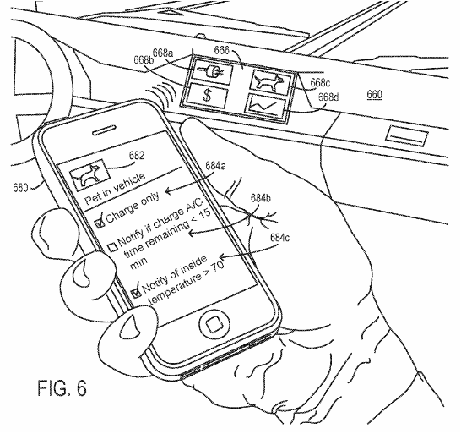
’135 patent, FIG. 6. Describing FIG. 6, the specification indicates that when the driver selects a pet menu option, the driver may also select a button to receive alerts regarding the car’s battery. The specification states the following:
An operator of the user device 680 may, for example, select the menu option 682 (and the user device 680 may receive an indication of such selection), which is depicted as being a menu option defining a situation of a pet being in the vehicle 660. The operator may then, for example, . . . determine whether it is desired that the operator be notified if the current charge level of the vehicle 660 falls below a level that allows the Air Conditioning (A/C) to remain on for
9fifteen (15) minutes (e.g., the second preference option 684b) . . . .
Id., 13:34–39, 44–48. In this disclosure, the specification merely indicates that the driver may be notified when the battery drops below a predetermined level. The Board fails to identify any other passage from the specification that links such notification to the operation of the climate control system. Thus, the specification does not indicate that the instructions “take into consideration” the battery level in some manner when operating the climate control mechanism.
Because the intrinsic evidence does not support the Board’s construction that the instructions must take into consideration the battery level in some manner when operating the climate control mechanism, we vacate that portion of the Board’s construction.
B.
We now turn to patentability. The Board found that Hibi in combination with other references failed to disclose the Climate Control Limitation of claim 1. The Board’s finding, however, “depended on an incorrect interpretation of that claim” and therefore was “not supported by substantial evidence.” See Praxair Distribution, Inc. v. Mallinckrodt Hosp. Prods. IP Ltd., 890 F.3d 1024, 1036 (Fed. Cir. 2018).
We hold that under the correct claim construction, claim 1 is unpatentable. The Board made sufficient findings regarding Hibi to determine that claim 1 would have been obvious under the proper meaning of the claim. The Board found that Hibi taught operating its climate control system in AUTO mode for a duration of time. J.A. 22. The Board further found that such duration of time can be up to and beyond the low battery abnormality condition. Id. These findings are supported by substantial evidence, as Hibi states that when “the capacity of the battery has been10 reduced by conducting cooling over a long period, . . . the engine is started by the engine starter 96 and heating or charging of the battery is conducted.” J.A. 294, ¶ 0043. The Board’s findings about Hibi, which are supported by substantial evidence, demonstrate that Hibi teaches the Climate Control Limitation under the proper construction. Because we conclude that claim 1 would have been obvious, we reverse the Board’s decision on patentability.
The Board’s decision as to the patentability of claims 2–5, 7, and 15, which depend upon claim 1, rested entirely on its conclusion that claim 1 was not unpatentable. Since the Board did not separately address the dependent claims, we vacate its determination as to those claims and remand for further proceedings.
II. Claims 8–11, 14, and 16
A.
Tesla argues that the Board improperly construed the Climate Control Limitations of claims 8 and 14. Tesla contends that the Board made two errors. First, the Board applied its improper construction of the Climate Control Limitation of claim 1 to claims 8 and 14. Appellant Br. 14. Second, Tesla argues that the Board erroneously imposed “an additional construction, albeit implicitly” that the claims require an actual determination of the time available for climate control operation, based on the “threshold amount of time” limitation. Id. Even if Tesla’s first point is correct, it does not help Tesla, because Tesla does not establish error on the second point. Accordingly, we affirm the Board’s construction for the following reasons.
Claims 8 and 14 each recite “a threshold amount of time”—a term not included in claim 1. Claim 8 requires operating the vehicle’s A/C mechanism in accordance with the selected mode of operation “for a duration of time until it is determined that the selected mode of operation cannot be maintained by the amount of charge residing in the11 battery for more than a threshold amount of time.” ’135 patent, 30:34–39 (emphasis added). Claim 14 recites that “the mode of operation defines (i) a stored temperature at which to maintain the interior of the electric vehicle and (ii) a minimum battery charge level required to maintain the stored temperature for a threshold amount of time.” Id., 31:16–20 (emphasis added).
Based on this language, the Board concluded that “[c]laims 8 and 14 require an actual determination of time available for climate control operation based on battery level as part of their recited operation of the climate control mechanism.” J.A. 26. We agree with this construction because it is supported by the intrinsic record.
Claims 8 and 14 each draw a correlation among the selected mode of operation, the charge residing in the battery, and a threshold amount of time. We first note that the mode of operation “is defined by” (claim 8) or “defines” (claim 14) a temperature at which to maintain the interior of the vehicle. ’135 patent, 30:24–26, 31:16–18. Thus, the mode of operation corresponds to a target temperature.
In claim 8, the correlation among the selected mode of operation, the charge residing in the battery, and a threshold amount of time is recited in a determination. The claim requires operating the vehicle’s A/C mechanism until it is determined that the selected mode of operation, i.e., the selected temperature, cannot be maintained for more than a threshold amount of time with the power that remains in the battery. See ’135 patent, 30:34–39. As the Board correctly explained, this determination would not be possible without determining the time available for maintaining the mode of operation based on battery level. See J.A. 26. We agree with the Board’s construction of claim 8.
In claim 14, the correlation among the three features is recited in a definition. The mode of operation defines a minimum battery charge required to maintain the target temperature for a threshold amount of time. See12 ’135 patent, 31:16–20. Like the “determin[ing]” in claim 8, this “defin[ing]” requires knowing the time that the mode of operation can be maintained based on battery level. J.A. 26. Thus, the Board correctly determined that both claims 8 and 14 reflect a requirement for a determination of time available for climate control based on battery level. The claims’ plain language supports the Board’s construction.
The specification lends further support. The ’135 patent discloses that a user may select to be notified “if the current charge level of the vehicle 660 falls below a level that allows the Air Conditioning (A/C) to remain on for fifteen (15) minutes.” ’135 patent, 13:45–47. The system could not accurately notify the user regarding the 15-minute threshold time without determining when the car will deplete the battery at the current A/C setting. Based on the plain language of the claims and the support in the specification, we agree with the Board’s construction of the Climate Control Limitations of claims 8 and 14.
B.
In light of the Board’s construction, we now consider whether substantial evidence supports its finding of non-obviousness. The Board found that the determination of time available for climate control operation based on battery level is missing in Hibi. J.A. 26. We hold that substantial evidence supports this finding.
Tesla argues that Hibi renders obvious the Climate Control Limitations of claims 8 and 14. Tesla relies on Hibi’s disclosure of a “Low battery” abnormality that is detected with a “Voltmeter.” Appellant Br. 35. Tesla contends that Hibi’s low battery level necessarily corresponds to an amount of time that the system can maintain the desired temperature. Appellant Br. 35–36. We disagree.
Hibi is directed to a system for detecting and responding to an abnormality in the operation of a parked vehicle.13 J.A. 284, Abstract. Upon detection, the system notifies the vehicle’s driver of the abnormality and executes measures to address the abnormality. Id. The system enables a driver to maintain a safe climate for a child or pet in the car. J.A. 294, ¶ 0047; J.A. 302, FIG. 6. If the driver leaves a child in the car, the car can automatically control the air conditioner to conduct cooling. J.A. 294, ¶¶ 0043, 0047. Hibi states, “[w]hen . . . the capacity of the battery has been reduced by conducting cooling over a long period, . . . the engine is started by the engine starter 96 and heating or charging of the battery is conducted.” Id. ¶ 0043.
We agree with the Board that Hibi’s system can determine when the battery reaches a predetermined level. See J.A. 24–25. But, as the Board notes, “Hibi is silent as to any relationship between operating its climate control system and remaining battery charge level.” J.A. 25. The Board properly rejected Tesla’s argument that Hibi’s low battery level necessarily defines a minimum battery charge level required to maintain the stored temperature for a threshold amount of time. J.A. 25–26. As the Board observed, adopting Tesla’s characterization of the claims would render much of the Climate Control Limitations of claims 8 and 14 meaningless. J.A. 26. The “determin[ing]” in claim 8 and the “defin[ing]” in claim 14 require determining the time available for the mode of operation based on battery level. Hibi’s disclosures cited by Tesla—the ability to “automatically control” air conditioning (J.A. 294, ¶ 47), to detect a “Low battery” abnormality with a “Voltmeter” (J.A. 300, Fig. 5(a)), and to execute a “countermeasure” of starting the engine and charging the battery (id.; J.A. 294, ¶ 43)—falls short of the claimed “determin[ing]” and “defin[ing].” As the Board noted, Hibi provides no teaching regarding any duration of time for operation of the climate control system relative to a remaining charge level of the battery. J.A. 25. We conclude that the Board’s finding of non-obviousness as to independent claims 8 and 14 is supported by substantial evidence. Claims 9–11 and 1614 depend from claim 8 and are likewise non-obvious by virtue of their dependence.
III. The Administrative Procedure Act
IPR proceedings are subject to the APA. Hamilton Beach Brands, Inc. v. f’real Foods, LLC, 908 F.3d 1328, 1338 (Fed. Cir. 2018). Pursuant to the APA, we will set aside a PTAB decision that is “arbitrary, capricious, an abuse of discretion, or otherwise not in accordance with law.” 5 U.S.C. § 706(2)(A).
Tesla contends that the Board’s construction of the Climate Control Limitation of claim 1, “requiring that the operation of the climate control mechanism ‘must take into account the predetermined battery level,’” was presented for the first time in the final written decision and thus violative of the APA. Appellant Br. 27. Because we vacate the portion of the Board’s construction that Tesla challenges, we do not reach the question of an APA violation for claim 1.
Regarding claims 8 and 14, Tesla argues that the Board violated the APA when it imported its erroneous construction of claim 1 into those claims as well. Appellant Br. 39. Tesla also contends that the Board’s “further constructions for claims 8 and 14 . . . were never proposed or adopted prior to implicitly adopting them in the [final written decision].” Id. We disagree.
The Board did not violate the APA. In its institution decision, the Board “strongly encourage[d]” the parties to address the meaning of the Climate Control Limitation of claim 1. J.A. 1080. The Board also recognized that the limitations in claims 8 and 14 are similar to those in claim 1. J.A. 1081. The parties discussed the Climate Control Limitations of claims 8 and 14 in detail at the hearing before the Board. See J.A 2057–60; J.A. 2080; J.A. 2083–85. The Board expressed doubt regarding Tesla’s construction as reflected in its reliance on Hibi. J.A. 2083–84 (“I’ll be15 honest with you. It seems like a little bit of a leap to get from that low battery to that being tied to a duration of time that you can operate this climate control. Right?”). The Board also questioned Tesla regarding the specific requirements of claims 8 and 14. J.A. 2080 (“[D]o you have to determine the charge amount to -- an actual amount for climate control operation? . . . Do [c]laims 8 and 14, at least, require an actual determination of charge level for climate control operation?”); J.A. 2084 (“Especially when you get to [c]laim 14, where it says that now you define a minimum battery charge level to maintain restored temperature for a threshold amount of time. So now you have to determine basically how much charge I need. I have to know an amount of time, too. Right?”). Based on the Board’s request for input in its institution decision and its questions and comments during oral argument, we conclude that Tesla had notice of the Board’s understanding of the Climate Control Limitations prior to issuance of the Final Written Decision. See TQ Delta, LLC v. DISH Network LLC, 929 F.3d 1350, 1355 (Fed. Cir. 2019) (finding party had notice of Board’s understanding where Board questioned party’s narrow construction at the Oral Hearing); see also Intellectual Ventures II LLC v. Ericsson Inc., 686 F. App’x 900, 906 (Fed. Cir. 2017) (rejecting patent owner’s APA and due process arguments as meritless because it was on notice of the at-issue construction before the final written decision issued because it had the “opportunity to seek a sur-reply or rehearing” and there was a “continuous focus on [the claim term] before and during oral arguments”).
We hold that Tesla was afforded sufficient notice and opportunity to address the construction of the Climate Control Limitations of claims 8 and 14 and thus the Board did not run afoul of the APA here.
16CONCLUSION
We have considered Tesla’s remaining arguments and find them unpersuasive. For the reasons stated above, we vacate the Board’s construction and reverse its judgment regarding obviousness of claim 1. We vacate it judgment regarding dependent claims 2–5, 7, and 15 and remand to the Board for consideration of the patentability of those claims. We affirm the Board’s construction and finding of non-obviousness for claims 8–11, 14, and 16.
AFFIRMED-IN-PART, REVERSED-IN-PART,
VACATED-IN-PART, AND REMANDED
COSTS
Each party shall bear its own costs for this appeal.