NOTE: This disposition is nonprecedential. United States Court of Appeals
for the Federal Circuit
IN RE WAG ACQUISITION, LLC,
Appellant
2024-1971
Appeal from the United States Patent and Trademark Office, Patent Trial and Appeal Board in No. 90/014,833.
Decided: August 7, 2026
RONALD ABRAMSON, Liston Abramson LLP, New York, NY, for appellant. Also represented by ARI JASON JAFFESS. BRIAN RACILLA, Office of the Solicitor, United States Patent and Trademark Office, Alexandria, VA, for appellee John A. Squires. Also represented by MONICA BARNES LATEEF.
Before DYK, REYNA, and STARK, Circuit Judges.
WAG Acquisition, LLC (“WAG”) appeals from a final written decision of the Patent Trial and Appeal Board (“Board”) finding claims 1 and 4 of its U.S. Patent No.2 8,327,011 (the “’011 patent”) unpatentable as anticipated by U.S. Patent No. 6,005,600 (“Hill”). We affirm.
I
WAG owns the ’011 patent, which is entitled “Streaming Media Buffering System.” J.A. 235. The ’011 patent purports to allow electronic devices to engage in “buffering,” a process by which the user of a device can enjoy audio or visual content while that content is still being downloaded from a media source, including via the internet. Id. (’011 pat. at Abstract). In general, “buffering” is achieved by ensuring that data is transmitted from the media source more rapidly than it is played to the user.
Independent claim 1 and dependent claim 4 are at issue on this appeal. They recite:
[1.pre] A media player for receiving an audio or video program, the program comprising media data elements, from a media data source over an Internet protocol network, and playing the program for a user of the media player, wherein each of the media data elements is associated with a serial number, comprising
[1.a] a processor; [1.b] a memory; [1.c] a connection to the network; and [1.d] media player software comprising
[1.e] instructions to cause the media player to request from the media source a predetermined number of data elements; [1.f] instructions to cause the media player to receive media data elements sent to the media player by
3the media source and store the media data elements in the memory; [1.g] instructions to implement a player buffer manager, for managing a player buffer established in the memory, operable to maintain a record of the serial number of the last media data element that has been received and stored in the player buffer; [1.h] instructions to cause the media player to play media data elements sequentially from the player buffer; and [1.i] [1.i.1] instructions to cause the media player to transmit to the media source a request to send one or more media data elements, each identified by a serial number, [1.i.2] and to repeat transmitting the requests to the media source for sequential media data elements so as to maintain the pre-determined number of media data elements in the player buffer until the last media data element comprising the program has been received.
4. The media player of claim 1, wherein the instructions for causing the media player to request from the media source a predetermined number of media data elements further causes the media player to receive the predetermined number of media data elements at a rate more rapid than the rate at which the media data elements are to be played out by the media player.
4J.A. 247 (’011 pat. at 13:13-14:26) (emphasis and bracketed numerals added).
In August 2021, Friendfinder Networks Inc. and Steamray Inc. (together, “Petitioners”) petitioned for reexamination of claims 1 and 4. In July 2022, an examiner issued final rejections of both claims. On review, the Board affirmed the examiner’s final determinations. After the Board denied WAG’s request for reconsideration in July 2024, this timely appeal followed. The Board had jurisdiction under 35 U.S.C. §§ 134(b), 305. We have jurisdiction under 28 U.S.C. § 1295(a)(4)(A).
II
We review any claim construction of the Board de novo and any subsidiary factual findings regarding extrinsic evidence for substantial evidence. See Personalized Media Commc’ns, LLC v. Apple Inc., 952 F.3d 1336, 1339 (Fed. Cir. 2020). Claims are generally construed according to their plain and customary meaning as understood by a person having ordinary skill in the art after reviewing the claim term in the context of the patent. See Phillips v. AWH Corp., 415 F.3d 1303, 1312-13 (Fed. Cir. 2005) (en banc); see also In re CBS-Sys. Int’l, Inc., 832 F.3d 1335, 1341 (Fed. Cir. 2016) (applying Phillips standard in case such as this involving reexamination of expired patent).
“A claim is anticipated if each and every element as set forth in the claim is found, either expressly or inherently, in a single prior art reference.” Arbutus Biopharma Corp. v. ModernaTX, Inc., 65 F.4th 656, 662 (Fed. Cir. 2023). “Anticipation is a question of fact reviewed for substantial evidence.” Wasica Fin. GmbH v. Cont’l Auto. Sys., Inc., 853 F.3d 1272, 1278 (Fed. Cir. 2017). Substantial evidence is “such relevant evidence as a reasonable mind might accept as adequate to support a conclusion.” Consol. Edison Co. of New York v. Nat’l Lab. Rels. Bd., 305 U.S. 197, 229 (1938).
5III
WAG argues that the Board erred by determining that Hill anticipates limitations [1.i.1] and [1.g], in independent claim 1, as well as dependent claim 4. We address each argument in turn.
A
Limitation [1.i.1] requires “[a] media player for receiving an audio or video program . . . from a media source over an Internet protocol network . . . comprising . . . instructions to cause the media player to transmit to the media source a request to send one or more media data elements, each identified by serial number.” J.A. 247 (’011 pat. at 13:13-14:10). The Board found that Hill’s prefetch protocol, shown in Hill Figure 1 (reproduced below), anticipated this limitation.

It reasoned that “(i) [Hill’s] buffer manager 118 sends requests for new frames to the cliplist manager 116 to receive frames from the appropriate source 122; and (ii) the frame request from cliplist manager 116 includes a global frame number.” J.A. 10. Hill’s retrieval protocol, in the Board’s view, met the requirement of “instructions to cause6 the media player to transmit” a request over the internet, and Hill’s use of the global frame number met the requirement that each request identify media data elements by “serial number.” The Board also pointed to Hill’s statement that “‘[e]ach source 122 may be any type of digital memory, and may be accessed either locally or via a network server,’ or ‘a source may be a site on the Internet.’” J.A. 8 (quoting J.A. 242 (’011 pat. at 3:49-56)). Figures 1 (above) and 3 (below) of Hill and the portions of Hill’s 7specification describing them, and relied on by the Board, constitute substantial evidence to support the Board’s finding that Hill anticipates limitation [1.i.1].
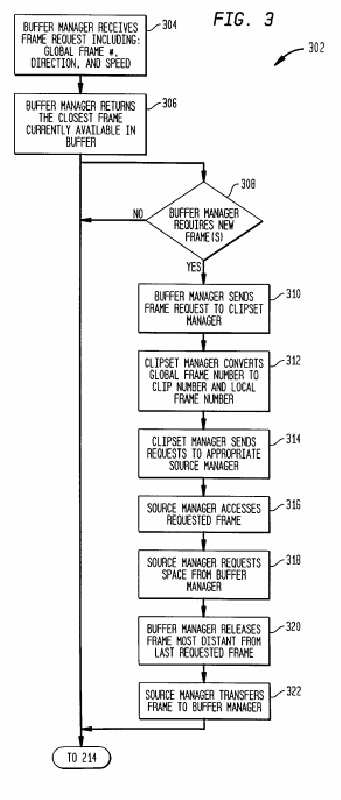
WAG argues the Board implicitly construed the claims of the ’011 patent as so broad as to include a transmission request sent over non-Internet sources when, instead, the claims should be understood as limited to transmission over the Internet. We need not decide if the Board implicitly construed any claim term – or, if it did, whether its implicit construction was correct – because the Board found Hill discloses this “transmit limitation” even under WAG’s preferred understanding of the claims, and substantial evidence supports this finding. J.A. 8 (relying on Hill’s disclosure that “[e]ach source 122 may be any type of digital memory, and may be accessed either locally or via a network server,” and that “a source may be a site on the Internet.”) (quoting J.A. 428 (Hill at 3:49-56)).
WAG also reiterates two arguments it made to the Board in requesting rehearing. Neither persuades us. First, WAG argues the Board erred by reading Hill’s communications between components internal to the workstation as also covering the claimed communications with sources external to the user workstation. But, in denying rehearing, the Board clarified that its interpretation of the “transmit” limitation “is broad enough to encompass cliplist manager 116 of Hill, which requests frames from a particular [external] source 122 (e.g., [a] network server or Internet site) via the appropriate source manager 120.” J.A. 23 (quoting J.A. 428 (Hill at 4:27-28)). Hill Figure 3 and the related portions of Hill’s specification provide substantial evidence for this finding.
Second, WAG contests the Board’s reading of Hill’s global frame number as anticipating identification of requests that identify each media data element by serial number. We are satisfied by the Board’s explanation that “the limitation ‘one or more media data elements, each8 identified by a serial number’ is broad enough to encompass the functionality of cliplist manager 116 of Hill, which request frames, such that the request also includes a global frame number.” J.A. 24.
B
WAG next challenges the Board’s finding that Hill anticipates limitation [1.g]. Limitation [1.g] requires “instruction[s] to implement a player buffer manager, for managing a player buffer established in the memory, operable to maintain a record of the serial number of the last media data element that has been received and stored in the player buffer.” J.A. 247 (’011 pat. at 14:1-5) (emphasis added). WAG faults the Board for reading Hill to disclose this limitation by “plainly equat[ing] the last element requested with the (claimed) last element received.” Open. Br. at 45. Again, we disagree.
The Board identified two independent grounds for finding limitation [1.g] to be disclosed in Hill and substantial evidence supports both. First, when Hill’s buffer manager checks the record of stored frames in order to request new ones, it checks the global frame number (i.e., serial number) of the last frame that was stored in the player buffer and then adds one to the global frame number to determine the next frame needed in the playback sequence. Second, once the next frame from the media source is added to the buffer, the buffer manager stores that global frame number for use in determining which frame to request next.
In finding this limitation anticipated, the Board relied primarily on Hill’s specification, which explains that “buffer manager 118 receives a frame request from cliplist manager 116” and that “buffer manager 118 uses the global frame number last requested as the starting point for determining which frames to request next.” J.A. 12 (citing J.A. 431 (Hill at 10:4-6)). It was reasonable for the Board to conclude that, in order to use the last requested frame as the starting point for the next request, Hill must store9 the global frame number of last received frame in a memory. That the ’011 system can receive media data elements out of order, as WAG emphasizes does nothing to undermine the Board’s finding that Hill discloses storage of the serial number of the frame most recently received.
C
Finally, we turn to the Board’s finding of anticipation with respect to dependent claim 4. WAG insists that Hill does not disclose claim 4’s requirement “wherein the instructions . . . further cause[] the media player to receive the predetermined number of media data elements at a rate more rapid than the rate at which the media data elements are to be played out by the media player.” In finding claim 4 anticipated, the Board relied on Hill’s Figure 4A (below) and particularly step 420.1
Hill’s specification describes that “[i]n step 420, the buffer manager 118 determines by how many frames the request threshold exceeds the fill level.” J.A. 14 (quoting J.A. 430 (Hill at 7:11-12)). Hill adds that in a preferred embodiment, “if the play rate is 24 frames per second, the sources will not be asked to supply more than 48 frames per second.” J.A. 14-15 (quoting J.A. 430 (Hill at 7:17-22)). In finding claim 4 anticipated by Hill, the Board reasoned that in this embodiment “source 122 supplies 48 frames per second when the play rate is 24 frames per second,” and in this way Hill discloses a system in which the aggregate rate at which the source supply frames exceeds the playback speed, meeting the limitation of dependent claim 4. See J.A. 15.
10In WAG’s view, dependent claim 4 demands that each individual frame be provided at a rate faster than the playback speed. No intrinsic evidence supports WAG’s overly narrow interpretation of dependent claim 4. The claims are written using broad language that does not speak to, or limit, the rate at which individual media data elements are sent, provided that the overall rate of receipt is more rapid than the playback rate. Even if WAG is correct that its claims can be practiced by having each media data element11 be sent at a rate faster than the playback speed, this does not mean its claims are limited to such embodiments.2

Under the Board’s correct, broader understanding of the scope of claim 4, substantial evidence supports the Board’s reading of Hill. Hill provides that under normal operation, when the buffer manager determines that the fill level is more than one frame below the request threshold, the buffer manager will request two frames, and ask the media source to supply those two frames at a rate no faster than twice the playback speed. From this, the Board found Hill teaches that the predetermined number of frames under normal operating conditions is two, and that the rate can be as high as twice the playback speed. WAG has demonstrated no error by the Board.
IV
We have considered WAG’s remaining arguments and find them unpersuasive. The judgment of the Board is affirmed.
AFFIRMED
Footnotes
- ↩ 1 The Board referred to a step 480, when it clearly (and indisputably) meant step 420.
- ↩ 2 In its final written decision, the Board discussed an IPR proceeding with respect to U.S. Patent No. 8,122,141 (the “’141 patent”), a parent of the ’011 patent at issue here. WAG contends that the Board improperly relied on its analysis in the ’141 patent IPR to reach its construction in connection with claim 4 of the ’011 patent. But there is no indication that the Board placed dispositive weight – or any weight at all – on its analysis of the ’141 patent. The Board only referred to the ’141 patent in connection with rejecting WAG’s argument that the ’141 construction supported its proposed construction here.