NOTE: This disposition is nonprecedential. United States Court of Appeals
for the Federal Circuit
GO1 PTY, LTD.,
Appellant
v.
OPENSESAME, INC.,
Appellee
2024-1762
Appeal from the United States Patent and Trademark Office, Patent Trial and Appeal Board in No. IPR2022-01439.
Decided: May 28, 2026
ROBERT MANHAS, Orrick, Herrington & Sutcliffe LLP, Washington, DC, argued for appellant. Also represented by BAS DE BLANK, Menlo Park, CA; ELIZABETH MOULTON, San Francisco, CA. WILLMORE F. HOLBROW, III, Buchalter LLP, Los Angeles, CA, argued for appellee. Also represented by ROBERT COLLINGS LITTLE; JASON WADE CROFT, CATHERINE MANESS, Salt Lake City, UT.
2Before HUGHES, LINN, and STOLL, Circuit Judges.
GO1 Pty, Ltd. appeals the final written decision of the Patent Trial and Appeal Board, determining that Go1 did not prove by a preponderance of the evidence that the challenged claims of U.S. Patent No. 8,784,113 are unpatentable under 35 U.S.C. § 103. For the following reasons, we vacate and remand the Board’s final written decision.
BACKGROUND
I
OpenSesame, Inc. is the owner of the ’113 patent, entitled “Open and Interactive E-Learning System and Method.” U.S. Patent No. 8,784,113 Title. The ’113 patent “relates to on-line learning systems in which content is readily publishable by a teacher and is readily accessible by a student via platform-independent means” to produce a nearly universal e-learning marketplace. Id. at col. 1 ll. 15–19. The Background of the Invention section of the specification explains that “[l]earning management systems (LMSs) conventionally are closed learning systems by which a corporation makes teaching content available online to employees who are authorized to subscribe thereto.” Id. at col. 1 ll. 23–26. The inventors here sought to provide an open system in which content from various authors can be stored and updated centrally, training managers could pay the author and subscribe to particular content, and then the licensed learners/users would be allowed access to that content.
Only one aspect of the invention is at issue in this appeal: the licensing/reporting server and its process for verifying a user’s license to access content. In particular, the specification discloses a “licensing/reporting server 14 [that] provides authorization and licensing services.” Id. at col. 4 ll. 37–38. The specification explains the3 licensing/reporting server’s action when it receives a request for content access:
When an access request [by a user] is made, licensing/reporting server 14 records the request, logging which user and license . . . seeks access. Licensing/reporting server 14 then compares those values to its license store. If the requesting user is permitted according to a favorable comparison, then licensing/reporting server 14 returns in its response a location designator, for example a uniform resource locator (URL) . . . .
Id. at col. 4 ll. 42–50. The user can then go on to “play[] . . . the e-learning course and/or content.” Id. at col. 4 ll. 56– 57.
The parties agree that claim 1 is representative. Claim 1 recites:
1. An e-learning delivery system, comprising: a licensing/reporting server; a network-side content player operably coupled with each of the licensing/reporting server and a content delivery network comprising stored e-learning content; and a proxy comprising coded instructions stored on a non-transitory computing device-readable medium at the network-side, wherein the proxy instructions identify a specific instance of licensed content, and wherein the proxy instructions are configured when executed on a client-side computing device to enable a user to access and interact with the licensed content via a browser of the computing device and are further configured to report a status of the user’s interaction with the content to one or both of the licensing/reporting server and a learning management system (LMS);
4wherein the licensing/reporting server includes coded instructions configured when executed to cause the licensing/reporting server to verify a validity status of the user license to the specific instance of content, and upon verifying the validity of the license, the instructions are further configured to cause the licensing/reporting server to provide to the proxy a location designator for accessing the content player; wherein the proxy instructions are further configured, when executed on the client-side computing device in response to a request for access to the specific instance of content, to:
cause the client-side computing device to request verification by the licensing/reporting server of the validity status of a license to the specific instance of content; and cause the client-side computing device to instruct a browser to access the content player via the location designator; and
wherein the proxy instructions are further configured to relay information to a client-side Learning Management System (LMS) including information indicating a status of content played by the content player.
Id. at col. 16 l. 48–col. 17 l. 19 (emphasis added).
Before the Board and on appeal, the parties agree that the license verification and location designator limitation (italicized above) sets forth two steps in sequence. First, the claimed e-learning delivery system verifies the validity of the license of the e-learning system user. See id. at col. 16 ll. 65–67 (“[T]he licensing/reporting server . . . verif[ies] a validity status of the user license to the specific instance of content.”). Then, “upon verifying the validity of the license,” the claimed e-learning delivery system5 configures coded instructions “to cause the licensing/reporting server to provide to the proxy a location designator for accessing the content player.” Id. at col. 17 ll. 1–4.
II
A
Go1 filed an inter partes review petition seeking review of claims 1–16 of the ’113 patent. In the Petition, Go1 challenged the patentability of the claims under 35 U.S.C. § 103, relying on the combination of Sperle1 and Madison.2 Sperle is directed to “delivery methods for remote learning system courses.” J.A. 1132. Sperle’s Figure 1 (reproduced below) “illustrates an example environment for a learning management system 140,” J.A. 1138 ¶ 11:

6J.A. 1133. Sperle’s Figure 2 (reproduced below) “illustrates one example implementation of learning management system (LMS) 140,” J.A. 1143 ¶ 28:

J.A. 1133. Sperle discloses that “[r]eporting functions 214 in training management enable managers to keep track of learners’ learning activities.” J.A. 1144 ¶ 34.
Madison is entitled “System and Method for Controlling Access to Digital Content, Including Streaming Media.” J.A. 1150. In order to solve complications associated with certain authentication methods for access to streaming media, Madison discloses using a “web server [to] cryptographically generate[] a ticket in response to an end user’s request for access to a file.” J.A. 1159 ¶ 8. Importantly to this appeal, Madison teaches a series of steps7 in which a redirector file is generated and sent to an end user before any access verification occurs. J.A. 1165 ¶ 81 (“The playlist server 610 then passes the ASX redirector file to the media player at the end user process[or ] 602.”); id. ¶ 83 (“Having received the ASX file, the end-user processor 602 proceeds to request the streaming media content.”); id. ¶ 84 (“In response to the media player’s call, the streaming media server 604 proceeds to determine whether or not to grant the end-user access to the requested content.”). Thus, while Madison discloses both providing a location designator for access to content and verifying that access, Madison discloses first providing the location designator and then verifying.
In the Petition, Go1 “combine[d] Madison’s teaching of authorization software that determines whether to grant or deny access to specific content with Sperle’s teachings regarding the reporting module,” J.A. 19, as demonstrated by the following annotated figure from Go1’s Petition:
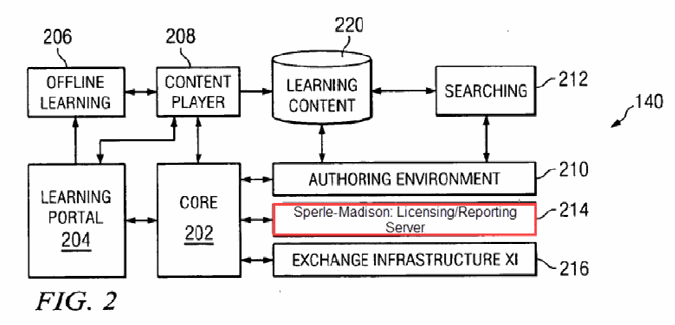
Id. (citing J.A. 95). Go1 argued that a skilled artisan would have “integrated Madison’s web server with authorization software and media server with similar authorization software into the reporting module[ 214] of Sperle, obtaining a licensing/reporting server as” in claim 1. J.A. 19 (citing J.A. 93–95). As evidence of the unpatentability of the ’113 patent’s “verifying the validity of the license” limitation, Go1 “relie[d] . . . on Madison’s teachings of a sequence8 of steps in which a redirector file is sent to a user before the streaming media server determines whether to deny or grant access.” J.A. 24.
In its Patent Owner Response, OpenSesame contended that the combination of Sperle and Madison did not satisfy the limitation “upon verifying the validity of the license” because in the combination, “verification of validity happens after generation of the redirector file.” J.A. 385. Thus, according to OpenSesame, “the steps in Madison are in reverse order as compared to the claim element which requires that the validity be determined before the proxy instructions are further configured to provide a location designator.” Id. (citing J.A. 2934 ¶ 113).
In reply, Go1 argued that “a [skilled artisan] would not require Madison to specify ‘proxy instructions’ that operate in an identical manner to [the ‘upon verifying the validity of the license’ limitation] to be motivated to combine the disclosures of Sperle-Madison with a reasonable expectation of success in achieving the purported claimed invention.” J.A. 25 (quoting J.A. 431). In support, Go1 relied on the testimony of its expert, Dr. Kevin Almeroth, who opined:
90. . . . A [skilled artisan] would not require Madison to specify “proxy instructions” that operate in an identical manner to [the “wherein the proxy instructions are further configured” and “cause the client-side computing device to request verification” limitations] in order to be motivated to combine the disclosures of Madison and Sperle with a reasonable expectation of success in achieving the purported invention of the claims. There is no practical difference between the request for streaming media content, in combination with an authorization ticket that is provided back to the network for verification; and “request[ing] verification . . . of the validity status of a license to the
9specific instance of content.” A [skilled artisan] would view them as insubstantially different, if at all, and would still be motivated to combine Sperle and Madison. Indeed, [OpenSesame’s expert] conceded that Madison did not teach away from this limitation and, in my opinion, there is no reason why the combination would not be an obvious design choice. 91. [OpenSesame] argues that “verification of validity happens after generation of the redirector file. Thus, the steps in Madison are in reverse order as compared to the claim element which requires that the validity be determined before the proxy instructions are further configured to provide a location designator.” Again, a [skilled artisan] would not require Madison to specify “proxy instructions” that operate in an identical manner to [the “upon verifying the validity of the license” limitation] in order to be motivated to combine the disclosures of Madison and Sperle with a reasonable expectation of success in achieving the purported invention of the claims. Moreover, there is no clear significance to the fact that the “steps in Madison” are in “reverse order compared to the claim element.” A [skilled artisan] would view them as insubstantially different, if different at all, and would still be motivated to combine Sperle and Madison.
J.A. 1491–92 (Almeroth Reply Decl. ¶¶ 90–91) (third alteration and second omission in original) (internal citations omitted); see J.A. 431–32.
B
The Board concluded that Go1 did not meet its burden to prove the challenged claims of the ’113 patent are unpatentable. The Board, in conducting its analysis, assumed, but did not decide, that the combination of Sperle10 and Madison taught all the limitations of claim 1 of the ’113 patent other than the “upon verifying the validity of the license, the instructions are further configured to cause the licensing/reporting server to provide to the proxy a location designator for accessing the content player” limitation. See J.A. 17; Oral Arg. at 0:27–1:11, https://www. cafc.uscourts.gov/oral-arguments/24-1762_03052026.mp3 (Go1 noting that “the Board made no findings on any other limitation”).
The Board determined Go1 did not meet its burden on the “upon verifying the validity of the license” limitation because Madison does not disclose the proper sequence. The Board found:
According to Madison, a redirector file is generated first, sent back to the user, and then when the user uses the redirector file to access the content, the media server determines whether or not to grant the end user access to the request. It is this last step of determining whether to grant access that [Go1] relies on for teaching the “verifying a validity status of the user license” limitation of claim 1. Thus, Madison does not disclose “upon verifying the validity of the license,” causing a licensing server “to provide to a proxy a location designator” for accessing the content player.
J.A. 27 (internal citations omitted). The Board acknowledged both (1) Go1’s argument that the specific sequence disclosed by Madison “does not matter because the key inquiry under KSR [International Co. v. Teleflex Inc., 550 U.S. 398 (2007),] is whether a person ordinarily skilled in the art—‘a person of ordinary creativity, not an automaton’—would have been motivated to combine the disclosures in Sperle and Madison to achieve the claimed invention,” J.A. 27 (citing J.A. 431); and (2) Go1’s accompanying reliance on Dr. Almeroth’s declarations, J.A. 27–28 (citing J.A. 709 ¶ 136; J.A. 1491–92 ¶¶ 90–91). But the11 Board concluded Dr. Almeroth’s testimony was “unsupported[ and] conclusory” and could not “fill in gaps in the prior art references.” J.A. 17. In particular, the Board concluded “Dr. Almeroth’s testimony d[id] not persuasively show why a [skilled artisan] . . . would have performed the redirector file creation and authorization differently from what Madison teaches.” J.A. 29. The Board faulted Dr. Almeroth’s testimony for neither “point[ing] to design considerations at the time of the invention to show why the differences between the art and claimed invention are ‘insubstantially different’ or that the modification would merely be a ‘design choice,’” nor “provid[ing] any technical explanation for his generic conclusions.” Id. Accordingly, the Board concluded Go1 did not “persuasively show that the subject matter of claim 1 would have been obvious over the combination of Sperle and Madison.” J.A. 30.
Go1 appeals. We have jurisdiction under 28 U.S.C. § 1295(a)(4)(A).
DISCUSSION
On appeal, Go1 asserts that the Board legally erred in finding no motivation to modify Sperle and Madison such that the combination would first verify the validity of the license and then provide a URL for accessing content. In particular, Go1 challenges the Board’s conclusion that Dr. Almeroth’s testimony was conclusory. “We review the Board’s obviousness determinations de novo and its factual findings underlying those determinations for substantial evidence.” Int’l Bus. Machs. Corp. v. Zillow Grp., Inc., 160 F.4th 1360, 1366 (Fed. Cir. 2025) (citation omitted). “Substantial evidence is ‘such relevant evidence as a reasonable mind might accept as adequate to support a conclusion.’” Arendi S.A.R.L. v. Google LLC, 882 F.3d 1132, 1133 (Fed. Cir. 2018) (quoting Consol. Edison Co. of N.Y. v. NLRB, 305 U.S. 197, 229 (1938)). After review, we hold that the Board’s finding that Dr. Almeroth’s testimony was conclusory is not supported by substantial evidence.
12Before the Board, Go1 sought to prove that the choice of first verifying the license and then sending the proxy URL (the sequence of claim 1 of the ’113 patent) was an obvious design alternative to first sending the proxy URL and then verifying the license (the sequence disclosed in Madison), and such a design choice is within the skilled artisan’s ordinary creativity under KSR. See J.A. 431; see also Appellant’s Br. 31. In other words, Go1 asserted that the order of performance of these two recited claim steps was a design choice that would have been obvious to one of ordinary skill in the art. In KSR, the Supreme Court noted that if a skilled artisan “can implement a predictable variation, § 103 likely bars its patentability.” 550 U.S. at 417. And “tak[ing] account of the inferences and creative steps that a [skilled artisan] would employ,” “[w]hen there is a design need . . . and there are a finite number of identified, predictable solutions, a [skilled artisan] has good reason to pursue the known options within his or her technical grasp.” Id. at 418, 421.
Here, the relevant number of solutions is “finite” and “predictable”: (1) verify the license and then send the URL, or (2) send the URL and then verify the license. The Board’s finding here did not consider that such a simple design choice may be within the “ordinary creativity” and “technical grasp” of a skilled artisan, thus giving the skilled artisan “good reason” to pursue that design choice. Id. at 421 (“A person of ordinary skill is also a person of ordinary creativity . . . .”); see also Randall Mfg. v. Rea, 733 F.3d 1355, 1362 (Fed. Cir. 2013) (“In KSR, the Supreme Court criticized a rigid approach to determining obviousness based on the disclosures of individual prior-art references, with little recourse to the knowledge, creativity, and common sense that an ordinarily skilled artisan would have brought to bear when considering combinations or modifications.” (citation omitted)). The Board also did not take into account that “[t]he amount of explanation needed to meet” the obviousness standard “necessarily depends on13 context.” Pers. Web Techs., LLC v. Apple, Inc., 848 F.3d 987, 994 (Fed. Cir. 2017). In some contexts, where the technology is “easily understandable,” a motivation to modify analysis “may include recourse to logic, judgment, and common sense available to the [skilled artisan] that do not necessarily require explication in any reference.” Perfect Web Techs., Inc. v. InfoUSA, Inc., 587 F.3d 1324, 1329 (Fed. Cir. 2009) (citation omitted); Meyer Intell. Props. Ltd. v. Bodum, Inc., 690 F.3d 1354, 1375–76 (Fed. Cir. 2012) (concluding the district court erred in excluding the expert’s evidence when the technology at issue was “not complex” and therefore the expert could “rel[y] on common sense in rendering his obviousness opinion”).
Dr. Almeroth’s testimony explained that a skilled artisan would have viewed the sequencing difference between Madison and the claimed invention as lacking technical significance. He testified that a skilled artisan “would not require Madison to specify ‘proxy instructions’ that operate in an identical manner . . . in order to be motivated to combine the disclosures of Madison and Sperle with a reasonable expectation of success.” J.A. 1492 ¶ 91. Further, he testified that “there is no clear significance to the fact that the ‘steps in Madison’ are in ‘reverse order compared to the claim element’” and that a skilled artisan “would view them as insubstantially different, if different at all.” Id. And OpenSesame points us to nothing in the record to question that view. While Dr. Almeroth did not point to a specific prior art reference in support of this statement, because of the simple nature of the difference between the order of the steps in Madison and the order of steps in the claim, as well as the unchallenged fact that it was generally known in other contexts to verify entitlement to access prior to providing access, Dr. Almeroth did not need a specific reference. Instead, Dr. Almeroth grounded his opinion in his understanding of how a skilled artisan would have approached the sequencing issue based on his knowledge as a skilled artisan himself. See J.A. 657–60 ¶¶ 45–4714 (Dr. Almeroth detailing his knowledge of e-learning and access control, including describing his research conducted before the priority date of the ’113 patent); see J.A. 9–10 (Board determining level of ordinary skill).
Before us, OpenSesame urges us to adopt the Board’s finding that Dr. Almeroth’s testimony was conclusory and unsupported. See Appellee’s Br. 46. We note that OpenSesame has not directly disputed Dr. Almeroth’s testimony that the sequencing difference here would be insubstantial to a skilled artisan.3 OpenSesame only takes issue that Dr. Almeroth “did not rely on or cite any evidence” in support of that testimony. Appellee’s Br. 61. But the absence of a separate reference expressly teaching the claimed sequencing does not, by itself, render the testimony conclusory. As discussed above, Dr. Almeroth’s testimony is not conclusory as it relied on the judgment and creativity of the skilled artisan, on which he is qualified to opine. Meyer, 690 F.3d at 1375–76. Accordingly, we hold that the Board’s finding that Dr. Almeroth’s testimony was conclusory is unsupported by substantial evidence.
CONCLUSION
We have considered OpenSesame’s remaining arguments, and we find them unpersuasive. We vacate the Board’s decision and remand the case to the Board for further proceedings consistent with this opinion.
VACATED AND REMANDED
15COSTS
Costs to Appellant.
Footnotes
- ↩ 1 U.S. Patent Application Publication No. 2007/0111180 A1.
- ↩ 2 U.S. Patent Application Publication No. 2004/0015703 A1.
- ↩ 3 At oral argument, we asked OpenSesame if it had put in evidence that a skilled artisan would not have known to verify a license and then provide access. OpenSesame pointed us to its Response to Go1’s Petition, but upon review, we do not find an answer to our question. See generally Oral Arg. at 15:50–19:00 (citing J.A. 384–89).