NOTE: This disposition is nonprecedential. United States Court of Appeals
for the Federal Circuit
MEDMIX SWITZERLAND AG,
Appellant
v.
JOHN A. SQUIRES, UNDER SECRETARY OF
COMMERCE FOR INTELLECTUAL PROPERTY
AND DIRECTOR OF THE UNITED STATES
PATENT AND TRADEMARK OFFICE,
Intervenor
2024-1516
Appeal from the United States Patent and Trademark Office, Patent Trial and Appeal Board in No. IPR2022-01462.
Decided: June 15, 2026
ANGELA M. OLIVER, Haynes and Boone, LLP, Washington, DC, argued for appellant. Also represented by ADAM CARL FOWLES, J. ANDREW LOWES, Plano, TX; DEBRA JANECE MCCOMAS, Dallas, TX; SUZANNE KONRAD, Spencer Fane LLP, Washington, DC; MICHAEL T. MURPHY, I, Global IP Counselors LLP, Washington, DC.
2JUSTIN BOVA, Office of the Solicitor, United States Patent and Trademark Office, Alexandria, VA, argued for intervenor. Also represented by MONICA BARNES LATEEF, NICHOLAS THEODORE MATICH, IV.
Before LOURIE, PROST, and CHEN, Circuit Judges.
Medmix Switzerland AG (“medmix”) appeals from a final written decision of the United States Patent Trial and Appeal Board (“the Board”) determining that claims 1–3, 9–13, and 16–17 of U.S. Patent 9,010,578 (“the ’578 patent”) had been shown to be unpatentable as obvious. Xinial Sys. Gmbh & Co. Kg v. Medmix Switzerland Ag, No. IPR2022-01462, 2024 WL 714900, at *1 (P.T.A.B. Feb. 21, 2024) (“Decision”). For the following reasons, we affirm.
BACKGROUND
Medmix owns the ’578 patent, which is directed to an arrangement for mixing and discharging fluids. ’578 patent, Abstract; J.A. 215 (Petition). The design contains three main parts: a “cartridge [with] at least two chambers,” an “accessory part,” i.e., a mixer, and a “connecting device” that links the cartridge and mixer. ’587 patent col. 9 ll. 50–51, 55–57, Abstract. Within the connecting device are two complementary “engagement parts,” referred to in the patent as “guide grooves” (attached to the cartridge) and “ramps” (attached to the mixer). Id. col 10 ll. 8–11. To connect and disconnect the cartridge and mixer, the guide grooves and ramps rotate into and away from one another along the axis of the device. See id. col. 10 ll. 5–7. The ’578 patent aims “to produce a reliable and rapid connection between the cartridge and the accessory part in such a way that, with little force being applied, the [mixer] can be secured sealingly on the cartridge and can also be lifted from the cartridge.” Id. at col. 2 ll. 16–20.
3Figure 4, shown below, depicts the design prior to connection. Reference numeral 2 corresponds to the cartridge; 3 the mixer; 6 and 7 the ramps; and 25 and 26 the guide grooves.
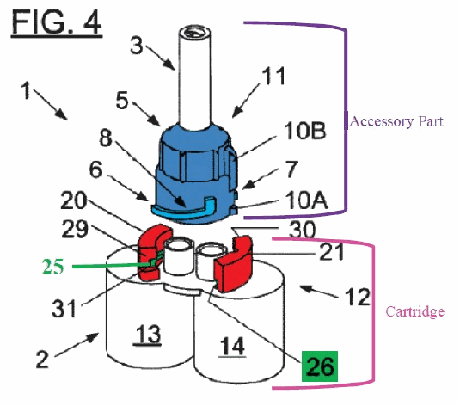
Appx1543–45 ¶ 57 (annotating FIG. 4 of the ’578 patent).
Representative claim 1 of the ’578 patent reads as follows:
A discharge arrangement, comprising: an accessory part with at least two inlets; a cartridge for at least two components, wherein the cartridge has at least two chambers for in each case one of the components and has at least two outlets, complementary to the inlets, for the components, wherein each of the outlets is adapted to be plugged into one of the inlets, or vice versa; and a connecting device with a first connecting component, which is arranged on the accessory part, and a second connecting component, which is complementary to the first connecting component and is arranged on the cartridge,
4wherein one of the connecting components comprises a socket and the other connecting component comprises a connector part that is adapted to be inserted into the socket along a longitudinal direction, wherein first engagement parts of a rotational guide placed at an incline to the longitudinal direction are provided on an outer circumference of the connector part, and corresponding second engagement parts of the rotational guide are provided on the inner circumference of the socket, wherein the connecting components are adapted to be rotated into each other over an effective connecting section along the rotational guide after the connector part has been plugged into the socket, wherein one of the engagement parts comprises guide grooves and the other engagement parts cooperating with the guide grooves comprise at least two ramps, which are designed corresponding to the guide grooves, and wherein the guide grooves and the at least two ramps are adapted to be brought increasingly into engagement with each other while being guided in the axial direction and to be disengaged from each other while being guided over an effective connecting section in the axial direction, such that, when the connection is established, the accessory part is positively guided towards the cartridge in a constrained manner, and such that, when the connection is released, the accessory part is lifted from the cartridge in a positively guided manner to cause a constrained lifting.
Id. col. 9 l. 48–col. 10 l. 23. (emphases added).
Xinial Systems GmbH & Co. KG (“Xinial”) petitioned for inter partes review (“IPR”), arguing that claims 1–3, 9– 13, and 16–17 of the ’578 patent would have been obvious5 over one or both of U.S. Patents 6,769,574 (“Keller ’574”) and 6,161,730 (“Heusser”), together with Canadian Patent 1,238,023 (“Yu”). Keller ’574 and Heusser disclose fluid mixing and discharging devices that contain dual-chamber cartridges attached to a mixer. J.A. 1680–1725 (Keller ’574), 1746–52 (Heusser). Yu discloses a caulking gun with a removable nozzle that is mounted with a curved coarse thread connection between the nozzle and gun. J.A. 1726– 45 (Yu). Xinial asserted, in relevant part, that a skilled artisan would have been motivated to incorporate Yu’s coarse thread connection into Keller ’574 and Heusser’s designs. J.A. 230–39, 272–76 (Petition).
At the Board, the parties disputed the construction of the term “at least two ramps” recited in all challenged claims. Medmix argued that the term should be construed to require an “inclined plane” shape, i.e., an angled plane with no curvature. Decision at *5. Xinial contended that the term does not require any specific shape. See id. The Board agreed with Xinial, stating that “at least two ramps” should be construed “using its plain and ordinary meaning,” which “does not require a particular shape . . . with inclined planes.” Id. at *6–7.
The Board then held that Xinial had met its burden to show that all challenged claims of the ’578 patent are unpatentable as obvious based on a motivation to combine both Keller ’574 and Heusser, with Yu. Id. at *42.
Medmix timely appealed. We have jurisdiction under 28 U.S.C. § 1295(a)(4)(A).
DISCUSSION
Medmix presents two main arguments on appeal. The principal argument is that the Board improperly construed the term “at least two ramps” to not require an “inclined plane.” Open. Br. 42–60. Separately, medmix asserts that6 the Board’s motivation-to-combine findings were not supported by substantial evidence. Open. Br. 73–76. We address each in turn.
As the claims are not argued separately, we do not address them separately; they all rise and fall together.
I
We start with medmix’s claim construction argument. When the Board relies only on intrinsic evidence to construe a claim, we review that construction de novo. Netflix, Inc. v. DivX, LLC, 166 F.4th 1341, 1345 (Fed. Cir. 2026). In doing so, “[w]e consider the ordinary meaning of the language specifically at issue, other claim language providing context, the specification, and aspects of prosecution history.” Id. (citing Phillips v. AWH Corp., 415 F.3d 1303, 1312–17 (Fed. Cir. 2005) (en banc)) (other citations omitted).
The disputed limitation recites: “wherein one of the engagement parts comprises guide grooves and the other engagement parts cooperating with the guide grooves comprise at least two ramps.” ’578 patent col. 10, ll. 8–12; see also id. at col. 10, ll. 13–18. As is evident from its text, the disputed limitation does not specify that the recited ramps must be a particular shape, let alone an inclined plane. The same is true of the surrounding limitations in claim 1 and the dependent claims: there is no indication that the disputed ramps must be any specific shape. See generally id. col. 9 l. 48–col. 10 l. 23. The text of the claims of the ’578 patent therefore suggest that “at least two ramps” should not be construed to require an inclined plane. Phillips, 415 F.3d at 1312 (“It is a bedrock principle of patent law that the claims of a patent define the invention.”) (cleaned up and citations omitted).
The specification supports that understanding. The specification states: “a guide groove . . . whose incline and shape correspond substantially to the ramps.” ’578 patent7 col. 6 ll. 14–17. No specific shape is mentioned for the “guide groove.” Rather, it is described only in broad terms, as having a generic “shape.” Id. And because the specification states that the guide groove’s shape “correspond[s] substantially” to the shape of the “ramps,” the specification likewise contemplates no particular shape for the “ramps.” See id.
Medmix does not dispute the above. Rather, medmix points to the few instances in the specification where a ramp is depicted or suggested to have an inclined plane shape and thus asserts that the disputed limitation should be limited to require such a shape. Specifically, medmix points to Figures 1 and 4, where the two disclosed ramps are inclined planes. Open. Br. 53–54; see ’578 patent, FIGS. 1, 4. Similarly, medmix points to a statement in the specification describing the ramps and a separate part of the connecting component—the “socket jaw.” Open. Br. 55. After referencing the “ramps,” the specification provides that a part of the socket jaws is “likewise designed . . . as an inclined plane.” Id. col. 8 ll. 7–10. Medmix asserts that the word “likewise” refers to the “ramps,” meaning that the specification “ramps” are also described as having an “inclined plane” shape. See id.
But “it is improper to read limitations from a preferred embodiment described in the specification . . . into the claims absent a clear indication in the intrinsic record that the patentee intended the claims to be so limited.” Cf. Polaris Innovations Ltd. v. Brent, 48 F.4th 1365, 1377 (Fed. Cir. 2022) (cleaned up and citation omitted). Medmix points to no such clear indication here, because there is none. Rather, the specification explicitly provides that its figures are “preferred illustrative embodiments,” and thus are not intended to limit the scope of the claims, including the “at least two ramps” limitation. Id. col. 4 ll. 38–41. Medmix’s specification-based arguments are therefore unpersuasive.
8Medmix’s main argument in support of its inclined-plane-requiring construction is based on the prosecution history of the ’578 patent. During prosecution, claim 1 originally recited “connecting components,” but was rejected over U.S. Patent 5,033,650 (“Colin”) (J.A. 1830–36), which does not contain ramps with an inclined-plane shape. J.A. 562 (annotating Colin FIG. 2).
Claim 1 was then amended to recite “engagement parts” containing “guide grooves” and “ramps.” J.A. 1235– 36, 1241–42. Medmix contends that this amendment indicates that the applicant intended to narrow the engagement parts to “having a particular shape,” i.e., a “ramp.” Open. Br. 47. In other words, medmix contends that “ramps” cannot be construed to be shape-agnostic or else the amendment would “read ‘ramps’ out of the claims.” Open. Br. 47. We disagree.
The amended claims were allowed after the applicant explained that Colin fails to disclose ramps and corresponding guide grooves that are axially guided when the connection between the cartridge and mixer “is released.” J.A. 1241. That is, the “at least two ramps” language was added to distinguish prior art that did not permit such axial guidance both during attachment and release of the cartridge and mixer. See J.A. 1241. There is no indication that the applicant intended the amendment to limit the scope of the claims to any particular shape of ramps, let alone those with inclined planes. Cf. Saffran v. Johnson & Johnson, 712 F.3d 549, 559 (Fed. Cir. 2013) (determining applicant disclaimed claim scope on two separate grounds despite Patent Office stating it accepted claims on only one of said grounds).
For the foregoing reasons, we conclude that the Board correctly construed the “at least two ramps” limitation to not require an inclined plane. And because medmix does not materially dispute that Yu discloses the “at least two9 ramps” limitation under that construction, we turn to the next issue.
II
We now address medmix’s motivation-to-combine argument. We review the Board’s legal conclusions de novo and its factual findings for substantial evidence. Redline Detection, LLC v. Star Envirotech, Inc., 811 F.3d 435, 449 (Fed. Cir. 2015). The presence or absence of a motivation to combine references is a question of fact reviewed for substantial evidence. In re Gartside, 203 F.3d 1305, 1316 (Fed. Cir. 2000). Substantial evidence is “such relevant evidence as a reasonable mind might accept as adequate to support a conclusion.” Consol. Edison Co. v. NLRB, 305 U.S. 197, 229 (1938).
The Board found that a skilled artisan would have been motivated to incorporate Yu’s coarse thread design into both Keller ’574 and Heusser because doing so provides “mechanical advantage[s].” J.A. 39, 76. For the Keller ’574-Yu combination, the Board found that such a modification would reduce the axial force required to detach the cartridge and mixer in Keller ’574. J.A. 39 (Keller ’574). And for the Heusser-Yu combination, such a modification reduces the “rotations necessary” to attach and detach the cartridge and mixer in Heusser. J.A. 75.
Medmix, relying on our decision in Henny Penny Corporation v. Frymaster LLC, contends that the Board’s motivation-to-combine finding was not supported by substantial evidence because the Board did not “weigh the disadvantages” of the proposed Keller ’574- and Heusser-Yu combinations against the mechanical benefits. Open. Br. 61–62 (citing 938 F.3d 1324 (Fed. Cir. 2019)). Before the Board, medmix argued that a skilled artisan would have been dissuaded from making the proposed combinations because each combination would have resulted in a design where the backpressure generated during dispensing would cause the coarse-thread connection between the10 mixer and cartridge to separate, leading to undesirable fluid leakage. J.A. 489–507 (Patent Owner Response). That argument is unpersuasive.
In Henny Penny, we stated that, when considering whether there was a motivation to combine asserted references, “the benefits, both lost and gained, should be weighed against one another.” 938 F.3d at 1332 (cleaned up and citation omitted). Applying that principle, the Henny Penny panel concluded that the Board’s no-motivation-to-combine finding appropriately considered that the proposed combination resulted in an “unappetizing combination” with “decreased efficiency.” Id.
But here, the Board explicitly found that a skilled artisan would have “easily” mitigated any back-pressure and leakage concerns by using “tangs” and “flanges,” small projections on each of the mixer and cartridge which attach to one another, to reinforce the connection between the mixer and cartridge. J.A. 46, 73; see e.g., J.A. 2921 (supporting Xinial expert testimony). Thus, this case is unlike Henny Penny because the proposed combination does not result in an “unappetizing combination” with “decreased efficiency” that may dissuade a skilled artisan from making the proposed combination. 938 F.3d at 1332. The Board’s motivation-to-combine finding therefore does not contravene Henny Penny and is otherwise supported by substantial evidence.
CONCLUSION
We have considered medmix’s remaining arguments but find them unpersuasive. For the foregoing reasons, we affirm the Board’s holding that the asserted claims would have been obvious and therefore are unpatentable and invalid.