NOTE: This disposition is nonprecedential. United States Court of Appeals
for the Federal Circuit
MEMORYWEB, LLC,
Appellant
v.
SAMSUNG ELECTRONICS CO., LTD.,
Appellee
2024-1322
Appeal from the United States Patent and Trademark Office, Patent Trial and Appeal Board in No. PGR2022-00034.
Decided: December 19, 2025
ANGELO CHRISTOPHER, Nixon Peabody LLP, Chicago, IL, argued for appellant. Also represented by DANIEL J. SCHWARTZ, MATTHEW A. WERBER; JENNIFER HAYES, Los Angeles, CA.
CHRISTOPHER DRYER, Fish & Richardson PC, Washington, DC, argued for appellee. Also represented by LAUREN ANN DEGNAN, IRENE HWANG, MICHAEL J. MCKEON; TIMOTHY RAWSON, San Diego, CA.
2Before TARANTO, SCHALL, and STARK, Circuit Judges.
MemoryWeb, LLC (“MemoryWeb”) appeals a decision of the Patent and Trademark Office, Patent Trial and Appeal Board (“Board”), in a post-grant review proceeding holding claims 1–34 of U.S. Patent No. 11,163,823 (“the ’823 patent” or “the patent”) unpatentable. Samsung Electronics Co. v. MemoryWeb, LLC, No. PGR2022-00034, 2023 WL 7923900 (P.T.A.B. Nov. 16, 2023), J.A. 1–104 (“Final Written Decision”).1 For the following reasons, we affirm.
BACKGROUND
A
The ’823 patent is directed to computer-implemented methods and systems for managing and displaying digital files, such as photographs. ’823 patent col. 1 ll. 17–20. Specifically, the patent describes “a web-based digital file storage system” that “include[s] a digital file repository for storing and retrieving digital files, such as photos, a digital tagging system configured to assign digital tags to the digital files, a sorting system, and a user interface.” Id. col. 4 ll. 33–38. The digital tagging system may include various types of data such as a person’s name or a location. Id. col. 4 ll. 39–42. The sorting system permits sorting of the digital files and their presentation to a user based on their3 corresponding data and based on user inputs via the user interface. Id. col. 4 ll. 42–47.
The patent refers to the presentation to a user of various “views.” See, e.g., id. col. 5 l. 54–col. 7 l. 14. A “search[-]filter view” has a search filter that allows a user to navigate to certain photographs based on selected filtering criteria. Id. col. 3 l. 30, col. 7 ll. 15–43, col. 35 ll. 3–5. A “location[s] view” “identifies within an interactive map . . . where digital files were taken or originated.” Id. col. 6 ll. 14–16, col. 35 ll. 40–41.
Relevant to this appeal, the claims of the ’823 patent require that, in the search-filter view, (i) responsive to a first input, filtering occurs based on people/person identifications, and (ii) responsive to a second input, a locations view is displayed and filtering occurs based on location-related information. Id. col. 35 ll. 6–9, 39–43. It is the action taken in response to a second input that is the focus here. Representative claim 1 of the ’823 patent recites “responsive to a second input within the search-filter view, causing the interface to display a locations view including a first name associated with a first location, and a second name associated with a second location.” Id. col. 35 ll. 39–43.
B
Samsung Electronics Co., Ltd., (“Samsung”) filed a petition for post-grant review challenging claims 1–34 of the ’823 patent as unpatentable. J.A. 317. Samsung challenged the claims as obvious in view of a combination of various prior art references. Id. Relevant to this appeal are two references describing Apple’s iPhoto ’09 photo management software program (“iPhoto”): (1) David Pogue and J.D. Biersdorfer, iPhoto ’09 The Missing Manual (2009), J.A. 1091–1477 (“Pogue”); and (2) Adam C. Engst, iPhoto ’09 for Mac OS X: Visual Quickstart Guide (2009), J.A. 1478–1719 (“Engst”).
4As Pogue explains, iPhoto is software for organizing, editing, and distributing digital photos. J.A. 1108. iPhoto provides a search feature that allows a user to search photos based on user input. J.A. 1185–86. iPhoto also includes a “Places” feature that plots photos on an electronic map. J.A. 1214. To get to the Places feature, a user selects the “Places” tab in iPhoto’s Source list, which appears on the left side of the iPhoto window. See J.A. 1118, 1139–41. The Places tab is the fourth item from the top under the heading “LIBRARY” in the Source list. Within the Places feature, iPhoto provides a “World view,” as shown in Pogue Figure 4-15, that displays a world map, “complete with a red pin for every location . . . ever[ ] tagged in a photo.” J.A. 1214–16.
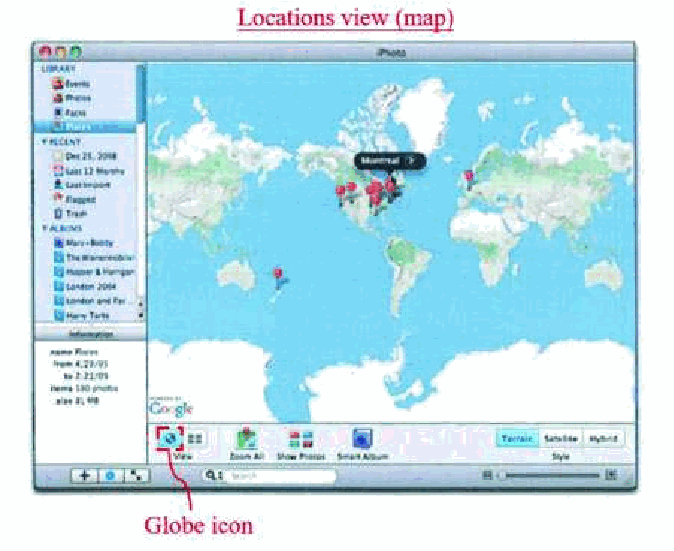
5J.A. 71 (cropped and annotated version of Pogue Figure 4-15). iPhoto also provides, within the Places feature, a “Browser view,” as shown in Pogue Figure 4-16, that “sorts [a user’s] photo sets by country, state/province, town, and even down to a landmark.” J.A. 1216.
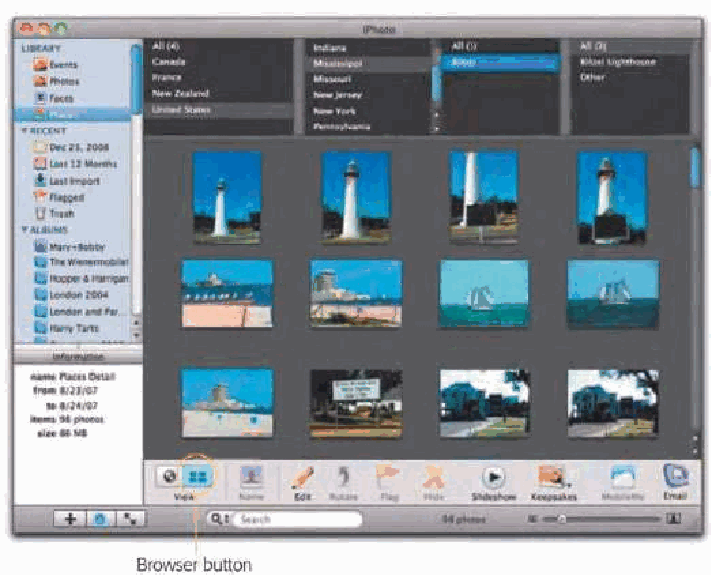
J.A. 41 (cropped version of Pogue Figure 4-16). The World view corresponds to the button labeled “Globe icon” in annotated Pogue Figure 4-15, while the Browser view corresponds to the button labeled “Browser button” in Pogue Figure 4-16. Id.; J.A. 71, J.A. 1214–16.
In its petition, Samsung asserted that selection of iPhoto’s Places tab corresponded to the claimed “second input” of claim 1 and that, “responsive to” the selection of the Places tab, iPhoto caused the Browser view, i.e., the claimed “locations view,” to be displayed. J.A. 349–50. In making this argument, Samsung provided citations to Pogue. Id. In response to Samsung’s petition, the Board6 instituted post-grant review of all the challenged claims of the ’823 patent. J.A. 2.
In its Patent Owner Response, MemoryWeb contended that the phrase “responsive to” should be construed to “require a cause-effect relationship between (1) the second input within the search-filter view and (2) causing the interface to display the locations view.” J.A. 3527; see J.A. 3512–16. MemoryWeb also argued that “Pogue does not disclose causing the display of the Browser [v]iew (alleged locations view) responsive to selecting the Places tab in the source pane to the left (alleged second input).” J.A. 3528. Instead, MemoryWeb contended, to cause the Browser view to be displayed, a user must first “select the Places tab within the alleged search-filter view to cause the World [v]iew to be displayed,” and then must “select the Browser button within the World [v]iew (alleged map view).” J.A. 3530.
In its Reply, Samsung disputed both MemoryWeb’s construction of “responsive to” and MemoryWeb’s description of the prior art. J.A. 4023–25. On the latter point, relying on Pogue and Engst, Samsung asserted that MemoryWeb was incorrect that iPhoto always defaults to showing the World view when the Places tab is selected. J.A. 4024–25. In support of its position, Samsung cited to new testimony by its expert, Dr. Philip Greenspun, addressing both Pogue and Engst. Id. (citing J.A. 4044–45 ¶¶ 16–17 (citing Pogue Figure 4-15 and stating that “Pogue mentions that the World [v]iew button (i.e., ‘globe icon’) should be clicked to get to the map view, further suggesting that there will be instance[s] in which the system does not default to showing the map view (meaning that the locations view was shown first”))). Samsung also provided additional citations to Engst’s description of iPhoto, asserting that the citations disclosed that selecting the Places tab can directly lead to either the World view (also referred to as the “map view”) or the Browser view (“locations view”), depending on which of the two corresponding buttons (i.e.,7 the World view button or the Browser button) was previously selected by the user. J.A. 4024–26 (citing J.A. 1560, 1564).
After an oral hearing, the Board issued its Final Written Decision, in which it held all of the challenged claims of the ’823 patent unpatentable. In connection with the claim term at issue here, the Board began by acknowledging that the parties disputed the meaning of the term “responsive to.” The Board declined to construe the term, however, stating that even if it adopted MemoryWeb’s “more restrictive” construction, which “require[ed] a direct cause-effect relationship between the ‘second input’ and the display of the ‘locations view,’ the prior art still meets the limitation.” J.A. 74.
Applying that narrower construction, and crediting Dr. Greenspun’s testimony, the Board determined:
Based on the evidence of record, a person of ordinary skill in the art would understand that iPhoto, as described by Pogue, and corroborated by Engst, does not default to showing the World view as Patent Owner contends, but that selecting the “Places” tab on the source pane can directly lead to either the “Locations view” (Browser view window shown in Pogue 4-16) or the “Locations view (map)” (World view window shown in Pogue 4-15) identified by Petitioner.
J.A.75.
Having concluded that Samsung had demonstrated that the prior art taught each element of claims 1–34 of the ’823 patent, the Board concluded that the claims had been8 shown to be unpatentable.2 MemoryWeb timely appealed. We have jurisdiction pursuant to 28 U.S.C. § 1295(a)(4)(A) and 35 U.S.C. §§ 141(c) and 329.
DISCUSSION
We review the Board’s legal conclusions de novo and its findings of fact for substantial evidence. Google LLC v. Hammond Dev. Int’l, Inc., 54 F.4th 1377, 1380 (Fed. Cir. 2022). Substantial evidence is “such relevant evidence as a reasonable mind might accept as adequate to support a conclusion.” Consol. Edison Co. v. Nat’l Lab. Rels. Bd., 305 U.S. 197, 229 (1938). Obviousness is a question of law based on underlying findings of fact, such as the scope and content of the prior art. Ancora Techs., Inc. v. Roku, Inc., 140 F.4th 1351, 1357 (Fed. Cir. 2025).
MemoryWeb makes two arguments in its appeal. We address each in turn.
A
First, MemoryWeb argues that the Board erred in finding that Pogue discloses displaying the claimed locations9 view responsive to a second input and asserts that the Board should have performed an inherency analysis. Appellant’s Br. 20–24. MemoryWeb contends that Pogue does not expressly disclose that selection of the Places tab leads directly to the Browser view and that, in concluding that a skilled artisan “would understand” that selecting the Places tab “can directly lead to either” the Browser view or the World view, the Board erroneously relied on the “mere possibilit[y]” that the feature was disclosed. Id. at 20–22 (quoting J.A. 75, PersonalWeb Techs., LLC v. Apple, Inc., 917 F.3d 1376, 1382 (Fed. Cir. 2019)); see also id. at 22 (discussing whether functionality is “necessarily present” or the “natural result of the combination of [explicitly disclosed] elements” under PAR Pharm., Inc. v. TWI Pharms., Inc., 773 F.3d 1186, 1195–96 (Fed. Cir. 2014)). In making this argument, MemoryWeb relies on a nonprecedential decision in LBT IP I LLC v. Apple Inc., No. 2022-1613, 2023 WL 3914920, at *3–4 (Fed. Cir. June 9, 2023)), where our court reversed a determination of obviousness by the Board when the patent challenger had made an argument that was “substantively one of inherency” but did not provide evidence that a feature “must necessarily be present.”
We are not persuaded that Samsung’s arguments before the Board invoked inherency. Instead, Samsung and MemoryWeb presented alternative arguments to the Board about whether the prior art disclosed that selection of the Places tab directly caused the display of the Browser view or whether an additional step needed to be undertaken before the Browser view would be displayed. The Board considered the arguments and evidence before it and found that “[t]he weight of the evidence shows that” MemoryWeb’s interpretation of the prior art “is incorrect.” J.A. 75. The Board instead adopted Samsung’s interpretation of Pogue that “selecting the ‘Places’ tab on the source pane can directly lead to either” the Browser view or the World view. Id. This finding is supported by substantial evidence in the form of Dr. Greenspun’s testimony, J.A.10 4044–45 ¶¶ 16–17, and Pogue, which instructs a user to click on the World view icon to get to the map view, J.A. 1214 (“Click the globe icon to see your photo locations in World view.”). It is additionally supported by Engst’s disclosure that upon selecting the Places tab, a user may need to “click the World [v]iew button” to view the map view. J.A. 1564; see J.A. 1560.
Contrary to MemoryWeb’s argument, LBT does not support its position. In that case, the patent challenger conceded that there was no explicit disclosure of a claim element and presented expert testimony that “a skilled artisan would understand” the missing element was present. 2023 WL 3914920, at *3. In contrast, here Samsung argued, and the Board agreed, that Pogue discloses the pertinent limitation. J.A. 75 (“The weight of the evidence shows that Patent Owner’s argument that the prior art, in particular Pogue, ‘does not disclose causing the display of the Browser [v]iew (alleged locations view) responsive to selecting the Places tab in the source pane to the left (alleged second input),’ is incorrect.” (internal citation omitted)). In addition, in LBT, the petitioner’s expert “repeatedly used qualifying language such as ‘presumably,’ ‘maybe,’ and ‘might,’” when addressing what a skilled artisan would understand the reference at issue to mean. 2023 WL 3914920, at *3. Dr. Greenspun’s testimony, however, does not describe the display of the Browser view after the Places tab is selected as merely being a possibility. Instead, Dr. Greenspun explained that “Pogue mentions that the World [v]iew button (i.e., ‘globe icon’) should be clicked to get to the map view, further suggesting that there will be instance[s] in which the system does not default to showing the map view (meaning that the locations view was shown first).” J.A. 74 (emphasis added) (second alteration in original) (quoting J.A. 4045 ¶ 17). MemoryWeb makes much of Dr. Greenspun’s use of the word “suggesting” in this statement, but we have long held what a reference “suggests” is an appropriate consideration in an obviousness analysis.11 See In re Baird, 16 F.3d 380, 383 (Fed. Cir. 1994) (“[A] reference must be considered not only for what it expressly teaches, but also for what it fairly suggests.” (alteration in original)); In re Aslanian, 590 F.2d 911, 914 (CCPA 1979) (explaining that in determining obviousness, all references are assessed “on the basis of what they reasonably disclose and suggest to one skilled in the art” (quoting In re Baum, 374 F.2d 1004, 1009 (CCPA 1967))).3
Additionally, the Board determined that Engst further supports the understanding that selecting the Places tab can directly lead to either the map view or the locations view. J.A. 74–75 (citing J.A. 4044–45 ¶¶ 16–17). Although MemoryWeb alludes to the Board’s reliance on Engst as being improper since Samsung’s petition cited only to Pogue as teaching this claim element, MemoryWeb does not directly challenge the Board’s reliance on the evidence and arguments Samsung provided in its Reply, which included additional citations to Engst. For the foregoing reasons we conclude that the Board’s determinations regarding the content of the prior art are supported by substantial evidence.
12B
MemoryWeb’s second argument is that the Board erred by failing to construe “responsive to.” It urges us to construe the claim term in the first instance. As noted above, in the Final Written Decision, the Board declined to construe “responsive to,” since the Board’s fact findings established that the claims were obvious in view of the prior art even under MemoryWeb’s more restrictive construction. J.A. 74. Having concluded that a construction was not necessary to resolve the controversy, the Board did not err in declining to construe “responsive to.” See Nidec Motor Corp. v. Zhongshan Broad Ocean Motor Co., 868 F.3d 1013, 1017 (Fed. Cir. 2017) (explaining that the Board “need only construe terms . . . to the extent necessary to resolve the controversy” (internal quotation marks and citation omitted)). Concluding that there was no error in the Board’s approach, we similarly decline to address claim construction here.4
CONCLUSION
We have considered MemoryWeb’s remaining arguments and find them unpersuasive. For the foregoing reasons, we affirm the Board’s Final Written Decision.
AFFIRMED
Footnotes
- ↩ 1 Four patents related to the ’823 patent were involved in two companion appeals argued before the panel on the same day as this case. See generally Apple Inc. v. MemoryWeb, LLC, No. 23-2361, 2025 WL 3494991 (Fed. Cir. Dec. 5, 2025); MemoryWeb, LLC v. Samsung Electronics Co., Ltd., No. 24-1315, 2025 WL 3494918 (Fed. Cir. Dec. 5, 2025).
- ↩ 2 In addition to Pogue and Engst, Samsung’s obviousness challenge for claims 12–14 and its obviousness challenge for claim 26 relied upon U.S. Patent Publ. No. 2005/0116954 to Ripps, and U.S. Patent Publ. No. 2010/0058212 to Belitz (“Belitz”), respectively. The Board instituted both challenges. With respect to claims 12–14, having determined that these claims were unpatentable based on the combination of Pogue and Engst, the Board did not reach Samsung’s arguments on this ground. J.A. 100. With respect to claim 26, the Board agreed with Samsung that the combination of Pogue, Engst, and Belitz rendered claim 26 obvious. J.A. 99–100. In its appeal, MemoryWeb does not make any arguments pertaining to claim 26 or Belitz.
- ↩ 3 At oral argument, counsel for MemoryWeb acknowledged that reliance on what a reference “suggests to a person of skill in the art” is proper in an obviousness analysis, but argued that Samsung never argued obviousness for the second input limitation, since Samsung’s petition cited solely to Pogue for the element. Oral arg. 5:30– 5:50, 24:55–26:50, https://www.cafc.uscourts.gov/oral-arguments/24-1322_11032025.mp3. We do not read the petition so narrowly. The petition specifically relied upon 35 U.S.C. § 103, asserted that “iPhoto” rendered the claim limitation obvious, and defined and described iPhoto as encompassing both Pogue and Engst, since they both describe the same Apple software. J.A. 317, 349, 322–24 & *n.5.
- ↩ 4 We note, however, that our panel construed “responsive to” in Apple, 2025 WL 3494991, at *8–11, in a way that rejected a similar, although not identical, claim construction argument by MemoryWeb.