NOTE: This disposition is nonprecedential. United States Court of Appeals
for the Federal Circuit
IN RE: BONNIE IRIS MCDONALD FLOYD,
Appellant
2023-2395
Appeal from the United States Patent and Trademark Office, Patent Trial and Appeal Board in No. 29/685,345.
Decided: April 22, 2025
MICHAEL DREW, Michael Drew Attorney at Law, Stone Mountain, GA, argued for appellant.
BRIAN RACILLA, Office of the Solicitor, United States Patent and Trademark Office, Alexandria, VA, argued for appellee Coke Morgan Stewart. Also represented by WILLIAM LAMARCA, AMY J. NELSON, FARHEENA YASMEEN RASHEED.
Before PROST, LINN, and STOLL, Circuit Judges.
Applicant Bonnie Iris McDonald Floyd (“Floyd”) appeals the decision of the Patent Trial and Appeal Board (“Board”) affirming a final office action that denied Floyd’s2 design application’s claim of priority to her previously filed utility application and rejected her design claim as anticipated by her utility application. For the reasons that follow, we affirm.
BACKGROUND
I
On January 23, 2016, Floyd filed a utility application, Application No. 15/004,938 (the “’938 application”), directed to a cooling blanket featuring “an integrated ventilation system” and “multiple, sealed compartments.” Figures 1 and 1A of the ’938 application depict embodiments of the inventive cooling blanket featuring six-by-six and six-by-four arrays, respectively:


’938 application Figures 1 &1A.
The utility application discloses: “the embodiment can be made in any size suitable for cooling the body core, or entire body of any human or animal.” Id. at ¶ 25. The application also states that “[w]hile [the] description contains3 many specifications, these should not be construed as limitations on the scope, but rather as an exemplification of several embodiments. Many other variations are possible.” Id. at ¶ 27.
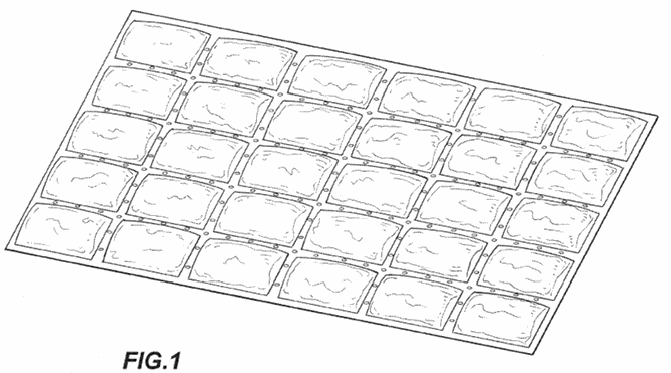
On March 27, 2019, Floyd filed U.S. Design Patent Application No. 29/685,345 (the “’345 application”), claiming priority to the ’938 application. Specifically, the ’345 application claims “[t]he ornamental design for a Cooling Blanket for Humans and Animals, as shown and described.” J. App’x 22. Figure 1 of the ’345 application is depicted below:
J. App’x 23.
II
During prosecution, the Examiner determined that the design claimed in the ’345 application could not claim the benefit of the ’938 application’s priority date because the claimed design includes new matter and the change in the blanket’s number of compartments was not expressly shown in the ’938 application. Thus, the Examiner concluded that the ’938 application qualified as prior art and anticipated the claimed design.
4The Board affirmed the Examiner’s § 102 rejection. Specifically, the Board concluded that “nothing in the ’938 application leads to the precise visual appearance represented in the [six-by-five] array configuration claimed here.” J. App’x 6. While the Board acknowledged that the ’938 application indicates that “the embodiment can be made in any size,” the Board concluded that this “could mean that the rectangular sections are of a different size, as opposed to the blanket having a different number of rectangular sections.” Id. Further, the Board found that “the drawings of the [six-by-six] and [six-by-four] array configurations are not sufficient to narrow down [the numerous potential design] options to a specific visual impression of a blanket of any other configuration than those explicitly shown.” Id. Thus, the Board concluded that the design claimed in the ’345 application did not benefit from the ’938 application’s priority date. Id. Applying the ordinary observer test for anticipation, the Board affirmed the Examiner’s finding that the ’938 application anticipated the design claimed in the ’345 application. J. App’x 7.
Floyd only challenges the Board’s priority analysis and, specifically, its finding that her prior filed utility application does not provide written description support for her claimed design. J. App’x 10–11. Floyd “admits that if the claimed design . . . is found not to be entitled to the filing date of Appellant’s earlier ’938 application, then the claimed design . . . would be anticipated” by the same ’938 application that does not provide written description support.1
5We have jurisdiction under 28 U.S.C. § 1295(a)(4)(A).
ANALYSIS
I
We review the Board’s legal conclusions de novo, In re Elsner, 381 F.3d 1125, 1127 (Fed. Cir. 2004), and its factfinding for substantial evidence.2 In re Gartside, 203 F.3d 1305, 1316 (Fed. Cir. 2000). On substantial evidence review, we ask whether a reasonable fact finder could have arrived at the agency’s decision. RAI Strategic Holdings, Inc. v. Philip Morris, S.A., 92 F.4th 1085, 1092 (Fed. Cir. 2024). Where the record supports multiple reasonable conclusions, we will not find the Board’s decision unsupported6 by substantial evidence simply because the Board chose one conclusion over a plausible alternative. In re Jolley, 308 F.3d 1317, 1320 (Fed. Cir. 2002).
The written description inquiry is a question of fact, RAI Strategic Holdings, Inc. v. Philip Morris Prods. S.A., 92 F.4th 1085, 1088 (Fed. Cir. 2024), as is whether a patented design is functional or ornamental. PHG Techs., LLC v. St. John Co., Inc., 469 F.3d 1361, 1365 (Fed. Cir. 2006).
II
An invention described in an earlier filed application in accordance with § 112(a) will benefit from the filing date of the earlier application. 35 U.S.C. § 120. We have held that § 112(a) requires a written description of the invention. Ariad Pharms., Inc. v. Eli Lilly & Co., 598 F.3d 1336, 1344 (Fed. Cir. 2010) (en banc). When determining whether written description support exists, we apply the same test to both design and utility applications, asking “whether the disclosure of the application relied upon reasonably conveys to those skilled in the art that the inventor had possession of the claimed subject matter as of the filing date.” In re Owens, 710 F.3d 1362, 1366 (Fed. Cir. 2013) (internal quotations omitted).
Floyd argues that the Board erroneously concluded that the ’938 application does not provide written description support for the claimed design because: (1) the ’938 application’s disclosure is not limited to the embodiments depicted in the figures, (2) a skilled artisan would recognize that Floyd possessed the six-by-five array configuration based on her disclosure of arrays that “lie in adjacent size juxtaposition,” J. App’x 20–21, (3) the claimed design is inherent in the ’938 application’s disclosure, (4) the precise number of compartments is a functional, rather than ornamental, feature that does not limit the claimed design, and (5) the Board relied on an erroneous interpretation of §§ 112, 120, and 171. We address each argument in turn.
7A
Floyd first contends that the Board erred by limiting the ’938 application’s disclosure to the embodiments depicted in the figures. She contends that her design more broadly pertains to “a pattern comprising rectangular objects set off by cross-hatching of apertured narrow channels.” Appellant’s Opening Br. 12. The ’938 application uses language that, Floyd argues, shows that the specification does not limit the design to just the embodiments depicted in Figures 1 and 1A. Id. at 18–19; see also J. App’x 41 (noting that the claimed blanket “can be made in any size for cooling the body core, or entire body, of any human or animal.”).
The Patent Office argues that the drawings of Floyd’s utility application may provide written description support for a later filed design but that “[u]ndepicted designs that happen to fall within the scope of broad language in the specification . . . do not allow skilled artisans to recognize that the inventor invented the design.” Appellee’s Br. 23– 24. The Patent Office also contends that the broad language of the ’938 application does not evince Floyd’s possession of the specific six-by-five design claimed in the ’345 application.
The key question for written description is whether a skilled artisan would recognize that Floyd, at the time the ’938 application was filed, possessed the particular design claimed in the ’345 application. The Board concluded that “nothing in the ’938 application leads to the precise visual appearance represented in the [six-by-five] array configuration claimed here.” J. App’x 6. The Board reasonably interpreted the specification’s statement that the invention “can be made in any size” as indicating that the rectangular sections can vary in size rather than that the blanket may feature additional compartments and seams. J. App’x 6. While Floyd argues that the specification includes “expansive language” and that “[m]any other variations [of the8 invention] are possible,” the Board could reasonably read the statements in the specification as merely generalizing away from the depicted embodiments without providing the details needed to show possession of the six-by-five design. This suffices under substantial evidence review. See In re Jolley, 308 F.3d 1317, 1320 (“[W]e will not find the Board’s decision unsupported by substantial evidence simply because the Board chose one conclusion over another plausible alternative.”). Thus, the Board recognized and gave effect to the broader language in the ’938 application but concluded that such language failed to show possession of the specific design that Floyd now claims. We, therefore, reject Floyd’s argument that the Board improperly limited the disclosure of the ’938 application to the embodiments depicted in the drawings.
B
Floyd also contends that the “the ’938 application clearly conveys that [she] was in possession of the [claimed design],” in part, because ’938 application discloses six-by-six and six-by-four arrays that “lie in adjacent size juxtaposition” with the six-by-five array. Appellant’s Opening Br. 20–21 (citing PowerOasis, Inc. v. T-Mobile USA, Inc., 522 F.3d 1299, 1306 (Fed. Cir. 2008) (noting that, to satisfy the written description requirement, “a prior application need not contain precisely the same words as are found in the asserted claims”)). Because of the predictability of the field and the simplicity of the invention, Floyd argues, less detail is needed to provide written description support for the claimed design and, thus, a skilled artisan would recognize from her disclosure of the six-by-six and six-by-four arrays that she also possessed the six-by-five array configuration. Appellant’s Reply Br. 8–9 (citing RAI, 92 F.4th at 1090).
The Patent Office argues that the ’938 application does not disclose a range of arrays at all but, instead, discloses two standalone embodiments of the invention.9 Alternatively, if the ’938 application discloses a range of array configurations, the Patent Office argues, Floyd still cannot prevail because “[t]he disclosure of a broad range of values does not by itself provide written description support for a particular value within that range.” Appellee’s Br. 26 (quoting Gen. Hosp. Corp. v. Sienna Biopharms., Inc., 888 F.3d 1368, 1372 (Fed. Cir. 2018)).
Although the technology in the utility application is simple and perhaps predictable, this does not eliminate the need to provide written description support for the design within the four corners of the specification. The predictability of the technology embodied in the utility application does not necessarily carry over into the predictability of the designs, which are not limited to their utilitarian functionality, and which may range from the straightforward to the ornate. Accordingly, Floyd’s contention that the technology of the article embodying the claimed design is simple does not suffice to show that the Board’s written description determination lacks substantial evidence support.
Moreover, substantial evidence supports the Board’s determination that the ’938 application’s figures do not support any designs other than those they depict. First, Floyd fails to identify anything in the ’938 application disclosing a range of possible arrays rather than the distinct examples depicted in the figures. Second, Figure 1 and Figure 1A differ not only in the number of rows and columns each depicts, but also in the shape of their compartments. As the Board found, Figure 1 shows an array of rectangular segments whereas Figure 1A depicts an array of square segments. J. App’x 5. Because the figures show embodiments that differ in multiple ways, not just in the array configurations they embody, the ’938 application reasonably supports the view that the figures, rather than defining a range, depict distinct embodiments. Thus, we conclude that substantial evidence supports the Board’s finding that “the drawings of the [six-by-six] and [six-by-four] array configurations are not sufficient to narrow down [the10 numerous potential design] options to a specific visual impression of a blanket of any other configuration other than those explicitly shown.” J. App’x 6.
While Floyd is correct that in haec verba support is not necessary to satisfy the written description requirement, she must still show that a skilled artisan would recognize that she possessed the claimed design based on the ’938 application’s disclosure. Because the figures of the ’938 application do not define endpoints of a range that might suggest Floyd’s contemplation of intervening designs, we conclude that their similarity to the claimed design does not suffice to overcome the Board’s finding of no written description support. See Ariad, 598 F.3d at 1352 (“[A] description that merely renders obvious the invention does not satisfy the requirement.”); see also Vas-Cath, 935 F.2d at 1562 (noting that a description that suffices to anticipate does not necessarily satisfy the written description requirement). Thus, we reject Floyd’s argument that her disclosure of arrays in “adjacent size juxtaposition” with the claimed design shows the Board erred in finding no written description support.
C
Floyd next asserts that because the ’938 application discloses arrays that feature a plurality of individualized compartments, the claimed six-by-five array design is inherently disclosed. Appellant’s Opening Br. 21 (citing PowerOasis, 522 F.3d at 1306 (noting that written description support requires that “the written description actually or inherently disclose the claim element”)); see also Appellant’s Opening Br. 20 (quoting Hyatt v. Boone, 146 F.3d 1348, 1352 (Fed. Cir. 1998) (“The claims as filed are part of the specification, and may provide or contribute to compliance with § 112.”)); ’938 application claim 1 (reciting “individualized compartments in plurality”).
The Patent Office contends that the ’938 application’s disclosure of arrays having a plurality of “individualized11 compartments” does not fall within the narrow set of circumstances where the written description requirement may be satisfied by an inherent disclosure because, while a skilled artisan implementing the ’938 application’s invention may possibly select a design having a six-by-five array, there is nothing in the specification of the ’938 application to suggest that a skilled designer would necessarily do so.
Substantial evidence supports the Board’s view. The ’938 application’s disclosure of two specific arrays of individualized compartments provides no basis on which to conclude that a skilled artisan would necessarily recognize that she possessed the different claimed six-by-five design. See PowerOasis, 522 F.3d at 1306 (noting that “to satisfy the written description requirement, the missing descriptive matter must necessarily be present in the [original] application’s specification” (insertion in original and internal quotations omitted)); see also Lockwood v. Am. Airlines, Inc., 107 F.3d 1565, 1572 (Fed. Cir. 1997) (noting that a disclosure that satisfies the written description requirement must describe the claimed invention—“with all its claimed limitations”—“in sufficient detail that one skilled in the art can clearly conclude that the inventor [possessed what is claimed]”); Purdue Pharma L.P. v. Faulding Inc., 230 F.3d 1320, 1328 (Fed. Cir. 2000) (rejecting the view that “the written description requirement was satisfied because the disclosure revealed a broad invention from which the claims carved out a patentable portion”). While Floyd is correct that a specification may provide written description support for limitations that are inherently, but not expressly, disclosed, she has failed to show that such is the case here.
D
Floyd next argues that the number of individualized compartments is a functional, rather than ornamental, element “related to providing a blanket of sufficient size to address a proposed use.” Appellant’s Opening Br. 22.
12The Patent Office argues that this argument is forfeited because Floyd never presented it to the Board. On the merits, the Patent Office contends that the number of compartments in the claimed cooling blanket is not dictated by its function.
Failure to raise arguments before the tribunal under review results in forfeiture. See, e.g., In re Google Tech. Holdings LLC, 980 F.3d 858, 864 (Fed. Cir. 2020) (“We have regularly stated and applied the important principle that a position not presented in the tribunal under review will not be considered on appeal in the absence of exceptional circumstances.”). Floyd forfeited her functionality argument by failing to raise it before the Board. Reaching the merits would not lead us to a different conclusion, however, as Floyd’s argument calls for us to ignore findings of fact supported by substantial evidence. A design is functional when its appearance is dictated by primarily functional considerations. L.A. Gear, Inc. v. Thom McAn Shoe Co., 988 F.3d 1117, 1123 (Fed. Cir. 1993). Here, that would mean that the number of compartments would be dictated by the functional consideration of providing a blanket of sufficient size for a particular use. But the Board concluded that “the statement about ‘any size’ could mean that the rectangular sections are of a different size, as opposed to the blanket having a different number of rectangular sections.” J. App’x 6. As we explained above, this finding is supported by substantial evidence. Therefore, Floyd has not shown that the blanket’s functionality dictates the number of compartments.
E
Finally, Floyd argues that the Board applied an erroneous interpretation of 35 U.S.C. §§ 112, 120, and 171 and 37 C.F.R. § 1.153(a), contending that “[t]he Board appears to want to impart a requirement of some sort of threshold of creativity for an ornamental design beyond what patent law requires.” Appellant’s Reply Br. 11–12. The thrust of13 her argument, however, is nothing more than her disagreement with the Board’s application of this Court’s case law interpreting and applying the requirements of § 112. See Appellant’s Reply Br. 12 (contending that the claimed design and the figures of the ’938 application “are harmonious and consistent with one another”). For the reasons laid out in the foregoing analysis, we disagree with Floyd that the Board erred in concluding that the claimed design lacks written description support in the ’938 application.
CONCLUSION
We have considered Floyd’s other arguments but do not find them persuasive. For the foregoing reasons, we affirm the Board’s holding that the disclosure of the ’938 application does not provide written description support for the design claimed in the ’345 application. Because Floyd’s design patent cannot claim priority to the ’938 utility application, we affirm the Board’s anticipation holding.
AFFIRMED
COSTS
Each party shall bear its own costs.
Footnotes
- ↩ 1 The Board addressed Floyd’s argument that finding the prior filed utility application fails to provide written description support and yet anticipates the claimed design is “grossly inconsistent.” J. App’x 7. The Board rejected this argument, explaining that “the standard for evaluating whether a claim obtains the benefit of an earlier filing date is different than the standard for evaluating anticipation.” Id. We need not address this issue because Floyd agrees that, if the claimed design lacks written description support, it would be anticipated.
- ↩ 2 Floyd cites Vas-Cath v. Mahurkar for the proposition that factual questions are reviewed under the clearly erroneous standard. Appellant’s Opening Br. 13–14 (citing 935 F.2d 1555, 1563 (Fed. Cir. 1991)). While we continue to apply that standard in appeals from bench trials in the district courts, see, e.g., Forest Lab’ys, LLC v. Sigmapharm Lab’ys, LLC, 918 F.3d 928, 934 (Fed. Cir. 2019), the Supreme Court concluded in Dickinson v. Zurko that this Court’s review of Patent Office factfinding under this standard did not comport with the Administrative Procedure Act (“APA”). 527 U.S. 150, 155–56 (1999) (rejecting the application of the court/court standard of review to Patent Office factfinding). We have since applied the APA’s substantial evidence standard when reviewing the Patent Office’s factual determinations. In re Gartside, 203 F.3d at 1316; 5 U.S.C. § 706.