NOTE: This disposition is nonprecedential. United States Court of Appeals
for the Federal Circuit
AMERICAN SCIENCE AND ENGINEERING, INC.,
Appellant
v.
COKE MORGAN STEWART, ACTING UNDER
SECRETARY OF COMMERCE FOR
INTELLECTUAL PROPERTY AND ACTING
DIRECTOR OF THE UNITED STATES PATENT
AND TRADEMARK OFFICE,
Intervenor
2023-2127
Appeal from the United States Patent and Trademark Office, Patent Trial and Appeal Board in No. IPR2021-01585.
Decided: August 7, 2025
AARON E. HANKEL, Shook, Hardy & Bacon, LLP, Kansas City, MO, argued for appellant. Also represented by KYLE E. FRIESEN, Houston, TX. OMAR FAROOQ AMIN, Office of the Solicitor, United States Patent and Trademark Office, Alexandria, VA,
2argued for intervenor. Also represented by PETER J. AYERS, WILLIAM LAMARCA, AMY J. NELSON.
Before MOORE, Chief Judge, LINN and CUNNINGHAM,
Circuit Judges.
American Science and Engineering, Inc. (AS&E) appeals a final written decision (FWD) of the Patent Trial and Appeal Board (Board) determining claims 1–13 of U.S. Patent No. 7,400,701 are unpatentable. For the following reasons, we vacate and remand.
BACKGROUND
AS&E owns the ’701 patent, which relates to an inspection system using multiple sources of penetrating radiation to inspect an object. ’701 patent at Abstract. The inspection system includes a detector arrangement where an object of inspection, such as a vehicle, passes through a portal with a plurality of pencil-beam sources of penetrating radiation. Id. at 3:26–30, Fig. 1. To minimize cross-talk between radiation sources, only one source emits radiation at a time. Id. at 5:1–4. Claim 1 is representative:
1. An inspection system for inspecting an object characterized by motion in a direction with respect to the inspection system, the system comprising: a. a first pencil-beam source for providing a first beam of penetrating radiation of specified cross-section directed in a first beam direction substantially transverse to the direction of motion of the object; b. a second pencil-beam source for providing a second beam of penetrating radiation of specified cross-section substantially coplanar with, and substantially perpendicular to, the first beam of
3penetrating radiation, directed in a second beam direction, and temporally interspersed with the first beam of penetrating radiation; c. a plurality of scatter detectors each scatter detector of which is disposed so as to detect radiation scattered from both the first beam and the second beam by any scattering material within the inspected object and for generating a scattered radiation signal; and d. a controller for creating an image of the scattering material based solely on the scattered radiation signal. Viken Detection Corp. (Viken) filed a petition for inter partes review challenging claims 1–13 as anticipated and obvious over the prior art. J.A. 49–123. The Board held claims 1–4 and 10–13 unpatentable as anticipated by U.S. Patent No. 7,672,422 (Seppi) and claims 5–9 unpatentable as obvious over Seppi in view of U.S. Patent No. 6,459,764 (Chalmers) or U.S. Patent No. 6,459,764 (Grodzins). J.A. 1–32. AS&E appeals.1 We have jurisdiction under 28 U.S.C. § 1295(a)(4)(A).
DISCUSSION
Anticipation is a question of fact we review for substantial evidence. Sierra Wireless, ULC v. Sisvel S.p.A., 130 F.4th 1019, 1022 (Fed. Cir. 2025). Anticipation requires a single reference disclose each and every claim limitation, either expressly or inherently. Sage Prods., LLC v. Stewart, 133 F.4th 1376, 1380 (Fed. Cir. 2025).
4AS&E argues the Board erred in holding claims 1–4 and 10–13 unpatentable as anticipated by Seppi and claims 5–9 unpatentable as obvious based on the same findings in Seppi. AS&E Br. 35–47. Specifically, AS&E argues the Board’s finding of anticipation was not supported by substantial evidence because the Board failed to find Seppi’s scatter detectors can detect scattered radiation from two perpendicular pencil beam sources. See id. at 37– 39. We agree.
The challenged claims require two “substantially perpendicular” pencil beams and a plurality of scatter detectors disposed to detect radiation scattered from the perpendicular beams. ’701 patent at claims 1, 11. Seppi’s inspection system includes pencil beam sources 16a–f arranged on a semi-circular rail 18. J.A. 1080 (Seppi) at 7:60–62; see also J.A. 1069 (Seppi) at Fig. 1 (reproduced below). Seppi’s system also includes “additional detectors” not shown in the figures between sources 16a–f and the cargo container 14 being inspected to detect back scattered radiation. J.A. 1083 (Seppi) at 14:25–27. Seppi is silent as to whether the additional detectors detect radiation from multiple pencil beam sources.
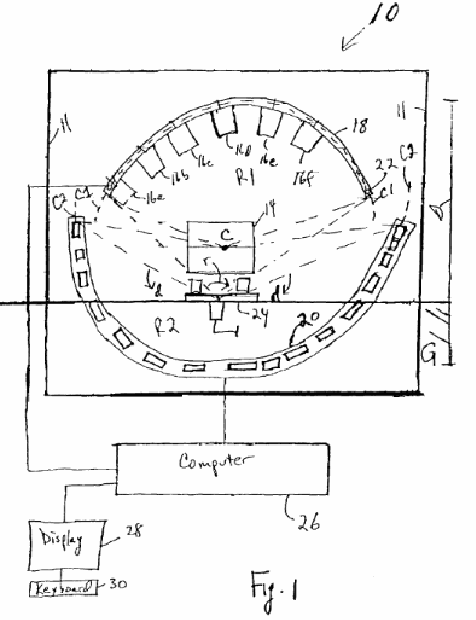
5The Board found Seppi’s pencil beam sources 16a–f and additional detectors comprising scintillator photomultiplier tubes satisfied the claim limitations. J.A. 17–19. Specifically, the Board found Seppi’s additional detectors were capable of detecting backscatter radiation from both pencil beams because Seppi discloses cycling pencil beam sources such that only one source is turned on at a time. J.A. 19. But the Board never expressly found Seppi’s additional detectors detect radiation from both pencil beams when the beams are in a “substantially perpendicular” arrangement as claimed. See Gechter v. Davidson, 116 F.3d 1454, 1460 (Fed. Cir. 1997) (“[T]o hold that a prior art reference anticipates a claim, the Board must expressly find6 that every limitation in the claim was identically shown in the single reference.”). The Director argues the Board’s FWD sets forth its reasoning for why Seppi’s additional detectors detect backscatter radiation from “substantially perpendicular” beams by necessary implication because the ’701 patent repeatedly acknowledges that radiation scatters from an object in all directions so the additional detectors detect at least some radiation from all of Seppi’s pencil beam sources 16a–16f. Director’s Br. 32–36 (citing ’701 patent at 1:41–44; J.A. 13– 16, 18–19). We disagree. The Board made no findings about the ’701 patent’s disclosure of how radiation scatters that allow us to discern the path of its reasoning. See In re Nuvasive, Inc., 842 F.3d 1376, 1383 (Fed. Cir. 2016) (“The PTAB’s own explanation must suffice for us to see that the agency has done its job and must be capable of being ‘reasonably . . . discerned’ from a relatively concise PTAB discussion.” (quoting In re Huston, 308 F.3d 1267, 1281 (Fed. Cir. 2002))).
The Director also argues the anticipation finding is supported by substantial evidence because the Board cites to the Petition’s discussion for these limitations, which in turn cites to Viken’s expert’s testimony that without shielding, Seppi’s additional detectors would detect radiation scattered from all sources 16. Oral Arg. 16:35–18:052; J.A. 19; J.A. 971 ¶ 130. But this theory advanced by the Director pointing to a citation within a citation amounts to “a reasoned justification for an agency decision that the agency itself has not given.” Power Integrations, Inc. v. Lee, 797 F.3d 1318, 1326 (Fed. Cir. 2015). The Board’s conclusory assertions and lack of explanation or reasoning do not allow us to discern whether it followed the proper path. See7 In re Warsaw Orthopedic, Inc., 832 F.3d 1327, 1335 (Fed. Cir. 2016).
Because the Board has failed to provide us with reasoning that is reviewable on appeal for its finding that Seppi’s additional detectors detect scattered radiation from substantially perpendicular pencil beams, we vacate for further explanation regarding the Board’s holding that claims 1–4 and 10–13 are anticipated by Seppi. We vacate the Board’s holding that claims 5–9 are obvious based on Seppi in combination with other references for the same reasons.
CONCLUSION
We have considered AS&E’s remaining arguments and find them unpersuasive. We vacate the Board’s holdings that claims 1–4 and 10–13 are unpatentable as anticipated by Seppi and claims 5–9 are unpatentable as obvious in view of Seppi and Chalmers or Grodzins. We remand for further proceedings consistent with this opinion.
VACATED AND REMANDED
COSTS
No costs.