NOTE: This disposition is nonprecedential. United States Court of Appeals
for the Federal Circuit
CA, INC.,
Appellant
v.
NETFLIX, INC.,
Appellee
2023-1768
Appeal from the United States Patent and Trademark Office, Patent Trial and Appeal Board in No. IPR2021-01319.
Decided: January 27, 2025
DAN YOUNG, Quarles & Brady LLP, Highlands Ranch, CO, argued for appellant. Also represented by KENT DALLOW, MATTHEW CHRISTIAN HOLOHAN.
HARPER BATTS, Sheppard Mullin Richter & Hampton LLP, Menlo Park, CA, argued for appellee. Also represented by JEFFREY LIANG, CHRISTOPHER SCOTT PONDER; JONATHAN RICHARD DEFOSSE, Washington, DC.
2Before REYNA, TARANTO, and STARK, Circuit Judges.
CA, Inc. (“CA”) appeals from an inter partes review decision by the Patent Trial and Appeal Board (the “Board”) finding its patent – which is directed to a method of automatically storing a set of network objects in cache memory to make those objects quicker and easier to access – invalid as obvious. CA primarily argues that the Board misread the plain and ordinary meaning of the term “cache memory” and that substantial evidence does not support the Board’s findings leading to its obviousness determination. We agree with the Board’s construction of cache memory and find substantial evidence supports each of the Board’s findings. Accordingly, we affirm.
I
A
CA’s U.S. Patent No. 7,103,794 (the “’794 patent”), entitled “Network Object Cache Engine,” claims priority to June 8, 1998 and consists of 15 independent claims and 42 dependent claims. J.A. 31 (’794 patent), 45-47 (’794 patent, 17:5-22:58). The ’794 patent is directed to a method of storing items without relying on a file storage system as in conventional computers. Conventional computers contain folders and call objects by name, but the system of the ’794 patent instead (in at least one embodiment) employs a “cache engine coupled to the network [that] provides a cache of transmitted objects, which it stores in memory and mass storage,” “taking direct control” when the objects are stored in “mass storage.” J.A. 37 (’794 patent, 1:64-67). The benefit of such a storage system is the ability to directly and immediately recall stored objects, rather than having to proceed more slowly through the file storage system.
3The specification explains: The invention provides a method and system for caching information objects transmitted using a computer network. A cache engine determines directly when and where to store those objects in a memory (such as RAM) and mass storage (such as one or more disk drives), so as to optimally write those objects to mass storage . . . . The cache engine actively allocates those objects to memory or to disk.
J.A. 31 (’794 patent, Abs.).
In a preferred embodiment, the cache engine stores network objects most often accessed by a user’s device. In this embodiment, the file system of the device does not control the cache storage; instead, the cache storage operates independently of the file system.
Independent claim 1 is representative of most of the disputes presented in this appeal. It recites:
A method, including steps of:
receiving a set of network objects in response to a first request to a server from a client; and maintaining said network objects in a cache memory in a cache engine, said cache engine connected via a network to the server and the client, said cache memory including mass storage; wherein said step of maintaining includes steps of recording said network objects in said cache memory and retrieving said network objects from said cache memory, so as to substantially minimizes a time required for retrieving said network objects from said mass storage.
4J.A. 45 (emphasis added).
Independent claim 17 is also at issue. It adds the requirement that the “maintaining of network objects in a cache memory” is “performed independently of a file system for mass storage,” as follows:
A method, including steps of:
receiving a set of network objects in response to a first request to a server from a client; and maintaining said network objects in a cache memory in a cache engine, said cache engine connected via a network to the server and the client, said cache memory including mass storage; wherein said step of maintaining is performed independently of a file system for said mass storage.
Id. (emphasis added).
B
On July 30, 2021, Netflix, Inc. (“Netflix”) filed a petition for inter partes review (“IPR”) of the ’794 patent. The Board instituted the IPR on February 9, 2022 and issued a Final Written Decision (“FWD”) on February 8, 2023. The FWD found all challenged claims (1, 3-9, and 11-17) unpatentable as obvious.
Three pieces of prior art are relevant here. “Medin” refers to U.S. Patent No. 6,370,571, “System and Method for Delivering High-Performance Online Multimedia Services.” J.A. 850. “Medin discloses a system and method for delivering online multimedia services using a distributed network architecture and processes for replicating and caching frequently accessed multimedia content.” J.A. 12; see also J.A. 865 (Medin at 2:21-25, 54-61). Medin’s system5 provides for frequently accessed content to be “cached” and replicated in local data centers. Medin is directed to, inter alia, systems using UNIX operating systems.
“Seltzer” is Margo Seltzer et al., An Implementation of a Log-Structured File System for UNIX, Proceedings of the 1993 Winter USENIX Conference (Jan. 1993). Seltzer discloses a “log-structured file system” (“LFS”) which “stor[es] all file system data in a single, continuous log.” J.A. 881. Seltzer explains that the problem with “large mainmemory file caches” is that while they “effectively cache reads, [they] do little to improve write performance.” Id. Seltzer, as its title implies, is directed to systems using UNIX operating systems.
Finally, “Markatos” is Evangelos P. Markatos, Main Memory Caching of Web Documents, 28 Computer Networks & ISDN Systems 893 (May 1996). Markatos provides a method for “caching a World Wide Web server’s documents in its main memory,” which allows for a small amount of memory to be dedicated to caching documents requested from the internet. J.A. 907-08.
In its petition, Netflix asserted that (i) claims 1, 3-9, and 11-16 are invalid as obvious over Medin and Seltzer, and (ii) claim 17 is invalid as obvious over Medin and Markatos.
C
In its FWD, the Board first addressed the parties’ claim construction disputes. Relevant to this appeal, CA asked the Board to adopt what it contended is the plain and ordinary meaning of “cache memory,” which it articulated as “both a memory (e.g., RAM) and mass storage (e.g., disk drives).” J.A. 7-8. It is undisputed that RAM is an abbreviation for “random access memory,” which is a form of volatile memory; that is, memory that is erased when a device is turned off. Before the Board, CA contended that the required “memory” of the challenged claims is limited to6 “volatile memory,” of which RAM is an example. J.A. 8. Netflix countered that while the “cache memory” of the claims must include mass storage, the claim does not require volatile memory (such as RAM). J.A. 7-8.
The Board agreed with Netflix, concluding that “[t]he claimed ‘cache memory’ cannot refer only to a cache with volatile memory because the claim states that the ‘cache memory includ[es] mass storage.’” J.A. 9 (second alteration in original). The Board acknowledged that the specification of the ’794 patent references RAM as an example of memory, but concluded RAM is just that: an example of what may be included in “cache memory” but not a required component of “cache memory.” The Board therefore determined that “the plain language [] require[s] mass storage [and] permissively allow[s] other types of memory, including volatile memory such as RAM.” J.A. 10.
Applying this construction, the Board then found that the combination of Seltzer and Medin disclosed all the limitations of claims 1, 3-9, and 11-16. It noted that even CA “acknowledge[d] that Medin’s cache system includes mass storage.” J.A. 16. The Board also found that a person of ordinary skill in the art would have been motivated to combine Medin with Seltzer, as these two references were “specifically compl[e]mentary” in that both deal with reading and writing content to storage in UNIX systems in order to minimize the time needed to retrieve network objects from mass storage. J.A. 20, 1920. That is, both Medin and Seltzer “share the goal of improving speed and efficiency” of systems storing information. J.A. 19-20. The Board further found that Markatos’ disclosure of a different, arguably better solution to the same problems the ’794 patent purports to solve would not undermine a skilled artisan’s motivation to combine Medin and Seltzer.
With respect to the Medin-Markatos combination, the Board agreed with Netflix that “a person of ordinary skill would have been motivated to combine Markatos’s7 teachings of main memory caching of web documents with Medin’s teachings of cache servers that store web documents,” for reasons including that both “references share the same overall goal of improving speed and efficiency of responding to requests for content over the internet.” J.A. 25. The Board rejected CA’s contrary view as being based on an “[i]mplicit” claim construction limiting claim 17 to embodiments in which all network objects must be cached independently of the file system. J.A. 26. In the Board’s view, however, claim 17 “does not exclude maintaining other network objects – network objects other than ‘said set of network objects’ – in the mass storage and having the maintenance of those other network objects implicate a file system.” J.A. 27. Thus, the Board found, in agreement with Netflix, a person of ordinary skill “would have been motivated to modify Medin based on the teachings of Markatos to incorporate main memory caching in combination with Medin’s teachings regarding a cache engine with cache memory that includes mass storage.” J.A. 27.
CA timely appealed.1
II
We review the Board’s claim construction de novo. See Intel Corp. v. Qualcomm Inc., 21 F.4th 801, 808 (Fed. Cir. 2021). Claim terms are generally accorded their plain and ordinary meaning to a person of ordinary skill in the art in the context of the patent. See Biogen Idec, Inc. v. GlaxoSmithKline LLC, 713 F.3d 1090, 1094 (Fed. Cir. 2013). “The ultimate determination of whether an invention would have been obvious is a legal conclusion based on underlying findings of fact.” In re Kahn, 441 F.3d 977, 985 (Fed. Cir. 2006). While we review a Board determination8 of obviousness de novo, see Intelligent Bio-Sys., Inc. v. Illumina Cambridge Ltd., 821 F.3d 1359, 1366 (Fed. Cir. 2016), that conclusion is based on factual findings such as a motivation to combine, which we review for substantial evidence, see Outdry Techs. Corp. v. Geox S.p.A., 859 F.3d 1364, 1368 (Fed. Cir. 2017).
III
CA presses three issues on appeal: (1) the Board’s construction of “cache memory” is incorrect; (2) the Board’s finding that a person of ordinary skill in the art would have a motivation to combine Medin and Seltzer lacks substantial evidence; and (3) the Board’s findings that all of the limitations of claim 17 are disclosed by the combination of Medin and Markatos also lacks substantial evidence. We have set out the Board’s reasoning in some detail above. Because we agree with it, our discussion below of CA’s challenges is succinct.
A
The Board correctly construed “cache memory,” in the claim term “a cache memory in a cache engine . . . said cache memory including mass storage,” as requiring mass storage and permitting, but not requiring, volatile memory such as RAM. J.A. 9-10. CA argues that this construction is “unjustifiably broad” and “obliviated the distinction between the claimed memory and mass storage elements, effectively reading ‘memory’ out of the limitation.” Opening Br. at 23. We disagree.
The claim language expressly calls out mass storage: “cache memory including mass storage.” It does not similarly call out any other type of memory. Thus, the claim language itself strongly supports the conclusion that “mass storage,” and only mass storage, is required in the cache memory. In this way, the claim language indicates that mass storage is required while any other type of memory, including volatile memory like RAM, is optional.
9The specification also supports the Board’s construction. For example, Figure 1 of the ’794 patent (reproduced below) shows network object 114 stored in the mass storage component of a cache memory 102, and not stored in the optional other memory 103 that is part of this embodiment’s cache memory. No objects, in this embodiment, are stored in the memory, contrary to what is required by CA’s construction.
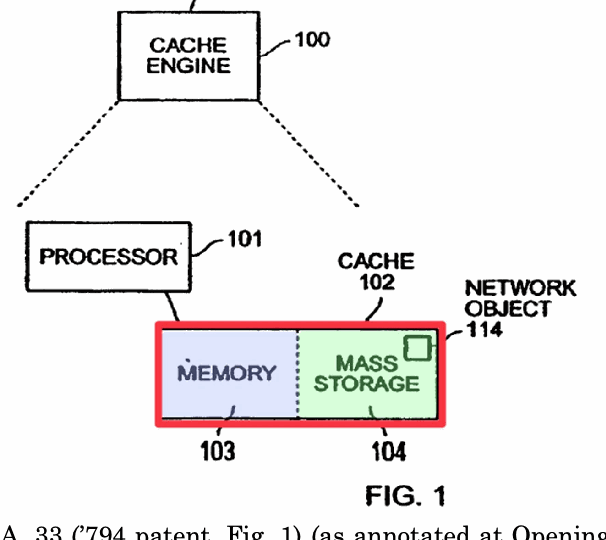
J.A. 33 (’794 patent, Fig. 1) (as annotated at Opening Br. at 31). Our precedents disfavor constructions that exclude embodiments expressly disclosed in a patent’s specification. See Oatey Co. v. IPS Corp., 514 F.3d 1271, 1277 (Fed. Cir. 2008) (“[W]here claims can reasonably [be] interpreted to include a specific embodiment, it is incorrect to construe the claims to exclude that embodiment, absent probative evidence on the contrary.”).
To be sure, there are parts of the specification that could be read as supporting CA’s proposed, more limiting,10 construction. See, e.g., J.A. 37 (’794 patent, 2:8-10) (“In the invention, a cache engine determines directly when and where to store those objects in a memory (such as RAM) and mass storage.”); J.A. 38 (’794 patent, 3:30-31) (“The cache 102 includes the program and data memory 103 and a mass storage 104.”). Still, we agree with the Board that “nothing in the specification limits memory—much less cache memory—to RAM of volatile memory.” J.A. 9 (internal quotation marks omitted). Hence, nothing in the specification renders CA’s proposed construction the correct construction.
The Board did not rely on prosecution history. J.A. 9. Regardless, nothing in it alters our conclusions. During prosecution, the patentee noted that in its claims the term “memory” “broadly encompass[es] both fixed memories such as . . . hard disks, caches, etc., as well as removable memories such as floppy disks.” J.A. 3012-13; see also J.A. 603. This indicates, if anything, that the patent uses “memory” broadly, providing no support for CA’s narrow construction of “cache memory.”
Because the proper construction of cache memory is clear from the claim language and specification, we need not consider extrinsic evidence, such as the parties’ competing dictionary definitions of “memory.” See J.A. 2998, 3040, 3243; see also Phillips v. AWH Corp., 415 F.3d 1303, 1318-20 (Fed. Cir. 2005) (en banc).
Thus, again, we agree with the Board’s construction of cache memory as requiring mass storage and including, but not requiring, volatile memory such as RAM.
B
With respect to the Board’s determination that claims 1, 3-9, and 11-16 are unpatentable as obvious over the combination of Medin and Seltzer, CA principally contends that “Medin does not disclose a ‘cache memory’ when analyzed” under CA’s proposed construction. Opening Br. at11 39-51. As we have not adopted CA’s proposed construction, this contention is moot.
CA additionally argues that the Board erred in finding that a skilled artisan would have been motivated to combine Medin and Seltzer, because the Board supposedly, and wrongly, relied on a motivation that is “generic.” Id. at 53 (citing J.A. 20). The Board found:
a person of ordinary skill would have been motivated to combine the teachings of Medin and Seltzer “so as to substantially minimize[] a time required for retrieving said network objects from said mass storage.” In particular, as Petitioner argues, Medin and Seltzer “share the goal of improving the speed and efficiency” of systems for storing information.
J.A. 19-20. This finding is supported by substantial evidence, including Netflix’s expert’s opinion. J.A. 19-20 (citing J.A. 754-55). And the motivation found by the Board is not too generic to satisfy the requirements for obviousness. Cf. ActiveVideo Networks, Inc. v. Verizon Commc’ns, Inc., 694 F.3d 1312, 1328 (Fed. Cir. 2012) (discounting purported motivation of “build[ing] something better,” which was “generic and [bore] no relation to any specific combination of prior art elements”). To the contrary, substantial evidence supports the Board’s determinations that Medin and Seltzer are “specifically compl[e]mentary,” as both arise in the field of UNIX read/write operations, and both are aimed at improving the speed and efficiency of these systems. J.A. 19-20 (citing Netflix’s expert, Dr. Houh (J.A. 754-55) and Shahram Ghandeharizadeh et al., Placement of Data in Multi-Zone Disk Drives, Second International Baltic Workshop on Databases and Information System, Tallinn, Estonia (1996) (J.A. 949)).
Even if, as CA asserts, another prior art reference, Markatos, would also have improved speed and efficiency in UNIX systems, and even if Markatos would have been12 even more effective in doing so, the Board weighed all the evidence relating to motivation and found substantial evidence for its conclusion that a person of ordinary skill in the art would have been motivated to combine Medin and Seltzer. See Intel Corp. v. Qualcomm Inc., 21 F.4th 784, 800 (Fed. Cir. 2021) (“It’s not necessary to show that a combination is the best option, only that it be a suitable option.”) (internal quotation marks omitted). We see no error in this conclusion.
CA’s remaining arguments seek to persuade us that the record contains substantial evidence to support its positions that the Board rejected. See, e.g., Opening Br. at 44 (“CA provided substantial evidence showing that there is no factual dispute.”); Reply Br. at 1 (“Netflix’s arguments are unpersuasive when compared to CA’s substantial evidence.”). These arguments are predicated on a misunderstanding of our standard of review, which is only to determine whether there is substantial evidence for the findings the Board actually did make. See Elbit Sys. of Am., LLC v. Thales Visionix, Inc., 881 F.3d 1354, 1356 (Fed. Cir. 2018) (“If two inconsistent conclusions may reasonably be drawn from the evidence in record, the PTAB’s decision to favor one conclusion over the other is the epitome of a decision that must be sustained upon review for substantial evidence.”) (internal quotation marks and brackets omitted); In re Gartside, 203 F.3d 1305, 1315 (Fed. Cir. 2000) (explaining issue on appeal is whether Board’s factual conclusions are “supported by ‘substantial evidence’ . . . within the record”). As we have explained, the record contains substantial evidence for the Board’s findings; whether substantial evidence might have also supported different findings is not relevant to our appellate review.
C
Turning, last, to the Markatos-Medin combination and claim 17, substantial evidence supports each of the13 findings CA challenges. CA argues that Markatos does not disclose the limitation “wherein said step of maintaining is performed independently of a file system for said mass storage,” because Markatos stores some objects in main memory and not solely in mass storage, and because some objects in mass storage are stored using a file system. We agree with the Board that CA’s arguments rely on an implicit claim construction (which CA never formally proposed) that would require in claim 17 that all network objects in the mass storage are always stored independent of a file system. J.A. 26-27; see also Oral Arg. at 13:51-14:32 (CA’s counsel arguing that “in the case[] of Markatos,” elements are “never found exclusively in the memory” and are not always accessed “without the use of a file system”). Claim 17 is not so narrow; the implicit construction CA needs in order to prevail is both forfeited and inconsistent with the intrinsic evidence. To the contrary, claim 17 encompasses embodiments in which some but not all of the network objects are maintained in the cache memory – which, again, must include mass storage and may also include other memory, including RAM.
Finally, substantial evidence supports the Board’s finding, crediting Netflix’s argument, that a person of ordinary skill “would have been motivated to modify Medin based on the teachings of Markatos to incorporate main memory caching in combination with Medin’s teachings regarding a cache engine with cache memory that includes mass storage.” J.A. 27; see also J.A. 25 (citing J.A. 108-09, 3031).
IV
We have considered CA’s remaining arguments and find them unpersuasive. For the reasons stated above, we affirm the decision of the Board.
AFFIRMED
COSTS
Costs awarded to Netflix.
Footnotes
- ↩ 1 The Board had jurisdiction under 35 U.S.C. §§ 6, 316(c). We have jurisdiction under 28 U.S.C. § 1295(a)(4)(A) and 35 U.S.C. §§ 141(c), 319.