NOTE: This disposition is nonprecedential. United States Court of Appeals
for the Federal Circuit
TELIT CINTERION DEUTSCHLAND GMBH, FDBA
THALES DIS AIS DEUTSCHLAND GMBH,
HONEYWELL INTERNATIONAL INC., SIERRA
WIRELESS, ULC, FKA SIERRA WIRELESS, INC.,
Appellants
v.
3G LICENSING, S.A.,
Appellee
2023-1497, 2023-1498, 2023-1499
Appeals from the United States Patent and Trademark Office, Patent Trial and Appeal Board in No. IPR2021-00906.
Decided: February 3, 2025
GUY YONAY, Pearl Cohen Zedek Latzer Baratz LLP, New York, NY, argued for all appellants. Appellant Telit Cinterion Deutschland GmbH also represented by KYLE AUTERI, I.
ALAN WRIGHT, Devlin Law Firm LLC, Wilmington, DE, argued for appellee. Also represented by TIMOTHY DEVLIN,
2ROBERT J. GAJARSA, NADIIA LOIZIDES.
JEFFREY R. GARGANO, K&L Gates LLP, Chicago, IL, for appellant Honeywell International Inc. Also represented by BRIAN PAUL BOZZO, Pittsburgh, PA; ERIK HALVERSON, San Francisco, CA. AMANDA TESSAR, Perkins Coie LLP, Denver, CO, for appellant Sierra Wireless, ULC. Also represented by DANIEL TYLER KEESE, Portland, OR.
Before MOORE, Chief Judge, LOURIE and STARK, Circuit
Judges.
Telit Cinterion Deutschland GmbH, f/d/b/a/ Thales Dis Ais Deutschland GmbH, Honeywell International Inc., Sierra Wireless Inc., TCL Communication Technology Holdings Limited, TCT Mobile International Limited, TCT Mobile, Inc., TCT Mobile (US) Inc., and TCT Mobile (US) Holdings, Inc. (collectively, Telit) appeal a final written decision from the Patent Trial and Appeal Board (Board) determining Telit did not establish unpatentability of substitute claims 66–85 of U.S. Patent No. 7,580,388. We vacate and remand the Board’s decision with regard to claims 69 and 77, and their dependent claims, but otherwise affirm.
BACKGROUND
The ’388 patent is directed to “a method and apparatus for providing new configurations for transmitting control information between a mobile terminal, for example user equipment (UE), and a radio network controller (RNC) using a common control channel (CCCH) logical channel/transport channel.” ’388 patent at 1:19–24. The ’388 patent purports to allow UEs to send larger messages than previously possible with the universal mobile3 telecommunications system (UMTS) while maintaining interoperability with legacy systems. The ’388 patent does this by adding an extension to the initial broadcast message from the RNC, which is visible to newer UEs that support larger transport block sizes but is invisible to legacy UEs to avoid impacting existing systems. Id. at 9:34–44.
Telit petitioned for inter partes review, challenging claims 1–4, 6, 8, 9, 12, 33–36, 38, 40, 41, 44, 56, 57, 62, and 63 of the ’388 patent on five grounds: (1) anticipation by TS-25.331,1 (2) obviousness based on TS-25.331 alone, (3) obviousness based on TS-25.331 in combination with Bannister,2 (3) obviousness based on U.S. Patent No. 7,333,443 (Beckmann) in combination with TS-25.331, and (5) obviousness based on Beckmann in view of TS-25.331 and Bannister. J.A. 295. The Board instituted review on all grounds. J.A. 538. 3G filed a motion to amend (MTA) and proposed substitute claims 66–85. J.A. 621–53. After the Board’s Preliminary Guidance, J.A. A844–65, 3G submitted a revised motion to amend (RMTA), J.A. 913–61.
The Board issued a final written decision determining all challenged, original claims of the ’388 patent were unpatentable. J.A. 1–60. Specifically, the Board found claims 1–3, 8, 9, 12, 56, and 57 were anticipated by TS-25.331 and all challenged claims would have been obvious over TS-25.331. J.A. 59. The Board granted 3G’s RMTA, finding 3G showed the proposed substitute claims met the requirements of 35 U.S.C. § 316(d) and 37 C.F.R. § 42.121, and Telit did not prove by a preponderance of the evidence the proposed substitute claims were unpatentable over the4 prior art. J.A. 60–85. Telit appeals. We have jurisdiction under 28 U.S.C. § 1295(a)(4)(A).
DISCUSSION
“[W]e will set aside Board actions that are arbitrary, capricious, an abuse of discretion, or otherwise not in accordance with law, and factual findings that are unsupported by substantial evidence.” Sisvel Int’l S.A. v. Sierra Wireless, Inc., 81 F.4th 1231, 1238 (Fed. Cir. 2023). Satisfying the written description requirement is a question of fact reviewed for substantial evidence. ULF Bamberg v. Dalvey, 815 F.3d 793, 797 (Fed. Cir. 2016). Obviousness is a question of law reviewed de novo, with underlying factual findings reviewed for substantial evidence. HTC Corp. v. Cellular Commc’ns Equip., LLC, 877 F.3d 1361, 1369 (Fed. Cir. 2017). Anticipation is a question of fact reviewed for substantial evidence. Blue Calypso, LLC v. Groupon, Inc., 815 F.3d 1331, 1341 (Fed. Cir. 2016).
I.
Telit argues the Board’s finding that amended claims 69 and 77 have written description support lacks substantial evidence. Appellants’ Opening Br. 26–34.
5In its RMTA, 3G amended original claims 4 and 6 as follows:
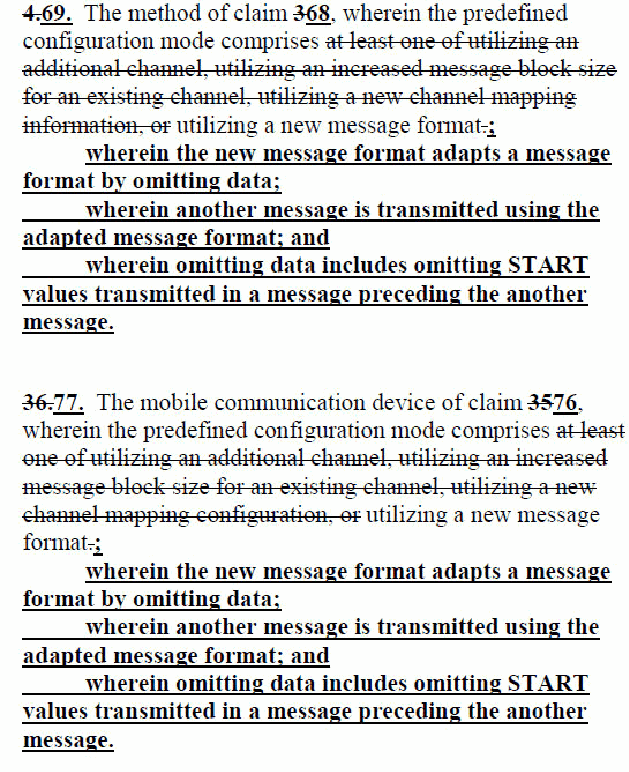
J.A. 64. Substitute claim 69 is a dependent claim in a cascade of multiple dependent claims as follows:3
666. A method of transmitting control information form a mobile terminal in a network, the method comprising: receiving a first message in the mobile terminal, the first message including information indicating at least one available configuration for transmitting a second message . . . 68. The method of claim 66, wherein the at least one available configuration comprises a predefined configuration mode and a predefined configuration identity. 69. The method of claim 68, wherein the predefined configuration mode comprises utilizing a new message format;
wherein the new message format adapts a message format by omitting data; wherein another message is transmitted using the adapted message format; wherein omitting data includes omitting START values transmitted in a message preceding another message.
J.A. 925–27 (emphasis added). Thus, four messages are required by the claim cascade: (1) “a first message” (message A), (2) “a second message” (message B), (3) “another message” (message D), and (4) “a message preceding another message” (message C).
The Board found proposed substitute claim 69 had written description support in Application 11/065,872, which issued as the ’388 patent, and in Provisional Applications 60/576,214 and 60/589,630. J.A. 69. Specifically, the Board found support for the claim in the fourth7 embodiment described and Figure 15 of the ’388 patent. J.A. 69–70 (citing J.A. 2228 ¶ 128 and ’388 patent at 12:15– 18). Critical to this appeal, the Board found it was not necessary for message A to be first in time, and it was therefore not necessary for messages A and B to precede messages C and D. J.A. 73.
While there is a presumption that steps of a method claim are not required to occur in the order they are listed, that presumption can be overcome when “logic or grammar[] requires that the steps be performed in the order written, or the specification directly or implicitly requires an order of steps.” Mformation Techs., Inc. v. Rsch. in Motion Ltd., 764 F.3d 1392, 1398 (Fed. Cir. 2014) (internal quotation marks omitted).
Telit argues that the Board erred by not requiring that the steps be performed in order. We agree. The language of claim 69 requires messages A and B come before messages C and D. Claim 69 recites “wherein the predefined configuration mode comprises utilizing a new message format.” J.A. 927. That predefined configuration format must be in use before the new message format can be utilized. The new message format is able to send a message omitting START values (message D) because the START values were in a preceding message (message C). The “predefined configuration mode” has an antecedent basis in claim 68, from which claim 69 depends. Claim 68 requires the “predefined configuration mode” to come from “the at least one available configuration.” Id. at 926. And the “at least one available configuration,” has an antecedent basis in claim 66, which requires the “first message,” message A, “include[] information indicating at least one available configuration mode for transmitting a second message.” Id. at 925–26. The claims thus require at least message A to precede messages C and D, and the Board’s finding otherwise is not supported by substantial evidence. The Board erred in not8 requiring this ordering of steps. We therefore vacate the Board’s determination regarding claims 69 and 77, and their dependent claims, and remand for the Board to determine patentability in the first instance in light of our determination that the claims require that messages A and B precede messages C and D.
CONCLUSION
We have considered the parties’ remaining arguments on appeal and find them unpersuasive. We therefore affirm-in-part, vacate-in-part, and remand for further proceedings.
AFFIRMED-IN-PART, VACATED-IN-PART, AND
REMANDED
COSTS
Each side shall bear their own costs.
Footnotes
- ↩ 1 Telecommunications System (UMTS); Radio Resource Control (RRC) protocol specification (V6.1.0); J.A. 2260–365.
- ↩ 2 JEFFREY BANNISTER ET AL., CONVERGENCE TECHNOLOGIES FOR 3G NETWORKS, IP, UMTS, EGPRS AND ATM Ch. 6 (2004); J.A. 2401–16, 2491–500.
- ↩ 3 For purposes of this appeal the parties treat claim 69 and 77 as substantively identical. See Appellants’ Opening Br. 26–33; Appellee’s Response Br. 39–45. We therefore cite only to claim 69, but recognize all arguments also apply to claim 77.