NOTE: This disposition is nonprecedential. United States Court of Appeals
for the Federal Circuit
APPLE INC.,
Appellant
v.
GESTURE TECHNOLOGY PARTNERS, LLC,
Appellee
2023-1494
Appeal from the United States Patent and Trademark Office, Patent Trial and Appeal Board in Nos. IPR2021-00923, IPR2022-00093, IPR2022-00361.
Decided: June 5, 2025
ABIGAIL COLELLA, Orrick, Herrington & Sutcliffe LLP, Washington, DC, argued for appellant. Also represented by MELANIE L. BOSTWICK; ELIZABETH MOULTON, San Francisco, CA; CLIFFORD T. BRAZEN, ADAM PRESCOTT SEITZ, Overland Park, KS; PAUL R. HART, Denver, CO.
FRED WILLIAMS, Williams, Simons, and Landis PLLC, Austin, TX, argued for appellee. Also represented by ERIC CARR, MARK JOHN EDWARD MCCARTHY; JOHN WITTENZELLNER, Philadelphia, PA.
2Before MOORE, Chief Judge, PROST and STOLL, Circuit
Judges.
Opinion for the court filed by Circuit Judge STOLL. Opinion dissenting filed by Circuit Judge PROST.
Apple Inc. appeals the Patent Trial and Appeal Board’s Final Written Decision in an inter partes review of U.S. Patent No. 8,194,924. Apple challenges the Board’s finding that an asserted prior art reference fails to qualify as analogous art. Because substantial evidence supports the Board’s finding, we affirm.
BACKGROUND
I
The ’924 patent is owned by Gesture Technology Partners, LLC and is titled “Camera Based Sensing in Handheld, Mobile, Gaming or Other Devices.” U.S. Patent No. 8,194,924 Title. The Abstract discloses that the invention is directed to methods and apparatuses “to enable rapid TV camera and computer based sensing in many practical applications, including, but not limited to, handheld devices, cars, and video games.” Id. Abstract. The ’924 patent specification describes the “Field of the Invention” as “relat[ing] to simple input devices for computers . . . and operating by optically sensing a human input to a display screen or other object and/or the sensing of human positions or orientations.” Id. col. 2 ll. 7–11. Before the Board, both parties explained that the ’924 patent “describes computer devices that ‘optically sens[e] human input’ using one or more cameras, contemplating applications in a ‘variety of fields such as computing, gaming, medicine, and education.’” J.A. 692 (alteration in original) (quoting ’924 patent col. 2 ll. 7–11) (Apple’s3 Declaration of Dr. Benjamin B. Bederson); see also J.A. 94 (Apple’s IPR Petition); J.A. 199 (Gesture Technology’s Initial Patent Owner Response).
The ’924 patent discloses several applications in which a user or an object held by a user can control a computer with one or more cameras, as illustrated in Figure 1A:

’924 patent Fig. 1A. The figure depicts “a combination of one or more TV cameras (or other suitable electro-optical sensors) and a computer to provide various position and orientation related functions of use.” Id. col. 3 ll. 19–23. In this embodiment, there are multiple cameras (100, 101, 144) located on a monitor (102) with a screen (103) facing a user and connected to a computer (106). Id. col. 3 ll. 27–56.
In another example, the ’924 patent discloses a handheld computer with multiple cameras, as depicted in Figure 18:

4Id. Fig. 18. As illustrated, a handheld computer (1901) with a central processing unit houses a camera (1902) that can be paired with another camera (1910) mounted on a display (1940). Id. col. 25 l. 40–col. 26 l. 5. When aimed at the user, the cameras can be used to obtain images of a user’s fingers, hand, objects in hand, gestures, and facial expressions, which can in turn be used to control computer objects on the display. Id. col. 25 ll. 50–63.
Claim 1, the ’924 patent’s only independent claim, is illustrative:
1. A handheld device comprising: a housing; a computer within the housing; a first camera oriented to view a user of the handheld device and having a first camera output; and
5a second camera oriented to view an object other than the user of the device and having a second camera output, wherein the first and second cameras include non-overlapping fields of view, and wherein the computer is adapted to perform a control function of the handheld device based on at least one of the first camera output and the second camera output.
Id. col. 26 ll. 54–65. Both parties interpret claim 1 to require (1) camera-based sensing of human gesture inputs and (2) interpreting that gesture input to be a control command. See, e.g., Appellant’s Br. 28 (“The ’924 claims recite a handheld device with two cameras, one facing the user, one facing out, that ‘perform[s] a control function of the handheld device based on . . . camera output.’” (alterations in original) (citation omitted)); Oral Arg. at 1:51–2:08, https://oralarguments.cafc.uscourts.gov/default.aspx?fl= 23-1494_12042024.mp3 (“We definitely believe that the claims here do require optical detection . . . .”).
II
A
In its IPR Petition, Apple asserted three grounds against claims 1–14 of the ’924 patent, all of which included the combination of Numazaki1 and Mann,2 while two grounds also included additional prior art references Amir3 and Aviv.4 The sole issue on appeal is whether the reference Mann is analogous art to the ’924 patent.
6Mann is directed to “means and apparatus for personal documentary photography and videography . . . [with] a personal camera with viewfinder means and a personal video annotation system . . . [such that t]he camera system integrates the process of making a personal handwritten diary or the like, with the capture of video.” J.A. 772. The Abstract also explains that the invention allows for “[v]ideo of a subject such as an official behind a counter [to] be captured by a customer or patron of an establishment, in such a manner that the official cannot readily determine whether or not video is being captured with the handwritten notes or annotations.” Id. The “Background of the Invention” goes on to explain that “[c]urrent state-of-the-art photographic or video apparatus cause[] a visual disturbance to others and attracts considerable attention on account of the gesture of bringing the camera up to the eye,” and “covert cameras . . . tend to produce inferior images, not just because of the technical limitations imposed by their small size, but, more importantly because they lack a viewfinder means.” J.A. 773–74. Accordingly, Mann “proposed [] a camera and viewfinder means for unobtrusively capturing video of exceptionally high compositional quality . . . , and some embodiments of this invention [] are hand-held rather than body-worn.” J.A. 774–75. “A typical embodiment of the invention comprises a hand-held pen-based computer or a combination clipboard and pen-based computer input device.” J.A. 775.
For example, Figure 1 depicts “a camera borne by a personal digital assistant (PDA),” J.A. 782:
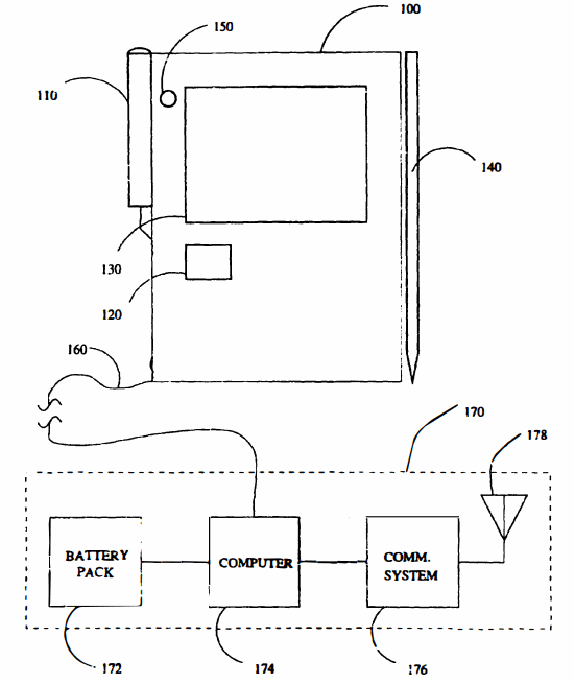
7J.A. 796. As shown in this embodiment, the PDA includes a video camera (110), an auxiliary screen (120) for displaying the image captured by the video camera, a screen for notetaking (130), and a pen (140). J.A. 783–84. Using the pen (140), annotations made on screen (130) “may also be captured and stored together with videoclips from camera 110.” J.A. 784. The PDA can also include a second camera (150), “if the user wishes to make a video recording of himself/herself while recording another person with camera 110.” Id. “In this way, both sides of the conversation may be simultaneously recorded by the two cameras, so that the resulting recordings could be edited later, so that there could, for example, be a cut back and forth8 between the two cameras to follow the natural flow of the conversation.” Id. The PDA is also connected via a wire (160) to a separate body worn pack (170) that allows the device to connect to the internet. Id.
Mann also teaches a “wristwatch embodiment 300 of the invention depicted in Fig[ure] 1,” J.A. 785, which is shown in Figure 3:

J.A. 798. As illustrated, a wristwatch houses a first camera (310) pointed to record a person other than the wearer9 and a second camera (350) to record the wristwatch wearer interviewing the other person. J.A. 785. The wristwatch also includes a viewfinder in the form of an auxiliary screen (320), which shows the image from the first camera. Id. Like in the embodiment shown in Figure 1, a separate internet-connected computer system is worn as a body pack. In this embodiment, “[c]amera 310 points forward such that, for example, while a customer is wearing the wristwatch embodiment of the invention and is standing at a counter, he or she can place his or her arm naturally upon the counter and aim the camera 310 at the official behind the counter without appearing unusual.” Id. Mann teaches that “[i]nteraction with the wristwatch version of the invention . . . may be done through a pen-based or touch-based interface to the screen.” J.A. 786.
B
In its IPR Petition, Apple stated that, “[b]ecause Mann, like the ’924 Patent, discloses a portable camera system that may be controlled by human gesture input, Mann is in the same field of endeavor as the ’924 Patent.” J.A. 106 (comparing J.A. 773, 783–84, 786, with ’924 patent Abstract, col. 25 ll. 40–41, 50–63). But in describing Amir, Apple argued that, “[b]ecause Amir, like the ’924 Patent, discloses a portable camera system that controls the operation of the device based on captured image information, Amir is in the same field of endeavor as the ’924 Patent.” J.A. 142–43 (citing the same part of the ’924 patent’s specification as for Mann). And in describing Aviv, Apple contended that “[b]ecause Aviv, like the ’924 Patent, discloses a camera system that controls the operation of the device based on captured image information, Aviv is in the same field of endeavor as the ’924 Patent.” J.A. 154 (citing the same part of the ’924 patent’s specification as for Mann).
The Board instituted the IPR. In its Patent Owner Response after institution, Gesture Technology contended that Apple failed to establish that Mann was analogous art10 to the ’924 patent. As to the field of endeavor test, Gesture Technology argued that Apple improperly failed to “identif[y] a field of endeavor for either the ’924 Patent or Mann. Instead, [Apple] has found teachings in the two documents that allegedly overlap, and then deemed the two documents as belonging to the same field of endeavor because of the alleged overlap.” J.A. 284. Gesture Technology further pointed out that Apple had failed to identify a shared problem from both the ’924 patent and Mann, thus failing to meet the reasonably pertinent to a particular problem test.
In its Petitioner’s Reply, Apple’s entire response regarding whether Mann was analogous art was:
For Mann . . . , Patent Owner alleges the Petition failed to define a field of endeavor in its analogous art discussions. Patent Owner is wrong. For Mann, the petition applies an identical field of endeavor definition to that applied to Numazaki— [i.e., ]Mann, Numazaki, and the ’924 Patent are each directed to “a portable camera system that may be controlled by human gesture input[.]” Tellingly, Patent Owner does not take issue with the field of endeavor analysis applied to Numazaki.
J.A. 359 (citations omitted) (third alteration original).
C
In its Final Written Decision, the Board held that Apple had not carried its burden to show Mann was in the same field of endeavor as the ’924 patent and had waived any argument under the reasonably pertinent to a particular problem test, thus failing to demonstrate that Mann was analogous art to the ’924 patent. Apple does not challenge the Board’s finding of waiver on appeal.
The Board explained that, under the field of endeavor test, Apple took the “unique approach” of not expressly defining the field of endeavor for either the ’924 patent or11 Mann, and instead only identified an “overlap in a general category of disclosure,” J.A. 11: “a portable camera system that may be controlled by human gesture input.” Id. (quoting J.A. 106). But, the Board further explained, this approach led Apple to characterize the ’924 patent’s field of endeavor differently when discussing prior art references Amir and Aviv—i.e., as “a camera system that controls the operation of the device based on captured image information.” J.A. 12 (citing J.A. 142–43, 154). Moreover, the Board continued, Mann does not “disclose[] a camera system that controls the operation of the device based on captured image information.” Id. (alteration in original). When asked about this at the hearing, Apple characterized the ’924 patent’s field of endeavor “in relation to Amir and Aviv as ‘slightly broader’ than” and “not competing” with that for Mann. Id. (citation omitted). The Board was not convinced:
[Apple]’s asserted field of endeavor covering Mann does not require that the human gesture input be “captured image information” as it does for Amir and Aviv. On the other hand, if the field of endeavor of “a portable camera system that may be controlled by human gesture input” requires that the human gesture input be “captured image information,” then the field of endeavor does not cover Mann.
J.A. 12–13. The Board thus found that Apple had not satisfied its burden to show that Mann is analogous art to the ’924 patent.
The Board went on to describe how Apple provided no analysis as to why it was appropriate to have different fields of endeavor based on the same cited disclosures in the ’924 patent, providing as an example Apple’s “contradictory positions that the cited portions of the ’924 patent teach that the field of endeavor may or may not require ‘control[ of] the operation of the device based on captured12 image information,’” and “may or may not require ‘human gesture input.’” J.A. 13 (alteration in original). The Board then considered the three citations Apple provided from the ’924 patent in reference to Mann and found that none supported Apple’s position that camera based sensing is optional: “the Abstract refers to camera based sensing, 25:40–41 says a handheld computer includes a camera, and 25:50–63 describes a camera obtaining an image of many things, including gestures.” J.A. 14.
The Board further found that Apple’s proposed field of endeavor for the ’924 patent and Mann—“a portable camera system that may be controlled by human gesture input”—was inconsistent with its prior statements and the ’924 patent itself. Id. First, the Board noted that the parties’ descriptions of the ’924 patent from before the analogous art dispute arose described the ’924 patent as directed to “computer devices that optically sense human input using one or more cameras, contemplating applications in a variety of fields such as computing, gaming, medicine, and education.” Id. (quotation marks and citation omitted) (cleaned up). And both parties described the ’924 patent’s embodiments and claims as “requiring computer devices that optically sense human input using one or more cameras.” Id. (citations omitted). The Board explained that the parties’ descriptions were consistent with the Title, Abstract, Field of the Invention, and claims of the ’924 patent. J.A. 15 (citing ’924 patent Title (“Camera Based Sensing . . .”), Abstract (“. . . TV camera and computer based sensing . . .”), col. 2 ll. 7–23 (“. . . optically sensing a human input . . .”), claim 1 (“a first camera . . . and a second camera” “perform a control function of the handheld device based on at least one of the first camera output and the second camera output”)). The Board thus “agree[d] with the parties that the ’924 patent is directed to computer devices that optically sense human input using one or more cameras.” Id. (quotation marks and citation omitted) (cleaned up). Accordingly, the Board found that Apple’s13 proposed field of endeavor for Mann was both too narrow, as it included “portable,” and too general, as it included “‘human gesture input’ not tied to optically sensing the input with a camera.” Id. The Board explained that “camera based sensing of the input is the one feature that is present in all of the noted sections of the ’924 patent and is highlighted by the parties,” and was also “included in the fields of endeavor with respect to Amir and Aviv in the Petition, but absent without explanation” for Mann. Id.
Because Apple relied on Mann in all grounds in its Petition, the Board determined that Apple had not proven by a preponderance of the evidence that any of the challenged claims were unpatentable. Apple appeals. We have jurisdiction under 28 U.S.C. § 1295(a)(4)(A).
DISCUSSION
Our precedent sets forth two separate tests to define the scope of analogous art: “(1) whether the art is from the same field of endeavor, regardless of the problem addressed and, (2) if the reference is not within the field of the inventor’s endeavor, whether the reference still is reasonably pertinent to the particular problem with which the inventor is involved.” Airbus S.A.S. v. Firepass Corp., 941 F.3d 1374, 1379 (Fed. Cir. 2019) (quoting In re Bigio, 381 F.3d 1320, 1325 (Fed. Cir. 2004)). “Whether a prior art reference qualifies as analogous prior art is a question of fact that we review for substantial evidence.” Netflix, Inc. v. DivX, LLC, 80 F.4th 1352, 1358 (Fed. Cir. 2023).
Based on the record before us, we hold that substantial evidence supports the Board’s finding that the field of endeavor of the ’924 patent is computer devices that optically sense human input using one or more cameras. See J.A. 15. Indeed, Apple advanced a consistent field of endeavor as one of its two proposals. As discussed, Apple proffered conflicting fields of endeavor: first, for Mann, a “portable camera system that may be controlled by human gesture input,” J.A. 106, and similarly for Numazaki a14 “portable camera system that may be controlled by human gesture input,” J.A. 110, but it later proposed for Amir a “portable camera system that controls the operation of the device based on captured image information,” J.A. 142–43 (emphasis added), and similarly for Aviv a “camera system that controls the operation of the device based on captured image information,” J.A. 154 (emphasis added). The Board essentially adopted the narrower of Apple’s proposals, requiring optical sensing. We cannot say that the Board erred on this record. In other words, substantial evidence supports the Board’s finding because Apple’s proffered field for other prior art required optical sensing. Furthermore, the Board’s finding is supported by the ’924 patent itself, including by the Title, “Camera Based Sensing . . . ”; the Abstract, which discloses “. . . camera and computer based sensing . . . ”; and the “Field of Endeavor,” which states that “the invention relates to simple input devices for computers . . . operating by optically sensing a human input to a display screen or other object and/or the sensing of human positions or orientations.” ’924 patent col. 2 ll. 7–11.
Additionally, the field of invention that a patent is directed to generally should not vary based on the prior art reference it is being compared to for purposes of the analogous art inquiry. That is not to say it could never vary, and we acknowledge that the analogous art inquiry is highly factual and “the scope of any field of endeavor will vary with the factual description of each invention.” Bigio, 381 F.3d at 1326. There may be some situations where a patent might have more than one field of endeavor—for example, where the specification discloses various distinct embodiments and the claims-at-issue are directed to one of them. But that is not the case here, and we see no basis for Apple’s attempt to define the field of endeavor differently based on the very same cited disclosures from the patent-in-suit in relation in an attempt to show different prior art references are analogous to the claims.
15Moreover, we cannot say that the Board erred in finding Mann non-analogous given how Apple litigated this issue before the Board. Under SAS Institute, Inc. v. Iancu, and the Administrative Procedure Act (APA), the Board is limited by the parties’ presentation of arguments and evidence to arrive at its fact findings. 584 U.S. 357, 363–68 (2018).5 Apple did not rely on the second prong of the analogous art test—i.e., that Mann is “reasonably pertinent to the particular problem with which the inventor is involved.” Airbus, 941 F.3d at 1379. We do not decide whether a broader and more general statement of the field of endeavor was available had the parties adopted a broader interpretation of claim 1.6 Here, Apple’s proffered claim construction is not inconsistent with the Board’s fact finding on the field of endeavor.
Our opinion in this case should serve as a warning to patent owners and petitioners alike in proceedings before the Board. When a patent owner challenges whether an asserted prior art reference is analogous, the petitioner16 must devote care and effort to carefully defining the field of the invention, addressing the reasonably pertinent problem test where necessary, and fully responding based on the facts and law. Otherwise, petitioners run the risk of an adverse fact finding with little basis for challenging that finding on appeal under our standard of review, which merely asks whether there is “such relevant evidence as a reasonable mind might accept as adequate to support” said fact finding. Arendi S.A.R.L. v. Google LLC, 882 F.3d 1132, 1133 (Fed. Cir. 2018) (quoting Consol. Edison Co. of N.Y. v. NLRB, 305 U.S. 197, 229 (1938)) (describing the substantial evidence standard); see also Medtronic, Inc. v. Teleflex Innovations S.a.r.l., 69 F.4th 1341, 1348 (Fed. Cir. 2023) (quoting Velander v. Garner, 348 F.3d 1359, 1378 (Fed. Cir. 2003)) (explaining that even “[i]f the evidence will support several reasonable but contradictory conclusions, we will not find the Board’s decision unsupported by substantial evidence simply because the Board chose one conclusion over another plausible alternative.”).
CONCLUSION
We have considered Apple’s arguments and find them unpersuasive. For the foregoing reasons, we affirm the Board’s holding that Apple had not carried its burden to show the challenged claims of the ’924 patent were unpatentable.
AFFIRMED
17NOTE: This disposition is nonprecedential. United States Court of Appeals
for the Federal Circuit
APPLE INC.,
Appellant
v.
GESTURE TECHNOLOGY PARTNERS, LLC,
Appellee
2023-1494
Appeal from the United States Patent and Trademark Office, Patent Trial and Appeal Board in Nos. IPR2021-00923, IPR2022-00093, IPR2022-00361.
PROST, Circuit Judge, dissenting.
I appreciate the majority’s emphasis on the “unique” factual circumstances of this case, which may have driven the result here. Maj. 10–11. However, I remain concerned that the Board’s approach to the field-of-endeavor analysis is too narrow and contradicts our case law repeatedly holding analogous art should be construed “broadly.” Wyers v. Master Lock Co., 616 F.3d 1231, 1238 (Fed. Cir. 2010); see also Netflix, Inc. v. DivX, LLC, 80 F.4th 1352, 1359 (Fed. Cir. 2023). I respectfully dissent and would reverse the Board on substantial-evidence review. Further, I respectfully disagree that the Board did not violate the APA. The18 Board, in my view, violated the APA by going beyond the scope of the parties’ arguments and defining a new field of endeavor in the final written decision that was not advanced by either party without giving notice and an opportunity to respond. I address these two issues below.
I
The Mann prior-art reference discloses a device that has two cameras, senses human input, and uses that input to control the device. Mann does not, however, use human input sensed by the cameras to control the device; that is the point of novelty of the ’924 patent. Yet, because Mann does not disclose this feature, the Board excluded it altogether from the obviousness analysis.
At bottom, the Board erred by defining the field of endeavor of the ’924 patent too narrowly, focusing on the specific point of novelty. This is not, in my view, consistent with our holding in Unwired Planet, LLC v. Google Inc., 841 F.3d 995 (Fed. Cir. 2016). In Unwired, we held that “[t]he field of endeavor of a patent is not limited to the specific point of novelty, the narrowest possible conception of the field, or the particular focus within a given field.” Id. at 1001.
The Board defined the field of endeavor for the ’924 patent as computer devices that optically sense human input using one or more cameras. J.A. 15. The Board’s analysis reveals that it also imported a control function into this definition (i.e., actuation of functionality based on the optically sensed human input). J.A. 15 (“Implicit in this statement is that the human input is used to control the computer device.”). To suggest, as the Board does, that the field of endeavor must be limited to camera-based sensing used for controlling the computer device essentially short-circuits the ultimate obviousness inquiry. The Board’s finding also goes against the general rule that we should “construe the scope of analogous art broadly,” comporting with the broad and flexible approach to obviousness19 demanded by KSR. Wyers, 616 F.3d at 1238 (citing KSR Int’l Co. v. Teleflex, Inc., 550 U.S. 398 (2007)).
The Board also took issue with Apple having articulated the field of endeavor in multiple, allegedly contradictory, ways. J.A. 12–13. But the notion that the field of endeavor for a patent can only ever be articulated a single way goes too far. As the majority recognizes, there is no per se rule that a patent’s field of endeavor must be articulated in only one way. Maj. 14. What matters is “that the prior art reference falls within the relevant field of endeavor of the patent-in-suit.” Netflix, 80 F.4th at 1359. So, it makes sense why the “relevant” articulation of the field of endeavor might differ depending on the prior-art reference at issue; the relevant one is the one that overlaps with the prior-art reference. In any event, I do not believe that substantial evidence supports the Board’s finding that the fields of endeavor articulated by Apple are contradictory. Rather, the different articulations of field of endeavor with respect to the different references serve to highlight different (but complementary) points of commonality between the respective references and the ’924 patent. See Appellant’s Br. 31.
II
I am also concerned with the Board’s definition of a new field of endeavor in its final written decision that was not advanced by either party. Apple articulated a field of endeavor in its Petition with respect to Mann, which is the same field of endeavor noted in its reply. In response to the Petition, Gesture did not argue that the field of endeavor was incorrect. Rather, Gesture argued that Apple failed to articulate a field of endeavor for either the ’924 patent or Mann. J.A. 284. While Gesture itself had no burden to identify the field of endeavor for Apple, the fact remains that Gesture made a singular argument in its Patent Owner Response that facially failed because Apple demonstrated the Petition did articulate a field of endeavor with20 respect to Mann and the ’924 patent. This should have been the end of the Board’s inquiry on the matter.
While I disagree that the Board’s reasoning as to Apple’s identified field of endeavor was supported by substantial evidence (as explained above), it was further erroneous and a violation of the APA for the Board to go beyond the parties’ arguments and define a new field of endeavor without giving notice and an opportunity to respond.
For these reasons, I respectfully dissent.
Footnotes
- ↩ 1 U.S. Patent No. 6,144,366.
- ↩ 2 Canadian Published Patent Application No. 2,237,939.
- ↩ 3 U.S. Patent No. 6,539,100.
- ↩ 4 U.S. Patent No. 5,666,157.
- ↩ 5 We are also not persuaded by Apple’s contention the Board violated the APA when it resolved the parties’ dispute over whether Mann was analogous art. As discussed above, Apple was on notice that Gesture Technology was disputing whether Mann qualified as analogous art, Apple did not itself define what the ’924 patent’s field of endeavor was, and the Board’s adopted field of endeavor is consistent with one proposed by Apple itself, albeit for a different prior art reference. In these circumstances, we do not see how Apple did not have notice or the opportunity to respond to the Board’s findings.
- ↩ 6 Both parties read claim 1 to require camera based sensing of non-touch gestures and interpreted the camera based sensing inputs as controlling commands of the device. See, e.g., Appellant’s Br. 28; J.A. 448 (Evidentiary Hearing Tr. 26:19–26); Oral Arg. at 1:51–2:08.