NOTE: This disposition is nonprecedential. United States Court of Appeals
for the Federal Circuit
CCS TECHNOLOGY, INC.,
Appellant
v.
PANDUIT CORP.,
Appellee
2018-1733, 2018-1734
Appeals from the United States Patent and Trademark Office, Patent Trial and Appeal Board in Nos. IPR2016-01647, IPR2016-01648.
Decided: July 19, 2019
JOHN C. O'QUINN, Kirkland & Ellis LLP, Washington, DC, argued for appellant. Also represented by HANNAH LAUREN BEDARD, JASON M. WILCOX; ERIC DAVID HAYES, Chicago, IL.
JOHN J. MOLENDA, Steptoe & Johnson, LLP, New York, NY, argued for appellee. Also represented by ROBERT GREENFELD; KELLY J. EBERSPECHER, DANIEL STEVEN STRINGFIELD, Chicago, IL; KATHERINE DOROTHY CAPPAERT, Washington, DC.
2Before TARANTO, MAYER, and CHEN, Circuit Judges.
Patent Owner CCS Technology Inc. (CCS) appeals from the final written decision of the Patent Trial and Appeal Board (Board) in two inter partes reviews finding unpatentable claims 1–3 and 8–10 of CCS’s U.S. Patent No. 6,869,227 (’227 patent) and claims 1 and 2 of U.S. Patent No. 6,758,600 (’600 patent) as anticipated by Japanese Patent No. H11-160542 (Toyooka), as well as finding claims 1 and 2 of the ’600 patent obvious in view of Toyooka and U.S. Patent No. 6,604,866 (Kang).
Because we agree with the Board’s claim constructions and conclude that the Board’s findings are supported by substantial evidence, we affirm.
A. BACKGROUND
The ’227 and ’600 patents are related patents that share a virtually identical specification and are both directed to systems for managing bi-directional fiber optic communications. See ’227 patent col. 1 ll. 11–13; ’600 patent col. 1 ll. 7–9. At issue in this appeal is the proper construction of a claim term that appears in substantially identical form in each of the challenged independent claims: “optical ribbon” (’227 patent) and “optical fiber ribbon” (’600 patent). Claim 1 of the ’227 patent is representative and is directed to a universal breakout harness for reversing the polarity of optical fibers. The universal breakout harness carries optical signals from a source to a target by sending and receiving data sent as light through the optical fibers of the optical ribbons. Claim 1 of the ’227 patent reads as follows:
1. A universal breakout harness for reversing the polarity of optical fibers, comprising:
3a multi-fiber connector with multiple optical paths formed therein, the optical paths being arranged in a generally planar array with each optical path being immediately adjacent to at least one other optical path; a plurality of optical fibers of an optical ribbon disposed in the optical paths formed in the multi-fiber connector; and a plurality of optical fiber connectors disposed opposite the multi-fiber connector, the plurality of optical fiber connectors defining a plurality of pairs of optical paths for receiving the optical fibers of the optical ribbon; wherein the optical fibers of the optical ribbon are separated and routed between the optical paths formed in the multi-fiber connector and the pairs of optical paths defined by the plurality of optical fiber connectors; and wherein the optical fibers in at least one of the pairs of optical paths defined by the plurality of optical fiber connectors are selected from optical fibers disposed in optical paths formed in the multi-fiber connector that are not immediately adjacent to each other.
’227 patent col. 4 ll. 33–54 (emphases added).
The Board construed the “optical ribbon” limitation (and corresponding “optical fiber ribbon” limitation of the ’600 patent) to “encompass[] optical fibers that are bonded together in a generally planar array or optical fibers that are grouped and aligned in a generally planar array.” J.A. 19 (emphases added). The Board found that Toyooka describes the subject matter of the optical ribbon limitations under its construction. J.A. 49.
4CCS argues on appeal that the Board erred in concluding that the optical ribbon limitations encompass individual fibers that are not necessarily bound together. According to CCS, the optical ribbon limitations are not so broad that they encompass fibers that are merely “grouped and aligned in a generally planar array.” We have jurisdiction pursuant to 28 U.S.C. § 1295(a)(4)(A).
B. DISCUSSION
As the parties agree, in this matter the Board was charged with construing claims in accordance with the broadest reasonable interpretation consistent with the specification. Cuozzo Speed Techs., LLC v. Lee, ––– U.S. – –––, 136 S. Ct. 2131, 2142 (2016). We review the Board’s ultimate claim construction de novo and any underlying factual determinations involving extrinsic evidence for substantial evidence. Teva Pharm. U.S.A., Inc. v. Sandoz, Inc., –––U.S. ––––, 135 S. Ct. 831, 841–42 (2015). The principle that the same limitation in different claims of the same patent or related patents should carry the same construed meaning is a strong one, overcome only if it is clear that the same limitation has different meanings in different claims. In re Varma, 816 F.3d 1352, 1363 (Fed. Cir. 2016); Omega Eng’g, Inc, v. Raytek Corp., 334 F.3d 1314, 1334 (Fed. Cir. 2003).
CCS believes the optical ribbon limitations should be construed to mean “a group of optical fibers that are coated with a ribbon common layer.” To support this construction, CCS refers to the specification’s statement that “[a]n optical ribbon includes a group of optical fibers that are coated with a ribbon common layer.” ’227 patent col. 1, ll. 18–19 (emphasis added); ’600 patent col. 1, ll. 14–15 (same). CCS argues the word “includes” is definitional rather than illustrative.
Upon reading the entire patent, we decline CCS’s invitation to read “ribbon common layer” into the optical ribbon limitations. The claims do not recite a ribbon common5 layer coating. As the Board pointed out, other references in the specification indicate that the fibers of an “optical ribbon” do not need to be bound together by a ribbon common layer. J.A. 13–18 (citing ’227 patent col. 3 ll. 30–33, col. 4 l. 65–col. 5 l. 4, FIG. 2). Specifically, the Board relied on claim 3 of the ’227 patent, reproduced in pertinent part below, which recites an “optical ribbon” that encompasses individual fibers:
installing one end of the optical ribbon into a multi-fiber connector with the optical fibers of the optical ribbon arranged in sequential number from left to right; and installing the other end of the optical ribbon into a plurality of optical fiber connectors with the optical fibers of the optical ribbon arranged in reverse sequential number from left to right.
’227 patent col. 4 l. 65–col. 5 l. 4 (emphasis added). The claimed recitation of “the other end of the optical ribbon” corresponds to the fibers between multi-fiber connector 40 and connector stations 51–56 in Figure 2:
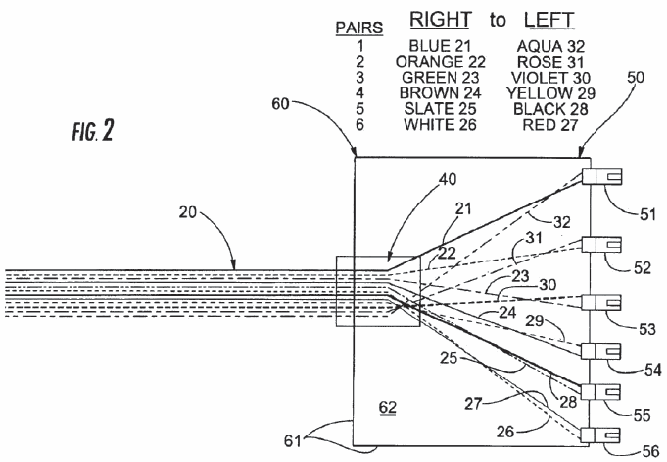
6Id. at FIG. 2. The specification only describes interconnecting the multi-fiber connector 40 and connector stations 51– 56 with individual fibers. See, e.g., id. at col. 3 ll. 30–33. As depicted in Figure 2, the individual fibers that interconnect the multi-fiber connector 40 and connector stations 51–56 are not bound together by a ribbon common layer. See id. at FIG. 2. Thus, CCS’s proposed construction does not comport with claim 3 and the specification’s disclosure of interconnecting the multi-fiber connector and connector stations with unattached fibers. Id. at col. 3 ll. 30–33, col. 4 l. 65–col. 5 l. 4, FIG. 2. Limiting the optical ribbon limitations to only those optical ribbons with a ribbon common layer, as suggested by CCS, would improperly exclude the disclosed embodiment of Figure 2. This court has clarified that an interpretation which “excludes a [disclosed] embodiment from the scope of the claim is rarely, if ever, correct.” Accent Pkg., Inc. v. Leggett & Platt, Inc., 707 F.3d 1318, 1326 (Fed. Cir. 2013); see Phillips v. AWH Corp., 415 F.3d 1303, 1312–13 (Fed. Cir. 2005) (en banc).
CCS acknowledged at oral argument that, as to claim 3 of the ’227 patent, the claimed recitation of “installing the7 other end of the optical ribbon into a plurality of optical fiber connectors” requires “separat[ing] out the fibers to do that.” Oral Argument at 34:17–24. This confirms that the optical fibers need not be bound together by a ribbon common layer to be an “optical ribbon” as recited in claim 3. J.A. 18.
CCS contends that the Board’s construction of the optical ribbon limitations eliminates two supposed “key advantages of the invention[]” stemming from the use of ribbon common layer: protecting the individual fibers and densely packing the fibers into a small space. CCS’s first advantage is based on the specification’s description that the ribbon common layer “may be of the ultraviolent (UV) light curable type” that “protects the optical fibers.” ’227 patent col. 1 ll. 18–27. CCS does not provide any compelling reason why the claims are limited to embodiments with this optional feature. Further the specification describes the multi-fiber connector 40, rather than the optical ribbon, as providing the “high density in a small space.” Id. col. 2 l. 59–col. 3 l. 5.
Lastly, CCS relies on definitions in technical dictionaries to argue that the optical ribbon requires a common layer to bond individual fibers together. The Board found this evidence to be not particularly useful in determining the broadest reasonable interpretation of the optical ribbon limitations in light of the intrinsic record discussed above. We agree that these technical dictionaries do not overcome the intrinsic evidence contained in the ’227 patent. We therefore agree with the Board that the broadest reasonable interpretation of the optical ribbon limitations must encompass optical fibers that are grouped and aligned in a generally planar array, and thus conclude that the specification’s usage of “includes” is best understood as introducing an illustrative example, in the context of this patent.
8CCS’s remaining arguments raised in its briefs relate to whether Toyooka discloses the subject matter of the optical ribbon limitations under CCS’s proposed construction. Having determined that the Board correctly construed the optical ribbon limitations, we need not address CCS’s remaining arguments. We conclude that the Board’s findings as to how the claim limitations involving the optical ribbon limitations are disclosed in Toyooka are supported by substantial evidence. We accordingly affirm the Board’s decision as to unpatentability of the claims at issue.