IN THE UNITED STATES DISTRICT COURT
FOR THE EASTERN DISTRICT OF TEXAS
TYLER DIVISION
SAXON INNOVATIONS, LLC §
§
V. § CIVIL ACTION NO. 6:07-CV-490
§
NOKIA CORP., et al. §
MEMORANDUM OPINION AND ORDER
This claim construction opinion construes the disputed terms in U.S. Patent Nos. 5,502,689 (“the ‘680 Patent”), 5,592,555 (“the ‘555 patent”), 5,771,394 (“the ‘394 Patent”).1 In the above-styled cause of action, Plaintiff Saxon Innovations, LLC accuses Defendants LG Electronics Inc., LG Electronics USA Inc., LG Electronics Mobilecomm U.S.A., Inc., Samsung Electronics Co. Ltd, Samsung Electronics America Inc., Samsung Telecommunications America LLC, Palm Incorporated, Research in Motion Ltd, Research In Motion Corporation, Nintendo Co. Ltd, and Nintendo of America (collectively “Defendants”) of patent infringement. The parties have submitted a number of claim terms for construction. Saxon has filed an Opening Claim Construction Brief (Doc. No. 250) and a Reply Claim Construction Brief (Doc. No. 281). Defendants have jointly filed a Responsive Claim Construction Brief. (Doc. No. 272.) A Markman hearing was held on June 25, 2009. For the reasons stated herein, the Court adopts the constructions set forth below.
CLAIM CONSTRUCTION PRINCIPLES
“It is a ‘bedrock principle’ of patent law that ‘the claims of a patent define the invention to which the patentee is entitled the right to exclude.” Phillips v. AWH Corp., 415 F.3d 1303, 1312
2(Fed. Cir. 2005) (quoting Innova/Pure Water Inc. v. Safari Water Filtration Sys., Inc., 381 F.3d 1111, 1115 (Fed. Cir. 2004)). In claim construction, courts examine the patent’s intrinsic evidence to define the patented invention’s scope. See id.; C.R. Bard, Inc. v. U.S. Surgical Corp., 388 F.3d 858, 861 (Fed. Cir. 2004); Bell Atl. Network Servs., Inc. v. Covad Communications Group, Inc., 262 F.3d 1258, 1267 (Fed. Cir. 2001). This intrinsic evidence includes the claims themselves, the specification, and the prosecution history. See Phillips, 415 F.3d at 1314; C.R. Bard, Inc., 388 F.3d at 861. Courts give claim terms their ordinary and accustomed meaning as understood by one of ordinary skill in the art at the time of the invention in the context of the entire patent. Phillips, 415 F.3d at 1312-13; Alloc, Inc. v. Int’l Trade Comm’n, 342 F.3d 1361, 1368 (Fed. Cir. 2003).
The claims themselves provide substantial guidance in determining the meaning of particular claim terms. Phillips, 415 F.3d at 1314. First, a term’s context in the asserted claim can be very instructive. Id. Other asserted or unasserted claims can also aid in determining the claim’s meaning because claim terms are typically used consistently throughout the patent. Id. Differences among the claim terms can also assist in understanding a term’s meaning. Id. For example, when a dependent claim adds a limitation to an independent claim, it is presumed that the independent claim does not include the limitation. Id. at 1314-15.
Claims “must be read in view of the specification, of which they are a part.” Id. (quoting Markman v. Westview Instruments, Inc., 52 F.3d 967, 979 (Fed. Cir. 1995)). “[T]he specification ‘is always highly relevant to the claim construction analysis. Usually, it is dispositive; it is the single best guide to the meaning of a disputed term.’” Id. (quoting Vitronics Corp. v. Conceptronic, Inc., 90 F.3d 1576, 1582 (Fed. Cir. 1996)); Teleflex, Inc. v. Ficosa N. Am. Corp., 299 F.3d 1313, 1325 (Fed. Cir. 2002). This is true because a patentee may define his own terms, give a claim term a
3different meaning than the term would otherwise possess, or disclaim or disavow the claim scope. Phillips, 415 F.3d at 1316. While courts must generally impose a “heavy presumption” in favor of the ordinary meaning of claim terms, this presumption can be overcome by statements of “clear disclaimer” expressly indicating “manifest exclusion or restriction.” Liebel-Flarsheim Co. v. Medrad, Inc., 358 F.3d 898, 913 (Fed. Cir. 2004); Brookhill-Wilk 1, LLC v. Intuitive Surgical Inc., 334 F.3d 1294, 1301 (Fed. Cir. 2003); see also Phillips, 415 F.3d at 1312-13. Further, this “heavy presumption” does not arise when the patentee acts as his own lexicographer and gives a claim term a different meaning than the term would otherwise possess. See Irdeto Access, Inc. v. Echostar Satellite Corp., 383 F.3d 1295, 1301(Fed. Cir. 2004); see also Nystrom v. TREX Co., 424 F.3d 1136, 1145 (Fed. Cir. 2005). In these situations, the inventor’s lexicography governs. Phillips, 415 F.3d at 1316.
Also, the specification may resolve ambiguous claim terms “where the ordinary and accustomed meaning of the words used in the claims lack sufficient clarity to permit the scope of the claim to be ascertained from the words alone.” Teleflex, Inc., 299 F.3d at 1325. For example, “[a] claim interpretation that excludes a preferred embodiment from the scope of the claim is rarely, if ever correct.” Globetrotter Software, Inc. v. Elan Computer Group, Inc., 362 F.3d 1367, 1381 (Fed. Cir. 2004). But, “‘[a]lthough the specification may aid the court in interpreting the meaning of disputed claim language, particular embodiments and examples appearing in the specification will not generally be read into the claims.’” Comark Commc’ns, Inc. v. Harris Corp., 156 F.3d 1182, 1187 (Fed. Cir. 1998) (quoting Constant v. Advanced Micro-Devices, Inc., 848 F.2d 1560, 1571 (Fed. Cir. 1988)); see also Phillips, 415 F.3d at 1323.
The prosecution history is another tool to supply the proper context for claim construction
4because a patent applicant may also define a term in prosecuting the patent. Home Diagnostics, Inc., v. Lifescan, Inc., 381 F.3d 1352, 1356 (Fed. Cir. 2004) (“As in the case of the specification, a patent applicant may define a term in prosecuting a patent.”). The doctrine of prosecution disclaimer is well established and prevents a patentee from recapturing through claim interpretation specific meanings disclaimed during the prosecution of the patent. See Omega Eng'g, Inc. v. Raytek Corp., 334 F.3d 1314, 1323 (Fed.Cir.2003). The prosecution history must show that the patentee “clearly and unambiguously” disclaimed or disavowed the proposed interpretation during the patent's prosecution to obtain claim allowance. Middleton, Inc. v. 3M Co., 311 F.3d 1384, 1388 (Fed.Cir.2002). “Indeed, by distinguishing the claimed invention over the prior art, an applicant is indicating what the claims do not cover.” Spectrum Int'l v. Sterilite Corp., 164 F.3d 1372, 1378-79 (Fed.Cir.1998). “As a basic principle of claim interpretation, prosecution disclaimer promotes the public notice function of the intrinsic evidence and protects the public's reliance on definitive statements made during prosecution.” Omega Eng'g, Inc., 334 F.3d at 1324.
Although extrinsic evidence can be useful, it is “less significant than the intrinsic record in determining ‘the legally operative meaning of claim language.’” Phillips, 415 F.3d at 1317 (quoting C.R. Bard, Inc., 388 F.3d at 862). Technical dictionaries and treatises may help a court understand the underlying technology and the manner in which one skilled in the art might use claim terms, but technical dictionaries and treatises may provide definitions that are too broad or may not be indicative of how the term is used in the patent. Id. at 1318. Similarly, expert testimony may aid a court in understanding the underlying technology and determining the particular meaning of a term in the pertinent field, but an expert’s conclusory, unsupported assertions as to a term’s definition is entirely unhelpful to a court. Id. Generally, extrinsic evidence is “less reliable than the patent and
5its prosecution history in determining how to read claim terms.” Id.
DISCUSSION
I. The ‘689 Patent
A. Overview of the Patent
The ‘689 Patent describes a way to reduce power consumption and conserve the battery life of an electronic device by stopping the device’s clock signal. ‘689 Pat. at 1:59-63. A clock signal is a regularly timed pulse used to synchronize the operations of a microprocessor. PL.’S BR. at 4; DEF’S TECH. TUTORIAL. If a microprocessor stops receiving clock pulses, it will stop executing instructions and enter a “power-down” or “shut-down” mode in which power consumption is reduced. ‘689 Pat. at 2:25-30. According to the ‘689 Patent, this method for reducing power consumption was well known in the prior art, but it presented several problems. Software errors or noise could trigger an inadvertent entry into shut down mode, a premature entry into shut down mode, or entry into shut down mode without any means to exit shut down mode. ‘689 Pat. at 2:22-3:7. The ‘689 Patent endeavors to solve these problems by requiring that the signal requesting that the device enter shut-down mode conform to a protocol.
Figure 1 shows a clock generator capable of entering shut-down mode:

6During normal operation, Oscillator 10 generates regular clock pulses which are ultimately sent to various modules in a device. ‘689 Pat. at 6:20-22. When the device needs to enter shut down mode, a signal is sent to the clock generator on line 48. ‘689 Pat. at 7:59-62. Register Access Circuit 20 provides a protection scheme to verify the signal on line 48. ‘689 Pat. at 7:59-8:16. This protection scheme is a predetermined protocol requirement which avoids inadvertent placement of the clock generator into shut-down mode. Once the signal on line 48 is verified, Register Access Circuit 20 sends a SDENTR signal along line 30 to Shut Down Control Circuit 12. ‘689 Pat. at 8:14-17. This Circuit sends a START TIMER signal to Shut-Down Entry Delay Timer 14. Timer 14 provides a delay for a “predetermined length of time” to allow one or more of the device modules to enter an idle state. ‘689 Pat. at 6:59-62. After this delay, a STOP OSCILLATOR signal is sent to Oscillator 10 to stop the clock pulses. The device is now in shut-down mode.
7The “predetermined length of time” is calculated by means of a separate clock. This clock, which is external to the clock generator, constantly sends clock pulses to the Shut Down Entry Delay Timer 14 at 280.9 Hz. ‘689 Pat. at 7:4-10. This clock is significantly slower than the clock pulses of Oscillator 10. Once Timer 14 receives the START TIMER signal, it waits to receive two clock pulses from the external clock, and then sends the STOP OSCILLATOR signal. ‘689 Pat. at 7:10-16. The timing of this process is shown in Figure 2:

At time t0 the SDENTR signal is asserted. ‘689 Pat. at 8:30-34. At time t1 Timer 14 receives a first pulse from the external clock. At time t2, Timer 14 receives the second pulse, and shuts down Oscillator 10. ‘689Pat. at 8:38-42. At 280.9 Hz, the time between each pulse of the external clock is 3.56ms. Because the SDENTR signal may be asserted at any time, it may take between 3.56ms and 7.12ms for Timer 14 to receive two clock pulses from the external clock. ‘689 Pat. at 8:38-43.
The following claims are at issue: 5. A method for controlling at least one output clock signal comprising the steps of: receiving a disable request signal;
stopping said at least one output clock signal after a predetermined length of time after receiving said disable request signal;
receiving an enable request signal; and starting said at least one output clock signal after receiving said enable request signal,
8wherein said step of stopping said at least one output clock signal comprises the steps of verifying that said disable request signal satisfies a predetermined protocol requirement, and processing said disable request signal only if said disable request signal satisfies said predetermined protocol requirement. [. . .] 8. A method as recited in claim 5 wherein the step of stopping said at least one output clock signal comprises the step of stopping said at least one output clock signal after said predetermined length of time following the most recent assertion of said disable request signal.
B. The Terms in Dispute
The parties present the following terms for construction.
1. “disable request signal”
| Claim Term | Plaintiff’s Proposal | Defendants’ Proposal |
| “disable request signal” Claims 5, 8 | a signal to initiate entry into a shut-down mode | a signal that requests the system to stop the output clock signal and that starts the predetermined length of time |
Saxon argues that the “disable request signal” corresponds with signal 48 of Figure 1. PL.’S BR. at 5. Defendants argue that the language of claim 5 requires that the “disable request signal” correspond with signal 48 and the SDENTR signal of Figure 1. DEF.’S BR. at 2. They point out that claim 1 describes two separate signals: a “shut-down entry request signal” which corresponds with signal 48, and a “disable activation signal” which corresponds with the SDENTR signal. Claim 5, on the other hand, only recites one signal by name—a “disable request signal.” Defendants argue that because this is the only signal identified in claim 5, it must perform both of the functions of the signals identified in claim 1.
Regardless of the merits of Defendants’ interpretation of claim 1, Defendants’ interpretation of claim 5 is not supported by the plain language of the claim. Claim 5 recites the step of “stopping
9said at least one output clock signal . . . after receiving said disable request signal” wherein this signal is processed only if it satisfies a predetermined protocol requirement. In other words, claim 5 recites the steps of (1) receiving a disable request signal, (2) verifying it, and (3) stopping the output clock signal only after the disable request signal has been received and verified and a predetermined length of time has elapsed.2 There is no requirement that the disable request signal must start the predetermined length of time. In fact, Defendants’ interpretation would exclude the figure 1 embodiment, which shows a separate signal initiating the predetermined length of time after signal 48 is verified, from the scope of this claim. See Globetrotter Software, Inc., 362 F.3d at 1381 (“A claim interpretation that excludes a preferred embodiment from the scope of the claim is rarely, if ever correct.”). Thus, the Court rejects Defendants’ proposed construction to the extent that it requires the disable request signal to start the predetermined length of time.
Having resolved the parties’ claim scope dispute, the Court must determine how best to construe this term for a lay jury. Defendants argue that Saxon’s proposed construction contains two needlessly ambiguous terms: “shut-down mode,” and “initiate entry into.” Although the term “shut-down mode” does not appear in the language of claim 5, it is adequately described throughout the ‘689 Patent. The title of this patent is “Clock Generator Capable of Shut-Down Mode and Clock Generation Method.” Furthermore, the patent specification consistently describes “shut-down mode” as a power saving mode in which “the clock generator does not generate any clock signals.” ‘689 Pat. at 3:11-15. Therefore, the Court finds that the term “shut-down mode” is not ambiguous. The term
10“initiate,” on the other hand, is more problematic. The patent specification uses this term in a number of different contexts. See ‘689 Pat. at 7:59-64, 8:49-52.
The Court finds that the proper construction of this term is “a signal requesting the system enter into shut-down mode.”
2. “predetermined length of time”
Claim Term Plaintiff’s Proposal Defendants’ Proposal “predetermined length an amount of time defined prior to or a definite amount of time fixed prior of time” at the time of receipt of the disable to receipt of the disable request
request signal signal
Claims 5, 8 “stopping said at least halting the output clock signal stopping the output clock signal at one output clock following an amount of time defined the expiration of an amount of time signal after a prior to or at the time of receipt of that is fixed prior to, and starts predetermined length the disable request signal from, receipt of the disable request of time after receiving signal said disable request signal” Claim 5
While the parties point out flaws in their respective proposals, according to the parties’ technology tutorials, the parties agree on the basic operation of the invention disclosed in the ‘689 specification. The ‘689 specification describes a preferred embodiment in which the predetermined length of time varies between 3.56ms and 7.12ms depending on when the SDENTR signal is asserted relative to the external clock. ‘689 Pat. at 8:30-47. Nonetheless, Defendants appear to argue that claim 5 requires that the predetermined length of time be an exact time, e.g. exactly 4ms, rather than a time period, e.g. 3.56ms-7.12ms.
Defendants point out that, as originally written, the patentee tried to claim a “predetermined minimum amount of time.” Defendants argue that because these claims were abandoned or rejected, the
11patentee may not now reclaim subject matter that it abandoned during prosecution. Defendants’ argument is misplaced for two reasons. First, by removing the word “minimum” the patentee broadened the scope of its claims; these amendments did not narrow claim scope. For example, a minimum amount of time would be “at least 5ms.” A “length of time” may include, “exactly 5ms,” “at least 5ms,” “between 3ms and 7ms,” or “up to 5ms.” Second, although the prosecution history cited by Defendants shows that the patentee removed the word “minimum” from the claims, the patentee offered no explanation for why this change was made. This amendment does not clearly and unambiguously disclaim any claim scope, and it certainly does not disclaim the preferred embodiment. See Omega Eng’g, Inc., 334 F.3d at 1323. Accordingly, the Court rejects Defendants proposal to the extent that it limits the predetermined length of time to a predetermined exact time.
The Court finds that Saxon’s construction does not clearly encompass the idea that the predetermined length of time refers to a time that may vary within a known time period. The Court finds that the proper construction of the term “predetermined length of time” is “a length of time within a known time period.” Because this construction resolves the parties’ claim scope dispute, the larger phrase “stopping said at least one output clock signal after a predetermined length of time after receiving said disable request signal” need not be construed. See O2 Micro Int’l Ltd. v. Beyond Innovation Tech. Co., 521 F.3d 1351, 1362 (Fed. Cir. 2008); Fenner Inv. Ltd. v. Microsoft Corp., No. 6:07-cv-8, 2008 WL 3981838 at *3 (E.D. Tex. Aug. 22, 2008) (finding that a court need not construe a disputed term as long as it has resolved the claim scope dispute between the parties).
3. “predetermined protocol requirement”
| Claim Term | Plaintiff’s Proposal | Defendants’ Proposal |
| “predetermined protocol requirement” | a requirement of a defined protection scheme | Defendants contend that this claim term is more appropriately construed in the context of the larger claim |
| Claim 5 | phrase in which it appears, below. | |
| “verifying that said disable request signal satisfies a predetermined protocol requirement” Claim 5 | confirming that said disable request signal meets a requirement of a defined protection scheme | confirming that the received disable request signal satisfies a predetermined series of steps |
12The primary dispute with regard to these terms is the meaning of the word “protocol.” Both parties cite to the definition of “protocol” contained in the same dictionary. See IEEE Standard Dictionary of Electrical and Electronic Terms, The Institute of Electrical and Electronics Engineers, Inc., 1984 (“[a] set of conventions or rules that govern the interactions of processes or applications within a computer system”). At the hearing, the Court proposed a construction based on this definition, i.e. construing “verifying that said disable request signal satisfies a predetermined protocol requirement” as “confirming that said disable request signal satisfies a known set of rules.” See Markman Hr’g Tr. at 46:18-20 (June 25, 2009). Saxon agreed to this construction. Id. at 47:7-8.Defendants argued that this construction is inconsistent with the patent specification. Id. at 47:12-24.
The Court begins its construction by consulting the claim language. Phillips, 415 F.3d at 1314. In this case, the plain and ordinary meaning of the term “protocol,” as evidenced by the parties’ dictionary definitions, is a known set of conventions or rules. Defendants argue that the Court’s construction should diverge from this plain and ordinary meaning because the only disclosed example of a predetermined protocol requirement involves a series of sequential steps rather than a set of rules. Defendants cite to the patent specification, which states that “the predetermined protocol requirement may be a predetermined number of writes in a predetermined order to the at least two registers.” ‘689 Pat. at 3:58-60. However, at most, this statement shows that the patent
13discloses one embodiment in which the predetermined protocol requirement involves a series of steps. Defendants have not cited any statements of disclaimer, or any other reason to import this limitation into the claim language. Liebel-Flarsheim Co., 358 F.3d at 913; Brookhill-Wilk 1, LLC, 334 F.3d 1294, 1301; see also Phillips, 415 F.3d at 1312-13.
Saxon’s original proposed claim construction is similarly flawed. While the patent explains that the purpose of the predetermined protocol requirement is for protection from inadvertent entry into shut-down mode, ‘689 Pat. at 8:13-16, Saxon offers no reason to import this purpose into the claim as a limitation. Furthermore, the term “defined protection scheme” would be unnecessarily confusing for a jury.
Therefore, the Court finds that the proper construction for the term “predetermined protocol requirement” is “a known set of rules.” Because this construction resolves the parties’ claim scope dispute, the larger phrase “verifying that said disable request signal satisfies a predetermined protocol requirement” need not be construed.
II. The ‘555 Patent
A. Overview of the Patent
The ‘555 Patent describes a method and system for private wireless communications. Wireless communications generally requires two processes: encryption/decryption, or enciphering/deciphering, and signal processing. For example, during cell phone communications, a cell phone must process the recorded message of the speaker so that it can be sent to a cell tower. Processing may include “encoding, compression, forward error correction and channel equalization of the communication signals.” ‘555 Pat. at 2:4-7. Before the signal is sent, however, it must be encrypted so that only the intended recipient can understand the message. The receiving device must then decrypt the signal and process it.
14In the prior art, wireless communications systems required separate circuitry for enciphering/deciphering and signal processing. ‘555 Pat. at 1:26-37, 2:49-54. This increased the cost of wireless devices and made them less flexible. ‘555 Pat. at 1:26-55. In contrast, the ‘555 Patent “utilizes the signal processing circuit of a single chip wireless communications controller not only for processing functions such as communications signal compression, encoding, and radio channel equalization, but also for enciphering and deciphering the processed signals.” ‘555 Pat. at 2:49-53. Saxon has asserted claims 1, 10, 21, 22, 24, 26, 43-46, and 51. Claim 51 is exemplary:
51. A communications controller circuit for privately communicating communication signals over a wireless communications network, comprising:
a signal processing circuit within said communications controller circuit for processing communications signals to form processed communication signals and further for enciphering said processed communication signals; and
a transceiver associated with said communications controller circuit for transmitting said enciphered and processed communication signals from said communications controller circuit;
wherein said signal processing circuit comprises circuitry and instructions for enciphering said processed communication signals in said signal processing circuit by programmably selecting an enciphering algorithm.
B. The Terms in Dispute
The parties present the following terms for construction.
1. “signal processing circuit”
| Claim Term | Plaintiff’s Proposal | Defendants’ Proposal |
| “signal processing circuit” Claims 1, 10, 21, 22, 24, 26, 43-46, 51 | a circuit, within a communications controller circuit, that executes program instructions to process communications signals and executes program instructions to encipher or decipher such signals | a signal processor that uses the same circuitry to load, store, and execute signal processing instructions and enciphering algorithms |
The claims at issue require that enciphering/deciphering and signal processing be performed by a “signal processing circuit.” The parties proposed constructions for this term are essentially equivalent
15except that Saxon’s proposal is broad enough to include general purpose microprocessors and signal processors, but Defendants’ proposal requires a “signal processing circuit” to be a signal processor. Saxon argues that Defendant is importing a limitation from the preferred embodiment into the claim language. Defendants argue that the patentee disclaimed broader scope in the specification and the prosecution history.
The claims at issue do not explicitly require that a “signal processing circuit” must be a signal processor. The plain meaning of the word “circuit” implies a broader structure, which may or may not include a signal processor. Thus, the Court will presume that Defendants’ proposed construction is improper unless Defendants identify statements of “clear disclaimer” expressly indicating “manifest exclusion or restriction.” Liebel-Flarsheim Co., 358 F.3d at 913; Brookhill-Wilk 1, LLC, 334 F.3d 1294, 1301; see also Phillips, 415 F.3d at 1312-13.
Defendants argue that the only embodiment disclosed in the specification is one in which enciphering/deciphering and signal processing are performed by a single digital signal processor (“DSP”), rather than different portions of circuitry within a circuit. ‘555 Pat. at 4:39-47, 6:52-55. Defendants further argue that the patentee disclaimed broader embodiments when it told the PTO that “[e]ach of Claims 1, 21 and 43 require signal processors having an integrated ability to perform enciphering or deciphering functions.” ‘555 Pat. Amendment at 30 (July 17, 1996). The patentee made this statement to distinguish a prior art reference which incorporated separate devices to perform the enciphering/deciphering and signal processing functions. Id. However, in the same paragraph, the patentee also stated that the prior art reference was distinguishable because the claimed invention “implements encryption/decryption as an additional task performed by the signal processing circuit.” Id.
While the Court recognizes Defendants’ concern that the patentee should not be able to acquire claim scope over devices present in the prior art, Defendants have not shown that the patentee has
16disclaimed claim scope. Omega Eng'g, Inc., 334 F.3d at 1324. While Defendants are correct that the only embodiment discussed in detail uses a DSP to perform enciphering/deciphering and signal processing, Defendants have not shown that the limitation of this embodiment should be imported into the claims. See Comark Commc’ns, Inc., 156 F.3d at 1187. In fact, the patent specification contemplates a variety of embodiments. ‘555 Pat. at 10:52-59 (stating that “[t]he present invention makes possible digital signature authentication and message encryption using either a single DSP or a single microprocessor, or using both a DSP and a microprocessor”). Similarly, Defendants have not presented a valid prosecution disclaimer argument. At best, Defendants have cited to an ambiguous passage in the prosecution history. Cf. Omega Eng'g, Inc., 334 F.3d at 1323.
Saxon’s proposed construction is consistent with the specification’s use of the term “signal processing circuit.” ‘555 Pat. at 10:23-28. However, the phrase “within a communications controller circuit” is superfluous since this limitation is already present in the claims. The Court finds that the proper construction for this term is “a circuit that executes program instructions to process communications signals and executes program instructions to encipher or decipher such signals.”
2. “processing (the) . . . communication signals”
| Claim Term | Plaintiff’s Proposal | Defendants’ Proposal |
| “processing (the). . . communication(s) signals” Claims 1, 10, 21, 43, 51 | performing a signal processing operation on (the) communication(s) signals | modifying the data to be transmitted prior to enciphering or after deciphering |
Saxon argues that Defendants’ proposal is confusing because the word “modifying” is not present in the claim language. Defendant argues that every example of “processing” contained in the ‘555 Patent necessarily involves some modification of data. See, e.g., ‘555 Pat. at 2:4-6 (“Processing may include encoding, compression, forward error correction, and channel equalization of the communication
17signals.”). In its reply brief, Saxon explained that, to the extent that the word “modifying” covers the examples of processing described in the patent, the parties apparently agree on the scope of this term. The parties did not address this term at the hearing.
Based on the arguments before the Court, the Court is unable to discern any claim scope dispute with regard to this term. Defendants do not cite to any intrinsic evidence that uses the term “modifying,” or explained how their proposal differs from Saxon’s proposal, which more closely follows the language of the claims at issue. Accordingly, the Court adopts Saxon’s proposed construction.
3. “enciphering (the) (said) processed communication signals”
| Claim Term | Plaintiff’s Proposal | Defendants’ Proposal |
| “enciphering (the) (said) processed communication signals” Claims 1, 10, 21, 26, 43, 45, 51 | applying an enciphering algorithm to encrypt (the) (said) processed communication signals | applying an enciphering algorithm to the processed communication signals to make the processed communication signals private |
The parties’ proposals are essentially the same except that Defendants’ proposal requires that the enciphering algorithm make the processed communication signals private. This additional limitation is not present in the claim language, and, although the specification describes this feature as a benefit of the invention, the Court sees no reason to insert it as a claim limitation. See Comark Commc’ns, Inc., 156 F.3d at 1187. Accordingly, the Court adopts Saxon’s proposed construction.
4. “programmably selecting an enciphering algorithm”
| Claim Term | Plaintiff’s Proposal | Defendants’ Proposal |
| “programmably selecting an enciphering algorithm” Claims 10, 51 | executing in a signal processing circuit a set of program instructions to select one of a plurality of enciphering algorithms | executing a set of program instructions to select one from among a plurality of enciphering algorithms |
18The parties proposals are essentially the same, except that Saxon’s proposal contains the additional limitation that the selection of an enciphering algorithm must occur in the signal processing circuit. Defendants argue that this limitation excludes embodiments disclosed in the specification. See ‘555 Pat. at 4:43-44, 4:57-59, Fig. 3.
While the Court is mindful of the fact that a construction which would result in excluding the preferred, and only, embodiment “is rarely, if ever, correct,” Globetrotter Software, Inc., 362 F.3d at 1381, the Court may not redraft claim language. See Lucent Techs., Inc. v. Gateway, Inc., 525
F.3d 1200, 1215 (Fed. Cir. 2008). In this case, Claim 10 states: “enciphering said processed communication signals in said first signal processing circuit by programmably selecting an enciphering algorithm” (emphasis added). Claim 51 states: “said signal processing circuit comprises circuitry and instructions for enciphering said processed communication signals in said signal processing circuit by programmably selecting an enciphering algorithm” (emphasis added). These statements require that enciphering occur in a signal processing circuit, and that the enciphering be accomplished by programmably selecting an enciphering algorithm. Thus, these statements require the selection of the enciphering algorithm to occur in the signal processing circuit.
Even if Defendants are correct that Saxon’s proposal excludes an embodiment disclosed in the specification, the Court cannot simply disregard this claim language. Accordingly, the Court adopts Saxon’s proposed construction.
5. “enciphering/deciphering algorithm”
| Claim Term | Plaintiff’s Proposal | Defendants’ Proposal |
| “enciphering algorithm” Claims 10, 26, 45, 51 | a prescribed set of well-defined rules or processes for the solution of a problem in a finite number of steps | a series of steps for encrypting signals |
19“deciphering a prescribed set of well-defined rules a series of steps for decrypting signals algorithm” or processes for the solution of a
problem in a finite number of steps
Claim 46
The primary dispute with regard to this term is the meaning of the word “algorithm.” At the hearing, Saxon proposed that the construction of this word be based on the dictionary definitions cited by Defendants. See Markman Hr’g Tr. at 106:4-15; Newton’s Telecom Dictionary (10th ed. 1996)) (defining algorithm as “[a] prescribed finite set of well defined rules or processes for the solution of a problem in a finite number of steps.”); IEEE Standard Dictionary of Electrical and Electronic Terms (1988) (defining algorithm as “[a] prescribed set of well-defined rules or processes for the solution of a problem in a finite number of steps”). Defendants argued that their proposal would be easier for a jury to understand.3
The Court finds that the dictionary definition offered by Defendants may be easily understood by a jury. However, the Court’s construction need not include the general purpose of an algorithm, e.g., “for the solution of a problem in a finite number of steps,” because the claim terms specify specific purposes. Accordingly, the Court construes “enciphering algorithm” as “a prescribed set of well defined rules or processes for encrypting signals.” The Court construes “deciphering algorithm as “a prescribed set of well defined rules or processes for decrypting signals.”
20III. The ‘394 Patent
A. Overview of the Patent
The ‘394 Patent discloses a microprocessor system with a master processor and multiple slave processors. The Patent overcomes, inter alia, the risk of overwriting data that is saved to one location by multiple processors. Pl.’s Br. at 22. One embodiment is shown in Figure 1b:
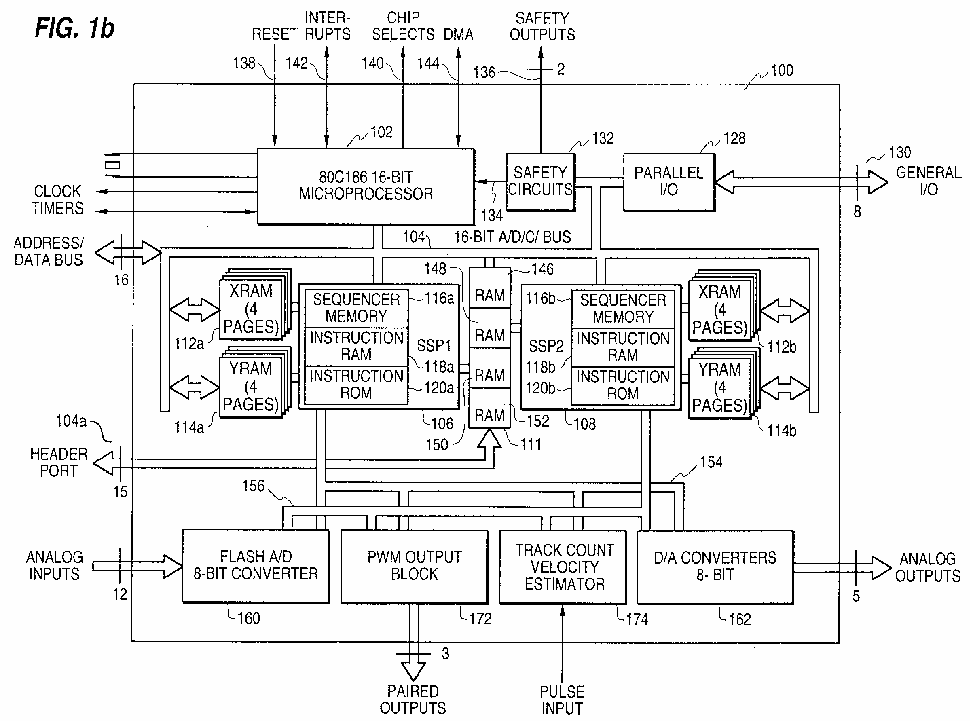
The Figure 1b embodiment includes a master processor 102 and slave signal processors 106 and 108. These processors are connected to Random Access Memory (“RAM”) 111 by a bus. RAM 111 is divided into four blocks. Each processor can write data to only one separate block of RAM 111. ‘394 Pat. at 5:17-22. Each processor can read from any block of RAM 111. ‘394 Pat. at 5:24-26. “[T]o exchange information between processors, for example, between streamlined signal processor
21106 and microprocessor 102, the processor with information writes its data to its own block of RAM . . . and signals the recipient (microprocessor 102) to read the sender’s RAM block.” ‘394 Pat. at 5:26-32.
B. The Terms in Dispute
The parties present the following terms for construction.
1. “signal processor”
| Claim Term | Plaintiff’s Proposal | Defendants’ Proposal |
| “signal processor” Claim 11 | processor for executing instructions to perform programmed tasks | a programmable device that interprets and executes instructions for performing signal processing |
Defendants argue that a signal processor is a processor specifically tailored to perform signal processing operations. Saxon argues that this term refers to a general purpose microprocessor, which need not be specifically designed to perform signal processing.4 Contrary to Saxon’s argument, the ‘394 Patent reinforces the idea that there is a generally recognized distinction between signal processors and general purpose microprocessors.
The ‘394 Patent specification states: “The above and other objectives of the invention are accomplished by a system which includes a general purpose microprocessor and one or more streamlined signal processors to which critical functions can be dedicated.” ‘394 Pat. at 2:5-8. This statement strongly implies that a “signal processor” is not simply a synonym for a “general purpose microprocessor.” The Court finds that Saxon’s proposal would read the word “signal” out of the claim term at issue. Therefore, the Court adopts Defendants’ proposed construction.
222. “master processor”
| Claim Term | Plaintiff’s Proposal | Defendants’ Proposal |
| “master processor” Claim 1 | general purpose processor not under control of a signal processor | a general purpose microprocessor, not under the control of a signal processor, that controls the apparatus |
The parties agree that a master processor is not under the control of a signal processor, but Defendants propose that a master processor must also control the apparatus. Defendants argue that Saxon’s proposal disregards the word “master” in the claim term. Saxon argues that the term “master” refers only to the fact that the processor is not under the control of a signal processor.
Defendant’s proposed additional limitation is not present in the claim language. While, the specification does describe an embodiment wherein a master processor controls the apparatus, ‘394 Pat. at 2:15-16, the Court sees no reason to import this limitation into the claim at issue. The Court’s conclusion is bolstered by the prosecution history, in which the patentee explained that a “master” processor “does not allow a slave processor to take over control of the master processor at any time.” ‘394 Pat. Amendment at 5 (Aug. 26, 1997). This explanation is consistent with Saxon’s proposal and makes no mention of Defendant’s proposed additional limitation.
The Court finds that Saxon’s proposal adequately explains the plain and ordinary meaning of “master processor,” and thus it does not read the word “master” out of the term. The Court adopts Saxon’s proposed construction.
3. “each signal processor having write access . . .”
| Claim Term | Plaintiff’s Proposal | Defendants’ Proposal |
| “each signal processor having write access at any time to only a particular one of said memories and read access at any time to | each of said plurality of signal processors being able to write to only a particular memory location, and said each of said plurality of signal processors being able to read from said particular memory location as | each signal processor can always: (1) write without delay to only its exclusive memory; and (2) read without delay from any of the memories |
| any of said memories” Claim 11 | well as other respective particular memory locations |
23The parties dispute the meaning of the language “at any time.” Defendants argue that this limitation requires that each signal processor have read access and write access “without latency” or, in other words, “without delay.” They further argue that Saxon reads the “at any time” language out of the term. Saxon argues that the “at any time” limitation refers to asynchronous operation of multiple processors, i.e. the idea that the processors need not all write at the same time or all read at the same time.
In addition to the Figure 1b embodiment discussed above, the patent also discloses an embodiment containing multiple processors, in which each processor does not have its own designated memory. ‘394 Pat. at 5:5-6. This embodiment is shown in Figure 1a:

24The Figure 1a embodiment contains a bus arbiter 110 which controls access to the bus. If, for example, both signal processors 106 and 102 need to access system memory at the same time a collision will occur. ‘394 Pat. at 4:1-3. During a colliding access request, Bus Arbiter 110 assigns priority to one of the processors and only that processor will be able to access system memory. ‘394 Pat. at 4:8-13. In the meantime, the other processor remains stalled until it has access to the bus. ‘394 Pat. at 4:13-15. One of the benefits of the Figure 1b embodiment is that it avoids this stalling, i.e. it allows each processor to access memory “without latency.” ‘394 Pat. at 5:18-26.
Defendants argue that the “at any time” limitation of this term refers to the Figure 1b embodiment and the fact that this embodiment allows write access and read access for each processor without latency. Saxon argues that this limitation refers to a more fundamental distinction over the prior art. Specifically, Saxon argues that the “at any time” limitation merely requires that the multiple processors be able to operate asynchronously. Saxon bases its argument on the prosecution history.
During prosecution, the patentee distinguished a prior art reference that also contained multiple processors (“Cutts”). See ‘394 Pat. Amendment at 1 (June 6, 1995). The patentee argued that Cutts disclosed a system in which each processor may have access to designated memories, but all of the processors operate on identical instruction streams. Thus, they would all read at the same time or write at the same time. ‘394 Pat. Amendment at 2. The patentee described Cutts as requiring synchronous operation. ‘394 Pat. Amendment at 3. In contrast, the patentee explained that “in the present invention, a processor’s ability to write to any memory location in its area at any time allows the processors to execute entirely different and unrelated streams of instructions and to operate asynchronously of each other.” ‘394 Pat. Amendment at 3. Furthermore, “[t]his ability for a processor to write to any of its memory locations at any time eliminates data write latency.” ‘394
25Pat. Amendment at 2-3. Based on this prosecution history, Saxon argues that the “at any time” limitation distinguishes systems that require synchronous operation, not systems that have data write latency.
Viewed in isolation, the phrase “at any time” could refer to asynchronous operation, but in the context of the entire claim, Saxon’s position cannot stand. Phillips, 415 F.3d at 1314(“the context in which a term is used in the asserted claim can be highly instructive”). Claim 11 requires that each signal processor have write access or read access at any time. The Figure 1a embodiment does not satisfy this limitation because each processor has read or write access only when no other processor has access. Cutts does not satisfy this limitation because each processor has read or write access only when every processor has read or write access. Thus, Saxon’s argument that the “at any time” limitation was only meant to distinguish Cutts does not account for the fact that this limitation excludes systems with data read/write latency. Furthermore, while Saxon is correct that Claim 11 distinguishes systems that require synchronous operation, it distinguishes those systems by requiring that “at least one of said signal processors in said plurality operates independently of other signal processors.”
To summarize, the parties have presented two different contexts in which data read/write latency may arise: (1) when bus access is limited, e.g. the Figure 1a embodiment, or (2) when multiple processors operate on identical instruction streams, e.g. Cutts. The Court finds that the “at any time” limitation excludes both embodiments. As explained above, neither the Figure 1a embodiment nor Cutts allows read and write access for each processor “without latency.” Because Saxon’s proposal does not account for the “at any time” limitation, it must be rejected. Defendants proposal, on the other hand,
26appropriately describes this limitation as “without delay.”5 Accordingly, the Court adopts Defendants’ proposed construction.
4. “at least one of said signal processors . . .”
| Claim Term | Plaintiff’s Proposal | Defendants’ Proposal |
| “at least one of said signal processors in said plurality operates independently of other signal processors” Claim 11 | one (1) or more of the signal processors of said plurality of signal processors executes instructions autonomously from another one of said signal processors | at least one signal processor can operate without being interrupted by any of the two or more other signal processors |
The parties dispute whether this term requires the presence of two or more signal processors or three or more signal processors. Saxon argues that because the term uses the word “plurality,” the claim only requires two or more signal processors. See, e.g., Dayco Prods., Inc. v. Total Containment, Inc., 258 F.3d 1317, 1327-28 (Fed. Cir. 2001) (“‘plurality,’ when used in a claim refers to two or more items, absent some indication to the contrary”). Saxon argues that “[t]he actual claim language requires two or more signal processors, with one of the two or more signal processors operating independently of one or more signal processors.” Defendants argue that the plain language of the term requires three or more signal processors.
Saxon’s argument focuses on the word “plurality,” and ignores the other limitations in the claim. While the term does recite a “plurality” of signal processors, it also states that at least one signal processor must operate independently of other signal processors. This is an undeniable
27“indication to the contrary,” id., that, at a minimum, the claim requires one signal processor to operate independently of two signal processors. Thus, the “plurality” referred to in the term must consist of three or more signal processors. The Court adopts Defendants’ proposed construction.
5. “respective indication signal”
| Claim Term | Plaintiff’s Proposal | Defendants’ Proposal |
| “respective indication signal” Claim 11 | a respective signal to said master processor so as to indicate to said master processor | a signal generated by a signal processor that instructs the master processor to read that signal processor’s exclusive memory |
| “wherein said signal processors provide a respective indication signal to said master processor so as to notify said master processor that newly-written-in data can be obtained” Claim 11 | wherein said signal processors provide a respective signal to said master processor so as to indicate to said master processor that a corresponding signal processor has written readable data | Defendants contend that the construction of this phrase is unnecessary in light of Defendants’ proposed construction for the claim term above. |
Defendants’ proposal inserts a limitation not present in the claim language, i.e. that the signal instruct the master processor to read from memory. For support, Defendants cite to the specification which states: “the processor . . . signals the recipient (microprocessor 102) to read from the sender’s RAM block.” ‘394 Pat. at 6:58-62. This passage appears in a general description of how the processors of the invention share information. Even if it could be interpreted as disclosing an embodiment in which a signal processor instructs the master processor, Defendants offer no reason for the Court to import this limitation into the claim language. Furthermore, Defendants’ proposal is inconsistent with the Court’s construction of “master processor.” As explained above, and as agreed by the parties, a master processor is not under the control of a signal processor.
28The Court finds that Saxon’s constructions are also deficient because they merely restate the claim language and replace the word “notify” with the word “indicate.” The Court finds that these terms will be easily understood by a jury, and that no construction is necessary for either of these terms.
6. “respective portions of a same memory”
| Claim Term | Plaintiff’s Proposal | Defendants’ Proposal |
| “respective portions of a same memory” Claim 12 | allocated corresponding memory locations within a memory unit | Defendants contend that this claim term is more appropriately construed in the context of the larger claim phrase in which it appears, below |
| “said plurality of memories comprise respective portions of a same memory” Claim 12 | said plurality of memories comprise allocated corresponding memory locations of a single memory device | the plurality of memories are respective blocks of a single memory device |
Although the parties have not expressed agreement for this term, the Court is unable to discern a substantive difference between the parties’ proposals. Because Saxon’s proposal more closely follows the actual claim language, the Court adopts Saxon’s proposed construction for the term “said plurality of memories comprise respective portions of a same memory.” The Court finds that no separate construction is necessary for the term “respective portions of a same memory.”
IV. Agreed Term
Prior to the hearing, the parties agreed that the term “communications controller circuit,” which appears in the ‘555 Patent should be construed as “a single chip wireless communications controller.”
CONCLUSION
For the foregoing reasons, the Court interprets the claim language in this case in the manner set forth above. For ease of reference, the Court’s claim interpretations are set forth in a table attached to this opinion as Appendix A.
30APPENDIX A
U.S. Pat No. 5,502,689
„689 Claims Term and Plaintiff‟s Proposed Defendants‟ Proposed Court‟s Construction
Claim(s) in Construction Construction which it appears
5. A method for “disable request a signal to initiate entry a signal that requests the A signal requesting the system controlling at least one signal” into a shut-down mode system to stop the output clock enter into shut down mode output clock signal signal and that starts the comprising the steps Claims 5, 8 Intrinsic Evidence: predetermined length of time of: „689 patent: Col. 7:58-62; Fig. 1 Intrinsic Evidence: receiving a disable „689 patent: Abstract; Col. 4, ll. request signal; Extrinsic Evidence: 63-67; Col. 6, ll. 20-22, 29-35, See “signal” in The New 40-47, 57-59; Col. 7, l. 59 – Col. IEEE Standard Dictionary 8, l. 16; Col. 8, ll. 10-13, 26-48; of Electrical and Col. 8, l. 66 - Col. 9, l. 10; Col.
Electronics Terms, Fifth 9, ll. 1-3, 14-19, 48-53; Fig. 1; Edition, IEEE Std 100- Claim 8. 1992, Copyright 1993, p. 1218
stopping said at least “predetermined an amount of time defined a definite amount of time fixed A length of time within a known one output clock signal length of time” prior to or at the time of prior to receipt of the disable time period after a predetermined receipt of the disable request request signal length of time after Claims 5, 8 signal receiving said disable Intrinsic Evidence: request signal; Intrinsic Evidence: „689 patent: Abstract; Col. 4, ll. „689 patent: Col. 3:30-33; 63-67; Col. 7, ll. 4-27; Col. 8, ll.
Col. 3:36-38; Col. 4:52-53; 26-48; Col. 9, ll. 48-53. Col. 6:57-62; Col. 7:4-7; Col. 7:16-21; Intrinsic Evidence from the „689 Col. 8:42-44 File History:
31„689 Claims Term and Plaintiff‟s Proposed Defendants‟ Proposed Court‟s Construction
Claim(s) in Construction Construction which it appears
„689 Patent File History, Original Application, at 30; Office Action (Dec. 27, 1994), at 2; Amendment Under 37 C.F.R. § 1.111 (June 8, 1995), at
2. Extrinsic Evidence: “predetermine: To determine, decide, or establish ahead of time.” Webster‟s II New Riverside University Dictionary, Houghton Mifflin Co., 1988. “predetermine: determine beforehand.” Webster‟s Ninth New Collegiate Dictionary, Merriam-Webster, Inc., 1986.
stopping said at least “stopping said at halting the output clock signal stopping the output clock No construction necessary one output clock signal least one output following an amount of time signal at the expiration of an after a predetermined clock signal defined prior to or at the time amount of time that is fixed length of time after after a of receipt of the disable prior to, and starts from, receiving said disable predetermined request signal receipt of the disable request request signal; length of time signal after receiving Intrinsic Evidence: said disable „689 patent: Col. 3:30-33; Intrinsic Evidence: request signal” Col. 3:36-38; Col. 4:52-53; „689 patent: Abstract; Col. 2, ll.
Col. 6:57-62; Col. 7:4-7; Col. 25-30; Col. 2, ll. 52-56; Col. 3, Claim 5 7:16-21; Col. 8:42-44; Col. 9: ll. 34-39; Col. 4, ll. 63-67; Col. 6,
32„689 Claims Term and Plaintiff‟s Proposed Defendants‟ Proposed Court‟s Construction
Claim(s) in Construction Construction which it appears
3-8; Col. 8:45-46; Fig. 2; Fig. ll. 11-14; Col. 6, ll. 29-36; Col. 3 6, ll. 40-47; Col. 6, ll. 57-62; Col. 8, ll. 26-46; Col. 7, ll. 4-27; Extrinsic Evidence: Figure 2. See “stopping (5.)” in The American Heritage College Intrinsic Evidence: Dictionary, 1993, Houghton Abstract; Col. 4, ll. 63-67; Col. Mifflin, pp. 1338-1339 7, ll. 4-27; Col. 8, ll. 26-48; Col. 9, ll. 48-53.
See “clock” in The New IEEE Standard Dictionary of Intrinsic Evidence from the „689 Electrical and Electronics File History: Terms, Fifth Edition, IEEE Std 100-1992, Copyright „689 Patent File History, 1993, p. 196 Original Application, at 30; Office Action (Dec. 27, 1994), See “clock” in Newton‟s at 2; Amendment Under 37 Telecom Dictionary, 5th C.F.R. § 1.111 (June 8, 1995), at Edition, 1992, Flatiron 2. Publishing, Inc., p. 197 Extrinsic Evidence: See “after” in The American “predetermine: To determine, Heritage College Dictionary, decide, or establish ahead of 1993, Houghton Mifflin, p. time.” Webster‟s II New 24 Riverside University Dictionary, Houghton Mifflin Co., 1988. See “receiving” in The American Heritage College “predetermine: determine Dictionary, 1993, Houghton beforehand.” Mifflin, p. 1139 Webster‟s Ninth New Collegiate Dictionary, Merriam-Webster,
33„689 Claims Term and Plaintiff‟s Proposed Defendants‟ Proposed Court‟s Construction
Claim(s) in Construction Construction which it appears
Inc., 1986, p. 926.
receiving an enable “predetermined a requirement of a defined Defendants contend that this A known set of rules request signal; protocol protection scheme claim term is more appropriately requirement” construed in the context of the starting said at least Intrinsic Evidence: larger claim phrase in which it one output clock signal Claim 5 „689 patent: Col. 3:47-51; appears, below. after receiving said Col. 3:58-60; Col. 4:50-53; enable request signal; Col. 7:65-67; Col. 8:13-15; Fig. 1 wherein said step of
Extrinsic Evidence:
stopping said at least
See “protocol” in The New
one output clock signal
IEEE Standard Dictionary of
comprises the steps of
Electrical and Electronics
verifying that said
Terms, Fifth Edition, IEEE
disable request signal
Std 100-1992, Copyright
satisfies a
1993, p. 1022
predetermined protocol requirement, and
See “requirement” in The
processing said disable
American Heritage
request signal only if
College Dictionary, 1993,
said disable request
Houghton Mifflin, p. 1160
signal satisfies said predetermined protocol requirement. wherein said step of “verifying that confirming that said disable confirming that the received No construction necessary stopping said at least said disable request signal meets a disable request signal satisfies one output clock signal request signal requirement of a defined a predetermined series of steps comprises the steps of satisfies a protection scheme verifying that said predetermined Intrinsic Evidence: disable request signal protocol Intrinsic Evidence: „689 patent: Col. 3, ll. 46-60; satisfies a requirement” „689 patent: Col. 7:58-62; Col. 7, l. 58 - Col. 8, l. 16; Col.
34„689 Claims Term and Plaintiff‟s Proposed Defendants‟ Proposed Court‟s Construction
Claim(s) in Construction Construction which it appears
predetermined protocol Fig. 1; Col. 3:47-51; Col. 8, ll. 8-10, 13-16. requirement, and Claim 5 3:58-60; Col. 4:50-53; Col. processing said disable 7:65-67; Col. 8:13-15 Extrinsic Evidence: request signal only if “Protocol - (1) (data said disable request Extrinsic Evidence: communication) - A formal set signal satisfies said See “verification” in The of conventions governing the predetermined protocol New IEEE Standard format and relative timing of requirement. Dictionary of Electrical messages exchanged between
and Electronics Terms, two communications Fifth Edition, IEEE Std terminals. (2) (software) - (A) 100-1992, Copyright A set of conventions or rules 1993, p. 1455. that govern the interactions of processes or applications See “verify” in the within a computer system or Microsoft Press Computer network. (B) A set of rules that Dictionary, 1991, govern the operation of Microsoft Press, p. 360. functional units to achieve communication.” IEEE See “verifying (2.)” in The
Standard Dictionary of American Heritage College
Electrical and Electronic Dictionary, 1993, Houghton
Terms, The Institute of Mifflin, p. 1499.
Electrical and Electronics Engineers, Inc., 1984. See “satisfies (5.)” in The American Heritage College
“predetermine: To determine, Dictionary, 1993, Houghton
decide, or establish ahead of Mifflin, p. 1213
time.” Webster‟s II New Riverside University Dictionary, Houghton Mifflin Co., 1988. “predetermine: determine
35„689 Claims Term and Plaintiff‟s Proposed Defendants‟ Proposed Court‟s Construction
Claim(s) in Construction Construction which it appears
beforehand.” Webster‟s Ninth New Collegiate Dictionary, Merriam-Webster, Inc., 1986.
8. A method as recited “disable request See Claim 5, above. See Claim 5, above.
in claim 5 wherein the signal” step of stopping said at least one output clock “predetermined signal comprises the length of time” step of stopping said at least one output clock Claims 5, 8 signal after said predetermined length of time following the most recent assertion of said disable request signal.
36U.S. Pat. No. 5,592,555
„555 Claims Term and Plaintiff‟s Proposed Defendants‟ Proposed Construction Court‟s Construction
Claim(s) in Construction
which it appears
1. A method for privately “communicatio [AGREED] [AGREED] a single chip wireless communications communicating over a ns controller controller wireless communications circuit” network, comprising the steps of: Claims 1, 10, 21, 43, 51 processing the communication signals in a first signal processing circuit within a first communications controller circuit at a first location to produce processed communication signals; processing the “signal a circuit, within a a signal processor that uses the A circuit that executes program communication signals in processing communications controller same circuitry to load, store, and instructions to process a first signal processing circuit” circuit, that executes program execute signal processing communications signals and executes circuit within a first instructions to process instructions and enciphering program instructions to encipher or communications Claims 1, 10, 21, communications signals and algorithms decipher such signals controller circuit at a first 22, 24, 26, 43-46, executes program instructions location to produce 51 to encipher or decipher such Intrinsic Evidence from the „555
37„555 Claims Term and Plaintiff‟s Proposed Defendants‟ Proposed Construction Court‟s Construction
Claim(s) in Construction
which it appears
processed communication signals File History: signals; „555 Patent File History, Intrinsic Evidence: “Amendment” (July 17, 1996) at
„555 patent: Col. 2:49-54; 30-31, et al. Col. 4:29-35; Col. 6:1-4; Col. 10:23-32; Col. 10:58; Fig. 2; „555 Patent File History, Fig. 3; Amendment “Amendment” (July 17, 1996) at 7/17/1996, p. 30. 31, et al.
Intrinsic Evidence from the „555 Specification: „555 patent: Col. 2, ll. 49-54; Col. 4, ll. 39-47; Col. 5, ll. 3-7; Col. 5, l. 66 - Col. 6, ll. 2, 52-55; Col. 6, ll. 3-17; Col. 6, ll. 52-55; Col. 11, ll. 6-13; Claim 1.
processing the “processing (the) performing a signal modifying the data to be Performing a signal processing communication signals in …. processing operation on transmitted prior to enciphering operation on (the) a first signal processing communication (the) communication(s) or after deciphering communication(s) signals circuit within a first (s) signals” signals communications Intrinsic Evidence: controller circuit at a first Claims 1, 10, Intrinsic Evidence: „555 patent: Col. 1, l. 67 - Col. 2, location to produce 21, 43, 51 „555 patent: Col. 2:4-6; Col. l. 4; Col. 2, ll. 4-12, 23-27, 49-54; processed communication 9:25-44; Col. 10:23-32. Col. 5, ll. 3-7; Col. 11, ll. 6-13, signals; 26-28.
Extrinsic Evidence Newton‟s Telecom Dictionary, 10th Edition, 1996, Flatiron Publishing,
38„555 Claims Term and Plaintiff‟s Proposed Defendants‟ Proposed Construction Court‟s Construction
Claim(s) in Construction
which it appears
Inc., p. 436, defining “encoding” as “[t]he process of converting data into code or analog voice into a digital signal.” Alan Freedman, The Computer Glossary (6th ed. 1993), p. 240, defining “forward error correction” as “Before transmission, the data is processed through an algorithm that adds extra bits for error correction.”
enciphering the processed “enciphering applying an enciphering applying an enciphering Applying an enciphering algorithm to communication signals in (the) (said) algorithm to encrypt (the) algorithm to the processed encrypt (the) (said) processed the first signal processing processed (said) processed communication signals to make communication signals circuit at said first communication communication signals the processed communication location to produce signals” signals private enciphered and processed Intrinsic Evidence: communication signals; Claims 1, 10, 21, „555 patent: Col. 1:17-19; Intrinsic Evidence: 26, 43, 45, 51 Col. 3:6-11; Col. 4:18-35; „555 patent: Col. 7, ll. 1-4; Col. 8, transmitting the Col. 8:23-25; Col. 8:52-56; l. 67-Col. 9, l . 13; title. enciphered and Col. 9:45-58 processed communication signals Extrinsic Evidence: between a first location See “encipher” and “encryption” and a second location in using the first the Microsoft Press Computer communications Dictionary, Third Edition,
39„555 Claims Term and Plaintiff‟s Proposed Defendants‟ Proposed Construction Court‟s Construction
Claim(s) in Construction
which it appears
controller circuit at said 1997, Microsoft Press, p. 175; first location; See “encryption” in Newton‟s receiving the enciphered Telecom Dictionary, 10th and processed Edition, 1996, Flatiron communication signals at Publishing, Inc., pp. 436-437 the second location using a second communications controller circuit; deciphering the enciphered and processed communication signals in a second signal processing circuit within the second communications controller circuit at said second location; and processing the deciphered and processed communication signals in the second signal processing circuit to produce communications
40„555 Claims Term and Plaintiff‟s Proposed Defendants‟ Proposed Construction Court‟s Construction
Claim(s) in Construction
which it appears
signals at the second location. 10. A method for “communication Please see above, Claim 1 Please see above, Claim 1 privately s controller communicating over a circuit” wireless communications Claims 1, 10, network, comprising 21, 22, 24, 26, the steps of: 43-46, 51 processing the communication signals “signal in a first signal processing processing circuit circuit” within a first communications Claims 1, 10, 21, controller circuit at a 22, 24, 26, 43-first location to 46, 51 produce processed communication signals; “processing (the) … enciphering the communication(s processed ) signals” communication signals in the first signal Claims 1, 10, 21, processing circuit at 43, 51 said first location to
41„555 Claims Term and Plaintiff‟s Proposed Defendants‟ Proposed Construction Court‟s Construction
Claim(s) in Construction
which it appears
produce enciphered and processed “enciphering communication (the) (said) signals; processed communication transmitting the signals” enciphered and processed Claims 1, 10, 21, communication signals 26, 43, 45, 51 between a first location and a second location using the first communications controller circuit at said first location; receiving the enciphered and processed communication signals at the second location using a second communications controller circuit; deciphering the enciphered and processed communication signals
42„555 Claims Term and Plaintiff‟s Proposed Defendants‟ Proposed Construction Court‟s Construction
Claim(s) in Construction
which it appears
in a second signal processing circuit within the second communications controller circuit at said second location; and processing the deciphered and processed communication signals in the second signal processing circuit to produce communications signals at the second location; wherein said “programmably executing in a signal executing a set of program Executing in a signal processing circuit a enciphering step selecting an processing circuit a set of instructions to select one from set of program instructions to select one further comprises the enciphering program instructions to select among a plurality of enciphering of a plurality of enciphering algorithms step of enciphering algorithm” one of a plurality of algorithms said processed enciphering algorithms communication signals Claims 10, 51 Intrinsic Evidence: in said first signal Intrinsic Evidence: „555 patent: Col. 2, ll. 54-58; Col. processing circuit by „555 patent: Col. 4:57-64; 3, ll. 2-5, 6-8; Col. 4, ll. 43-44, 57-programmably Col. 7: 4-7; Col. 7:37-39; 66; Col. 6, ll. 32-37; Col. 12, ll. selecting an Col. 10:11-17; Fig. 6 53-61; Col. 20, ll. 21-23; Fig. 3; Fig.
43„555 Claims Term and Plaintiff‟s Proposed Defendants‟ Proposed Construction Court‟s Construction
Claim(s) in Construction
which it appears
enciphering algorithm. 6.
Extrinsic Evidence: See “programmable” in The New IEEE Standard Dictionary of Electrical and Electronics Terms, Fifth Edition, IEEE Std 100-1992, p. 1014
wherein said enciphering “enciphering a prescribed set of well- a series of steps for encrypting A prescribed set of well defined rules or step further comprises the algorithm” defined rules or processes for signals processes for encrypting signals step of enciphering said the solution of a problem in a processed communication Claims 10, 26, finite number of steps Extrinsic Evidence: signals in said first signal 45, 51 IEEE Standard Dictionary of processing circuit by Intrinsic Evidence: Electrical and Electronic Terms, programmably selecting „555 patent: C. 1, L. 28-30; The Institute of Electrical and an enciphering algorithm. C. 7, L. 45-61; C. 8, L. 53-54; Electronics Engineers, Inc., 1988, C. 10, L. 56-63; Fig. 6 p. 29, defining “Algorithm” as “(1)
(general) - A prescribed set of
Extrinsic Evidence: well-defined rules or processes for See, e.g., “encryption” in the solution of a problem in a finite Newton‟s Telecom Dictionary, number of steps. (2) (software) -10th Edition, 1996, Flatiron (1) a finite set of well-defined Publishing, Inc., pp. 436-437; rules for the solution of a problem in a finite number of steps; (2) a See, e.g., “encryption” in the finite set of well-defined rules Microsoft Press Computer which gives a sequence of Dictionary, Third Edition, operations for performing a 1997, Microsoft Press, p. 175 specific task.”
44„555 Claims Term and Plaintiff‟s Proposed Defendants‟ Proposed Construction Court‟s Construction
Claim(s) in Construction
which it appears
See, e.g., “algorithm” in Newton‟s Telecom Dictionary, Newton‟s Telecom Dictionary, 10th Edition, 1996, Flatiron 10th Edition, 1996, Flatiron Publishing, Inc., p. 66, defining Publishing, Inc., p. 66 “algorithm” as “[a] prescribed
finite set of well defined rules or processes for the solution of a problem in a finite number of steps.” Newton‟s Telecom Dictionary, 18th Edition, 2002, CMP Books. p. 102, defining “block cipher” as
“A digital encryption method which ciphers long messages by segmenting them into blocks of fixed length, prior to encryption. Each block, which typically is 64 bits in length, is encrypted individually. The blocks may be sent as individual units, or they may be linked in a method knows [sic] as Cipher-Block-Chaining.”
45„555 Claims Term and Plaintiff‟s Proposed Defendants‟ Proposed Construction Court‟s Construction
Claim(s) in Construction
which it appears
21. A system for “communication Please see above, Claim 1 Please see above, Claim 1 privately communicating s controller communications signals circuit” over a wireless communications network, Claims 1, 10, comprising: 21, 22, 24, 26, 43-46, 51 a first communications controller at a first location; “signal processing a first signal processing circuit” circuit within said first communications Claims 1, 10, 21, controller circuit at the 22, 24, 26, 43-first location for 46, 51 processing communications signals to form processed “processing (the) communication signals … and further for communication(s enciphering said ) signals” processed communication signals; Claims 1, 10, 21, 43, 51 a first transceiver associated at said first location with said first “enciphering communications (the) (said)
46„555 Claims Term and Plaintiff‟s Proposed Defendants‟ Proposed Construction Court‟s Construction
Claim(s) in Construction
which it appears
controller for transmitting processed said enciphered and communication processed communication signals” signals between said first location and a second Claims 1, 10, 21, location; 26, 43, 45, 51 a second communications controller circuit at the second location for controlling communications at said second location; a second transceiver associated at the second location with said second communications circuit for receiving said enciphered and processed communication signals from said first transceiver; a second signal processing circuit within said second communications controller circuit at the second location for
47„555 Claims Term and Plaintiff‟s Proposed Defendants‟ Proposed Construction Court‟s Construction
Claim(s) in Construction
which it appears
deciphering said received enciphered and processed communication signals, said second signal processing circuit further for processing said deciphered and processed communication signals.
22. The system of claim “signal Please see above, Claim 1 Please see above, Claim 1
21, wherein said first processing signal processing circuit circuit” comprises a first digital signal processing circuit. Claims 1, 10, 21,
22, 24, 26, 43-46, 51
24. The system of claim “signal Please see above, Claim 1 Please see above, Claim 1
21, wherein said second processing signal processing circuit circuit” comprises a second digital signal processing circuit. Claims 1, 10, 21,
22, 24, 26, 43-46, 51
48„555 Claims Term and Plaintiff‟s Proposed Defendants‟ Proposed Construction Court‟s Construction
Claim(s) in Construction
which it appears
26. The system of claim “signal Please see above, Claims 1 Please see above, Claims 1 and 10
21, further comprising an processing and 10 enciphering algorithm circuit” embedded within said first signal processing Claims 1, 10, 21, circuit for enciphering 22, 24, 26, 43-said processed 46, 51 communication signals.
“enciphering algorithm” Claims 10, 26, 45, 51
43. A communications “communication Please see above, Claim 1 Please see above, Claim 1 controller circuit for s controller privately communicating circuit” communication signals over a wireless Claims 1, 10, communications network, 21, 22, 24, 26, comprising: 43-46, 51 a signal processing circuit within said “signal communications processing controller circuit for circuit” processing communications signals Claims 1, 10, 21,
49„555 Claims Term and Plaintiff‟s Proposed Defendants‟ Proposed Construction Court‟s Construction
Claim(s) in Construction
which it appears
to form processed 22, 24, 26, 43-communication signals 46, 51 and further for enciphering said processed communication “processing (the) signals; and … communication(s a transceiver associated ) signals” with said communications controller circuit for Claims 1, 10, 21, transmitting said 43, 51 enciphered and processed communication signals from said “enciphering communications (the) (said) controller circuit. processed
communication signals” Claims 1, 10, 21, 26, 43, 45, 51
50„555 Claims Term and Plaintiff‟s Proposed Defendants‟ Proposed Construction Court‟s Construction
Claim(s) in Construction
which it appears
44. The controller circuit “signal Please see above, Claim 1 Please see above, Claim 1 of claim 43, wherein said processing signal processing circuit circuit” comprises a digital signal processing circuit. Claims 1, 10, 21,
22, 24, 26, 43-46, 51
45. The controller circuit “signal Please see above, Claims 1 Please see above, Claims 1 and 10 of claim 43, further processing and 10 comprising an circuit” enciphering algorithm embedded within said Claims 1, 10, 21, signal processing circuit 22, 24, 26, 43-for enciphering said 46, 51 processed communication signals.
“enciphering algorithm” 10, 26, 45, 51
51„555 Claims Term and Plaintiff‟s Proposed Defendants‟ Proposed Construction Court‟s Construction
Claim(s) in Construction
which it appears
46. The controller circuit “signal Please see above, Claim 1 Please see above, Claim 1 of claim 45, further processing comprising a deciphering circuit” algorithm within said signal processing circuit Claims 1, 10, 21, for deciphering processed 22, 24, 26, 43-communication signals 46, 51 received from a second communications controller circuit. 46. The controller circuit of “deciphering a prescribed set of well- a series of steps for decrypting “a prescribed set of well defined rules or claim 45, further algorithm” defined rules or processes for signals processes for decrypting signals comprising a deciphering the solution of a problem in a algorithm within said Claim 46 finite number of steps Extrinsic Evidence: signal processing circuit for IEEE Standard Dictionary of deciphering processed Intrinsic Evidence: Electrical and Electronic Terms, communication signals „555 patent: Col. 1:28-30; The Institute of Electrical and received from a second Col. 7:45-61; Col. 8:53-54; Electronics Engineers, Inc., 1988, communications controller Col. 10:56-63; Fig. 6 p. 29, defining “Algorithm” as “(1) circuit. (general) - A prescribed set of
Extrinsic Evidence: well-defined rules or processes for See, e.g., “decipher” in The the solution of a problem in a finite American Heritage College number of steps. (2) (software) -Dictionary, 1993, Houghton (1) a finite set of well-defined Mifflin, p. 359 rules for the solution of a problem in a finite number of steps; (2) a see, e.g., “algorithm” in finite set of well-defined rules Newton‟s Telecom which gives a sequence of Dictionary, 10th Edition, operations for performing a
52„555 Claims Term and Plaintiff‟s Proposed Defendants‟ Proposed Construction Court‟s Construction
Claim(s) in Construction
which it appears
1996, Flatiron Publishing, specific task.” Inc., p. 66
Newton‟s Telecom Dictionary, 10th Edition, 1996, Flatiron Publishing, Inc., p. 66, defining “algorithm” as “[a] prescribed finite set of well defined rules or processes for the solution of a problem in a finite number of steps.” Newton‟s Telecom Dictionary, 18th Edition, 2002, CMP Books. p. 102, defining “block cipher” as “A digital encryption method which ciphers long messages by segmenting them into blocks of fixed length, prior to encryption. Each block, which typically is 64 bits in length, is encrypted individually. The blocks may be sent as individual units, or they may be linked in a method knows [sic] as Cipher-Block-Chaining.”
51. A communications “communication Please see above, Claims 1 Please see above, Claims 1 and 10 controller circuit for s controller and 10 privately communicating circuit” communication signals
53„555 Claims Term and Plaintiff‟s Proposed Defendants‟ Proposed Construction Court‟s Construction
Claim(s) in Construction
which it appears
over a wireless Claims 1, 10, communications network, 21, 22, 24, 26, comprising: 43-46, 51 a signal processing circuit within said “signal communications processing controller circuit for circuit” processing communications signals Claims 1, 10, 21, to form processed 22, 24, 26, 43-communication signals 46, 51 and further for enciphering said processed communication “processing (the) signals; and … communication(s a transceiver associated ) signals” with said communications controller circuit for Claims 1, 10, 21, transmitting said 43, 51 enciphered and processed communication signals from said “enciphering communications (the) (said) controller circuit; processed communication wherein said signal signals” processing circuit
54„555 Claims Term and Plaintiff‟s Proposed Defendants‟ Proposed Construction Court‟s Construction
Claim(s) in Construction
which it appears
comprises circuitry and Claims 1, 10, 21, instructions for enciphering 26, 43, 45, 51 said processed communication signals in “programmably said signal processing selecting an circuit by programmably enciphering selecting an enciphering algorithm” algorithm. Claims 10, 51
“enciphering algorithm” Claims 10, 26, 45, 51
55U.S. Pat. No. 5,771,394
„394 Claims Term and Plaintiff‟s Proposed Defendants‟ Proposed Construction Court‟s Construction
Claim(s) in Construction
which it appears
11. An apparatus “signal processor for executing a programmable device that Programmable device that interprets comprising a plurality of processor” instructions to perform interprets and executes instructions and executes instructions for signal processors, a programmed tasks for performing signal processing performing signal processing master processor, and a Claim 11 plurality of memories, Intrinsic Evidence: Intrinsic Evidence: each signal processor „394 patent: Col. 1:23-28; ‟394 patent: Abstract; Col. 1, ll. 23-having write access at Col. 2:17-21; Col. 2:23-27; 27; Col. 2, ll. 5-8, 17-19; Col. 3, ll. 30-any time to only a Col. 3:30-56; Col. 5:60 - Col. 56; Col. 4, l. 45 - Col. 5, l. 4; Col. 5, particular one of said 6:20; Fig. 1a, Fig. 1b l. 60 - Col. 6, l. 20. memories and read access at any time to any Intrinsic Evidence from the „394 File of said memories, History: wherein at least one of „394 Patent File History, said signal processors in “Amendment” (Aug. 26, 1997) at 2, said plurality operates 4. independently of other signal processors in said Extrinsic Evidence: plurality of signal “3.1731 processor. (1) A device that processors, and wherein interprets and executes instructions, said signal processors consisting of at least an instruction provide a respective control unit and an arithmetic unit.” indication signal to said IEEE Standard Glossary of master processor so as to Computer Hardware notify said master Terminology, IEEE Std. 610-10-processor that newly- 1994, The Institute of Electrical and written-in-data can be Electronics Engineers, Inc., 1994. obtained from one or more of said plurality of “This two-part paper explores the
| „394 Claims | Term and Claim(s) in which it appears | Plaintiff‟s Proposed Construction | Defendants‟ Proposed Construction | Court‟s Construction |
| Claim(s) in Construction which it appears | ||||
| memories. | architectural features of single-chip programmable digital signal processors (DSPs)... Programmable DSPs are specialized microcomputers for real-time number crunching. Target applications require extensive arithmetic computation, usually with hard real- time constraints.” E. A. Lee, Programmable DSP architectures: Part I, IEEE ASSP Mag., pp. 4-19, Oct. 1988. “Processor, P. A component that is capable of interpreting a program in order to execute a sequence of operations.” Siework, Bell, Newel, Computer Structures Principles and Examples, McGraw Hill Computer Science Series, New York, 1982, p. 18. IEEE Standard Dictionary of Electrical and Electronic Terms, 6th ed., p. 823, defining “processor” as “a device that interprets and executes instructions….” | |||
| programmable digital signal processors (DSPs)... Programmable DSPs are specialized microcomputers for real-time number crunching. Target applications require extensive arithmetic computation, usually with hard real- time constraints.” E. A. Lee, Programmable DSP architectures: Part I, IEEE ASSP Mag., pp. 4-19, Oct. 1988. “Processor, P. A component that is capable of interpreting a program in order to execute a sequence of operations.” Siework, Bell, Newel, Computer Structures Principles and Examples, McGraw Hill Computer Science Series, New York, 1982, p. 18. IEEE Standard Dictionary of Electrical and Electronic Terms, 6th ed., p. 823, defining “processor” as “a device that interprets and executes instructions….” |
57„394 Claims Term and Plaintiff‟s Proposed Defendants‟ Proposed Construction Court‟s Construction
Claim(s) in Construction
which it appears
11. An apparatus “master general purpose processor a general purpose microprocessor, not General purpose processor not under comprising a plurality of processor” not under control of a under the control of a signal control of a signal processor signal processors, a master signal processor processor, that controls the apparatus processor, and a plurality Claim 11 of memories, each signal Intrinsic Evidence: Intrinsic Evidence: processor having write „394 patent: Col. 2:5-8; „394 patent: Col. 1, ll. 55-60; Col. 2, access at any time to only Col. 2:15-18; Col. 9:63- ll. 5-32; Col. 3, ll. 21-29; Col. 13, ll. a particular one of said 67; Col. 11:63-67; Fig. 4-8. memories and read access 1a; Fig. 1b; Amendment at any time to any of said 8/26/1997, p. 5 Intrinsic Evidence from the „394 File memories, wherein at least History: one of said signal „394 Patent File History, processors in said plurality “Amendment” (Aug. 26, 1997) at 2, operates independently of 4. other signal processors in said plurality of signal processors, and wherein said signal processors provide a respective indication signal to said master processor so as to notify said master processor that newly-written-in-data can be obtained from one or more of said plurality of memories. 11. An apparatus “each signal each of said plurality of signal each signal processor can always: each signal processor can always: (1) comprising a plurality of processor processors being able to write (1) write without delay to only its write without delay to only its signal processors, a master having write to only a particular memory exclusive memory; and (2) read exclusive memory; and (2) read
58„394 Claims Term and Plaintiff‟s Proposed Defendants‟ Proposed Construction Court‟s Construction
Claim(s) in Construction
which it appears
processor, and a plurality access at any location, and said each of said without delay from any of the without delay from any of the of memories, each signal time to only a plurality of signal processors memories memories processor having write particular one of being able to read from said access at any time to only said memories particular memory location as Intrinsic Evidence from the „394 File a particular one of said and read access well as other respective History: memories and read access at any time to particular memory locations „394 Patent File History, at any time to any of said any of said “Amendment and Request for memories, wherein at least memories” Intrinsic Evidence: Reconsideration Under 37 C.F.R. § one of said signal „394 patent: Col. 2:27-33; 1.111” (Jan. 11, 1996) at 3-4, et al. processors in said plurality Claim 11 Col. 4:1-17; Col. 4:57-59; operates independently of Col. 5:1-4; Col. 5: 49-52; „394 Patent File History, other signal processors in Col. 6:65-67; Col. 7:1-7 “Amendment and Request for said plurality of signal Reconsideration Under 37 C.F.R. § processors, and wherein Extrinsic Evidence: 1.111” (Jan. 11, 1996) at 5, et al. said signal processors See “[read/write] access” in provide a respective the Microsoft Press „394 Patent File History, indication signal to said Computer Dictionary, 1991, “Examiner‟s Action” (April 1, 1996) master processor so as to Microsoft Press, p. 7 at 3, et al. notify said master processor that newly- See “memory” “storage” and „394 Patent File History, “Office written-in-data can be “storage location” in The New Action” (Oct. 16, 1995). obtained from one or more IEEE Standard Dictionary of of said plurality of Electrical and Electronics See Dann „373 at Col. 4, l. 59 - Col. memories. Terms, Fifth Edition, IEEE 5, l. 40.
Std 100-1992, pp. 797, 1294- Dann „373 Col. 2, ll. 60-64 and Col. 96 5, ll. 14-30.
Intrinsic Evidence from the „394 Specification: „394 patent: Col. 5, ll. 5-32; Fig. 1b.
59„394 Claims Term and Plaintiff‟s Proposed Defendants‟ Proposed Construction Court‟s Construction
Claim(s) in Construction
which it appears
Extrinsic Evidence: “anytime... at any time whatever: under any circumstances.” Webster‟s Third New International Dictionary, Unabridged. Merriam-Webster, 2002. http://unabridged.merriam-webster.com (Jan. 8, 2009).
11. An apparatus “at least one of one (1) or more of the signal at least one signal processor can at least one signal processor can comprising a plurality of said signal processors of said plurality of operate without being interrupted by operate without being interrupted by signal processors, a master processors in signal processors executes any of the two or more other signal any of the two or more other signal processor, and a plurality said plurality instructions autonomously processors processors of memories, each signal operates from another one of said processor having write independently signal processors access at any time to only of other signal Intrinsic Evidence: a particular one of said processors” Intrinsic Evidence: „394 patent: Abstract; Col. 3, ll. 44-memories and read access „394 patent: Abstract; Col. 51; Col. 5, ll. 12-16; Col. 10, ll. 56-at any time to any of said Claim 11 3:30-56; Col. 3:57 - Col. 62; claim 11. memories, wherein at least 4:29; Col. 5:60 - Col. 6:20; one of said signal Col. 9:56-67; Amendment Extrinsic Evidence: processors in said plurality 01/11/1996, p. 2; Amendment “independent... 1: not dependent: as operates independently of 01/25/1996, pp. 3-4 a (1): not subject to control by others other signal processors in : not subordinate : SELF-said plurality of signal Extrinsic Evidence: GOVERNING, AUTONOMOUS, processors, and wherein See “independent” in The FREE.” said signal processors American Heritage College Webster‟s Third New International provide a respective Dictionary, 1993, Houghton Dictionary, Unabridged. Merriam-indication signal to said Mifflin, p. 690 Webster, 2002. master processor so as to http://unabridged.merriam-
60„394 Claims Term and Plaintiff‟s Proposed Defendants‟ Proposed Construction Court‟s Construction
Claim(s) in Construction
which it appears
notify said master See “plurality” in The webster.com (Jan. 8, 2009). processor that newly- American Heritage written-in-data can be College Dictionary, obtained from one or more 1993, Houghton Mifflin, of said plurality of p. 1053 memories. 11. An apparatus “respective a respective signal to said a signal generated by a signal No construction necessary comprising a plurality of indication master processor so as to processor that instructs the master signal processors, a signal” indicate to said master processor to read that signal master processor, and a processor processor‟s exclusive memory plurality of memories, Claim 11 each signal processor Intrinsic Evidence: Intrinsic Evidence: having write access at „394 patent: Col. 4:31-40 „394 patent: Col. 4, ll. 36-40; Col. 5, any time to only a Col. 8:42-57; Amendment ll. 5-24, 26-32; Col. 6, ll. 58-62; Col. particular one of said 8/26/1997, p. 5; Fig. 1a; Fig 12; ll. 66-67; Col. 13, ll. 4-8; Fig. 1b. memories and read 1b access at any time to Intrinsic Evidence from the „394 File any of said memories, Extrinsic Evidence: History: wherein at least one of See “respective” in The „394 Patent File History, said signal processors in American Heritage College “Amendment and Request for said plurality operates Dictionary, 1993, Houghton Reconsideration Under 37 C.F.R. § independently of other Mifflin, p. 1162 1.111” (Jan. 11, 1996). signal processors in said See, “signal” in the Microsoft plurality of signal Press Computer Dictionary, processors, and wherein 1991, Microsoft Press, p. 317 said signal processors provide a respective indication signal to said master processor so as to notify said master
61„394 Claims Term and Plaintiff‟s Proposed Defendants‟ Proposed Construction Court‟s Construction
Claim(s) in Construction
which it appears
processor that newly-written-in-data can be obtained from one or more of said plurality of memories.
11. An apparatus “wherein said wherein said signal Defendants contend that the No construction necessary comprising a plurality of signal processors provide a construction of this phrase is signal processors, a processors respective signal to said unnecessary in light of master processor, and a provide a master processor so as to Defendants‟ proposed plurality of memories, respective indicate to said master construction for the claim term each signal processor indication signal processor that a above. having write access at any to said master corresponding signal time to only a particular processor so as processor has written one of said memories and to notify said readable data read access at any time to master any of said memories, processor that wherein at least one of newly-written- Intrinsic Evidence:
62„394 Claims Term and Plaintiff‟s Proposed Defendants‟ Proposed Construction Court‟s Construction
Claim(s) in Construction
which it appears
said signal processors in in data can be „394 patent: Col. 4:31-40; said plurality operates obtained” Col. 8: 42-57; Amendment independently of other 8/26/1997, p. 5; Fig. 1a; Fig signal processors in said Claim 11 1b plurality of signal Extrinsic Evidence: processors, and wherein See “respective” in The said signal processors American Heritage College provide a respective Dictionary, 1993, Houghton indication signal to said Mifflin, p. 1162 master processor so as to See, “signal” in the Microsoft notify said master Press Computer Dictionary, processor that newly- 1991, Microsoft Press, p. 317 written-in-data can be obtained from one or more of said plurality of memories. 12. The apparatus recited “respective allocated corresponding Defendants contend that this claim No construction necessary in claim 11, wherein said portions of a memory locations within a term is more appropriately construed plurality of memories same memory” memory unit in the context of the larger claim comprise respective phrase in which it appears, below. portions of a same Claim 12 Intrinsic Evidence: memory. „394 patent: Col. 5:5-32
Extrinsic Evidence: See “respective” in The American Heritage College Dictionary, 1993, Houghton Mifflin, p. 1162 See “portion” in The American
63„394 Claims Term and Plaintiff‟s Proposed Defendants‟ Proposed Construction Court‟s Construction
Claim(s) in Construction
which it appears
Heritage College Dictionary, 1993, Houghton Mifflin, p. 1066
12. The apparatus recited “said plurality said plurality of memories the plurality of memories are said plurality of memories comprise in claim 11, wherein said of memories comprise allocated respective blocks of a single allocated corresponding memory plurality of memories comprise corresponding memory memory device locations of a single memory device comprise respective respective locations of a single memory portions of a same portions of a device Intrinsic Evidence: memory. same memory” „394 patent: Col. 5, ll. 5-32; Fig. 1b.
Intrinsic Evidence: Claim 12 „394 patent: Col. 5:5-32 Extrinsic Evidence:
“memory... 6a: a component in an Extrinsic Evidence: electronic computing machine (as a See “respective” in The computer) in which information (as American Heritage College data or program instructions) may Dictionary, 1993, Houghton be inserted and stored and from Mifflin, p. 1162 which it may be extracted when wanted.” Webster‟s Third New See “portion” in The American International Dictionary, Heritage College Unabridged. Merriam-Webster, Dictionary, 1993, Houghton 2002. http://unabridged.merriam-Mifflin, p. 1066 webster.com (Jan. 8, 2009). See “memory” “storage” and “storage location” in The New IEEE Standard Dictionary of Electrical and Electronics Terms, Fifth Edition, IEEE Std 100-1992, pp. 797, 1294-96
Footnotes
- ↩ 1 Saxon also alleges infringement of U.S. Patent No. 5,247,621 (“the ‘621 Patent”), and the parties have presented terms from the ‘621 Patent for construction. However, as explained in the Court’s Report and Recommendation regarding Defendants’ Motion for Summary Judgment of Invalidity of Claim 1 of the ‘621 Patent, the Court finds that the only claim of the ‘621 Patent asserted in this case is invalid. Accordingly, the Court will not address the ‘621 claim terms disputed by the parties.
- ↩ 2 At the hearing, Defendants argued that, because claim 5 requires that the predetermined length of time begin “after” the disable request signal is received, the predetermined length of time must begin immediately after the disable request signal is received. Defendants further argued that this requirement is equivalent to the requirement that the disable requirement signal initiate the predetermined length of time. However, Defendants offer no support for the idea that the word “after” means “immediately after” or “in response to.”
- ↩ 3 The only evidence cited by Defendants to support their proposals are the dictionary definitions cited above. The Court finds these definitions to be inconsistent with Defendants’ proposals.
- ↩ 4 This position is arguably inconsistent with Saxon’s proposed construction for the term “signal processing circuit” discussed above, which Saxon supported by arguing that the term was broad enough to cover “both a DSP and a general microprocessor.” PL.’S REPLY at 6.
- ↩ 5 Saxon also argues that this “without delay” limitation is inappropriate because it is not physically possible. Saxon is correct that no processor can read or write to memory instantaneously. See, e.g., Paragon Solutions, LLC v. Timex Corp., No. 2008-1516, 2009 WL 1424443 at * 11 (Fed. Cir. May 22, 2009) (finding that “‘real time’ cannot mean instantaneous”). Nonetheless, at the hearing, Defendants explained that they will not argue that this limitation requires an accused product to defy the laws of physics. Markman Hr’g Tr. at 117:18-118:6. Thus, Saxon’s concern is unfounded.