IN THE UNITED STATES DISTRICT COURT
FOR THE EASTERN DISTRICT OF TEXAS
TYLER DIVISION
IVAN G. RICE § §
Plaintiff § §
vs. § CIVIL ACTION NO. 6:05cv330 § HONEYWELL INTERNATIONAL, §
INC. and ROLLS-ROYCE, PLC., § §
Defendants, § §
vs. § §
NORTHROP GRUMMAN CORP., § §
Third-Party Defendant §
ORDER ADOPTING REPORT AND RECOMMENDATION
OF UNITED STATES MAGISTRATE JUDGE
The above entitled and numbered civil action was referred to United States Magistrate Judge John D. Love pursuant to 28 U.S.C. § 636. The Report of the Magistrate Judge (Docket No. 229) containing his recommendation concerning the disposition of Defendant Rolls Royce’s Motion for Summary Judgment of NonInfringement of U.S. Patent No. B1 4,896,499 (“the ‘499 patent”) (Docket No. 137). Plaintiff Ivan G. Rice (“Rice”) has filed objections to the Report and Recommendation (“Report”) primarily arguing that: (1) an incorrect standard was applied in granting summary judgment of non-infringement, (2) the Report overlooks competent evidence that defeats summary judgment of non-infringement, and (3) the Report does not adhere to the claim constructions set forth in the Memorandum Opinion and Order on claim construction. For the reasons discussed below, the Court is of the opinion that the2 findings and conclusions are correct and the Court hereby adopts the Report of the United States Magistrate Judge as the findings and conclusions of the Court.1
ANALYSIS
I. The Objection to the Standard Applied on Summary Judgment
Rice objects to the Report on grounds that, in reaching the conclusion of noninfringement, the Report engages in improper fact-finding by applying the construed claim limitations to the accused WR-21 engine. According to Rice, even if there is no dispute as to the structure of the accused device, it is improper to grant summary judgment when there are conflicting arguments as to whether a claim limitation does or does not find response in the accused device. Rice relies upon Int’l Rectifier Corp. v. IXYS Corp., 361 F.3d 1363 (Fed. Cir. 2004) and Dorel Juvenile Group, Inc. v. Graco Children’s Prods., Inc., 429 F.3d 1043 (Fed. Cir. 2005).2
In the Report, the summary judgment standard applied is that of whether a reasonable jury could find that the claim limitation as construed by the Court is found in the accused device. See Report at 7, 14. In International Rectifier Corp., the Federal Circuit reviewed a grant of summary judgment of infringement.3 The same standard was applied. Int’l Rectifier Corp., 361 F.3d at 1369 (“Because infringement is a question of3 fact, infringement is properly decided on summary judgment only ‘when no reasonable jury could find that every limitation recited in the properly construed claim either is or is not found in the accused device.’” (citation omitted)). Rice maintains that despite that commonly understood premise, International Rectifier Corp. nevertheless instructs that conflicting arguments as to whether a claim limitation is or is not present in the accused device precludes summary judgment. Rice misreads Int’l Rectifier Corp.
In International Rectifier Corp., the Federal Circuit first reversed the district court’s claim construction of the terms “polygonal” and “annular.” The record on summary judgment did not contain evidence as to whether IXYS’s devices included the "polygonal” and “annular” limitations, as properly construed. Id. at 1375. The Federal Circuit’s statement cited by Rice of “Here, in contrast, only the structure of IXYS’s product has been stipulated to for summary judgment purposes, not the factual determination of whether that product meets one or another claim construction” is made in the context of General Mills, Inc. v. Hunt-Wesson, Inc., 103 F.3d 978 (Fed. Cir. 1997). As the Federal Circuit points out, in General Mills, the record on summary judgment included a stipulation as to how each of two competing claim constructions would apply to the undisputed structure of accused infringing device. Thus, in International Rectifier Corp., the Federal Circuit was only making clear that the record on summary judgment was not developed as to evidence of the existence of the “polygonal” and “annular” limitations in the IXYS products under the new claim constructions.
Based on a misreading of International Rectifier Corp., Rice contends that “International Rectifier applies here, since the factual determination of whether the WR-21 meets either of the claim constructions has not been stipulated to, and in fact is4 vigorously disputed.” See Rice’s Objections at 4 (emphasis added). There is no “either of the claim constructions.” There is only a single claim construction, although Rice attempted to invoke a claim construction other than that set forth in the Memorandum Opinion and Order on claim construction.4 The Report considers the evidentiary record on summary judgment against the claim construction set forth in the Memorandum Opinion and Order on claim construction.5 Thus, International Rectifier Corp. is inapplicable, at least in the portion thereof relied upon by Rice.
In International Rectifier Corp., a denial of IXYS’s motion for summary judgment of non-infringement was also under review. Int’l Rectifier Corp., 361 F.3d at 1375. The Federal Circuit reversed the district court’s claim construction as to the term “adjoining.” Under the new claim construction and undisputed evidence as to the structure of the accused infringing devices, the Federal Circuit concluded that there could be no infringement. The Federal Circuit remanded with instructions to enter a judgment of non-infringement in favor of IXYS. Id. This portion of International Rectifier Corp. is applicable here and supports the grant of Rolls-Royce’s motion for summary judgment of non-infringement in the Report. 6
Rice’s reliance on Dorel is similarly misplaced. Rice represents Dorel as involving a similar dispute wherein the Federal Circuit precluded summary judgment of non-infringement. In what manner Dorel is similar, Rice does not articulate. After5 finding that the district court had properly construed the relevant claim terms, the Federal Circuit in Dorel turned to the summary judgment evidence. Dorel, 429 F.3d at 1047. The claim was directed to a child’s car seat. Dorel, 429 F.3d at 1044-45. The key claim terms specified separate “seat” and “base” structures, wherein the “seat” structure when removed continues to function as a seat for a child in, for example, an infant stroller. Id. at 1045. The accused product was a child’s car seat assembly having a top structure and a bottom structure, which were removable from one another. Id. Because the top and bottom structures of the accused product formed an integrated unit, the district court held that it lacked the limitation of a “seat” as a separate stand-alone structure. Id. The Federal Circuit reversed on the basis that the district court failed to assess whether the top structure after removal was capable of functioning as a “seat.”7 Id. at 1047. Again, Dorel is merely illustrative of a situation where the evidentiary record on summary judgment was not sufficiently developed.
The Report relies upon K-2 Corp. v. Solomon, S.A., 191 F.3d 1356 (Fed. Cir. 1999) and Athletic Alternatives, Inc. v. Prince Manufacturing, Inc., 73 F.3d 1573 (Fed. Cir. 1996). Rice asserts that these authorities are inapplicable. However, the recitation of the cases provided by Rice demonstrates the direct applicability of them. Rice Objections at 5. In K-2 Corp., the structure of the accused device as having a removable screw was not in dispute, whereas the claim construction required an “unremovable” connection. K-2 Corp., 191 F.3d at 1365-66. In Athletic Alternatives, there was no dispute that the accused racket had only two offset distances, whereas the claim construction required three offset distances. Athletic Alternatives, 73 F.3d at 1579.
6Rice fails to present a basis for the objection to the Report as failing to apply the correct summary judgment standard. The Court finds that the Report does not engage in impermissible fact-finding. Also, the Court does not find that the Report makes a comparison of a construed claim limitation to the accused WR-21 structure other than on the basis of the evidentiary record presented and as a matter of determining whether a reasonable jury could find, based on the evidentiary record presented, that a claim limitation, as construed by the Court, is or is not found in the accused WR-21.
Rice’s objection is overruled.
II. The Objection That the Report Overlooks Competent Evidence That Defeats
Summary Judgment of Non-infringement as to the Counterflow Limitation Rice’s objection is that there exists sufficient evidence to require submission of the question of infringement as to the counterflow limitation to the jury. Rice argues that the Report is in error in concluding otherwise.8 Rice’s evidence is again that the air flow and the coolant flow are in opposite directions within the return pan of the intercooler. Rice Objections at 10. Indeed, all of Rice’s evidence of infringement is directed to the air flow and coolant flow only within the return pan of the intercooler.
Based on the evidence of flow within the return pan, Rice then postulates that “A reasonable jury could interpret the claim construction (which uses the definite article ‘the’) in the context of the claim language itself, which does not use the definite article, and arrive at the conclusion that the air flow and the coolant flow are ‘in counterflow’ if at least a portion of the air flow and the coolant flow are in an opposite direction.” Rice7 Objections at 9 (emphasis in original). The flaw in Rice’s objection is that determinations as to the meaning of the claim language is not within the province of the jury. Giving the jury an instruction as to claim construction does not open a forum for it to discuss the meaning of the claim construction. Rice’s objection violates the fundamental premise of Markman that claim construction is a question of law for the court to determine.
Inherent in Rice’s objection as to the Report’s conclusion that the counterflow limitation is not satisfied is a challenge to the claim construction that requires “all” of the air flow and all of the coolant flow to be in opposite directions. Rice particularly challenges the Report’s conclusion that the ‘499 patent, particularly Fig. 1, does not allow for anything else. Rice Objections at 6-9. Rice bases its challenge on an annotated diagram of Fig. 1 and the characterization of air flow “inside the intercooler.” Defendant Rolls-Royce submitted a color version of Rice’s annotated diagram. For clarity, Rolls-Royce’s color diagram is presented as follows:
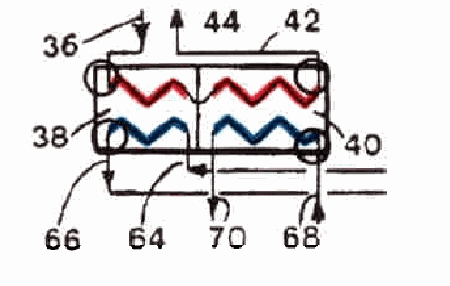
8The construction of the counterflow limitation in the Memorandum Opinion and Order on claim construction was:
the air flow and the coolant through an intercooler flowing in thermal contact and in opposite direction through a heat exchanger so that the temperature of the air flow through the intercooler closely approaches the temperature of the coolant at its inlet to the intercooler.
(emphasis added). Thus, in the circled areas of Fig. 1, which are not colored, the air flow and the coolant are not in thermal contact. Where the diagram is colored red and blue, there is thermal contact. The claim construction is not merely anywhere “inside the intercooler,” which is the premise for Rice’s objection.
In addition to the diagram of Fig. 1, Rice advances prior art heat exchanger configurations that are labeled “counterflow” and “cross-counterflow” in support of an argument that in them only a portion of the air flow and coolant oppose one another. The characterizations given by the prior art, even though appearing in the prosecution history, are not relevant. Those prior art heat exchanger configurations are not part of the written description of the ‘499 patent specification. Moreover, the only heat exchanger configuration shown and described in the written description of the ‘499 patent specification is that of Fig. 1, wherein all of the air flow and coolant flow that are in thermal contact are in opposite directions. The written description does not indicate that any other heat exchanger configuration would provide for the temperature of the air flow to closely approach the temperature of the coolant. The only structure described as providing for that is the heat exchanger arrangement diagramed in Fig. 1. The claim construction must comport with the written description. See Wang Labs., Inc. v. Am.9 Online, Inc., 197 F.3d 1377 (Fed. Cir. 1999); Bell Atl. Network Servs., Inc. v. Covad Commc’ns Group, Inc., 262 F.3d 1258 (Fed. Cir. 2001).
Rice’s final attempt to identify evidence of infringement under the requirement that “all” air flow and coolant flow are in opposite directions is to urge comparison between Fig. 1 of the ‘499 patent and a schematic diagram of the WR-21 intercooler presented in Exhibit M to the Branch Declaration. First, a comparison of the drawings of a patent to an accused device is improper, because infringement is based upon a comparison of the claim limitations to the accused device. Second, Exhibit M is merely a generalized representation of a heat exchanger without characterization of the actual configuration of the WR-21 intercooler. Exhibit M is far from being “compelling” evidence of infringement. Rice Objections at 10.
Rice’s objection is overruled.
III. The Objection That the Report Overlooks Competent Evidence That Defeats
Summary Judgment of Non-infringement as to the Design Rule Limitation Contrary to Rice’s statement of objection, the Report does not conclude that the WR-21 lacks the design rule limitation because of the design methodology employed by Rolls-Royce.9 The Report clearly frames the issue as a matter of structure.10 Nowhere does the Report contain any expression that the conclusion of non-infringement of the design rule limitation was reached based upon whether there had or had not been a 10resizing of either the high pressure compressor inlet flow area or the low pressure compressor inlet flow area.
However, the design methodology used is probative evidence as to the resulting structure of the WR-21 and whether the design rule limitation is present in the WR-21 engine. The written description of the ‘499 patent indicates as much in explaining the structure of Fig. 4 in the context of a design methodology that results in compliance with Boyle’s Law according to “this invention.”11 Moreover, the portion of the design rule limitation specifying inverse proportionality of the HPC inlet flow area to T / T
LPC HPC necessarily requires compliance with Boyle’s Law.12 Thus, an indicia of infringement of the design rule limitation is evidence that an intercooled engine has been designed to adhere to Boyle’s Law.13 In other words, if the evidence was that the WR-21 had been designed to adhere to Boyle’s Law, such evidence could raise a genuine issue of material fact. The Report merely identifies that there is no evidence that Rolls-Royce designed the WR-21 in adherence to Boyle’s Law.14 In fact, the evidence is to the contrary. Rice’s Additional Objection #4 is, therefore, necessarily overruled. See Rice Objections at 18.
Quite clearly, the Report addresses non-infringement of the design rule limitation on the basis of structure. The Report first concludes that the first aspect of the design rule limitation is met on the basis that the initial design conditions included a direct proportioning of the HPC inlet flow area and the LPC outlet flow area. The focus then11 becomes whether the second aspect of the design rule limitation is met. That is, the Report focuses on whether the operational parameters of the WR-21, selected as set forth in the Branch Declaration to account for the change in temperature and density of the air flow attributable to the intercooler, are such that for a predetermined operating condition of the intercooler the relationship T /T = 1.64, which is the same as A / A . The
LPC HPC LPC HPC
Report then addresses Rice’s evidence on this point.
The Report concludes that Rice’s proffered evidence is insufficient to demonstrate a genuine issue as to whether, for a predetermined operating condition of the intercooler, the relationship T /T = 1.64, which is the same as A / A , is met in
LPC HPC LPC HPC
the WR-21. Rice objects to this conclusion. In support of the objection, Rice contends that the evidence shows that the WR-21 LPC (IPC) is “capable” of delivering air flow at a temperature “that ranges up to 589°K” and that the intercooler is “capable” of cooling that air flow to a temperature of 318 °K, which provides TLPC /THPC = 1.85. Rice then submits that a “range” including 1.64 is established. This range of temperature relationships according to Rice are “predetermined, since they were known in advance.” Rice Objections at 13.
Before addressing Rice’s contentions and evidence as to the alleged capabilities of the WR-21, consideration must first be given to Rice’s view of the claim construction that “reasonable interpretation of the phrase ‘predetermined’ is ‘known in advance ’” and that according to patent parlance “a reasonable interpretation of the phrase ‘a predetermined operating condition’ is at least one ‘predetermined operating condition.’” Rice Additional Objection #7 at 20. First, that patent claim parlance provides for the article “a” to mean “one or more” is of no moment here. Second, the inclusion in the12 claim construction of “for a predetermined operating condition of the intercooler” was explained in the Memorandum Opinion and Order on claim construction to be required based upon the disclosure in the written description that the invention is premised on the intercooler being sized to effect a specified exit temperature under specified environmental conditions for a particular approach temperature, citing to the ‘499 patent at column 16, lines 54-57. Furthermore, see column 9, lines 16-26 of the ‘499 patent, wherein application of the design rule is made based on a predetermined operating condition of the intercooler. Thus, regardless of Rice’s objection as to the weight accorded to the Rice Declaration, Rice does not advance that evidence in the context of the design rule limitation, as construed in the Memorandum Opinion and Order on claim construction. Moreover, contrary to Rice’s belief, the claim construction taken in the context of the Memorandum Opinion and Order on claim construction is only reasonably interpreted to mean a single, particular operating condition. Rice’s objection is overruled on the basis of advancing an erroneous claim construction in support, regardless of the treatment of the evidentiary record.
In Additional Objection #9, Rice objects to the weight given to the Wilson Declaration and to the Rice Declaration, which were found to be “merely conclusory” or lacking “factual foundation.” Specifically, Rice objects that the Report ignores Branch Declaration Exhibit T, p. 6, as referenced in paragraph 36 of the Rice Declaration. Rice Objections at 21-22. In paragraph 36 of the Rice Declaration, Rice is purporting to support a statement as to “specified operating temperatures of WR-21 intercoolers (emphasis added).” Rice relies upon Branch Declaration Exhibit T only as evidence of a lower limit for air exiting the intercooler. Branch Declaration Exhibit T, however,13 indicates boundary conditions for the coolant temperature range and not for a temperature of air exiting the intercooler at a predetermined operating condition. Branch Decl., Ex. T, at 6. Branch Declaration Exhibit T says nothing whatsoever about a specified operating temperature of air exiting the intercooler.
Rice’s objection further includes a statement that “Branch Declaration Exhibit T plainly discloses that the intercooler is rated for an inlet temperature of 176.85°C, which is 450°K.” Rice Objections at 22. However, paragraph 36 of the Rice Declaration does not rely upon Branch Declaration Exhibit T for the inlet temperature (i.e., air entering the intercooler); Rice’s reliance is only as to air exiting the intercooler. To the extent Branch Declaration Exhibit T indicates an inlet temperature rating, such rating is indicated for engine operation when the intercooler is inoperative. Paragraph 36 of the Rice Declaration only relies upon Exhibit E for support of the inlet temperature rating of 450°K. Therefore, the Report concludes that Rice’s opinion of TLPC /THPC = 1.65 was without an adequate factual foundation.15 Rice’s opinion is not supported by the evidence he relies upon. Furthermore, no inference can be drawn from that evidence that, even if the intercooler inlet and outlet temperatures of 450°K and 273°K, respectively, are realized in operation of the intercooler, that those temperatures would exist simultaneously such that TLPC /THPC = 1.65 is realized.
The Report properly evaluated paragraph 36 of the Rice Declaration and is correct in concluding that paragraph 36 of the Rice Declaration is insufficient to raise a genuine issue of material fact as to whether, for a predetermined operating condition of the intercooler, the relationship T /T = 1.64, which is the same as A / A , is met in
LPC HPC LPC HPC
14the WR-21.16 The Report did not ignore Branch Declaration Exhibit T. Moreover, paragraph 36 of the Rice Declaration did not in any event rely upon Branch Declaration Exhibit T for the inlet temperature rating of the WR-21 intercooler. All reasonable inferences possible as to paragraph 36 of the Rice Declaration were drawn in Rice’s favor. There simply were no inferences that could be drawn to raise a genuine issue of material fact.
The objection set forth in Rice’s Additional Objection #9 is overruled. In Additional Objection #10, Rice objects to the conclusion in the Report that Exhibit E relied upon in paragraph 36 of the Rice Declaration is not probative as to an actual low pressure compressor air flow temperature applied to the intercooler of the WR-21. However, the statement of Rice’s objection is to the effect that Exhibit E is “probative as to the capabilities of the intercooler to withstand high temperatures” and “such evidence is probative as to the capabilities of the intercooler to withstand high temperature IPC delivery air flow.” Rice Objections at 22. However, this objection does not meet the substance of the statement in the Report. Again, Rice attempts to supplement paragraph 36 of the Rice Declaration with reliance on Branch Declaration Exhibit T when such reliance is not present. But, in addition to being an inappropriate supplementation of the record, Rice’s objection once again fails because Branch Declaration Exhibit T, as discussed above in regard to Additional Objection #9, does not15 support, nor can inference even be made, that operation of the intercooler at an inlet air temperature of 450°K actually occurs.17
The objection set forth in Rice’s Additional Objection #10 is overruled. Rice’s Additional Objections #11, #12 and #13 essentially restate the objections of Additional Objections ## 9 and 10. These objections are therefore overruled.
Rice’s Additional Objections #3, #5, #14, #15, and #16 object to certain semantics in the Report. These objections are overruled.
Rice’s Additional Objections #6, #8, #17 and #18 make objection that the Report fails to credit all of Rice’s evidence and to draw justifiable inferences from that evidence. These objections are overruled as merely restating previous objections.
Finally, Rice’s Additional Objection #2 makes objection that the Report fails to consider or give appropriate weight to Rice’s own interrogatory responses, including Amended Response to Interrogatory No. 2 appended to the Elliott Declaration as Exhibit C. Rice points to paragraphs 36-53 of the Rice Declaration and paragraph 11 of the Wilson Declaration. While the Elliott Declaration is cited in the declarations, no specific portion thereof is identified. Specifically, in paragraph 36 of the Rice Declaration, wherein Rice’s opinion of the existence of the design rule limitation in the WR-21 is given, no specific factual foundation for the opinion is indicated to be within the Elliott Declaration, Exhibit C. A review of Amended Response to Interrogatory No. 2 reveals only Rice’s infringement contentions. As to the absolute temperature ratio, the response16 merely states the same factual foundation set forth in the Rice Declaration. The objection of Rice’s Additional Objection #2 is overruled.
Rice’s objections to the claim constructions for the “counteflow limitation” and the “design rule limitation” have been addressed above. These objections are overruled.
CONCLUSION
Accordingly, Rice’s objections to the Report and Recommendation are OVERRULED and Rolls-Royce’s Motion for Summary Judgment of Non-Infringement of U.S. Patent No. B1 4,896,499 is GRANTED.
So ORDERED and SIGNED this 28th day of June, 2007.

LEONARD DAVIS
UNITED STATES DISTRICT JUDGE
Footnotes
- ↩ 1Somewhat oddly, Rolls-Royce has also filed objections (Docket No. 231) to the Report granting its motion for summary judgment. The Court finds these objections to be without merit and said objections are overruled. Rolls-Royce has also filed objections (Docket No. 230) to the Magistrate Judge’s report denying its Motion for Summary Judgment of Invalidity (Docket No. 228). The Court likewise finds these objections to be without merit. Accordingly, the Court adopts that Report as the findings and conclusions of the C2 ourt and denies Rolls-Royce’s invalidity motion. There is no discussion in these cases of what Rice characterizes as a proposition that “application of claim construction is always a question of fact.” See Rice Objections at 3, 6. The cases only state the fundamental rule that a second step in the infringement analysis is a comparison of properly construed claims to the alleged infringing device.
- ↩ 3 Rice incorrectly represents that a grant of a motion for summary judgment of non-infringement was under review in Int’l Rectifier Corp. See Rice Objections at 3.
- ↩ 4 Rice based a finding of the presence of the “counterflow limitation” in the WR-21 on a claim construction that is satisfied by any counterflow between the coolant and the airflow anywhere, including only that within the return pan of the WR-21 intercooler.
- ↩ 5 The counterflow limitation was construed to require that the air flow and the coolant through the intercooler flow in thermal contact and in opposite direction through a heat exchanger. The Report explains why the construction can only be understood to mean that all the air flow and coolant flow within the heat exchanger that are in thermal contact must be in counterflow. See Report at 7 n.4.
- ↩ 6 In fact, according to Rice’s objection here, the Federal Circuit engaged in fact-finding and substituted its findings for those of the jury.
- ↩ 7 Of interest, the dissent referred to this as a “non-issue.” Dorel, 429 F.3d at 1049.
- ↩ 8 Rice also argues that the Report at page 6 makes an “inherently factual” conclusion that the evidence does not show that the counterflow limitation is satisfied by the counterflow at the return pan. Rice Objections at p. 6. The Report is merely doing what the Federal Circuit did in International Rectifier Corp., in reversing the denial of IXYS’s motion for summary judgment of non-infringement and directing entry of judgment of non-infringement. Int’l Rectifier Corp., 361 F.3d at 1375.
- ↩ 9 Rice Objections at 11.
- ↩ 10 “Rice as the non-moving party and having the burden of proof on infringement must offer evidence that the accused infringing WR-21 engine has a high pressure compressor (HPC) with an inlet flow area that is sized (1) directly proportional to the low pressure compressor (LPC) outlet flow area and (2) inversely proportional to the absolute temperature ratio of the temperature of the airflow exiting the low pressure compressor to the temperature of the air flow from the intercooler passed to the inlet of the high pressure compressor (TLPC / THPC).” Report at 7-8.
- ↩ 1112 ‘499 Patent at col. 8, line 48 to col. 9, line 27. Even Rice agrees that the equation expressing the design rule limitation is derived from Boyle’s Law. Rice Objections at 25 (Additional Objection #14).
- ↩ 13 The Report acknowledges the prosecution history wherein Rice distinguished the Quandt prior art on the basis of its teaching to change compressor speed of rotation in order to obtain adherence to Boyle’s Law. However, the Report does not rest its conclusion of non-infringement on Rice’s apparent disclaimer of c14hanging compressor speed of rotation as being within the scope of the design rule limitation. The “red car” analogy offered by Rice is not instructive as color is not a structural characteristic of a car.
- ↩ 15 Paragraph 36 of the Rice Declaration also includes reference to Exhibit C of the Elliot Declaration. However, nowhere does Rice make a specific reference to reliance on any particular item of evidence contained in Exhibit C.
- ↩ 16 Arthur A. Collins, Inc. v. Telecom Ltd., 216 F3d 1042, 1047-48 (Fed. Cir. 2000) (“Thus, the expert must set forth the factual foundation for his opinion -- such as a statement regarding the structure found in the accused product -- in sufficient detail for the court to determine whether that factual foundation would support a finding of infringement under the claim construction adopted by the court, with all reasonable inferences drawn in favor of the nonmovant.”) This Rice failed to do.
- ↩ 17 Rice’s Additional Objection #10 further advances an argument that the Report ignores paragraphs 41-55 of the Rice Declaration. Rice Objections at 23. Rice’s opinion as to the existence of the design rule limitation is only contained in paragraphs 35-36. The factual basis for it is set forth only in paragraph 36. Rice does not indicate that a factual foundation for his opinion exists in paragraphs 41-55 of the Rice Declaration.