United States District Court
EASTERN DISTRICT OF TEXAS
SHERMAN DIVISION
SHENZHEN CHITADO §
TECHNOLOGY CO., LTD., §
§
Plaintiff, §
v. § Civil Action No. 4:26-cv-1608
§ Judge Mazzant
GREAT WORKS INTERNATIONAL §
DEVELOPMENT CO., LIMITED, §
§
Defendant. §
MEMORANDUM OPINION AND ORDER
Pending before the Court is Plaintiff Schenzhen Chitado Technology Co. Ltd.’s Emergency Motion for Temporary Restraining Order and Preliminary Injunction (Dkt. #8). Having considered the Motion and the relevant pleadings, the Court finds that the Motion should be DENIED.
BACKGROUND
Plaintiff Schenzhen Chitado Technology Co. Ltd. (“Chitado”) is the applicant and assignee named on U.S. Patent Nos. 12,649,534 (the “’534 Patent”) and 12,595,012 (the “’012 Patent”) (together, the “Asserted Patents”) (Dkt. #8 at p. 2). Plaintiff alleges Defendant infringes the asserted patents by selling the GREATWORK K7 and K7 Pro through Amazon, Walmart, and the website greatowrkbike.com (Dkt. #8 at p. 3).
LEGAL STANDARD
A party seeking a temporary restraining order must establish the following elements: (1) a substantial likelihood of success on the merits; (2) a substantial threat plaintiff will suffer irreparable harm if the injunction is not granted; (3) the threatened injury outweighs any damage the injunction might cause the defendant; and (4) the injunction will not disserve the public2 interest. Nichols v. Alcatel USA, Inc., 532 F.3d 364, 372 (5th Cir. 2008). Because this is a patent infringement case, likelihood of success on the merits is governed by Federal Circuit law; the other factors are governed by the law of the regional circuit—here, the Fifth Circuit, in which this Court sits. ABC Corp. I v. P’ship & Unincorporated Ass’ns Identified on Sch. “A”, 52 F.4th 934, 941 (Fed. Cir. 2022). “A preliminary injunction is an extraordinary remedy and should only be granted if the plaintiffs have clearly carried the burden of persuasion on all four requirements.” Id. Nevertheless, a movant “‘is not required to prove its case in full at a preliminary injunction hearing.’” Fed. Sav. & Loan Ins. Corp. v. Dixon, 835 F.2d 554, 558 (5th Cir. 1985) (quoting Univ. of Tex. v. Camenisch, 451 U.S. 390, 395 (1981)). The decision whether to grant a preliminary injunction lies within the sound discretion of the district court. Weinberger v. Romero-Barcelo, 456 U.S. 305, 320 (1982).
ANALYSIS
Chitado requests the Court enjoin and restrain Defendant from selling the K7 and K7 Pro (Dkt. #8 at pp. 9–10). Chitado also asks the Court to direct Amazon and Walmart, upon actual notice, to disable listings for the K7 and K7 Pro (Dkt. #8 at pp. 9–10). The Court will evaluate whether a temporary restraining order should issue using the traditional four-factor test.
I. Likelihood of Success on the Merits
For a patentee-plaintiff to establish that it is likely to succeed on the merits of a patent infringement claim, it must show (1) that it is likely to prove infringement of the patent claim, and (2) that the infringed-upon claim is valid. AstraZeneca LP v. Apotex, Inc., 633 F.3d 1042, 1050 (Fed. Cir. 2010). Where a “competitor raises a substantial question concerning either infringement or validity, i.e., asserts an infringement or invalidity defense that the patentee cannot prove ʻlacks3 substantial merit’” a court should not issue injunctive relief. Amazon.com v. Barnesandnoble.com, Inc., 239 F.3d 1343, 1350–1351 (Fed. Cir. 2001).
First, neither party provides competing claim construction arguments. The Court will therefore construe the terms with their plain and ordinary meaning, emphasizing that claim construction at this stage of the proceedings is preliminary. Wavetronix LLC v. Iteris, Inc., No. A-14-CV-970-SS, 2015 WL 300726, *3 (W.D. Tex. Jan. 22, 2015).
The Court will next address validity. Chitado argues that “[b]oth patents are presumed valid, 35 U.S.C. § 282(a), and absent evidence of invalidity, that presumption satisfied Chitado’s burden on validity at this stage” (Dkt. #8 at p. 6). Both Asserted Patents are continuations-in-part of PCT/CN2025/106945 (the “PC Application”), which claims priority to Chinese Application No. 202410885010.1 (the “Chinese Application”) filed on July 3, 2024 (Dkt. #14 at p. 6). The Asserted Patents claim the priority date of the Chinese Application, July 3, 2025 (Dkt. #14 at p. 6). Defendant argues that the claims are not entitled to this priority date because the Chinese Application does not support every limitation of the asserted claims (Dkt. #14 at p. 9). Defendants argue instead that the claims are entitled to a priority date of July 3, 2025, the date the PCT Application was filed. Defendant then cites sales activity over a year before July 3, 2024 (Dkt. #14 at p. 7). Sales made more than one year before a patent’s priority date implicate the on-sale bar to patentability. 35 U.S.C.A. § 102; see Definitive Holdings v. Powerteq, 171 F.4th 1373 (Fed. Cir. 2026). At this stage, Defendant must establish a “substantial question of invalidity” to defeat a temporary restraining order on the basis of invalidity. PHG Techs., LLC v. St. John Comps., Inc., 469 F.3d 1361, 1365 (Fed. Cir. 2006). The Court finds that Defendant has met that burden here making a temporary restraining order improper under these circumstances.
4Even though Defendant has established a “substantial question of invalidity,” the Court will also consider the parties arguments as to infringement. Chitado argues that it is likely to succeed on the merits by citing two claim charts that “identify the same claimed structure in both models” (Dkt. #8 at p. 5). To exemplify this contention, Chitado discusses two claims, Claim 15 from the ’534 Patent and Claim 7 from the ’012 Patent (Dkt. #8 at pp. 5–6). At this stage, the Court should compare the construed claim to the accused product to determine whether the accused product is likely to fall within the scope of the claims. Tinnus Enterprises, LLC v. Telebrands Corp., No. 6:16-cv-33, 2016 WL 9131960, at *2 (E.D. Tex. Nov. 21, 2016). To infringe, the accused device must embody each claim limitation or its equivalent. TIP Sys., LLC v. Phillips & Brooks/Gladwin, Inc., 529 F.3d 1364, 1379 (Fed.Cir.2008). A preliminary injunction should not issue if Defendant raises a substantial question of infringement. Genentech, Inc. v. Novo Nordisk, A/S, 108 F.3d 1361, 1364 (Fed.Cir.1997). The Court will examine both claims discussed in the Motion.
Claim 15 from the ’534 Patent requires “a frame body defining a substantially flat support plate located between front and rear ends of the frame body” and that the lower end of each sidewall be “positioned proximate a left [or right] edge of the support plate” (Dkt. #14 at p. 12). Defendant argues that the support plate is much narrower than the storage basket, meaning the sidewalls are not proximate left/right edge of the support plate (Dkt. #14 at p. 12). Plaintiff contends that the Defendant’s online listings show the “basket’s open top and its sidewalls rising from the edges of the plate” (Dkt. #8 at p. 5). The Court agrees that Defendant has raised a substantial question as to infringement because the images show that the sidewalls are not proximate left/right edge of the support plate as shown in images of the accused product (Dkt. #14 at p. 12).
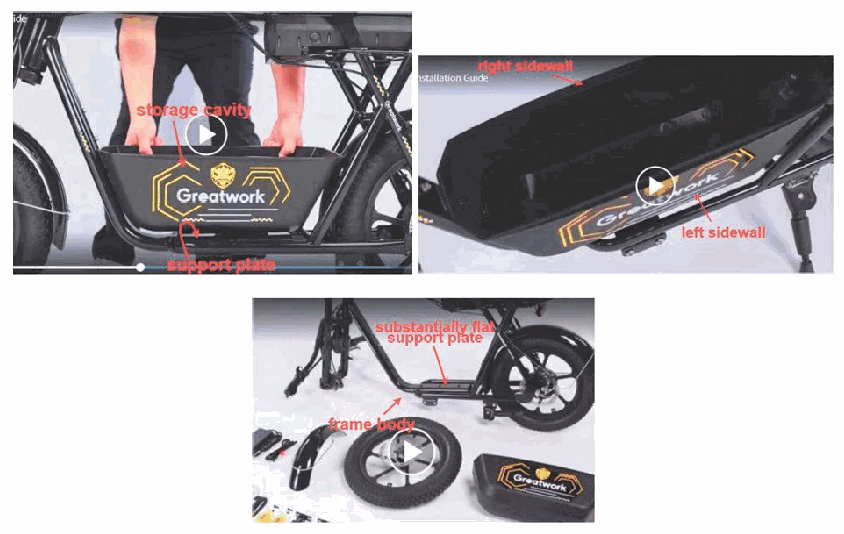
5(Dkt. #14 at p. 12).
Next the Court will consider claim 7 of the ’012 Patent. Asserted claim 7 requires, among other things “an installation position of the left footrest is longitudinally nearer a left-front end of the base portion rather than at or adjacent to a left-rear end of the base portion” (Dkt. #14 at p. 14). Chitado argues that the “footrests are installed as described above” (Dkt. #8 at p. 6) while Defendant argues that the footrest is at the center of the support plate, not nearer a front end (Dkt. #14 at p. 14). A temporary restraining order is a “extraordinary, and perhaps drastic remedy” that is not granted unless “the movant clearly carries the onerous burden of persuasion.” Keddy v. UTMB, No. 6:17cv502, 2017 WL 6506359, at *2 (E.D. Tex. Dec. 19, 2017). The Court finds that Plaintiff has not met the burden of showing that it will likely prove infringement of the Asserted Patents. Because the Court concludes that Plaintiff has failed to carry its burden of showing a substantial likelihood of success on the merits, the Court need not address the remaining three6 factors. See DFW Metro Line Servs. v. Sw. Bell Tel. Co., 901 F.2d 1275, 1269 (5th Cir. 1990). Plaintiffs’ request for a temporary restraining order is therefore denied.
CONCLUSION
It is therefore ORDERED that Plaintiff Schenzhen Chitado Technology Co. Ltd.’s Emergency Motion for Temporary Restraining Order and Preliminary Injunction (Dkt. #8) is hereby DENIED.
IT IS SO ORDERED.