United States District Court
EASTERN DISTRICT OF TEXAS
SHERMAN DIVISION
§
INTELLECTUAL VENTURES I LLC and §
INTELLECTUAL VENTURES II LLC §
§
Plaintiffs, §
§ Civil Action No. 4:24cv980
v. § Judge Mazzant
§
AMERICAN AIRLINES, INC. §
§
Defendant. §
MEMORANDUM OPINION AND ORDER
On July 8, 2026, the Court held a hearing to determine the proper construction of the disputed claim terms U.S. Patent Nos. 7,822,841 (“’841 Patent”); 8,352,584 (“’584 Patent”); 7,721,282 (“’282 Patent”); 7,712,080 (“’080 Patent”); and 11,032,000 (“’000 Patent”) (collectively, the “Asserted Patents”).1 Having reviewed the arguments made by the parties at the hearing and in their supplemental claim construction briefing (Dkt. Nos. 139, 141, 142, 144)2, having considered the intrinsic evidence, and having made subsidiary factual findings about the extrinsic evidence, the Court hereby issues this Claim Construction Memorandum and Order. See Phillips v. AWH Corp., 415 F.3d 1303, 1314 (Fed. Cir. 2005) (en banc); see also Teva Pharm. USA, Inc. v. Sandoz, Inc., 135 S. Ct. 831, 841 (2015).
2TABLE OF CONTENTS
I. BACKGROUND ................................................................................................................ 3 II. APPLICABLE LAW .......................................................................................................... 8 III. LEVEL OF ORDINARY SKILL IN THE ART .............................................................. 14 IV. CONSTRUCTION OF AGREED TERMS ...................................................................... 15 V. CONSTRUCTION OF DISPUTED TERMS PRESENTED BUT NOT BRIEFED OR
ARGUED BY DEFENDANT ...................................................................................................... 16 VI. CONSTRUCTION OF DISPUTED TERMS ................................................................... 18
A. “high performance [computing] cluster” ..................................................... 18 B. “operational and[/or] connectivity problems” / “hardware and[/or] software problems” ............................................................................................................ 20 C. “communications within the first and second clusters are isolated” /
“communications between the first [HPC] cluster and the second [HPC] cluster are isolated” ......................................................................................................... 23 D. “appropriate persistent mapping” ................................................................ 26 E. “low-level driver” ........................................................................................ 29 F. “root image” ................................................................................................. 30 G. “the modifying” ........................................................................................... 33 H. “at an operational level” .............................................................................. 36 I. “distributed parallel computing program” .................................................... 37 J. “time interval” / “time intervals” .................................................................. 40 K. “a processor” / “the processor”; “a receiver” / “the receiver”; “a transmitter” / “the transmitter” ................................................................................................ 45 L. “in the same time interval that the uplink physical signal is sent, a plurality of UEs transmit uplink physical signals in the same time interval” ................... 48 VII. CONCLUSION ................................................................................................................. 50
3I. BACKGROUND
Plaintiffs Intellectual Ventures I LLC and Intellectual Ventures II LLC (“IV” or “Plaintiff”) alleges that Defendant American Airlines, Inc. (“American” or “Defendant”) infringes the Asserted Patents. Before the start of the July 8, 2026 hearing, the Court provided the parties with preliminary constructions with the aim of focusing the parties’ arguments and facilitating discussion.
The ’584 Patent is a continuation of the ’841 Patent, and two patents share the same specification. The ’841 Patent, titled “Method and System for Hosting Multiple, Customized Computing Clusters,” was filed on October 30, 2007, and issued on October 26, 2010. The ’584 Patent, titled “System for Hosting Customized Computing Clusters,” was filed on September 30, 2010, and issued on January 8, 2013. The patents relate “to distributed computing and clustered computing environments, and, more particularly, to computer software, hardware, and computer-based methods for hosting a set of computer clusters that are uniquely configured or customized to suit a number of remote customers or clients.” ’841 Patent at 1:8–13; ’584 Patent at 1:15–20.
The Abstract of the patents state:
A computer system for hosting computing clusters for clients. The system includes clusters each including a set of computing resources and each implemented in custom or differing configurations. Each of the configurations provides a customized computing environment for performing particular client tasks. The configurations may differ due to configuration of the processing nodes, the data storage, or the private cluster network or its connections. The system includes a monitoring system that monitors the clusters for operational problems on a cluster level and also on a per-node basis such as with monitors provided for each node. The system controls client access to the clusters via a public communications by only allowing clients to access their assigned cluster or the cluster configured per their specifications and performing their computing task. Gateway mechanisms isolate each cluster such that communications within a cluster or on a private cluster communications network are maintained separate.
4Claim 1 of the ’841 Patent is an illustrative claim and recites the following elements (disputed term in italic):
1. A computer system for hosting computing clusters for clients,
comprising:
a private communications network linked to a public
communications network;
a first cluster comprising a set of computing resources, including at
least one hardware processor, in a first configuration, wherein the first cluster is communicatively linked to the private communications network;
a second cluster comprising a set of computing resources, including
at least one hardware processor, in a second configuration, wherein the second cluster is communicatively linked to the private communications network; and
a monitoring system monitoring operations of the first and second
clusters, identifying operational and connectivity problems, and issuing an alert in response to the identified problems indicating a corresponding one of the first and second clusters associated with the identified problems;
wherein the first configuration differs from the second configuration
and wherein the first configuration provides a first computing environment for performing a first client task and the second configuration provides a second computing environment for performing a second client task;
wherein the monitoring system comprises a main monitor that
operates to monitor the first and second clusters to identify the operation and connectivity problems and further comprises monitors for each node of the first and second clusters operating to check for hardware and software problems within a particular node and to report the hardware and software problems to the main monitor.
Claim 1 of the ’584 Patent is an illustrative claim and recites the following elements (disputed term in italic):
1.A computer system, comprising: a private communications network linked to a public
communications network;
a first cluster comprising a set of computing resources, including at
least one hardware processor, in a first configuration, wherein the first cluster is communicatively linked to the private communications network;
a second cluster comprising a set of computing resources, including
at least one hardware processor, in a second configuration,
5wherein the second cluster is communicatively linked to the private communications network; and
a monitoring system to monitor operations of the first cluster and the
second cluster for communications problems;
wherein the first configuration differs from the second
configuration;
wherein the first configuration provides a first computing
environment to perform a first client task and the second configuration provides a second computing environment to perform a second client task; and
wherein the computing resources comprise processing nodes, data
storage shared by the processing nodes, and at least one communications network to link the processing nodes to each other and to the data storage;
wherein the first cluster establishes communications between the set
of computing resources of the first cluster and a first gateway communicatively linked between the first cluster and the private communications network;
wherein the second cluster establishes communications among the
set of computing resources of the second cluster and a second gateway communicatively linked between the second cluster and the private communications network;
wherein communications between the first cluster and the second
cluster are isolated;
wherein the first cluster is a high performance cluster; and wherein the second cluster is a high performance cluster.
The ’282 Patent, titled “Block-Level I/O Subsystem for Distributed Application Environment Management,” was filed on March 30, 2006, and issued on May 18, 2010. The ’282 Patent relates “relate to distributed application environment deployment in a multi-computer system.” ’282 Patent at 1:18–19.
The Abstract of the ’282 Patent states:
An embodiment of the present invention is directed to a system for distributing an application environment to a compute node. The system includes a first storage unit for storing blocks of a root image of the compute node and a second storage unit for storing a leaf image comprising new data blocks and changes to the blocks of the root image. The system further includes a union block device for interfacing between the compute node and the first and second storage units to distribute the application environment to the compute node. The union block device creates the application environment by merging the blocks of the root image stored on the
6first storage unit with the leaf image stored on the second storage unit.
Claim 1 of the ’282 Patent is an illustrative claim and recites the following elements (disputed terms in italic):
1.A system for distributing an application environment comprising: a compute node comprising a computer system; a first storage unit for storing blocks of a root image of the compute
node, wherein the first storage unit comprises a first non-volatile memory, wherein the root image comprises a computer program, wherein the blocks comprise sections of data, and wherein a file of the root image comprises at least one block;
a second storage unit for storing a leaf image, the leaf image
comprising new data blocks and changes to the blocks of the root image, wherein the second storage unit comprises a second non-volatile memory; and
a union block device for interfacing between the compute node and
the first and second storage units to distribute the application environment to the compute node, wherein the union block device comprises a driver, wherein the union block device creates the application environment by merging the blocks of the root image stored on the first storage unit with the blocks of the leaf image stored on the second storage unit; the union block device comprises a low-level driver for interfacing between the first and second storage units and the file system of the compute node; and the union block device, upon receiving a write request from the compute node for a sector X, creates an appropriate persistent mapping for sector X. The ’080 Patent, titled “Systems and Methods for Parallel Distributed Programming,” was filed on May 21, 2004, and issued on May 4, 2010. The ’080 Patent relates to a network services system “to systems and methods for parallel distributed programming.” ’080 Patent at 1:14–15.
The Abstract of the ’080 Patent states:
The present invention relates generally to computer programming, and more particularly to systems and methods for parallel distributed programming. Generally, a parallel distributed program is configured to operate across multiple processors and multiple memories. In one aspect of the invention, a parallel distributed program includes a distributed shared variable located across the multiple memories and distributed programs capable of operating
7across multiple processors.
Claim 1 of the ’080 Patent is an illustrative claim and recites the following elements (disputed terms in italic):
1.A method of developing a distributed parallel computing
program, comprising steps of:
establishing at least one distributed shared variable, wherein the at
least one distributed shared variable is a single variable that includes several variables that may be physically distributed across multiple memories;
developing at least one distributed sequential computing program
to access the at least one distributed shared variable; and
transforming the at least one distributed sequential computing
program into at least one distributed parallel computing program by spawning at least one child distributed sequential computing program from the at least one distributed sequential computing program when at least one intermediate condition occurs within the at least one distributed sequential computing program, wherein the at least one distributed parallel computing program concurrently uses the at least one distributed sequential computing program and the at least one spawned child distributed sequential computing program to perform parallel processing and/or operations, wherein the at least one intermediate condition comprising one intermediate result that will be required by the at least one spawned child distributed sequential computing program to continue computation.
The ’000 Patent, titled “Communications in a Wireless Network,” was filed on November 13, 2019, and issued on June 8, 2021. The ’000 Patent generally relates to wireless communications between user equipment (“UEs”) and a base station.’000 Patent at 2:20–24.
The Abstract of the ’000 Patent states:
A user equipment (UE) may, in a time interval that it is not sending information over a physical uplink shared channel, send an uplink physical signal based on received resource allocation information. The uplink physical signal may be used to determine channel conditions by a base station. The UE may receive, on a downlink control channel, control information. The control information may be based on the determined channel conditions.
Claim 1 of the ’000 Patent is an illustrative claim and recites the following elements8 (disputed terms in italic):
1.A user equipment (UE) comprising: a receiver and a processor are configured to receive resource
allocation information associated with an uplink physical signal, wherein the uplink physical signal and a physical uplink shared channel have different resources;
a transmitter and the processor are configured to send, over the
physical uplink shared channel, data in assigned time intervals;
the transmitter and the processor are further configured, in a time
interval that it is not sending information over the physical uplink shared channel, to send the uplink physical signal based on the received resource allocation information, wherein the uplink physical signal is used to determine channel conditions by a base station and in the same time interval that the uplink physical signal is sent, a plurality of UEs transmit uplink physical signals in the same time interval; and
the receiver and the processor are further configured to receive, on
a physical control channel, control information, wherein the control information is based on the determined channel conditions, wherein physical control channels are transmitted in a same time slot with other physical channels in a plurality of predetermined time slots in a downlink frame, wherein other time slots of the downlink frame do not include a physical control channel, wherein a number of bits sent over the physical control channel is based on a number of fields of control information to be sent to the UE.
II. APPLICABLE LAW
A. Claim Construction
“It is a ‘bedrock principle’ of patent law that ‘the claims of a patent define the invention to which the patentee is entitled the right to exclude.’” Phillips v. AWH Corp., 415 F.3d 1303, 1312 (Fed. Cir. 2005) (en banc) (quoting Innova/Pure Water Inc. v. Safari Water Filtration Sys., Inc., 381 F.3d 1111, 1115 (Fed. Cir. 2004)). To determine the meaning of the claims, courts start by considering the intrinsic evidence. Id. at 1313; C.R. Bard, Inc. v. U.S. Surgical Corp., 388 F.3d 858, 861 (Fed. Cir. 2004); Bell Atl. Network Servs., Inc. v. Covad Commc’ns Grp., Inc., 262 F.3d 1258, 1267 (Fed. Cir. 2001). The intrinsic evidence includes the claims themselves, the9 specification, and the prosecution history. Phillips, 415 F.3d at 1314; C.R. Bard, Inc., 388 F.3d at 861. The general rule—subject to certain specific exceptions discussed infra—is that each claim term is construed according to its ordinary and accustomed meaning as understood by one of ordinary skill in the art at the time of the invention in the context of the patent. Phillips, 415 F.3d at 1312–13; Alloc, Inc. v. Int’l Trade Comm’n, 342 F.3d 1361, 1368 (Fed. Cir. 2003); Azure Networks, LLC v. CSR PLC, 771 F.3d 1336, 1347 (Fed. Cir. 2014) (quotation marks omitted) (“There is a heavy presumption that claim terms carry their accustomed meaning in the relevant community at the relevant time.”) cert. granted, judgment vacated, 135 S. Ct. 1846 (2015).
“The claim construction inquiry . . . begins and ends in all cases with the actual words of the claim.” Renishaw PLC v. Marposs Societa’ per Azioni, 158 F.3d 1243, 1248 (Fed. Cir. 1998). “[I]n all aspects of claim construction, ‘the name of the game is the claim.’” Apple Inc. v. Motorola, Inc., 757 F.3d 1286, 1298 (Fed. Cir. 2014) (quoting In re Hiniker Co., 150 F.3d 1362, 1369 (Fed. Cir. 1998)) overruled on other grounds by Williamson v. Citrix Online, LLC, 792 F.3d 1339 (Fed. Cir. 2015). First, a term’s context in the asserted claim can be instructive. Phillips, 415 F.3d at 1314. Other asserted or unasserted claims can also aid in determining the claim’s meaning, because claim terms are typically used consistently throughout the patent. Id. Differences among the claim terms can also assist in understanding a term’s meaning. Id. For example, when a dependent claim adds a limitation to an independent claim, it is presumed that the independent claim does not include the limitation. Id. at 1314–15.
“[C]laims ‘must be read in view of the specification, of which they are a part.’” Id. (quoting Markman v. Westview Instruments, Inc., 52 F.3d 967, 979 (Fed. Cir. 1995) (en banc)). “[T]he specification ‘is always highly relevant to the claim construction analysis. Usually, it is dispositive; it is the single best guide to the meaning of a disputed term.’” Id. (quoting Vitronics Corp. v.10 Conceptronic, Inc., 90 F.3d 1576, 1582 (Fed. Cir. 1996)); Teleflex, Inc. v. Ficosa N. Am. Corp., 299 F.3d 1313, 1325 (Fed. Cir. 2002). This is true because a patentee may define his own terms, give a claim term a different meaning than the term would otherwise possess, or disclaim or disavow the claim scope. Phillips, 415 F.3d at 1316. In these situations, the inventor’s lexicography governs. Id.
The specification may also resolve ambiguous claim terms “where the ordinary and accustomed meaning of the words used in the claims lack sufficient clarity to permit the scope of the claim to be ascertained from the words alone.” Teleflex, Inc., 299 F.3d at 1325. But, “‘[a]lthough the specification may aid the court in interpreting the meaning of disputed claim language, particular embodiments and examples appearing in the specification will not generally be read into the claims.’” Comark Commc’ns, Inc. v. Harris Corp., 156 F.3d 1182, 1187 (Fed. Cir. 1998) (quoting Constant v. Advanced Micro-Devices, Inc., 848 F.2d 1560, 1571 (Fed. Cir. 1988)); see also Phillips, 415 F.3d at 1323. “[I]t is improper to read limitations from a preferred embodiment described in the specification—even if it is the only embodiment—into the claims absent a clear indication in the intrinsic record that the patentee intended the claims to be so limited.” Liebel-Flarsheim Co. v. Medrad, Inc., 358 F.3d 898, 913 (Fed. Cir. 2004).
The prosecution history is another tool to supply the proper context for claim construction because, like the specification, the prosecution history provides evidence of how the U.S. Patent and Trademark Office (“PTO”) and the inventor understood the patent. Phillips, 415 F.3d at 1317. However, “because the prosecution history represents an ongoing negotiation between the PTO and the applicant, rather than the final product of that negotiation, it often lacks the clarity of the specification and thus is less useful for claim construction purposes.” Id. at 1318; see also Athletic11 Alts., Inc. v. Prince Mfg., 73 F.3d 1573, 1580 (Fed. Cir. 1996) (ambiguous prosecution history may be “unhelpful as an interpretive resource”).
Although extrinsic evidence can also be useful, it is “‘less significant than the intrinsic record in determining the legally operative meaning of claim language.’” Phillips, 415 F.3d at 1317 (quoting C.R. Bard, Inc., 388 F.3d at 862). Technical dictionaries and treatises may help a court understand the underlying technology and the manner in which one skilled in the art might use claim terms, but technical dictionaries and treatises may provide definitions that are too broad or may not be indicative of how the term is used in the patent. Id. at 1318. Similarly, expert testimony may aid a court in understanding the underlying technology and determining the particular meaning of a term in the pertinent field, but an expert’s conclusory, unsupported assertions as to a term’s definition are not helpful to a court. Id. Extrinsic evidence is “less reliable than the patent and its prosecution history in determining how to read claim terms.” Id. The Supreme Court has explained the role of extrinsic evidence in claim construction:
In some cases, however, the district court will need to look beyond the patent’s intrinsic evidence and to consult extrinsic evidence in order to understand, for example, the background science or the meaning of a term in the relevant art during the relevant time period. See, e.g., Seymour v. Osborne, 11 Wall. 516, 546 (1871) (a patent may be “so interspersed with technical terms and terms of art that the testimony of scientific witnesses is indispensable to a correct understanding of its meaning”). In cases where those subsidiary facts are in dispute, courts will need to make subsidiary factual findings about that extrinsic evidence. These are the “evidentiary underpinnings” of claim construction that we discussed in Markman, and this subsidiary factfinding must be reviewed for clear error on appeal.
Teva Pharm. USA, Inc. v. Sandoz, Inc., 574 U.S. 318, 331–32 (2015).
B. Departing from the Ordinary Meaning of a Claim Term
There are “only two exceptions to [the] general rule” that claim terms are construed according to their plain and ordinary meaning: “1) when a patentee sets out a definition and acts as his own lexicographer, or 2) when the patentee disavows the full scope of the claim term either12 in the specification or during prosecution.”3 Golden Bridge Tech., Inc. v. Apple Inc., 758 F.3d 1362, 1365 (Fed. Cir. 2014) (quoting Thorner v. Sony Comput. Entm’t Am. LLC, 669 F.3d 1362, 1365 (Fed. Cir. 2012)); see also GE Lighting Sols., LLC v. AgiLight, Inc., 750 F.3d 1304, 1309 (Fed. Cir. 2014) (“[T]he specification and prosecution history only compel departure from the plain meaning in two instances: lexicography and disavowal.”). The standards for finding lexicography or disavowal are “exacting.” GE Lighting Sols., 750 F.3d at 1309.
To act as his own lexicographer, the patentee must “clearly set forth a definition of the disputed claim term,” and “clearly express an intent to define the term.” Id. (quoting Thorner, 669 F.3d at 1365); see also Renishaw, 158 F.3d at 1249. The patentee’s lexicography must appear “with reasonable clarity, deliberateness, and precision.” Renishaw, 158 F.3d at 1249.
To disavow or disclaim the full scope of a claim term, the patentee’s statements in the specification or prosecution history must amount to a “clear and unmistakable” surrender. Cordis Corp. v. Bos. Sci. Corp., 561 F.3d 1319, 1329 (Fed. Cir. 2009); see also Thorner, 669 F.3d at 1366 (“The patentee may demonstrate intent to deviate from the ordinary and accustomed meaning of a claim term by including in the specification expressions of manifest exclusion or restriction, representing a clear disavowal of claim scope.”). “Where an applicant’s statements are amenable to multiple reasonable interpretations, they cannot be deemed clear and unmistakable.” 3M Innovative Props. Co. v. Tredegar Corp., 725 F.3d 1315, 1326 (Fed. Cir. 2013).
C. Definiteness Under 35 U.S.C. § 112, ¶ 2 (pre-AIA) / § 112(b) (AIA) Patent claims must particularly point out and distinctly claim the subject matter regarded as the invention. 35 U.S.C. § 112, ¶ 2. A claim, when viewed in light of the intrinsic evidence,13 must “inform those skilled in the art about the scope of the invention with reasonable certainty.” Nautilus Inc. v. Biosig Instruments, Inc., 572 U.S. 898, 910 (2014). If it does not, the claim fails § 112, ¶ 2 and is therefore invalid as indefinite. Id. at 901. Whether a claim is indefinite is determined from the perspective of one of ordinary skill in the art as of the time the application for the patent was filed. Id. at 911. As it is a challenge to the validity of a patent, the failure of any claim in suit to comply with § 112 must be shown by clear and convincing evidence. BASF Corp. v. Johnson Matthey Inc., 875 F.3d 1360, 1365 (Fed. Cir. 2017). “[I]ndefiniteness is a question of law and in effect part of claim construction.” ePlus, Inc. v. Lawson Software, Inc., 700 F.3d 509, 517 (Fed. Cir. 2012).
When a term of degree is used in a claim, “the court must determine whether the patent provides some standard for measuring that degree.” Biosig Instruments, Inc. v. Nautilus, Inc., 783 F.3d 1374, 1378 (Fed. Cir. 2015) (quotation marks omitted). Likewise, when a subjective term is used in a claim, “a court must determine whether the patent’s specification supplies some standard for measuring the scope of the [term].” Ernie Ball, Inc. v. Earvana, LLC, 502 F. App’x 971, 980 (Fed. Cir. 2013) (citations omitted). The standard “must provide objective boundaries for those of skill in the art.” Interval Licensing LLC v. AOL, Inc., 766 F.3d 1364, 1371 (Fed. Cir. 2014).
D. Means-Plus-Function Limitations
Where a claim limitation is expressed in “means plus function” language and does not recite definite structure in support of its function, the limitation is subject to 35 U.S.C. § 112, ¶ 6. Braun Med., Inc. v. Abbott Labs., 124 F.3d 1419, 1424 (Fed. Cir. 1997). In relevant part, 35 U.S.C. § 112, ¶ 6 mandates that “such a claim limitation ‘be construed to cover the corresponding structure . . . described in the specification and equivalents thereof.’” Id. (citing 35 U.S.C. § 112, ¶ 6). Accordingly, when faced with means-plus-function limitations, courts “must turn to the written14 description of the patent to find the structure that corresponds to the means recited in the [limitations].” Id.
Construing a means-plus-function limitation involves multiple steps. “The first step in construing [a means-plus-function] limitation is a determination of the function of the means-plus-function limitation.” Medtronic, Inc. v. Advanced Cardiovascular Sys., Inc., 248 F.3d 1303, 1311 (Fed. Cir. 2001). Once a court has determined the limitation’s function, “the next step is to determine the corresponding structure described in the specification and equivalents thereof.” Id. A “structure disclosed in the specification is ‘corresponding’ structure only if the specification or prosecution history clearly links or associates that structure to the function recited in the claim.” Id. Moreover, the focus of the “corresponding structure” inquiry is not merely whether a structure is capable of performing the recited function, but rather whether the corresponding structure is “clearly linked or associated with the [recited] function.” Id.
III. LEVEL OF ORDINARY SKILL IN THE ART
It is well established that patents are interpreted from the perspective of one of ordinary skill in the art (“POSITA”). See Phillips, 415 F.3d at 1313 (“[T]he ordinary and customary meaning of a claim term is the meaning that the term would have to a person of ordinary skill in the art in question at the time of the invention, i.e., as of the effective filing date of the patent application.”). The Federal Circuit has advised that the “[f]actors that may be considered in determining the level of skill in the art include: (1) the educational level of the inventors; (2) the type of problems encountered in the art; (3) prior art solutions to those problems; (4) the rapidity with which innovations are made; (5) sophistication of the technology; and (6) education level of active workers in the field.” Env’tl Designs, Ltd. v. Union Oil Co. of California, 713 F.2d 693, 696 (Fed. Cir. 1983). “These factors are not exhaustive but are merely a guide to determining the level15 of ordinary skill in the art.” Daiichi Sankyo Co. Ltd. v. Apotex, Inc., 501 F.3d 1254, 1256 (Fed. Cir. 2007).
Plaintiff’s expert, Dr. Mahdi Eslamimehr, proposes that “a POSITA would have a bachelor’s degree in electrical engineering, computer science, or a similar area of study, and two or more years of industry experience in networking and distributed computing. Additional experience may make up for a lack of education, and vice versa.” (Dkt. No. 139-3 at ¶ 31).
Defendant’s expert, Dr. Michael Goodrich, opines that a POSITA “would have had a Bachelor’s degree in electrical engineering, computer science, or the like, and/or two or more years of industry experience in networking and distributed computing. Additional experience may make up for a lack of education and vice versa” (Dkt. No. 139-5 at ¶ 18).
The parties essentially agree on the level of skill in the art. Given the parties’ agreement, and the factors that may be considered in determining the level of skill in the art, the Court finds a POSITA would have a Bachelor’s degree in electrical engineering, computer science, or the like, and/or two or more years of industry experience in networking and distributed computing. Additional education may substitute for industry experience, or vice versa.
IV. CONSTRUCTION OF AGREED TERMS
During the claim construction hearing, the parties agreed to the construction of the following terms:
| Claim Term/Phrase | Agreed Construction |
| “means ... to limit access ...” (’584 Patent: Claim 8) | Function: limit access to the first cluster to communication access from a first client associated with the first client task and limit access to the second cluster to communication access from a second client associated with the second client task. |
| Structure: firewall and authentication system/mechanism (e.g., 210 in Figure 2; 410/411/412 in Figure 4). | |
| “distributed sequential computing program” (’080 Patent: Claims 1, 9) | “program using a single locus of computation over distributed data” |
| “parallel processing and/or operations” (’080 Patent: Claims 1, 9) | “processing that enables calculations to be carried out simultaneously” |
16In view of the parties’ agreement on the proper construction of the identified term, the Court hereby ADOPTS the parties’ agreed constructions.
V. CONSTRUCTION OF DISPUTED TERMS PRESENTED BUT NOT
BRIEFED OR ARGUED BY DEFENDANT
Plaintiff briefed a number of terms and phrases in its Supplemental Opening Claim Construction Brief that were not included in Defendant’s brief. The terms and phrases included the following:
“wherein the first configuration differs from the second configuration” (’841 Patent, Claim 1; ’584 Patent, Claims 1 and 10);
“new data blocks” (’282 Patent, Claims 1 and 15); “sector” (’282 Patent, Claims 1, 10, and 15); “multiple nodes” (’080 Patent, Claim 6); “distributed shared memory system” (’080 Patent, Claims 17 and 18); and “a plurality of predetermined time slots in a downlink frame, wherein other time slots of the downlink frame do not include a physical control channel” (’000 Patent Claim 13)
Defendant did not brief any of these terms, but instead provided a footnote for some of these terms stating that “[t]his term does not require construction at this time, but if IV applies it in a way that creates a dispute, American will raise that dispute when appropriate.” See, e.g., Dkt. No. 141 at 9, n.1. For others terms, Defendant did not even bother to provide a footnote.
17After the briefing was completed, the parties identified these terms and phrases in their P.R. 4-5(d) Supplemental Joint Claim Construction Chart as disputed, and indicated that “[t]he parties discussed, but did not reach agreement, regarding dropping any terms identified in the Supplemental Joint Claim Construction Statement (Dkt. 124).” (Dkt. No. 146 at 2, n.2). As indicated during the July 8, 2026 hearing, the Court does not follow a wait-and-see approach. To the extent that Defendant later attempts to raise a claim construction dispute related to these terms and phrases, the Court finds that Defendant waived that argument. Bettcher Indus., Inc. v. Bunzl USA, Inc., 661 F.3d 629, 640 (Fed. Cir. 2011) (affirming decision not to perform supplemental claim construction where court “issued a Markman order premised on the express belief that there were no other claim construction disputes”). Accordingly, the Court construes the terms and phrases as follows:
| Claim Term/Phrase | Agreed Construction |
| “wherein the first configuration differs from the second configuration” (’841 Patent: Claim 1) (’584 Patent: Claims 1, 10) | Plain and ordinary meaning, not indefinite. |
| “new data blocks” (’282 Patent: Claims 1, 15) | Plain and ordinary meaning. |
| “sector” (’282 Patent: Claims 1, 10, 15) | Plain and ordinary meaning. |
| “multiple nodes” (’080 Patent: Claim 6) | Plain and ordinary meaning. |
| “distributed shared memory system” (’080 Patent: Claims 17, 18) | Plain and ordinary meaning. |
| “a plurality of predetermined time slots in a downlink frame, wherein other time slots of the downlink frame do not include a physical control channel” (’000 Patent: Claim 13) | Plain and ordinary meaning, not indefinite. |
18VI. CONSTRUCTION OF DISPUTED TERMS
The parties dispute the meaning and scope of sixteen terms or phrases in the Asserted Patents. Each dispute is addressed below.
A. “high performance [computing] cluster”
| Disputed Term | Plaintiff’s Proposal | Defendant’s Proposal |
| “high performance [computing] cluster” | Plain and ordinary meaning, not indefinite. | Indefinite. |
1. Analysis
The term “high performance [computing] cluster” appears in Asserted Claim 9 of the ’841 Patent, and Asserted Claims 1 and 10 of the ’584 Patent. The Court finds that the term is used consistently in the claims and is intended to have the same general meaning in each claim. The parties dispute whether the term “high performance [computing] cluster” is indefinite.
Defendant argues that “high” is a classic term of degree. (Dkt. No. 144 at 6). Defendant contends that the intrinsic record fails to state how a POSITA would distinguish a “high performance” cluster from a “medium” or “low” performance cluster, or an “average” or “poor” performance cluster. Id. at 10 (citing Dkt. No. 139-5 at ¶ 63). According to Defendant, the specification uses “high performance” as an undefined marketing label untethered to measurable attributes. (Dkt. No. 141 at 10) (citing ’841 Patent at 1:32–2:18, 2:5–18, 5:1–11; ’584 Patent at 2:12–25, 5:10–20; Dkt. No. 139-5 at ¶¶ 61, 63, 71).
Defendant further contends that the indefiniteness problem is compounded by the breadth of the underlying “cluster” concept. (Dkt. No. 141 at 11). Defendant argues that the same19 architecture, running different workloads or configured with modest hardware upgrades, might be called “high performance” by one POSITA and not another. (Dkt. No. 141 at 11) (citing Interval Licensing LLC v. AOL, Inc., 766 F.3d 1364, 1371 (Fed. Cir. 2014)). According to Defendant, the specifications fail to provide an objective boundary as to what constitutes a “high” vs. “average” vs. “low” performance clusters. (Dkt. No. 144 at 7).
The Court disagrees with Defendant’s analysis. The specification describes different cluster configurations, including High Performance Computing (“HPC”) clusters. The specification contrasts HPC clusters with descriptions of load balancing clusters and high availability clusters. ’841 Patent at 2:10–18. The specification further states that “HPC systems allow a set of computers to work together to solve a single problem. The large problem is broken down into smaller independent tasks that are assigned to individual computers in the cluster allowing the large problem to be solved faster.” ’841 Patent at 1:51–55. In other words, an HPC clusters “solve large problems that would take an inordinate amount of time to solve with a single computer.” ’841 Patent at 1:38–39.
The specification’s subsequent recitations of HPC clusters are consistent with this description. See, e.g., ’841 Patent at 2:19–44, 3:4–25, 4:51–5:11, 10:3–12. Indeed, Plaintiff’s expert, Dr. Eslamimehr, opines that “‘high performance’ refers to computing systems designed or configured to achieve high throughput, speed, and/or computational capability as compared to conventional systems, ‘computing’ refers to the execution of computational tasks and ‘cluster’ refers to a group of interconnected computers or computing nodes that operate together as a system.” (Dkt. No. 139-3 at ¶ 95). Dr. Eslamimehr further opines that the phrase “high performance computing cluster” would be understood by a POSITA to mean a cluster of interconnected computing resources configured to perform computationally intensive tasks,20 typically using parallel or distributed processing.” Id. Thus, the evidence before the Court indicates that the term “high performance [computing] cluster” should be construed to mean “cluster of interconnected computing nodes configured to use parallel processing to solve large problems faster than a single computer.”
In summary, the thrust of Defendant’s argument is that the claims are ambiguous because it is not clear whether the claims read on the accused products. But definiteness “does not require that a potential infringer be able to determine ex ante if a particular act infringes.” Nevro Corp. v. Bos. Sci. Corp., 955 F.3d 35, 40 (Fed. Cir. 2020);see also SmithKline Beecham Corp. v. Apotex Corp., 403 F.3d 1331, 1340-41 (Fed. Cir. 2005) (“The test for indefiniteness does not depend on a potential infringer’s ability to ascertain the nature of its own accused product to determine infringement, but instead on whether the claim delineates to a skilled artisan the bounds of the invention.”). Accordingly, the Court finds that Defendant failed to prove by clear and convincing evidence that the term is indefinite.
2. Court’s Construction
For the reasons set forth above, the Court construes the term “high performance [computing] cluster” to mean “cluster of interconnected computing nodes configured to use parallel processing to solve large problems faster than a single computer.”
B. “operational and[/or] connectivity problems” / “hardware and[/or]
software problems”
| Disputed Term | Plaintiff’s Proposal | Defendant’s Proposal |
| “operational and[/or] connectivity problems” | Plain and ordinary meaning, not indefinite. | Indefinite. |
| “hardware and[/or] software problems” | Plain and ordinary meaning, not indefinite. | Indefinite. |
1. Analysis
The term “operational and[/or] connectivity problems” appears in Asserted Claim 1 of the21 ’841 Patent, and Asserted Claims 5 and 6 of the ’584 Patent. The Court finds that the term is used consistently in the claims and is intended to have the same general meaning in each claim. The term “hardware and[/or] software problems” appears in Asserted Claim 1 of the ’841 Patent, and Asserted Claim 6 of the ’584 Patent. The Court finds that the term is used consistently in the claims and is intended to have the same general meaning in each claim. The parties dispute whether the terms are indefinite.
Defendant argues that both sets of terms are indefinite because the shared specification does not provide objective boundaries for what counts as a “problem.” (Dkt. No. 141 at 11-12). Defendant contends that the specification only describes what happens after a “problem” is detected. Id. at 12 (citing ’841 Patent at 3:26–31, 8:27–9:6). According to Defendant, the specifications never gives an example, threshold, or metric for what qualifies as a “problem.” (Dkt. No. 141 at 12). Defendant contends that POSITAs could disagree about whether the same cluster behavior is a “problem” or normal operation and nothing in the specification resolves that disagreement. Id. at 13. Defendant argues that “problems” is no less subjective than “aesthetically pleasing” or “significant.” Id. at 5 (citing Datamize, LLC v. Plumtree Software, Inc., 417 F.3d 1342, 1350 (Fed. Cir. 2005); Intellectual Ventures I LLC v. T-Mobile USA, Inc., 902 F.3d 1372 (Fed. Cir. 2018)).
The Court finds Defendant’s analysis lacking, because it attempts to consider the term “problem” in isolation. Medrad, Inc. v. MRI Devices Corp., 401 F.3d 1313, 1319 (Fed. Cir. 2005) (“We cannot look at the ordinary meaning of the term . . . in a vacuum. Rather, we must look at the ordinary meaning in the context of the written description and the prosecution history.”). When considered in the proper context, the terms “operational and/or connectivity problems” and “hardware and/or software problems” are neither purely subjective nor dependent on personal22 opinion. The specifications identify Intelligent Platform Management Interface (“IPMI”) as a per-node monitoring mechanism that “monitors the hardware and software components,” and Simple Network Management Protocol (“SNMP”) as a mechanism that “operate to notify the central monitoring system … of the problem.” ’841 Patent at 7:43–52; 8:36–48. The specification further states that “[t]he clients have the option of having additional monitoring components on each node to monitor additional components as requested by the client.” ’841 Patent at 9:2–4. Thus, Defendant’s argument that the scope of a type of “problem” cannot be reasonably determined by a POSITA is contradicted by the specification, which anchor the claim terms to industry protocols.
More importantly, the Asserted Claims of the ’841 Patent and ’584 Patent recite that the monitoring system identifies operational and connectivity problems, and issues “an alert in response to the identified [operational or connectivity] problems.” ’841 Patent at Claim 1; ’584 Patent at Claim 5. Similarly, the Asserted Claims recite that the monitoring system monitors each node to check for hardware and software problems within a particular node, and reports the hardware and software problems to the main monitor. ’841 Patent at Claim 1, ’584 Patent at Claim 6. Thus, the scope of “problems” is limited by the surrounding claim language, which requires identifying the problem and sending an alert or a report of the problem. In other words, the claim are not required to specify a “level” of the problems, because that may differ from one organization to another. ’841 Patent at 6:24–7:8. Instead, the system will be preconfigured to the level specified by the client or the staff of the hosting facility. Otherwise, the system would not provide “a customized computing environment for performing particular client tasks.” ’841 Patent at Abstract.
To be sure, a POSITA would have understood that operational “problems” are issues affecting cluster operations, for example execution failures and performance degradation. ’84123 Patent at 3:26–29; see also Dkt. No. 139-3 at ¶ 48. Similarly, the specification describes “connectivity” as relating to the ability of clusters to communicate using connections over a network. ’841 Patent at 1:19-22, 5:12–26; see also Dkt. No. 139-3 at ¶¶ 48, 55-56. A POSITA would have thus understood that connectivity “problems” relate to issues affecting cluster network communications, for example loss of network availability, communication failures, and network connectivity interruptions. ’841 Patent at 5:12–26, 7:43–52; see also Dkt. No. 139-3 at ¶ 48.
Likewise, a POSITA would have understood that hardware “problems” refer to problems arising from malfunction or failure of physical components of a computing node, such as processor faults, memory errors, storage device failures, and other similar problems. ’841 Patent at 7:43–50; see also Dkt. No. 139-3 at ¶ 64. Similarly, a POSITA would have understood that software “problems” refer to problems arising from malfunction or failure of software executing on a node, such as software crashes, execution errors, misconfiguration, or other failures in software operation. ’841 Patent at 7:43–50; see also Dkt. No. 139-3 at ¶ 65. The threshold or metric for what qualifies as a “problem” would be preconfigured by the system based on the client needs, and this configuration would allow a POSITA to determine the scope of the disputed terms. Accordingly, the Court finds that Defendant failed to prove by clear and convincing evidence that the terms are indefinite.
2. Court’s Construction
The Court finds that the term “operational and[/or] connectivity problems,” and the term “hardware and[/or] software problems” are not indefinite, and are given their plain and ordinary meaning.
C. “communications within the first and second clusters are isolated” /
“communications between the first [HPC] cluster and the second [HPC] cluster are isolated”
| Disputed Term | Plaintiff’s Proposal | Defendant’s Proposal |
| “communications within the first and second clusters are isolated” | Plain and ordinary meaning. | “network traffic within each cluster is maintained separate from other clusters by a gateway positioned between the private cluster network and the private company network that manages traffic destined for its corresponding cluster” |
| “communications between the first [HPC] cluster and the second [HPC] cluster are isolated” | Plain and ordinary meaning. | “network traffic within each cluster is maintained separate from other clusters by a gateway positioned between the private cluster network and the private company network that manages traffic destined for its corresponding cluster” |
241. Analysis
The phrase “communications within the first and second clusters are isolated” appears in Asserted Claim 8 of the ’841 Patent. The phrase “communications between the first [HPC] cluster and the second [HPC] cluster are isolated” appears in Asserted Claims 1 and 10 of the ’584 Patent. The parties dispute whether the phrases require construction. Plaintiff argues that Defendant’s construction are wrong for a plethora of reasons. (Dkt. No. 139 at 11). Plaintiff also argues that the claim language does not recite any specific structure that isolates communications “within the first and second clusters.” Id. According to Plaintiff, the specification recites other potential components that may be involved with isolating communications within clusters. Id.
The Court agrees that other components may be involved in isolating. However, the intrinsic evidence ties “isolation,” at a minimum, to gateway-based segregation. For example, the specification states that “[g]ateway mechanisms isolate each cluster such that communications within a cluster or on a private cluster communications network are maintained separate (e.g., do not have to share bandwidth of a single system network).” ’841 Patent at Abstract, see also id. at 3:43–47. The specification further states that gateway 240 provides “efficient separation of the individual cluster network traffic to prevent one cluster from interfering with other clusters.” ’84125 Patent at 5:27–36. Thus, the recited “communications … are isolated” language refers to this gateway-based separation described in the specification. A POSITA would understand that clusters are not isolated from all external communication; rather gateway mechanisms maintain separation so clusters do not interfere with one another. (See Dkt. No. 139-5 at ¶¶ 55–57). Accordingly, the recited isolation is achieved by at least the recited gateway mechanism or gateway.
Plaintiff also argues that Claim 8 recites a “gateway mechanism” that has a different and broader meaning than a “gateway.” The Court finds that the specification uses the terms “gateway mechanism” and “gateway” interchangeably. For example, the specification states that “[g]ateway mechanism isolate each cluster such that communications within a cluster or on a private cluster communications network are maintained separate.” ’584 Patent at Abstract (emphasis added). Similarly, the specification states that “[t]he embodiment shown with system 200 provides efficient separation of the individual cluster network traffic to prevent one cluster from interfering with other clusters. The traffic separation is achieved through the gateway 240, 241, and/or 242 located between each cluster 250, 251, and 252 and the company network 230.” Id. at 5:37–42 (emphasis added). As discussed above, this indicates that the recited isolation is achieved by at least the recited gateway mechanism or gateway.
Plaintiff further argues that the claims do not recite a “private company network.” (Dkt. No. 139 at 11). The Court agrees that this language is improper. The claim language explicitly recites the location of the recited gateway mechanism or gateway. Claim 8 of the ’841 Patent recites that the gateway mechanism is “positioned between the private cluster network and the private communications network.” Likewise, Claims 1 and 10 of the ’584 Patent recite that the first gateway is “communicatively linked between the first cluster and the private communications26 network,” and the second gateway is “communicatively linked between the second cluster and the private communications network.” Accordingly, it would be improper to read into the claims an unrecited “private company network.”
Finally, Plaintiff contends that the disputed terms in the ’584 Patent recite communications “between” the first and second clusters, whereas the similar term in Claim 1 of the ’841 Patent recites communications “within” the recited clusters of that claim. (Dkt. No. 139 at 13). Plaintiff argues that these terms are different in scope, but Defendant proposes the same construction for both terms. Id. The Court finds that the difference is whether the claim focuses on intra-cluster traffic (’841 Patent, Claim 8) or inter-cluster traffic (’584 Patent, Claims 1 and 10). Regardless, the intrinsic evidence indicates that the recited isolation is achieved by at least the recited gateway mechanism or gateway.
2. Court’s Construction
For the reasons set forth above, the Court construes the phrase “communications within the first and second clusters are isolated” to mean “communications within the first and second clusters are isolated by at least the gateway mechanism.” The Court construes the phrase “communications between the first [HPC] cluster and the second [HPC] cluster are isolated” to mean “communications between the first [HPC] cluster and the second [HPC] cluster are isolated by at least the respective gateway.”
D. “appropriate persistent mapping”
| Disputed Term | Plaintiff’s Proposal | Defendant’s Proposal |
| “appropriate persistent mapping” | Plain and ordinary meaning, no construction necessary. | Indefinite. |
1. Analysis
The term “appropriate persistent mapping” appears in Asserted Claims 1 and 15 of the ’28227 Patent. The parties dispute whether the term is indefinite. Defendant argues that the ’282 Patent does not provide objective boundaries for what makes a mapping “appropriate persistent.” (Dkt. No. 141 at 18) (citing Dkt. No. 139-5 at ¶¶ 108–113). Defendant contends “appropriate” is a term of degree, and the specification never supplies the degree. (Dkt. No. 141 at 19). According to Defendant, a POSITA would recognize multiple reasonable mapping strategies, and the intrinsic record provides no thresholds, correctness conditions, or algorithmic constraints separating “appropriate” and inappropriate mappings. Id. (citing Dkt. No. 139-5 at ¶ 110). Defendant argues that one engineer might deem a particular mapping approach “appropriate,” another might not, and the patent gives no way to choose between them. (Dkt. No. 141 at 19). Defendant contends that the term leaves infringement to subjective judgment rather than objective boundaries. Id. (citing Datamize, 417 F.3d at 1350–51). Defendant argues that there is no intrinsic boundary between infringing (“appropriate”) and non-infringing (“inappropriate”) implementations. (Dkt. No. 141 at 20).
Plaintiff argues that in the context of Claims 1 and 15, a “mapping” refers to an association between the sector specified by the write request and a particular storage location, such that read and write operations for that sector are directed to the appropriate storage unit, and a “persistent” mapping refers to one that is maintained so that subsequent accesses to the same sector continue to be directed to the same storage location. (Dkt. No. 139) (citing Dkt. No. 139-3 at ¶¶ 180-181; ’282 Patent at 5:3–11). Plaintiff further argues that the language “appropriate” does not render this claim indefinite because it reflects that the mapping created depends on the state of the system. (Dkt. No. 139 at 19). Specifically, Plaintiff contends that “appropriate” indicates whether the sector is already stored in the leaf image or must be newly mapped from the root image before modification. Id. (citing Dkt. No. 139-3 at ¶¶ 184-186; ’282 Patent at 5:1–11). In other words, “if28 sector X is not yet recorded in the leaf image, the UBD creates a new mapping redirecting that sector’s writes to the second storage unit; if sector X already exists in the leaf image, no new mapping is needed because the persistent mapping already exists.” (Dkt. No. 142 at 12).
The Court agrees that a POSITA would understand that “mapping” refers to an association between the sector specified by the write request and a particular storage location, such that read and write operations for that sector are directed to a storage unit. (Dkt. No. 139-3 at ¶ 181). Likewise, a POSITA would understand that “persistent” mapping refers to one that is maintained so that subsequent accesses to the same sector continue to be directed to the same storage location. (139-3 at ¶ 181). The Court further agrees that the specification discloses an embodiment that “upon receiving a write request from their respective compute nodes for a sector X, the UBDs 130 a-n will create an appropriate persistent mapping for sector X and then write sector X onto their respective second storage units 150 a-n, where sector X can then be modified.” ’282 at 5:3–7.
However, in the context of the claim language, this embodiment fails to inform those skilled in the art about the scope of the invention with reasonable certainty, because Claims 1 and 15 do not require a “new mapping if necessary.” Instead, the claim language requires an “appropriate” mapping with no guidance as to what the term “appropriate” means. The specification does not tell a POSITA when or how a mapping is “appropriate,” and fails to provide boundaries distinguishing an “appropriate” mapping from an “inappropriate” one.
The Court agrees with Defendant that different people consider different things “appropriate” or “inappropriate,” which makes the term “completely dependent on a person’s subjective opinion.” Datamize, LLC v. Plumtree Software, Inc., 417 F.3d 1342, 1350 (Fed. Cir. 2005). Accordingly, Defendant proved by clear and convincing evidence that the term “appropriate” is indefinite, because the specification does not provide objective criteria for what29 makes a mapping “appropriate.”
2. Court’s Construction
The term “appropriate persistent mapping” is indefinite for failing to inform, with reasonable certainty, those skilled in the art about the scope of the invention.
E. “low-level driver”
| Disputed Term | Plaintiff’s Proposal | Defendant’s Proposal |
| “low-level driver” | Plain and ordinary meaning, no construction necessary. | “driver that operates below the file system” |
1. Analysis
The term “low-level driver” appears in Asserted Claim 1 of the ’282 Patent. The parties dispute whether the term “low-level driver” requires construction. Claim 1 recites in part “the union block device comprises a low-level driver for interfacing between the first and second storage units and the file system of the compute node.” As recited in Claim 1, the recited “driver” provides an interface between the storage units and the file system and managing write operations directed to specific storage locations.
By using the specific phrase “low-level driver” instead of just “driver,” the patentees intended to define the layer at which the driver operates as part of the claim. The specification states that the UBDs are “effectively low-level drivers” that interface between the storage devices and the file system, and that “[b]ecause UBDs 130a–n operate below the file system, they are concerned merely with the blocks of data themselves, rather than files they form.” ’282 Patent at 4:42–51 (emphasis added). This informs a POSITA that a “low-level driver” is a driver that operates beneath the file system that handles blocks and sectors while the file system manages files. (See Dkt. No. 139-5 at ¶¶ 119–121).
Plaintiff argues that “operate below the file system” describes only one embodiment. (Dkt.30 No. 139 at 20). The Court disagrees, because the specification’s use of “low-level driver” equates it with operation below the file system, and the claim repeats that same role. ’282 Patent at 4:42– 51, 7:32–34. There is no disclosure of a “low-level driver” that sits at or above the file-system layer, nor any disclosure of a driver at another layer labeled “low-level.” (See Dkt. No. 139-5 at ¶¶ 119–120). Plaintiff would have the Court ignore the “below the file system” language in the specification and read to the term “low-level” out of the claims. This would be improper. Bicon, Inc. v. Straumann Co., 441 F.3d 945, 950 (Fed. Cir. 2006) (“[C]laims are interpreted with an eye toward giving effect to all terms in the claim.”). Accordingly, the Court finds that the term “low-level driver” should be construed to mean “driver that operates below the file system.”
2. Court’s Construction
For the reasons set forth above, the Court construes the term “low-level driver” to mean “driver that operates below the file system.”
F. “root image”
| Disputed Term | Plaintiff’s Proposal | Defendant’s Proposal |
| “root image” | Plain and ordinary meaning, no construction necessary. | “a read-only base set of data blocks, operating beneath the file system, that provide the common portion of the application environment” |
1. Analysis
The term “root image” appears in Asserted Claims 1, 4, 5, 15, 17, 20, and 21 of the ’282 Patent. The Court finds that the term is used consistently in the claims and is intended to have the same general meaning in each claim. The parties dispute whether the term “root image” requires construction. The Court previously construed “root image” as recited in certain claims of U.S. Patent No. 8,332,844 (the “’844 Patent”) as “a common set of data blocks unchanged by the plurality of compute nodes.” The ’844 Patent, is a continuation-in-part of the ’282 Patent, and the31 parties agree that the term carries a consistent meaning across the patent family. (Dkt. No. 141 at 21) (citing NTP, Inc. v. Research in Motion, Ltd., 418 F.3d 1282, 1293 (Fed. Cir. 2005)).
Like the ’844 Patent, the ’282 Patent discloses storing data blocks of a root image on a first storage unit and storing data blocks of leaf images on a second storage unit, where the leaf image includes additional data blocks that are not contained in the root image, including changes made to the blocks of the root image. ’282 Patent at Abstract. The specification states that “[t]he leaf image may contain blocks of new data, blocks of changed data, or other blocks of data unique to the individual compute node.” Id. at 4:22–24. The specification further states that “[t]he root image contains data initially common to the compute nodes 120a-n,” and “[t]he root image is not changed by compute nodes 120a-n.” Id. at 4:12–14. Thus, the commonality of the root image addressed the “major problem” with the prior art of having to update “a number of copies of the boot image.” Id. at 1:54–57.
These aspects of the disclosure are generally captured in the language of independent Claims 1 and 15. Claims 1 and 15 recite, in part, “storing blocks of a root image of the compute node,” and “storing a leaf image” where the leaf image comprises “new data blocks and changes to the blocks of the root image.” ’282 Patent at 7:14–24, 8:5–15. Per the claim language, a root image includes blocks of data, and any changes to those blocks are stored in the leaf image. Accordingly, a “root image” is “a common set of data blocks that are unchanged by the plurality of compute nodes.”
Defendant argues that the specification expressly characterizes the root image as “a read-only base image (or ‘root’ image) of the application environment” that is “accessible by all compute nodes in the cluster,” with changes stored in a “‘leaf’ image unique to that compute node.” (Dkt. No. 141 at 22) (citing ’282 Patent at 1:62–67). Defendant contends that the specification32 equates the “root image” with a “read-only base image,” and does so in definitional, not merely descriptive, language. (Dkt. No. 141 at 23) (citing Cultor Corp. v. A.E. Staley Mfg. Co., 224 F.3d 1328, 1331 (Fed. Cir. 2000)).
Defendant argues that if compute nodes could modify the root image blocks directly, the entire root/leaf overlay scheme would lose its storage benefits and coherence guarantees. (Dkt. No. 141 at 22) (citing Dkt. No. 39-5 at ¶ 99). The Court agrees that the intrinsic evidence indicates that the commonality of the root image is the claimed system. However, as discussed above, this is captured in the claim language and the Court’s construction. Defendant did not provide a persuasive reason to explicitly redraft the claims to include a “read-only” limitation. See Lionra Technologies Ltd. v. Cisco Systems, Inc., No. 2:24-CV-00097-JRG, 2025 WL 1384261, at *3 (E.D. Tex. May 13, 2025) (“To act as his own lexicographer, the patentee must ‘clearly set forth a definition of the disputed claim term,’ and ‘clearly express an intent to define the term.’”) (quoting GE Lighting Sols., 750 F.3d at 1309). Indeed, Claims 13 and 29 recite that it is the “first storage unit” that is read-only. Thus, when the patentees wanted to recite “read-only,” they explicitly did so in the claims.
Defendant next argues that the specification teaches that “by storing data at the block level, embodiments are able to operate beneath the file system and thus are designed to be file system and operating system independent.” (Dkt. No. 141 at 22) (citing ’282 Patent at 5:65–6:2). According to Defendant, a POSITA would understand that the blocks of the root image necessarily operate beneath the file system. (Dkt. No. 141 at 22) (citing Dkt. No. 39-5 at ¶¶ 95–98).
The Court finds that Defendant’s construction improperly incorporates one embodiment. Specifically, the disclosure at column 5, line 65 to column 6, line 2 describes an embodiment shown in Figure 3, and recites step 310 “is storing blocks of a root image of the compute node on33 a first storage unit. By storing data at the block level, embodiments are able to operate beneath the file system and thus are designed to be file system and operating system independent.” ’282 Patent at 5:65–6:2 (emphasis added).
Notably, this specification indicates that this embodiment is able to operate at a layer beneath the file system, not that it must do so. Claims 1 and 15 recite that blocks of data are stored, it does not require “operating beneath the file system.” This would introduce an unwarranted limitation in the “root image” term. Defendant’s argument that the root image must be characterized as operating beneath the file system because of the UBD improperly conflates two distinct elements: the UBD (a driver/interface component) and the root image (a set of data blocks stored on a first storage unit). As discussed above, the disputed term “low-level driver” defines the layer at which the driver operates.
Finally, regarding Defendant’s “common portion of the application environment” proposal, the Court rejects it. The specification does not recite “common” and “portion” in combination. As recited in Claims 1 and 15, a root image includes blocks of data, and changes to those blocks are stored in the leaf image. Accordingly, a “root image” is “a common set of data blocks unchanged by the plurality of compute nodes.”
2. Court’s Construction
For the reasons set forth above, the Court construes the term “root image” to mean “a common set of data blocks that are unchanged by the plurality of compute nodes.”
G. “the modifying”
| Disputed Term | Plaintiff’s Proposal | Defendant’s Proposal |
| “the modifying” | Plain and ordinary meaning, not indefinite. | Indefinite. |
1. Analysis
The term “the modifying” appears in Asserted Claim 15 of the ’282 Patent. The parties34 dispute whether Claim 15 is indefinite because “the modifying” lacks antecedent basis. As shown below, the disputed claim language originally appeared as dependent Claim 19 during prosecution.4 Claim 19 depended on dependent Claim 18, which depended on independent Claim 17 (Final Claim 15). Dependent Claim 18 provided antecedent basis for “the modifying” in dependent Claim 19.
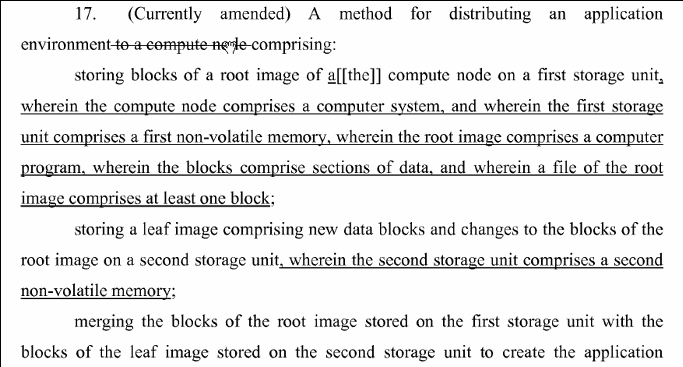
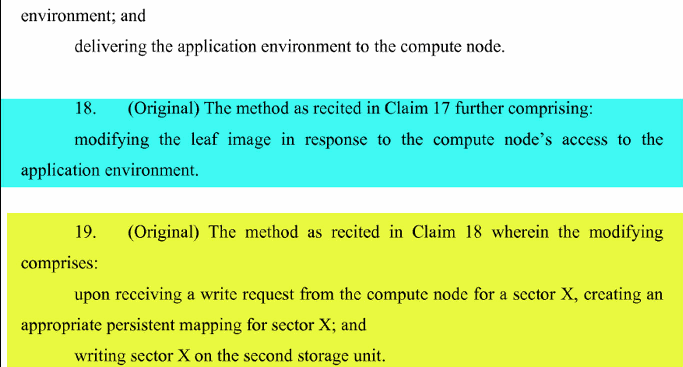
Court Exhibit A at 12 (highlight added). In the Notice of Allowance, the examiner amended independent Claim 17 by bringing up dependent Claim 19 into Claim 17, but did not bring up35 Claim 18. Thus, it was the examiner’s amendment in the Notice of Allowance that created the lack of antecedent basis for the term “the modifying.”
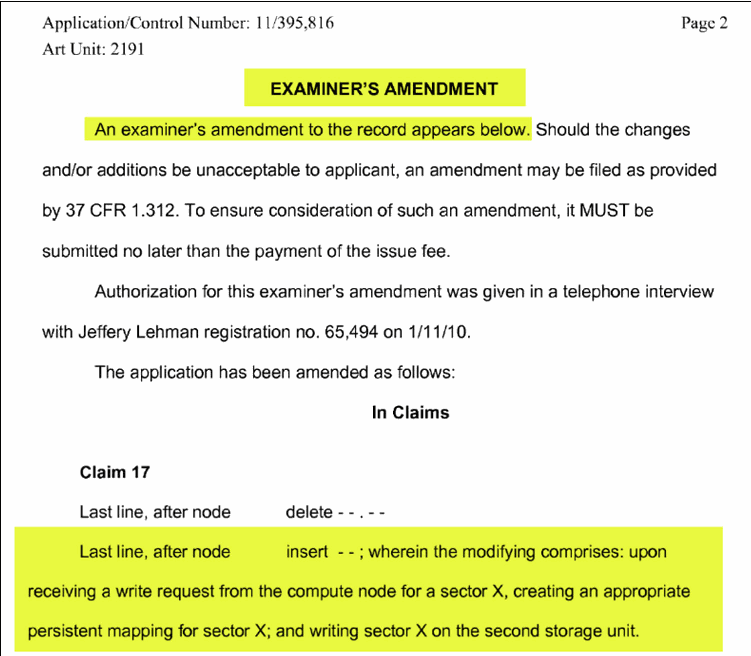
Court Exhibit A at 6-7 (highlight added). With this background, the Court turns to the parties’ dispute.
Claim 15 recites in part “the modifying comprises: upon receiving a write request from the compute node for a sector X, creating an appropriate persistent mapping for sector X; and writing sector X on the second storage unit.” In other words, upon receiving a write request for a sector X, an appropriate persistent mapping for sector X is created and sector X on the second storage unit is written to. Thus, the “modifying” unambiguously refers to modifying the second storage unit based on the received write request. (Dkt. No. 139-3 at ¶¶ 205-207). This understanding is consistent with the specification, which discloses modifying the leaf image’s storage unit by36 writing to a sector X in response to a write request for sector X:
UBDs 130a-n may also modify the leaf image in response to their respective compute node's access to its instance of the application environment. For example, upon receiving a write request from their respective compute nodes for a sector X, the UBDs 130a-n will create an appropriate persistent mapping for sector X and then write sector X onto their respective second storage units 150a-n, where sector X can then be modified. It will be appreciated that the data block being modified may already exist in the leaf image, in which case it does not need to be mapped and copied from the root image before modification.
’282 Patent at 5:1–11 (emphasis added). It is not disputed that the term lacks antecedent basis, but a claim term with an antecedent basis error is still valid when it provides reasonable certainty to persons of ordinary skill in the art. See Cheetah Omni LLC v. Alcatel-Lucent Inc., 939 F.Supp.2d 649 (E.D. Tex. 2013) (finding claims were not indefinite despite lacking explicit antecedent basis because a term had “reasonably ascertainable meaning” and “an antecedent basis may be present by implication.”). As discussed, the specification and prosecution history is consistent with the language in Claim 15, and a POSITA would have understood with reasonable certainty the meaning of this limitation given the intrinsic evidence. (Dkt. No. 139-3 at ¶ 211). Accordingly, Defendant failed to prove by clear and convincing evidence that the term is indefinite.
2. Court’s Construction
The Court finds that the term “the modifying” is not indefinite, and is given its plain and ordinary meaning.
H. “at an operational level”
| Disputed Term | Plaintiff’s Proposal | Defendant’s Proposal |
| “at an operational level” | Plain and ordinary meaning, not indefinite. | Indefinite. |
1. Analysis
The term “at an operational level” appears in Asserted Claim 26 of the ’282 Patent. The37 parties dispute whether the term “at an operational level” is indefinite. Claim 26 recites “wherein merging occurs at an operational level between the first and second storage units and file system of the compute node.” ’282 Patent at 8:51–53. The word “operational” is not in the specification. Defendant argues that a POSITA would have no guidance on whether “operational level” refers to block level versus file-system-level operation, kernel-mode versus user-mode execution, or some other abstraction. (Dkt. No. 141 at 25) (citing Dkt. No. 139-5 at ¶¶ 131–132). The Court agrees.
Plaintiff suggests that “operational” refers to the system’s functioning during normal use. (Dkt. No. 139 at 22) (citing Dkt. No. 139-3 at ¶¶ 212-214). Plaintiff’s argument does not distinguish any particular technical layer and collapses into a vague statement that the system works. The specification discusses low-level drivers operating below the file system, but it never equates “operational level” with any layer. ’282 Patent at 4:42–51. Indeed, Plaintiff does not argue for that understanding, but instead argues “operational” refers to the system’s functioning during normal use. (Dkt. No. 139 at 22). This does not provide an objective boundary for the term “at an operational level.” Thus, the term “might mean several different things and no informed and confident choice is available among the contending definitions.” Interval Licensing LLC v. AOL, Inc., 766 F.3d 1364, 1371 (Fed. Cir. 2014) (internal citations omitted). Accordingly, Defendant proved by clear and convincing evidence that the term “at an operational level” is indefinite,
2. Court’s Construction
The term “at an operational level” is indefinite for failing to inform, with reasonable certainty, those skilled in the art about the scope of the invention.
I. “distributed parallel computing program”
| Disputed Term | Plaintiff’s Proposal | Defendant’s Proposal |
| “distributed parallel computing program” | Plain and ordinary meaning, not indefinite. | “program that computes using multiple concurrent distributed sequential computing programs configured to operate across multiple processors/nodes and multiple memories” |
381. Analysis
The term “distributed parallel computing program” appears in Asserted Claims 1, 4, 5, 6, 9, 17, and 18 of the ’080 Patent. The Court finds that the term is used consistently in the claims and is intended to have the same general meaning in each claim. The parties dispute whether the term “distributed parallel computing program” requires construction.
Claim 1 is directed to “[a] method of developing a distributed parallel computing program.” The claim recites that a distributed parallel computing program is created by “transforming the at least one distributed sequential computing program into at least one distributed parallel computing program by spawning at least one child distributed sequential computing program from the at least one distributed sequential computing program.” ’080 Patent at 11:14–18. The specification further provides the meaning of the term “distributed parallel computing program.” Specifically, the specification states that “[a]nother aspect of navigational programming is distributed parallel computing (‘DPC’), which is computing using multiple concurrent DSC programs.” ’080 at 5:57–59 (emphasis added).
A POSITA would understand this to be the patentees’ intended meaning for the term “distributed parallel computing program.” Indeed, Plaintiff’s expert opines that this “description is consistent with the ordinary technical meaning of distributed parallel computing because it focuses on concurrency and parallel execution through the composition of distributed sequential programs.” (Dkt. No. 139-3 at ¶ 224).
39Likewise, Defendant agrees that patentees defined the term “distributed parallel computing” as “computing using multiple concurrent DSC programs.” (Dkt. No. 141 at 27) (citing ’080 Patent at 5:58–59). Accordingly, the Court construes the term “distributed parallel computing program” to mean “program that computes using multiple concurrent distributed sequential computing programs.”
Defendant further attempts to equate “distributed parallel computing” and “parallel distributed program,” without explain how the terms are synonymous. (Dkt. No. 141 at 27) (citing Dkt. No. 139-9 at ¶ 53). Defendant argues that the patentees defined the term “parallel distributed program” in the specification as “a software application for operation on multiple processors that uses multiple memory areas may be more complex.” (Dkt. No. 141 at 27) (citing ’080 Patent at 1:25–30, 2:10–12).
The Court agrees that this indicates how the patentees understood the term “parallel distributed program,” but disagrees that the patentees used the terms “distributed parallel computing” and “parallel distributed program” synonymously. In fact, the specification states that distributed parallel programs may operate in environments involving multiple processors, nodes, and memories, but does not state that every distributed parallel computing program must operate across each of those resources. ’080 Patent at 2:10–12 (“Generally a parallel distributed program includes at least one distributed shared variable located across multiple memories and one or more distributed programs configured to operate across multiple processor”). Moreover, the specification expressly discloses that the execution environment of a DPC application may vary. In particular, it states that “a DPC application targeted to multi-processor environments may be utilized on a uni-processor and operates as a multi-threaded application.” ’080 Patent at 6:1–4; see also Dkt. No. 139-3 at ¶ 227.
40A POSITA would understand that this disclosure demonstrates that a distributed parallel computing program is not limited to execution across multiple processors or multiple nodes. (Dkt. No. 139-3 at ¶ 228). In other words, the specification discloses that the same DPC program may be deployed in different environments and still operate as a parallel application through multi-threaded execution. Accordingly, the Court rejects this portion of Defendant’s construction.
2. Court’s Construction
For the reasons set forth above, the Court construes the term “distributed parallel computing program” to mean “program that computes using multiple concurrent distributed sequential computing programs.”
J. “time interval” / “time intervals”
| Disputed Term | Plaintiff’s Proposal | Defendant’s Proposal |
| “time interval” / “time intervals” | Plain and ordinary meaning. | “time slot” and “time slots” |
1. Analysis
The term “time interval” / “time intervals” appears in Asserted Claims 1, 6, and 13 of the ’000 Patent. The Court finds that the term is used consistently in the claims and is intended to have the same general meaning in each claim. Defendant argues that Plaintiff clearly and unmistakably told the patent office that “time interval” is synonymous with “time slot,” in an IPR proceeding for the ’000 Patent’s grandparent (U.S. Patent No. 8,811,356, the “’356 Patent”). (Dkt. No. 141 at 31-32) (citing Dkt. No. 141-4 at 15). Defendant contends that Plaintiff should be held to that express disclaimer. (Dkt. No. 141 at 33).
Defendant further argues that the ’000 Patent itself confirms that “time interval” should be construed as “time slot.” Id. (citing Dkt. No. 139-14 at ¶ 39). Defendant contends that the term “time interval” appears only in the ’000 Patent’s abstract and claims, not in its specification. (Dkt. No. 141 at 33). According to Defendant, the UE is configured to send the uplink physical signal41 (i.e., UL_Beacon) and data at different time intervals, reflecting the claims’ use of “time interval.” Id. (citing ’000 Patent at 2:37–39, 5:28–32).
The Court agrees that the intrinsic record indicates that the terms “time interval” and “time slot” are used synonymously. Defendant correctly argues that the ’000 Patent shares a specification with its grandparent ’356 Patent, and the claims of both patents use “time interval” in similar limitations. Both patents claim a UE with a processor configured to send data “in assigned time intervals” and send uplink physical signals “in a time interval that it is not sending information over the physical uplink shared channel.” ’000 Patent at Claim 1; ’356 Patent at Claim 1. Thus, Plaintiff’s statements in the ’356 Patent prosecution history “appl[y] with equal force” to the ’000 Patent. Elkay Mfg. Co. v. Ebco Mfg. Co., 192 F.3d 973, 980 (Fed. Cir. 1999) (“When multiple patents derive from the same initial application, the prosecution history regarding a claim limitation in any patent that has issued applies with equal force to subsequently issued patents that contain the same claim limitation.”); see also LT v. Bright Data Ltd., No. 2:22-cv-011-JRG-RSP, 2022 U.S. Dist. LEXIS 236653, at *3 (E.D. Tex. Dec. 19, 2022), report and recommendation adopted, 2023 U.S. Dist. LEXIS 12791 (“The prosecution history also includes . . . inter partes review”) (citing Aylus Networks, Inc. v. Apple, Inc., 856 F.3d 1353, 1362 n.3 (Fed. Cir. 2017)) (other internal citation and quotation omitted).
However, when considered in the proper context, the Court disagrees that Plaintiff limited the terms “time interval” or “time slot” to a single time slot in a single frame, as Defendant appears to contend. Specifically, the claim language at issue in the IPR was “the processor is further configured, in a time interval that it is not sending information over the physical uplink shared channel, to send a signal over the uplink physical control channel.” (Dkt. No. 141-4 at 14). Plaintiff argued that “[i]n the context of the ’356 Patent, the recited ‘interval’ is the period of time between42 transmissions over the physical uplink shared channel.” Id. (emphasis added).
Plaintiff further argued that “[t]he specification is replete with statements that the timeslot used by the UE for the UL-Beacon is interposed in a frame structure between data time slots.” Id. at 15) (citing ’356 Patent at 2:29–33, 3:9–11, 5:15–19, 5:32–45, 5:50–6:4, 6:22–24). Plaintiff contended that “Petitioners – as well as their expert Dr. Akl -- recognize that, in the ’356 Patent, the uplink control signal (UL-Beacon) is interposed in the same frame with timeslots used by the UE for data.” (Dkt. No. 141-4 at 17).
However, Plaintiff also argued that the Petitioner “construes these limitations as -- control information is sent when a UE joins the network, and data is sent later during operation of the channel.” Id. at 18. Plaintiff contended that “[s]uch a reading has nothing to do with the problem posed by the ’356 Patent.” Id. Thus, Plaintiff did not clearly and unambiguously argue that the terms “time interval” or “time slot” are limited a single time slot in a single frame. DDR Holdings, LLC v. Hotels.com, L.P., No. 2:06–CV–42–JRG, 2012 WL 4742809, at *4 (E.D. Tex. Oct. 3, 2012) (holding that, “[w]hile the isolated statements made by DDR before the USPTO initially appear to support Digital River’s arguments for prosecution history estoppel, Digital River’s arguments lose much of their persuasive force when read within the full context of the reexamination file,” which showed that the patent holder was “la[ying] out a different premise to overcome” the specific reference at issue).
Indeed, Plaintiff correctly argues that the ’000 Patent specification discloses multiple embodiments relevant to understanding the term “time interval” that demonstrate flexibility in how uplink transmission opportunities are allocated. (Dkt. No. 139 at 29). In Figure 2, the uplink beacon is transmitted within a single time slot. See ’000 Patent at 6:3–6 (“The uplink frame comprises a UL_Beacon control timeslot 216”); see also Dkt. No. 139-13 at 45:12-47:8, 59:1-9.43 ’000 Patent at Figure 2 (showing the UL-Beacon transmitted within a time slot) (highlight added). Defendant’s argument appears to focus on this embodiment. Even if this was the only embodiment, there are no disclaimers or disavowals in the specification that would serve to limit this one embodiment to define the broader term “time interval.” Teleflex, Inc. v. Ficosa N. Am. Corp., 299 F.3d 1313, 1328 (Fed. Cir. 2002) (holding absent lexicographic definition or disclaimer “We have ‘cautioned against limiting the claimed invention to preferred embodiments or specific examples in the specification.’”) (citation omitted).
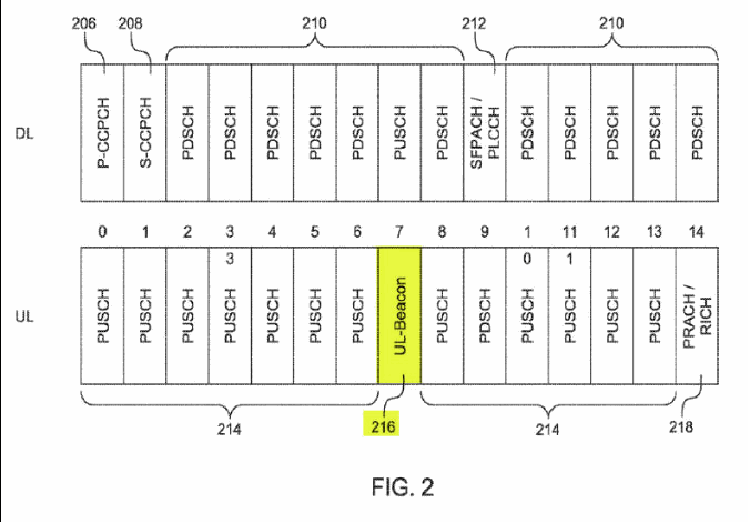
More importantly, this is not a single embodiment case. In the second embodiment (Figure 3), the specification describes a “fractionation” approach in which the same UL_Beacon timeslot is reused across different frames with different UEs transmitting in different frames. See ’000 Patent at 6:7 (“Figure 3 illustrates the case where the fractionation phase is 3” explaining that terminals 1, 2, and 3 occur in different frames).
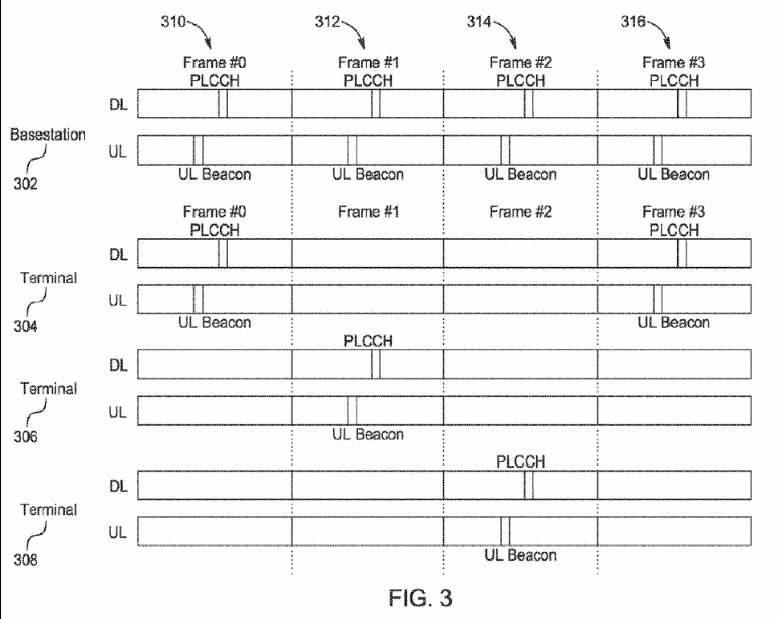
44’000 Patent at Figure 3. Finally, in the third embodiment, instead of reusing a single slot across frames, the system provides multiple UL_Beacon slots within the same frame. ’000 Patent at 5:44– 50 (“Those skilled in the art will recognize that there are a large number of possibilities for the arrangement of a UL_Beacon and its associated PLCCH within the frame structure according to embodiments of the invention. More than one UL_Beacon and PLCCH per frame could be supported if the feedback update rate is required to be faster than the frame rate (at the expense of system capacity”), 6:35–37; (“In particular, this may also apply for the case where there are more than one UL_Beacon timeslot per, frame.”)
Thus, the specification discloses different approaches to allocating uplink beacon resources, including (1) using a single time slot, (2) “fractionating” that slot across multiple frames so different UEs transmit at different times, and (3) providing multiple beacon time slots within a single frame to accommodate additional UEs. These distinct embodiments demonstrate that the45 claimed “time interval” is not limited to a single time slot in a single frame as Defendant argues is required by the ’000 Patent specification. Contrary to Defendant’s argument, the specification describes a flexible temporal framework, not a rigid one-timeslot-per-transmission structure. Accordingly, to the extent that Defendant contends that the terms “time interval” or “time slot” are limited to a single time slot in a single frame, the Court rejects that argument. As recited in the claims, the “interval” or “slot” is when the UE is not sending or receiving information over the physical uplink shared channel.
2. Court’s Construction
For the reasons set forth above, the Court construes the term “time interval” / “time intervals” to mean “time slot within a frame.”
K. “a processor” / “the processor”; “a receiver” / “the receiver”; “a transmitter” / “the transmitter”
| Disputed Term | Plaintiff’s Proposal | Defendant’s Proposal |
| “a processor” / “the processor” | Plain and ordinary meaning. | “one or more processors, at least one of which is configured to receive resource allocation information ..., send, over the physical uplink shared channel, data ..., send the uplink physical signal ..., and receive, on a physical control channel, control information ...” |
| “a receiver” / “the receiver” | Plain and ordinary meaning. | “one or more receivers, at least one of which is configured to receive resource allocation information..., and receive, on a physical control channel, control information...” |
| “a transmitter” / “the transmitter” | Plain and ordinary meaning. | “one or more transmitters, at least one of which is configured to send, over the physical uplink shared channel, data ..., and send the uplink physical signal ...” |
1. Analysis
The term “a processor” / “the processor” appears in Asserted Claims 1, 2, and 4 of the ’000 Patent. The Court finds that the term is used consistently in the claims and is intended to have the same general meaning in each claim. The term “a receiver” / “the receiver” appears in Asserted46 Claims 1, 2, and 4 of the ’000 Patent. The Court finds that the term is used consistently in the claims and is intended to have the same general meaning in each claim. The term “a transmitter” / “the transmitter” appears in Asserted Claim 1 of the ’000 Patent. The parties dispute whether a single component (i.e., one processor, receiver, or transmitter) must perform all recited functions.
Defendant argues that Claim 1 requires at least one processor, receiver, and transmitter configured to perform all of the corresponding claimed functions. (Dkt. No. 141 at 35) (emphasis added). Defendant contends that the Federal Circuit recently construed claims precisely like this one, explaining that while the indefinite article “a” does allow for “one or more,” the rule of antecedent basis still applies. Id. (citing Finjan LLC v. SonicWall, Inc., 84 F.4th 963, 975 (Fed. Cir. 2023)). The Federal Circuit in Finjan stated that “[e]ven if an infringing system can use ‘one or more computers,’ the plain language of the claims requires at least one of those computers to perform all the functions listed in the claims”). Similarly, the Federal Circuit in Salazar stated that “while the claim term ‘a microprocessor’ does not require there be only one microprocessor, the subsequent limitations referring back to ‘said microprocessor’ require that at least one microprocessor be capable of performing each of the claimed functions.” Salazar v. AT&T Mobility LLC, 64 F.4th 1311, 1317 (Fed. Cir. 2023).
Defendant argues that the claims here are like those the Federal Circuit construed in Finjan and Salazar, by reciting “a processor,” and then reciting the processor’s additional characteristics by using the definite article “the.” (Dkt. No. 141 at 35). According to Defendant, the claims require at least one processor that is configured to: “receive resource allocation information,” “send, over the physical uplink shared channel, data,” “send the uplink physical signal,” and “receive, on a physical control channel, control information.” Id. at 36. Defendant argues that this antecedent basis rule also applies to “a/the receiver” and “a/the transmitter.” Id.
47The Court agrees that the claim language requires a singular element to be capable of performing all of the recited functionality. However, that singular element is the user equipment (UE) that may include one or more processors, one or more receivers, and one or more transmitters. The ’000 Patent specification expressly states that the invention can use multiple processors in the context of performing the invention. For example, the specification states “that computing system 500 can include one or more processors” and the “processors can be a general or special purpose processing engine.” ’000 Patent at 8:4–8. Thus, the specification indicates that the tasks including receiving and sending information, is not restricted to a single processor performing all the recited functionality.
Moreover, the claim itself does not address the processor alone, it claims “a receiver and a processor are configured.” With regards to the receiver and transmitter, the specification also makes it clear that multiple antennas (receivers and transmitters) are also contemplated. ’000 Patent at 2:3–7 (“multiple transmit/ and/or receive antennas at the network and/or mobile terminal.”). There is nothing in the specification that would serve to limit the invention to require a single processor, transmitter, and/or receiver to perform all of the recited functionality.
Accordingly, the Court construes the disputed terms to mean “one or more processors/receivers/transmitters of the user equipment (UE).” As the Federal Circuit stated in Salazar, the disputed terms must be “read in the context of the full claim.” Salazar , 64 F.4th at 1318. Likewise, the Federal Circuit in Finjan focused on the “the plain language of the claims.” Finjan, 84 F.4th at 975. The plain language of the claim requires the user equipment (UE), which may include one or more processors, one or more receivers, and one or more transmitters that perform the recited functionality. The claims do not require only one processor, one receiver, and one transmitter perform each of the corresponding claimed functions. The claims only require the48 user equipment (UE) to perform the claimed functions using at least one processor, one receiver, and one transmitter.
2. Court’s Construction
For the reasons set forth above, the Court construes the term “a processor” / “the processor” to mean “one or more processors of the user equipment (UE).” The Court construes the term “a receiver” / “the receiver” to mean “one or more receivers of the user equipment (UE).” The Court construes the term “a transmitter” / “the transmitter” to mean “one or more transmitters of the user equipment (UE).”
L. “in the same time interval that the uplink physical signal is sent, a plurality of UEs transmit uplink physical signals in the same time interval”
| Disputed Term | Plaintiff’s Proposal | Defendant’s Proposal |
| “in the same time interval that the uplink physical signal is sent, a plurality of UEs transmit uplink physical signals in the same time interval” | Plain and ordinary meaning, not indefinite. | Indefinite under IPXL Holdings, LLC v. Amazon.com, Inc., 430 F.3d 1377, 1384 (Fed. Cir. 2005) |
1. Analysis
The phrase “in the same time interval that the uplink physical signal is sent, a plurality of UEs transmit uplink physical signals in the same time interval” appears in Asserted Claim 1 of the ’000 Patent. The parties dispute whether Claim 1 of the ’000 Patent claims both a system and a method.
Defendant argues that a claim is invalid as indefinite when it “recites both a system and the method for using that system.” (Dkt. No. 141 at 36) (citing IPXL Holdings, L.L.C. v. Amazon.com, Inc., 430 F.3d 1377, 1384 (Fed. Cir. 2005)). Defendant contends that Claim 1 recites the apparatus user equipment, with a number of structural limitations. (Dkt. No. 141 at 36). Defendant further contends that Claim 1 also recites a method step that “a plurality of UEs transmit49 uplink physical signals in the same time interval” as the claimed UE. Id. According to Defendant, the claim’s requirement that “a plurality of UEs transmit …” makes it unclear whether infringement “occurs when one creates a system that allows the user to [infringe the claims],” or “when the user actually [infringes the claims.]” (Dkt. No. 141 at 36) (citing IPXL, 430 F.3d at 1384). The Court disagrees.
The Federal Circuit has found that the term “configured to” constitutes permissible functional language, because it indicates the capability of using a claimed method but does not require performance of the method steps. In re McFadden, No. 2024-2107, 2025 LX 344436, at *11 (Fed. Cir. 2025). Claim 1 recites a UE in terms of conventional structural components, a “receiver,” “transmitter,” and “processor,” “configured to” support uplink physical signaling and downlink control reception. ’000 Patent at Claim 1; Dkt. No. 139-13 at 106:20-22. The use of the language “configured to” indicates the capabilities of the wireless signaling scheme, not required steps. A POSITA would find this limitation definite because it reasonably advises as to the scope of the claim and does not recite method steps performed by a user. Dkt. No. 139-12 at ¶ 71.
From the perspective of a POSITA, infringement analysis would focus on whether a UE includes the recited receiver, transmitter, and processor configured as claimed, not on when or how a user operates the device. Claim 1 does not require any user-performed action and does not mix apparatus and method requirements in a way that creates uncertainty. Accordingly, the Court finds that Defendant failed to prove by clear and convincing evidence that the term is indefinite.
2. Court’s Construction
The Court finds that the phrase “in the same time interval that the uplink physical signal is sent, a plurality of UEs transmit uplink physical signals in the same time interval” is not indefinite, and is given its plain and ordinary meaning.
50VII. CONCLUSION
The Court adopts the constructions above for the disputed terms of the Asserted Patents. Furthermore, the parties should ensure that all testimony that relates to the terms addressed in this Order is constrained by the Court’s reasoning. However, in the presence of the jury the parties should not expressly or implicitly refer to each other’s claim construction positions and should not expressly refer to any portion of this Order that is not an actual construction adopted by the Court. The references to the claim construction process should be limited to informing the jury of the constructions adopted by the Court.
IT IS SO ORDERED.
Footnotes
- ↩ 1 This is the second claim construction hearing in this case. The first claim construction hearing was held on January 22, 2026. The Court issued a Memorandum Opinion and Order on February 19, 2026, construing the disputed claim terms in U.S. Patent No. 8,332,844 (the “’844 Patent”), U.S. Patent No. 8,407,722 (the “’722 Patent”), U.S. Patent No. 7,949,785 (the “’785 Patent”), U.S. Patent No. 7,324,469 (the “’469 Patent”), U.S. Patent No. 7,257,582 (the “’582 Patent”). (Dkt. No. 127).
- ↩ 2 Citations to the parties’ filings are to the filing’s number in the docket (Dkt. No.) and pin cites are to the page numbers assigned through ECF.
- ↩ 3 Some cases have characterized other principles of claim construction as “exceptions” to the general rule, such as the statutory requirement that a means-plus-function term is construed to cover the corresponding structure disclosed in the specification. See, e.g., CCS Fitness, Inc. v. Brunswick Corp., 288 F.3d 1359, 1367 (Fed. Cir. 2002).
- ↩ 4 The Court finds that certain documents in the prosecution history of the ’282 Patent provide insight into the parties’ dispute. Accordingly, as indicated during the claim construction hearing, the Court takes judicial notice of relevant documents from the prosecution history, which can be found at https://patentcenter.uspto.gov/. The relevant documents are entered with this Order as Court Exhibit A, and citations to this exhibit are to the page numbers assigned through ECF.