IN THE UNITED STATES DISTRICT COURT
FOR THE EASTERN DISTRICT OF TEXAS
MARSHALL DIVISION
K.MIZRA LLC, §
§
Plaintiff, §
§
v. § CASE NO. 2:24-CV-00974-JRG
§
NOKIA OF AMERICA CORPORATION, §
§ Defendant. §
MEMORANDUM CLAIM CONSTRUCTION OPINION AND ORDER
In this patent case, K.Mizra LLC alleges infringement by Nokia Corporation of America of claims from three patents related to networking. U.S. Patent 8,018,880 relates to a Layer 2 virtual private network over an Ethernet network that restores network traffic after a link failure more quickly than the prior art. See ’880 Patent at 1:16–33. “Layer 2” refers to the data link layer of the OSI model, a conceptual framework for thinking about how computers communicate over networks. U.S. Patent 9,749,249 at 1:21–24. The ’249 Patent concerns “data traffic protection and redundancy” in Layer 2 network traffic. See generally id. at 1:21–2:8. Finally, U.S. Patent 10,735,320 concerns “manag[ing] application traffic over a carrier network.” ’320 Patent at 2:22– 26.
The parties have three disputes about claim scope. From the ’880 Patent, the parties dispute the scope of “Virtual Switch Instance,” or VSI, and what it means for a control plane—the part of a network that establishes the network topology—to be “external to the plurality of sites.” From the ’249 Patent, the parties dispute what it means to “preempt” traffic on a standby pseudowire, which is a virtual connection between endpoints that acts like a dedicated wire. Having considered2 the parties’ briefing, along with arguments of counsel at a March 31, 2026 hearing, the Court resolves these disputes as follows.
I. BACKGROUND
A. U.S. Patent 9,749,249
The ’249 Patent relates to pseudowires used for data link layer (or “Level-2”) traffic. “A Pseudowire (PW) refers to an emulation of a native service over a network.” ’249 Patent at 1:24– 30. The patent explains that, as carriers “have extended the use of Pseudowires beyond packet encapsulation, and offered Pseudowires as a type of network service,” “data traffic protection and redundancy in environments that use Pseudowire[s] have become critical.” Id. at 1:31–36. To that end, the patent teaches protecting data flow in a pseudowire such that, “if an active Pseudowire fails, the data flow [is] redirected to an alternative Pseudowire to avoid data loss.” Id. at 1:45–47.
At a high level, the patent discloses configuring “a standby Pseudowire between a source node and a destination node.” ’249 Patent at [57]. Once the pseudowire is correctly configured, the patent teaches determining whether to switch from a primary pseudowire to the standby pseudowire when the primary link fails. Id. at 2:66–3:14. That determination may be made based on a number of factors, such as the relative priority of traffic on the two pseudowires. See id. at 5:57–65 (“[I]n some embodiments, whether the traffic on the primary Pseudowire can preempt the traffic on the standby Pseudowire and be switched over depends on priority configuration of the Pseudowires.”).
Figures 5–6 show an example. In Figure 5 (below), when the system detects a network failure (502) and requires preemption of traffic because the failed PW has more traffic than the available bandwidth on the standby PW, the system compares the “setup priority” of the failed PW to the “holding priority” of the standby PW. If the former exceeds the latter, the system switches3 the traffic of the failed link to the standby PW. See generally ’249 Patent at 7:25–42.

FIG. 5 of the ’249 Patent, showing two paths to “switch over pseudowire” (506) depending on whether preemption is required (504).
In Figure 6 (below), if PWs (600) and (602) fail, the nodes initiate switchover using standby PW (604). The nodes compare the setup priorities of PWs (600, 602) and give priority to PW (602) as the PW with the higher “setup priority.” The nodes then compare the “setup priority” of PW (602) with the “holding priority” of PW (604). Because PW’s (602) “setup priority” exceeds the standby PW’s (604) “holding priority,” data on PW (602) is sent over PW (604).

4FIG. 6 of the ’249 Patent, showing three PWs (600, 602, 604). The sole dispute from the ’249 Patent relates to Claims, 1, 7, and 12. Claim 1 recites:
1. A method, comprising:
detecting, by a source node device comprising a processor, acknowledgement data indicating that configuration data sent to a destination node device by the source node device has been accepted by the destination node device, wherein the configuration data specifies a priority, a domain type and a standby mode for a standby pseudowire, wherein the domain type indicates whether a plurality of node devices comprising the standby pseudowire are coupled to a single carrier network or multiple carrier networks;
in response to the detecting, establishing the standby pseudowire between the source node device and the destination node device in accordance with the standby mode and domain type specified by the pseudowire configuration data; and
determining whether to initiate a preemption of data traffic on the standby pseudowire based at least in part on the priority.
’249 Patent at 8:5–23 (emphasis added). Claim 12 includes an identical “determining” computer-executable instruction, id. at 10:1–3, and Claim 7 also has similar language, id. at 9:6–8. Various5 dependent claims then recite a “switchover” from a primary pseudowire to the standby pseudowire. See, e.g., id. at 8:23–25 (reciting, in Claim 2, “[t]he method of claim 1, further comprising initiating a switchover of the data traffic from a primary pseudowire to the standby pseudowire”); id. at 9:9– 12 (reciting, in Claim 8, “[t]he system of claim 7, wherein the processor further executes or facilitates the execution of the computer-executable instructions to initiate a transition of the network traffic from a primary pseudowire to the standby pseudowire”); id. at 10:4–7 (reciting, in Claim 10, “[t]he computer-readable storage device of claim 12, wherein the operations further comprise initiating a switchover of the data traffic from a primary pseudowire to the standby pseudowire”). Generally, the parties dispute whether there must be data on the standby pseudowire at the time of “switchover.”
B. U.S. Patent 8,018,880
The ’880 Patent addresses the issue of “a slow recovery or convergence time in the event of failure, such as a physical link failure[,]” in a Layer 2 Virtual Private Network (L2VPN) over an Ethernet network. ’880 Patent at 1:20–22. Then-existing standards “may take seconds to restore traffic after a link fails,” which “is not acceptable for service provide[rs] that need to provide Carrier Ethernet services with traffic restoration requirements on the order of tens of milliseconds.” Id. at 1:27–32. Also, existing systems didn’t give service providers “complete control over provisioned routes or how new routes will be dynamically chosen after link or node failures.” Id. at 1:34–47.
The patent purports to disclose new ways to address these issues, one of which is a new “split horizon” rule. Generally, split-horizon rules “constrain[] the normal forwarding feature of a [virtual switch instance (VSI)], which would normally allow a frame received on a VSI connection to be forwarded to any one of the other VSI connections.” ’880 Patent at 6:39–42. This can cause6 loops that unnecessarily consume bandwidth. See id. at 6:37–39 (“[S]plit horizon is used to prevent or avoid loops so that frames do not unnecessarily flood the L2VPN.”).
Figure 5 (below) shows a number of split-horizon rules that regulate network traffic in an end-to-end L2VPN formed of L2VPN1 (530), L2VPN2 (531), and VPLS (532). For example, a split-horizon rule (500) applies to a VSI (n-PE11) connected to service instances (502, 503) over PBT trunks and customer-bound interfaces (504, 505) such that (1) a frame received from service instance (502) can only be forwarded to interface connections (504, 505) and not to another service instance, but (2) a frame received from customer interface (504 or 505) can be forwarded anywhere. See generally ’880 Patent at 6:34–7:8.
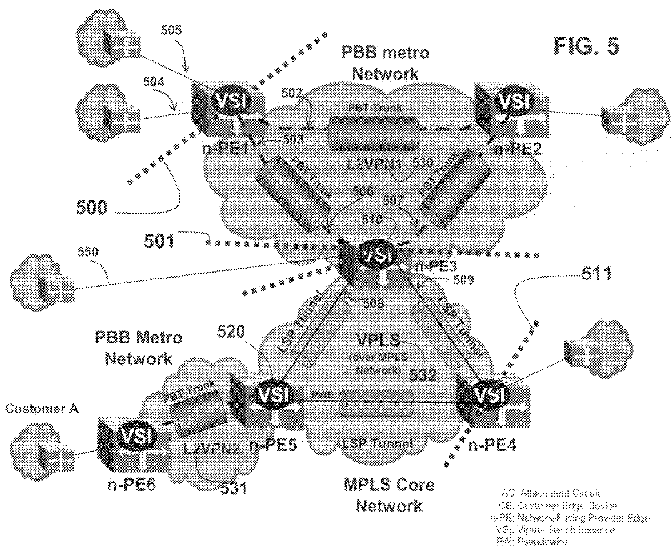
FIG. 5 of the ’880 Patent
The claims at issue concern split-horizon rule (501). The rule has three “sides,” each7 corresponding to a different type of network: (1) a frame received from a service instance (506 or 507) can only be forwarded to pseudowires (508, 509) and the customer interface (550) and not to another service instance; (2) a frame received from a pseudowire (508 or 509) can only be forwarded to service instances (506, 507) and the customer-interface connection (550) and not to another pseudowire; and (3) a frame received from the customer-interface connection (550) can be sent anywhere. See generally ’880 Patent at 7:8–35.
The claims at issue recite this three-sided split-horizon rule. Claim 1, for example, recites:
1. A method for interconnecting a Layer 2 Virtual Private Network
(L2VPN) system, comprising: coupling a plurality of sites in a Provider Backbone Bridge (PBB) network using a plurality of provider backbone trunks that includes a Provider Backbone Transport (PBT) trunk or a Provider Backbone Bridge Traffic Engineering (PBB-TE) trunk, such that the L2VPN includes the plurality of sites;
provisioning one or more Virtual Switch Instances (VSIs) associated with the plurality of sites, the provisioning to be performed using a control plane that is external to the plurality of sites; and
using a split horizon rule to control distribution of received frames, wherein the split horizon rule is associated with a first VSI coupling the PBB network to a Multi Protocol Label Switching (MPLS) network, the split horizon rule to restrict the normal VSI frame forwarding/distribution of received frames such that: (1) in the event a frame is received from a Service Instance over one of the plurality of provider backbone trunks, the received frame is forwarded to Pseudowires over the MPLS network and a set of customer bound interfaces; (2) in the event a frame is received from a Pseudowire over the MPLS network, the received frame is forwarded to a set of Service Instances over the plurality of provider backbone trunks and a set of customer bound interfaces;
8and
(3) in the event a frame is received from a customer bound interface, the received frame is forwarded as defined by the normal VSI frame forwarding behavior and no forwarding restrictions are imposed on the VSI.
’880 Patent at 9:18–50 (disputed terms in bold); see also id. at 10:32–67 (reciting, in Claim 14, a system for interconnecting an L2VPN with a first VSI configured to use the same split-horizon rule recited in Claim 1). The parties’ disputes, however, don’t concern the split-horizon rule so much as the VSIs and control plane that provisions them. Specifically, the parties dispute the scope of “virtual switch instance” and “control plane that is external to the plurality of sites.”
II. LEGAL STANDARDS
“[T]he claims of a patent define the invention to which the patentee is entitled the right to exclude.” Phillips v. AWH Corp., 415 F.3d 1303, 1312 (Fed. Cir. 2005) (en banc). As such, if the parties dispute the scope of the claims, the court must determine their meaning. See, e.g., Verizon Servs. Corp. v. Vonage Holdings Corp., 503 F.3d 1295, 1317 (Fed. Cir. 2007) (Gajarsa, J., concurring in part); see also Markman v. Westview Instruments, Inc., 517 U.S. 370, 390 (1996), aff’g, 52 F.3d 967, 976 (Fed. Cir. 1995) (en banc).
Claim construction, however, “is not an obligatory exercise in redundancy.” U.S. Surgical Corp. v. Ethicon, Inc., 103 F.3d 1554, 1568 (Fed. Cir. 1997). Rather, “[c]laim construction is a matter of [resolving] disputed meanings and technical scope, to clarify and when necessary to explain what the patentee covered by the claims . . . .” Id. A court need not “repeat or restate every claim term in order to comply with the ruling that claim construction is for the court.” Id.
When construing claims, “[t]here is a heavy presumption that claim terms are to be given their ordinary and customary meaning.” Aventis Pharm. Inc. v. Amino Chems. Ltd., 715 F.3d 1363,9 1373 (Fed. Cir. 2013) (citing Phillips, 415 F.3d at 1312–13). Courts must therefore “look to the words of the claims themselves . . . to define the scope of the patented invention.” Id. (citations omitted). The “ordinary and customary meaning of a claim term is the meaning that the term would have to a person of ordinary skill in the art in question at the time of the invention, i.e., as of the effective filing date of the patent application.” Phillips, 415 F.3d at 1313. This “person of ordinary skill in the art is deemed to read the claim term not only in the context of the particular claim in which the disputed term appears, but in the context of the entire patent, including the specification.” Id.
Intrinsic evidence is the primary resource for claim construction. See Power-One, Inc. v. Artesyn Techs., Inc., 599 F.3d 1343, 1348 (Fed. Cir. 2010) (citing Phillips, 415 F.3d at 1312). For certain claim terms, “the ordinary meaning of claim language as understood by a person of skill in the art may be readily apparent even to lay judges, and claim construction in such cases involves little more than the application of the widely accepted meaning of commonly understood words.” Phillips, 415 F.3d at 1314; see also Medrad, Inc. v. MRI Devices Corp., 401 F.3d 1313, 1319 (Fed. Cir. 2005) (“We cannot look at the ordinary meaning of the term . . . in a vacuum. Rather, we must look at the ordinary meaning in the context of the written description and the prosecution history.”). But for claim terms with less-apparent meanings, courts consider “those sources available to the public that show what a person of skill in the art would have understood disputed claim language to mean . . . [including] the words of the claims themselves, the remainder of the specification, the prosecution history, and extrinsic evidence concerning relevant scientific principles, the meaning of technical terms, and the state of the art.” Phillips, 415 F.3d at 1314.
III. THE LEVEL OF ORDINARY SKILL IN THE ART
The level of ordinary skill in the art is the skill level of a hypothetical person who is10 presumed to have known the relevant art at the time of the invention. In re GPAC, 57 F.3d 1573, 1579 (Fed. Cir. 1995). In resolving the appropriate level of ordinary skill, courts consider the types of and solutions to problems encountered in the art, the speed of innovation, the sophistication of the technology, and the education of workers active in the field. Id. Importantly, “[a] person of ordinary skill is also a person of ordinary creativity, not an automaton.” KSR Int’l Co. v. Teleflex Inc., 550 U.S. 398, 421 (2007).
Here, K.Mizra says a skilled artisan at the time of the invention “would have had a bachelor’s degree in electrical engineering, computer engineering, computer science, or a similar field, along with two years of experience designing or developing network communication systems such as MPLS networks[.]” Dkt. No. 79 at 3 (citing Akl Decl., Dkt. No. 79-1 ¶ 30). Nokia agrees with K.Mizra’s proposal “in large part” but suggests a skilled artisan would have three to four years of experience. Dkt. No. 84 at 1. Despite that disagreement about experience, Nokia says “the proper construction of disputed terms are the same under both proposals,” id., and K.Mizra does not dispute that assertion. Accordingly, the Court will resolve the differences in the parties’ characterizations of a skilled artisan only to the extent necessary to resolve the disputes.
11IV. THE DISPUTED TERMS
A. “determining whether to initiate a preemption of data traffic on the standby
pseudowire” (’249 Patent, Claims 1, 12) “determine whether to initiate a preemption of network traffic on the standby pseudowire” (’249 Patent, Claim 7)
| K.Mizra’s Construction | Nokia’s Construction |
| Plain and ordinary meaning (“determining whether to initiate switching traffic from the primary pseudowire to the standby wire—i.e., taking over the standby pseudowire link,” Dkt. No. 86 at 5) | “[determining/determine] whether to initiate dropping existing [data/network] traffic that is carried by the standby pseudowire” |
The disputed phrase appears in the last limitation of Claims 1, 7, and 12. Nokia frames the dispute as whether “the step require[s] data traffic or network traffic present on the standby pseudowire[.]” Dkt. No. 84 at 14. Suggesting it does, Nokia asserts both lexicography and disavowal based on the prosecution history, contending “preemption” requires “dropping” of existing data. Id. at 15–16. K.Mizra says “preemption” only requires “taking over” a standby pseudowire. Dkt. No. 86 at 5.
To start, the Court agrees with Nokia that these phrases require more than just switching over to the standby pseudowire. Not only is that evident from the claim language, which requires “traffic on the standby pseudowire,” but it aligns with the ordinary meaning of “preemption.” See preempted thread, The Authoritative Dictionary of IEEE Terms, Dkt. No. 84-9 at 859 (“A running thread whose execution is suspended due to another thread becoming runnable at a higher priority”); preemption, id. at 859 (“On a precedence call, the disconnection and subsequent reuse of part of an established connection of lower priority if all the relevant circuits are busy”); preemptive control, id. at 859 (“An action or function which, by reason of pre-established priority, is able to12 seize or interrupt the process in progress and cause to be performed a process of a higher priority”); yourdictionary.com/preempt (“To take the place of or take precedence over.”). If no traffic is “on the standby pseudowire,” there’s nothing to preempt.
The specification supports this interpretation. It explains “[p]reemption is required when the failed link carries more Pseudowire traffic than the available bandwidth on the standby link. If preemption is not required, the Pseudowire(s) may directly switchover (506).” ’249 Patent at 7:27– 31 (emphasis added). Thus, not only is “preemption” different from “switchover,” it might not even be necessary. See id. at fig.5 (showing two paths to “switch over pseudowire” (506) depending on the need for preemption (504)).
The claims and prosecution history also support this interpretation. The claims use both “switchover” and “preemption,” which shows these terms have different meanings. See ’249 Patent at 8:24–26 (reciting, in Claim 2, “[t]he method of claim 1, further comprising initiating a switchover of the data traffic from a primary pseudowire to the standby pseudowire” (emphasis added)). And during prosecution, the applicants distinguished one cited reference on the basis that, in that reference, “there is no prior data traffic on a standby connection to preempt on the event of a network failure.” Reply to Final Office Action, Dkt. No. 84-7 at 9.
Resisting any notion of lexicography or disclaimer, K.Mizra replies that the specification’s statements about existing traffic on the standby pseudowire do not clearly express an intent to redefine “preemption.” Dkt. No. 86 at 6. Even if that’s true, K.Mizra does not establish that “preemption” is synonymous with “switchover.” The prosecution history instead shows the ordinary meaning of “preemption” is consistent with Nokia’s position. Thus, the Court agrees with Nokia that “preemption of data [or network] traffic on the standby pseudowire” requires traffic on the standby pseudowire and not merely a “switch over” to that wire.
13That said, the Court agrees with K.Mizra that the applicant did not clearly and unambiguously define “preemption” of traffic to mean only “dropping” traffic. At a minimum, what it means to “drop” traffic on virtual connections like pseudowires is unclear, and thus lacks the requisite precision for finding lexicography. See In re Paulsen, 30 F.3d 1475, 1480 (Fed. Cir. 1994) (“Although an inventor is indeed free to define the specific terms used to describe his or her invention, this must be done with reasonable clarity, deliberateness, and precision.”). It could, for example, mean the data then on the pseudowire is simply lost. See, e.g., ’249 Patent at 7:38–42 (noting that when the setup priority of the failed link is less than the holding priority of the standby pseudowire, the data of the failed link is “simply lost”). But it could also mean “dropping” existing traffic for the moment, only to later send the “dropped” traffic once the pseudowire is no longer needed for its “standby” purposes. Or it could have some other meaning altogether.
In sum, the Court agrees with K.Mizra that this term should be given a “plain and ordinary meaning” construction, but that “ordinary meaning” is different from merely switching from a primary to a standby pseudowire. The Court, however, rejects Nokia’s attempts to limit the scope of the “preemption” to “dropping” traffic given the lack of clear intent and precision in the alleged lexicography or disclaimer.
B. “Virtual Switch Instances (VSIs)” (’880 Patent, Claims 1, 14, 26, 39)
| K.Mizra’s Construction | Nokia’s Construction |
| Plain and ordinary meaning | “a bridge used to construct a VPLS service over an MPLS network” |
According to the specification, “[a] VSI is an IETF term for a bridge used to construct a VPLS service over an MPLS network.” ’880 Patent at 4:26–34. Nokia says this statement is definitional. Dkt. No. 84 at 21–22. K.Mizra contests any lexicography, and claims the ordinary14 meaning of “VSI” is broader. Dkt. No. 79 at 17.
The Court agrees with K.Mizra. For one, the statement on which Nokia relies could be read not to define what a VSI is, but rather as specifying one use for a VSI. Regardless, to the extent that statement might by itself be considered definitional, other parts of the specification undercut any lexicography. Most notably, Figure 4 shows three VSIs connected to a PBB metro network, not an MPLS network. See also ’880 Patent at 4:31–32 (“A VSI is a learning bridge and can be used to bridge Ethernet traffic from any source.”). Thus, there is no clear and unambiguous lexicography on this record, and the Court construes this term as “a learning bridge and can be used to bridge Ethernet traffic from any source.”2
C. “control plane that is external to the plurality of sites” (’880 Patent, Claims 1,
26, 39) “control plan to be external to the plurality of sites” (’880 Patent, Claim 14)
| K.Mizra’s Construction | Nokia’s Construction |
| Plain and ordinary meaning3 | Plain and ordinary meaning, which does not include an in- band control plane between provider edge routers |
The claims recite “provisioning one or more Virtual Switch Instances (VSIs) associated with the plurality of sites, the provisioning to be performed using a control plane that is external to the plurality of sites[.]” ’880 Patent at 9:26–29 (emphasis added); see also id. at 10:44–46 (Claim 14), 11:55–58 (Claim 26), 13:11–14 (Claim 39). In the briefing, this dispute centered on what it means for a “control plane”—the part of a network that establishes the network topology—to be15 “external to a plurality of sites.” According to Nokia, K.Mizra suggests these limitations can be met by any “control plane,” despite the specification’s clear distinction between “external control planes” and “in-band distributed control planes.”4 Dkt. No. 84 at 24. Nokia also asserts the applicants disclaimed “in-band control planes” during prosecution. Id. at 26–27.
K.Mizra asserts the disputed phrases are “understandable to factfinders and POSITAs alike and needs no further construction.” Dkt. No. 86 at 9. It stresses “in-band” and “provider edge router” are terms not otherwise used in the claims. Dkt. No. 79 at 19. In its reply, K.Mizra suggests “[t]he two mentions of ‘in-band’ in the specification refer to making the actual piece of hardware that provisions the routers separate from the other network elements, so it can be more easily and cost-effectively upgraded.” Id. at 10 (citing ’880 Patent at 6:14–30).
The hearing helped clarify the parties’ dispute. Although they generally agreed the claims require an “external control plane” and on the meaning of the disputed phrases, they differed on whether accused instrumentalities that use both an “external control plane” and some sort of in-band control plane for provisioning the VSIs are within the scope of the claim. Nokia acknowledged the mere presence of an in-band control plane in an accused instrumentality is not enough to remove the instrumentality from the scope of the claim. Instead, Nokia asserted an “in-band control plane” cannot perform the “provisioning” step based on the patent’s disparagement of using that kind of control plane for that purpose.
The Court agrees with K.Mizra. Each of the claims at issue uses the transition “comprising,” which “‘creates a presumption that the recited elements are only a part of the device, that the16 claim does not exclude additional, unrecited elements.’” MagSil Corp. v. Hitachi Glob. Storage Techs., Inc., 687 F.3d 1377, 1383 (Fed. Cir. 2012) (quoting Crystal Semiconductor Corp. v. TriTech Microelectronics Int’l, Inc., 246 F.3d 1336, 1348 (Fed. Cir. 2001)). That presumption can be overcome, however, by showing an unclaimed feature is inconsistent with the claim elements or would “make the claim elements no longer satisfied.” In re Varma, 816 F.3d 1352, 1362 (Fed. Cir. 2016); see also Mitsubishi Chem. Corp. v. Barr Labs., Inc., 435 F. App’x 927, 935 (Fed. Cir. 2011) (explaining “the addition of new compounds to the [claimed] composition that would defeat the ‘pharmaceutical’ character of the overall composition would move the composition outside the scope of the claimed invention”).
Nokia makes no such showing here. In fact, its brief doesn’t make that argument, instead asserting a “control plane that is external to the plurality of sites”—not the claim as a whole—does not include an in-band control plane. See Dkt. No. 84 at 24–30. Nor does Nokia’s expert opine on that dispute. See Lin Decl., 84-2 ¶ 281 (opining “the ordinary meaning of the phrase as understood by a POSITA in light of the specification and the Applicants’ own statements made during prosecution does not include an in-band control plane between provider edge routers” (emphasis added)). While some sort of “dual” provisioning system or method—that is, a system or method using both an external and in-band control plane—might be redundant, redundancy does not “make the claim elements no longer satisfied” or “move the [method or system] outside the scope of the claimed invention.”
Nor does Nokia show how any disparagement of the “in-band control planes” by the patent excludes embodiments that use both external and in-band control planes. Nokia’s “disparagement” argument would be stronger if the “provisioning” limitation simply recited a “control plane.” In that case, the patent’s extensive discussion of the differences between the two control-plane types17 and the advantages of an “external control” plane might meet the “high bar to finding disavowal of claim scope through disparagement of the prior art.” Openwave Sys. v. Apple Inc., 808 F.3d 509, 517 (Fed. Cir. 2015). But the claims already require an “external control plane,” and nothing in the specification suggests only an external control plane could be used for provisioning the VSIs.
Accordingly, while the Court agrees with Nokia that an “external control plane” and “control plane that is external to the plurality of sites” does not include an in-band control plane, it rejects the notion an accused instrumentality that includes both an external control plane and in-band control plane that provisions the VSIs is necessarily outside the scope of the claims. Otherwise, given the parties’ general agreement on the meaning of the disputed phrases and their synonymity with “external control plane,” the Court will give this term a “plain and ordinary meaning” construction.
V. CONCLUSION
| Disputed Term | The Court’s Construction |
| “determining whether to initiate a preemption of data traffic on the standby pseudowire” (’249 Patent, Claims 1, 12) | Plain and ordinary meaning. |
| “determine whether to initiate a preemption of network traffic on the standby pseudowire” (’249 Patent, claim 7) | Plain and ordinary meaning. |
| “Virtual Switch Instances (VSIs)” (’880 Patent, Claims 1, 14, 26, 39) | “a learning bridge and can be used to bridge Ethernet traffic from any source” |
| “control plane that is external to the plurality of sites” (’880 Patent, Claims 1, 26, 39) | Plain and ordinary meaning |
| “control plan to be external to the plurality of sites” (’880 Patent, Claim 14) | “control plane to be external to the plurality of sites” |
18The Court ORDERS each party not to refer, directly or indirectly, to its own or any other party’s claim-construction positions in the presence of the jury. Likewise, the Court ORDERS the parties to refrain from mentioning any part of this opinion, other than the actual positions adopted by the Court, in the presence of the jury. Neither party may take a position before the jury that contradicts the Court’s reasoning in this opinion. Any reference to claim construction proceedings is limited to informing the jury of the positions adopted by the Court.
So Ordered this Apr 14, 2026

Footnotes
- ↩ 1 An “n-PE” is a “network-facing provider edge,” which is a device at the boundary of the network that interfaces with customer equipment or other networks. See ’880 Patent at 2:66–3:4.
- ↩ 2 At the hearing, the parties agreed this is an appropriate construction should the Court opt not to adopt Nokia’s proposal.
- 3 K.Mizra proposes correcting “control plan” in Claim 14 to “control plane.” Nokia does not oppose that correction.
- ↩ 4 Generally, an “in-band control plane” shares the same physical links, ports, and infrastructure as the traffic.