NN << nnn ninnmnene nes. Case 2:09-cv-00198-DF Document170 Filed 06/02/09 Page 1 of 7 PagelD #:
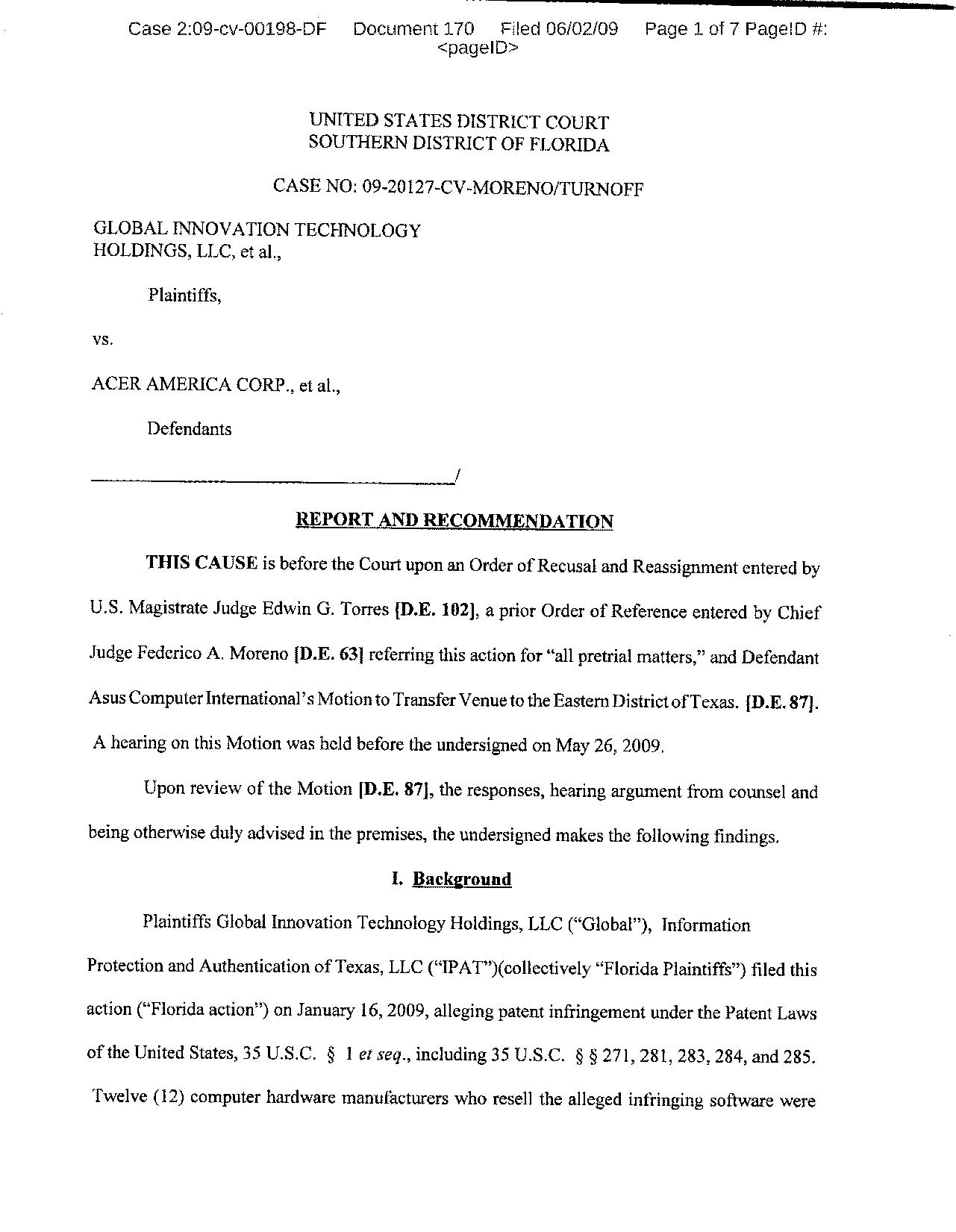
UNITED STATES DISTRICT COURT
SOUTHERN DISTRICT OF FLORIDA
CASE NO: 09-20127-CV-MORENO/TU
RNOFF
GLOBAL INNOVATION TECHNOLOGY
HOLDINGS, LLC, et al.,
Plaintiffs,
VS.
ACER AMERICA CORP., et al.,
Defendants /
REPORT AND RECOMMENDATION
THIS CAUSE is before the Court upon an Order of Recus
al and Reassignment entered by U.S. Magistrate Judge Edwin G. Torres [D.E. 102], a prior Orde
r of Reference entered by Chief Judge Federico A. Moreno [D.E. 63] referring this action for “all
pretrial matters,” and Defendant Asus Computer International’s Motion to Transfer Venue to the Eastern Distr
ict of Texas. [D.E. 87 |. A hearing on this Motion was held before the undersigned on May 26, 200
9. Upon review of the Motion [D.E. 87], the responses, hearing argument fro
m counsel and being otherwise duly advised in the premises, the undersigned makes the fo
llowing findings. I. Background
Plaintiffs Global Innovation Technology Holdings, LLC (“Global”), Inform
ation
Protection and Authentication of Texas, LLC (“IPAT”)(collectively “Florid
a Plaintiffs”) filed this action (“Florida action”) on January 16, 2009, alleging patent infringement
under the Patent Laws of the United States, 35 U.S.C. § 1 ef seq., including 35 U.S.C. § § 271, 2
81, 283, 284, and 285. Twelve (12) computer hardware manufacturers who resell the al
leged infringing software were
2Case 2:09-cv-00198-DF Document170 Filed 06/02/09 Page 2 of 7 PagelD #:
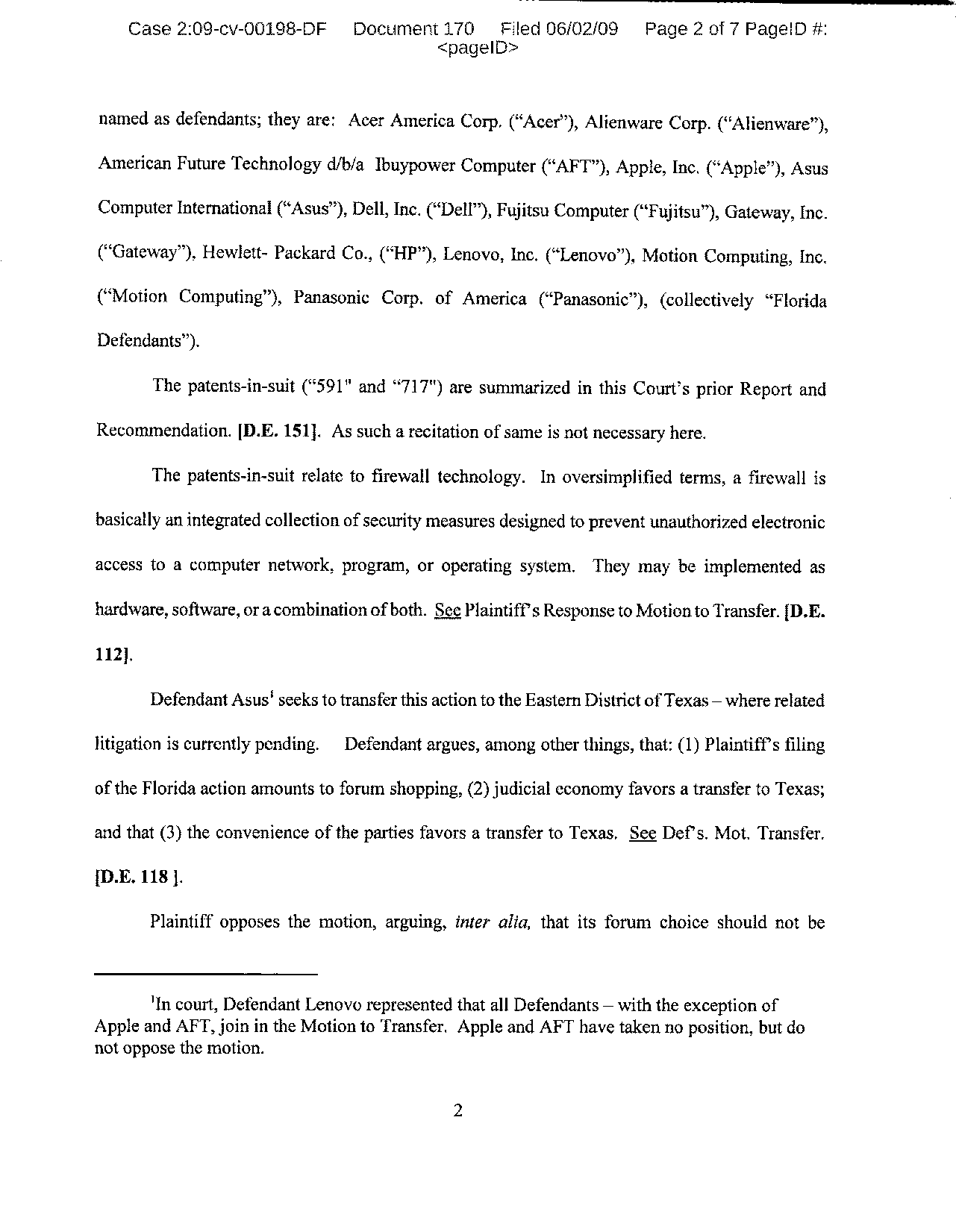
named as defendants; they are: Acer America Corp. (“Acer”), A
lienware Corp. (“Alienware”), American Future Technology d/b/a Ibuypower Computer (“AFT
”), Apple, Inc. (“Apple”), Asus Computer International (“Asus”), Dell, Inc. (“Dell”), Fujitsu Com
puter (“Fujitsu”), Gateway, Inc. (“Gateway”), Hewlett- Packard Co., (“HP”), Lenovo, Inc. (“Len
ovo”), Motion Computing, Inc. (“Motion Computing”), Panasonic Corp. of America (“Pana
sonic”), (collectively “Florida Defendants”).
The patents-in-suit (“591" and “717") are summarized in this Court’s pr
ior Report and Recommendation. [D.E. 151]. As such a recitation of same is not necessary here.
The patents-in-suit relate to firewall technology. In oversimplified terms, a firewall is basically an integrated collection of security measures designed to prevent unauthorized electronic access to a computer network, program, or operating system. They may be implemented as hardware, software, or a combination of both. See Plaintiff's Response to Motion to Transfer. [D.E. 112].
Defendant Asus' seeks to transfer this action to the Eastern District of Texas — where related litigation is currently pending. Defendant argues, among other things, that: (1) Plaintiff's filing of the Florida action amounts to forum shopping, (2) judicial economy favors a transfer to Texas; and that (3) the convenience of the parties favors a transfer to Texas. See Def’s. Mot. Transfer. [D.E. 118 ].
Plaintiff opposes the motion, arguing, inter alia, that its forum choice should not be 'In court, Defendant Lenovo represented that all Defendants — with the exception of Apple and AFT, join in the Motion to Transfer. Apple and AFT have taken no position, but do not oppose the motion.
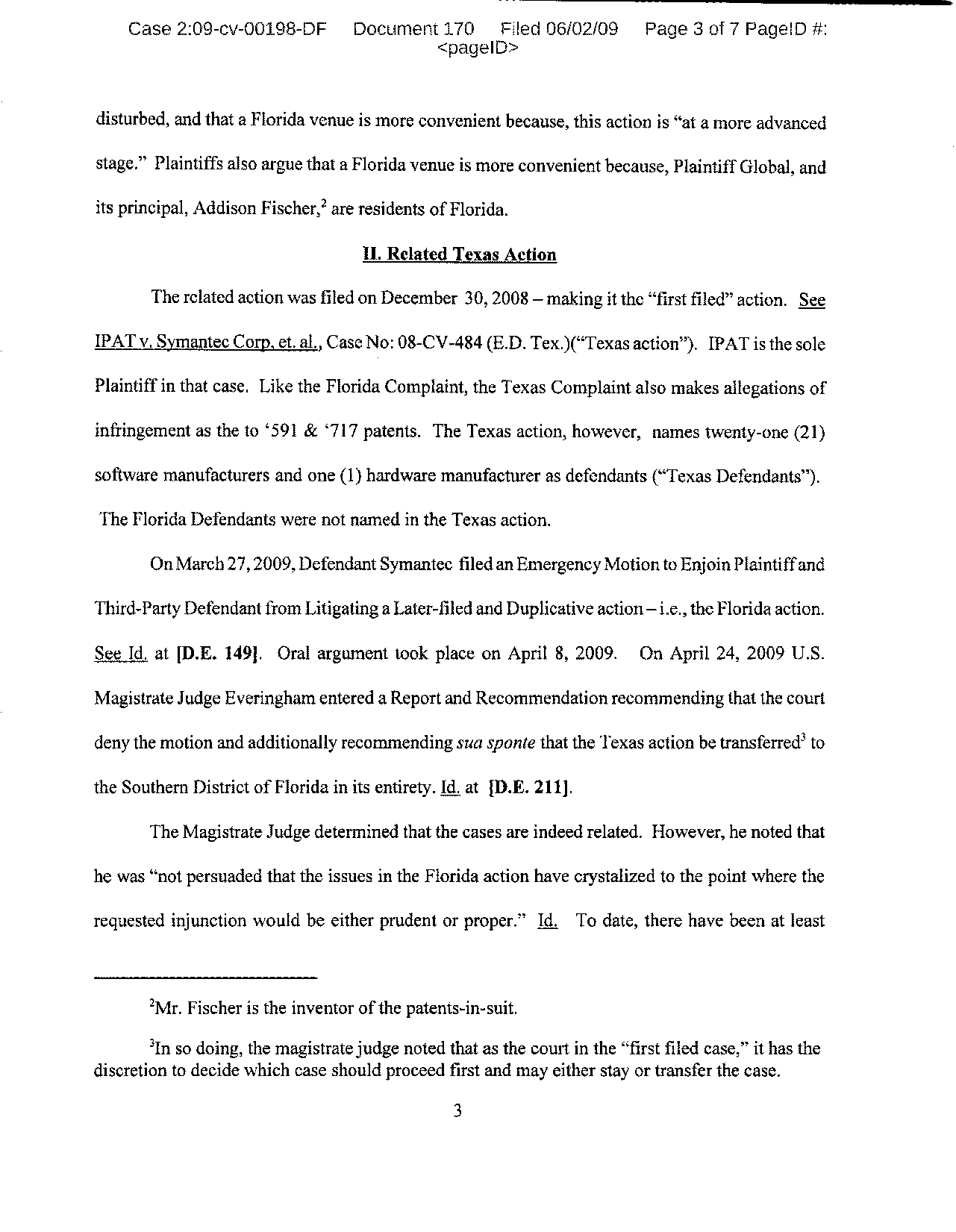
3disturbed, and that a Florida venue is more convenient because, this action
is “at a more advanced stage.” Plaintiffs also argue that a Florida venue is more convenient becaus
e, Plaintiff Global, and its principal, Addison Fischer,” are residents of Florida.
II. Related Texas Action
The related action was filed on December 30, 2008 — making it the “first filed” action. See IPAT v. Symantec Corp, et. al., Case No: 08-CV-484 (E.D. Tex.)(“Texas action”). IPAT is the sole Plaintiff in that case. Like the Florida Complaint, the Texas Complaint also makes allegations of infringement as the to ‘591 & ‘717 patents. The Texas action, however, names twenty-one (21) software manufacturers and one (1) hardware manufacturer as defendants (“Texas Defendants’’). The Florida Defendants were not named in the Texas action.
On March 27, 2009, Defendant Symantec filed an Emergency Motion to Enjoin Plaintiffand Third-Party Defendant from Litigating a Later-filed and Duplicative action —1.e., the Florida action. See Id. at [D.E. 149]. Oral argument took place on April 8, 2009. On April 24, 2009 U.S. Magistrate Judge Everingham entered a Report and Recommendation recommending that the court deny the motion and additionally recommending sua sponte that the Texas action be transferred’ to the Southern District of Florida in its entirety. Id. at [D.E. 211].
The Magistrate Judge determined that the cases are indeed related. However, he noted that he was “not persuaded that the issues in the Florida action have crystalized to the point where the requested injunction would be either prudent or proper.” Id. To date, there have been at least
?Mr. Fischer is the inventor of the patents-in-suit. *In so doing, the magistrate judge noted that as the court in the “first filed case,” it has the discretion to decide which case should proceed first and may either stay or transfer the case.
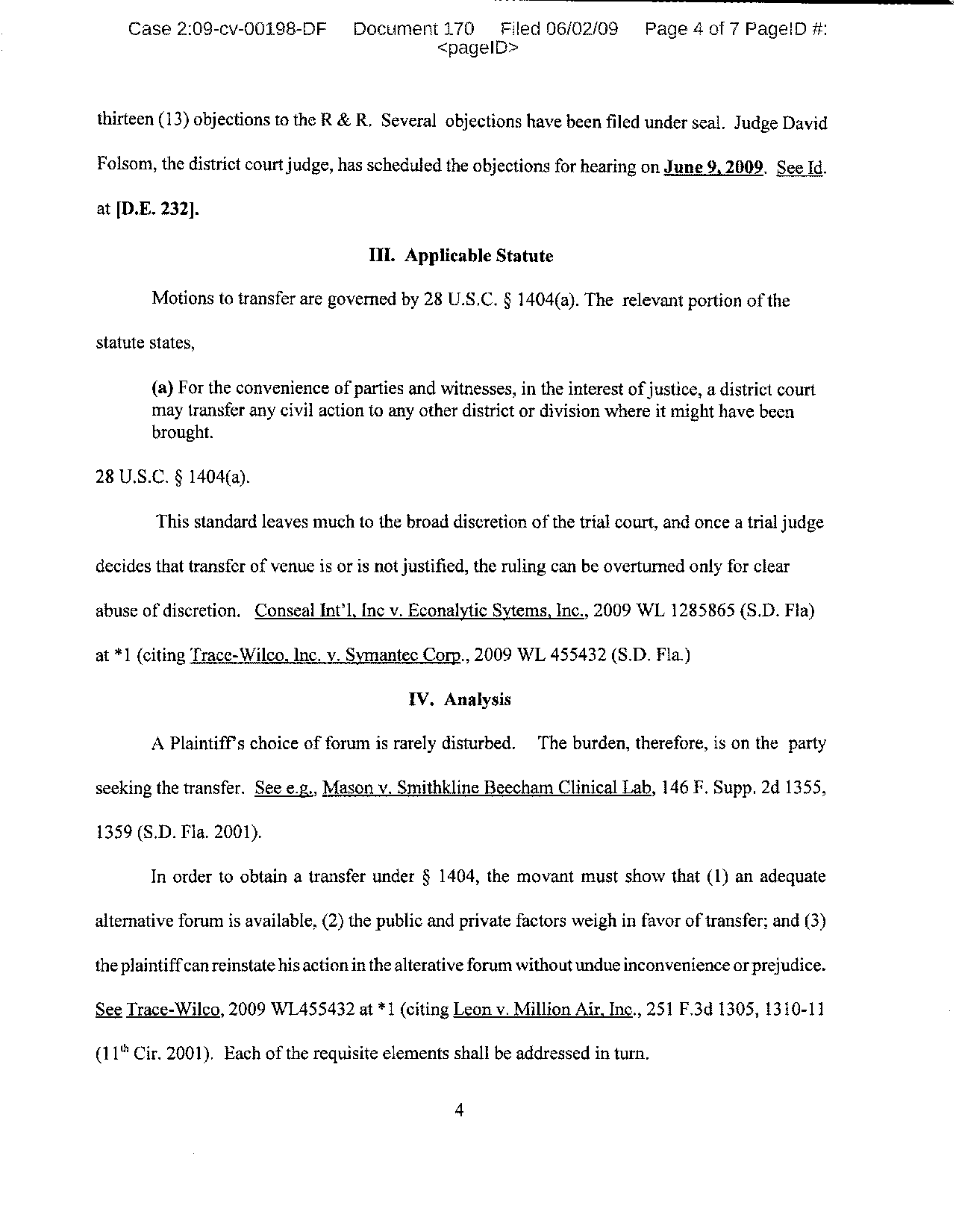
4thirteen (13) objections to the R & R. Several objections have been filed u
nder seal. Judge David Folsom, the district court judge, has scheduled the objections for hearing on
June 9, 2009. See Id. at [D.E. 232].
III. Applicable Statute
Motions to transfer are governed by 28 U.S.C. § 1404(a). The relevant portion of the Statute states,
(a) For the convenience of parties and witnesses, in the interest of justice, a district court may transfer any civil action to any other district or division where it might have been brought.
28 U.S.C. § 1404 (a).
This standard leaves much to the broad discretion of the trial court, and once a trial judge decides that transfer of venue is or is not justified, the ruling can be overturned only for clear abuse of discretion. Conseal Int’l, Inc v. Econalytic Sytems, Inc., 2009 WL 1285865 (S.D. Fla) at *1 (citing Trace-Wilco, Inc. v. Symantec Corp., 2009 WL 455432 (S.D. Fla.)
IV. Analysis
A Plaintiff's choice of forum is rarely disturbed. The burden, therefore, is on the party seeking the transfer. See e.g.,M ason v. Smithkline Beecham Clinical Lab, 146 F. Supp. 2d 1355, 1359 (S.D. Fla. 2001).
In order to obtain a transfer under § 1404, the movant must show that (1) an adequate alternative forum is available, (2) the public and private factors weigh in favor of transfer; and (3) the plaintiff can reinstate his action in the alterative forum without undue inconvenience or prejudice. See Trace- Wilco, 2009 WL455432 at *1 (citing Leon v. Million Air, Inc., 251 F.3d 1305, 1310-11 (11" Cir. 2001). Each of the requisite elements shall be addressed in turn.
5A. Adequate Alternative Forum
The is no question that the Florida action could have been brought in Texas. Both subject matter and personal jurisdiction over Defendants — national companies that conduct business in all states — exists. Further, Plaintiff IPAT is a Texas limited liability corporation.
B. Public and Private Factors
The public and private factors to be considered are: (1) the convenience of the parties, (2) the location of relevant documents and the relative ease of access to sources of proof; (3) the convenience of the parties; (4) the locus of the operative facts (5); the availability of process to compel the attendance of unwilling witnesses; (6) the relative means of the parties; (7) a forum’s familiarity with the governing law; (8) the weight accorded a plaintiff's choice of forum; and (9) the trial efficiency and the interests of justice, based on the totality of the circumstances. See Manuel v. Convergys Corp., 430 F.3d 1132, 1135, n.1 (11" Cir. 2005).
At first glance, it appears that the existence of a similar action pending in the proposed transferee court heavily favors a transfer — and subsequent consolidation. A transfer would, no doubt, be convenient. However, in reality consolidation can just as easily take place in this court — if the Texas action is transferred here. All other factors are neutral, especially given the fact that both cases are in the embryonic stages.
C. Reinstatement of Plaintiff's Action
Typically, courts considering motions to transfer will determine whether Plaintiff can reinstate the lawsuits in the transferee court without undue inconvenience or prejudice. This factor is likewise neutral. That is, there does not appear to be any issue that would bar either set
6of Plaintiffs from reinstating their respective cases in either Florida or Tex
as in the event of a
transfer.
V. Consolidation
It is important to note that what is presently before this Court is a motion to transfer — not a motion to consolidate. Notwithstanding, such relief may indeed be appropriate upon transfer. Fed.R.Civ.P. 42 (a) states in pertinent part,
(a) Consolidation. When actions involving a common question of law or fact are pending before the court, it may order a joint hearing or trial of any or all the matters in issue in the actions; it may order all the actions consolidated; and it may make such orders concerning the proceedings therein as may tend to avoid unnecessary costs or delay.
Fed.R.Civ.P. 42 (a).
Upon review of both sets of pleadings, and both court dockets, the undersigned finds that consolidation upon transfer would be appropriate.
VI. Recommendation
Consistent with the above and foregoing, and based upon this evolving record, this Court cannot recommend that this case be transferred at this time. Like the Texas action, this case has yet to crystalize sufficiently to warrant a transfer. Accordingly, it is RESPECTFULLY RECOMMENDED that Asus’ Motion to Transfer [D.E. 87] be DENIED.
Given the unique posture of this case, its is RESPECTFULLY RECOMMENDED that the district court judge re-evaluate this matter on the record before it at the time of its review of this Report and Recommendation.
It is FURTHER RESPECTFULLY RECOMMENDED that the two matters be consolidated in the event of a future transfer of the Texas action to this district.
7Pursuant to Local Magistrate Rule 4 (b), the parties have ten
(10) days from the service of this Report and Recommendation to serve and file written objec
tions, if any, with the Honorable Federico A. Moreno, Chief United States District Court Judge. Fail
ure to timely file objections shall bar the parties from attacking on appeal the factual findings contained her
ein. Loconte v. Dugger, 847 F. 2d 745 (11" Cir. 1998); cert. denied, 488 U.S. 958 (1988); RTC v. H
allmark Builders, Inc., 996 F. 2d 1144, 1149 (11" Cir. 1993).
RESPECTFULLY RECOMMENDED in Chambers at Miami, Florida o
n this 2nd
day of June 2009.
WILLIAM C. TURNOFF
UNITED STATES MAGISTRATE JUDGE
ce: Hon. Federico A. Moreno, Chief United States District Court Judge
Counsel of Record