IN THE UNITED STATES DISTRICT COURT
FOR THE EASTERN DISTRICT OF TEXAS
MARSHALL DIVISION
ADVANCED TECHNOLOGY §
INCUBATOR, INC. § §
Plaintiff §
§ Case No. 2:07-CV-468
V. § JURY TRIAL DEMANDED § SHARP CORPORATION, §
SHARP ELECTRONICS CORPORATION, §
DAI NIPPON PRINTING, and § DNP COLOR TECHNO KAMEYAMA §
CO., LTD. § §
Defendants §
ORDER
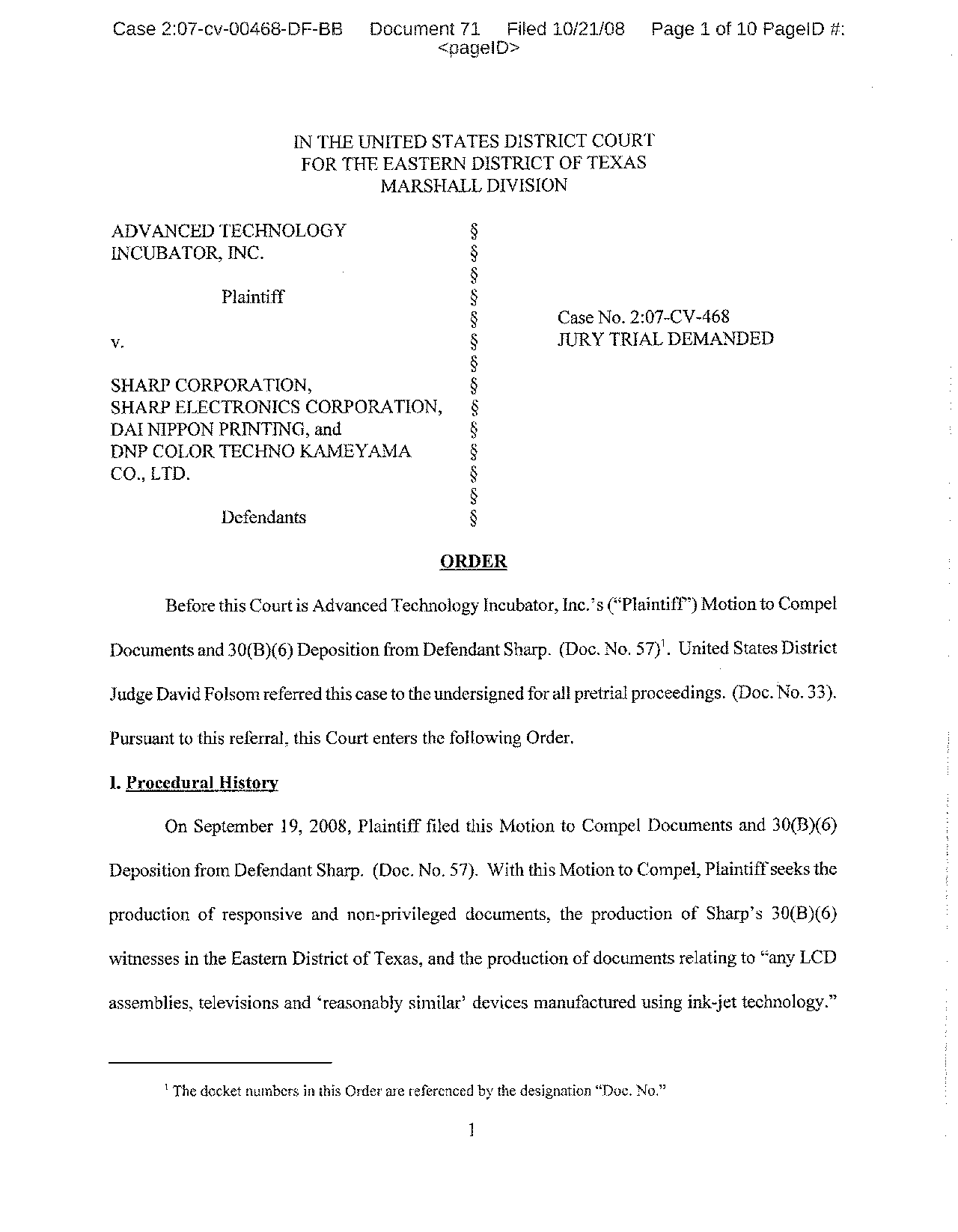
Before this Court is Advanced Technology Incubator, Inc.’s (“Plaintiff”) Motion to Compel Documents and 30(B)(6) Deposition from Defendant Sharp. (Doc. No. 57)'. United States District Judge David Folsom referred this case to the undersigned for all pretrial proceedings. (Doc. No. 33). Pursuant to this referral, this Court enters the following Order. I. Procedural History
On September 19, 2008, Plaintiff filed this Motion to Compel Documents and 30(B)(6) Deposition from Defendant Sharp. (Doc. No. 57). With this Motion to Compel, Plaintiff seeks the production of responsive and non-privileged documents, the production of Sharp’s 30(B)(6) witnesses in the Eastern District of Texas, and the production of documents relating to “any LCD assemblies, televisions and ‘reasonably similar’ devices manufactured using ink-jet technology.”
' The docket numbers in this Order are referenced by the designation “Doc. No.” ]
2Id.
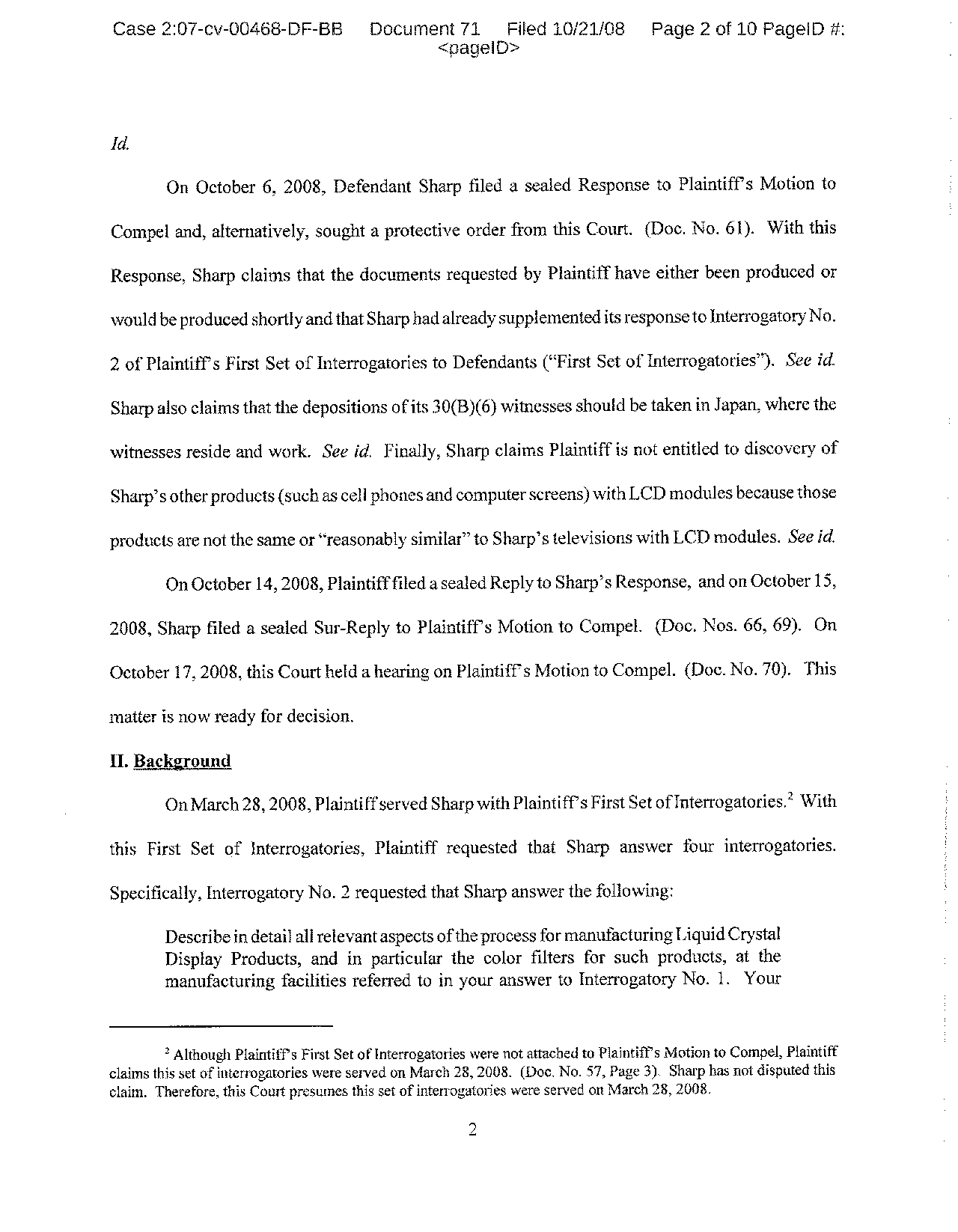
6, 2008, Defendant Sharp filed a sealed Response to Plaintiffs Motion to On October
ly, sought a protective order from this Court. (Doc. No. 61). With this Compel and, alternative
s that the documents requested by Plaintiff have either been produced or Response, Sharp claim
be produced shortly and that Sharp had already supplemented its response to Interrogatory No. would
ntiffs First Set of Interrogatories to Defendants (“First Set of Interrogatories”). See id. 2 of Plai
the depositions of its 30(B)(6) witnesses should be taken in Japan, where the Sharp also claims that
eside and work. See id. Finally, Sharp claims Plaintiff is not entitled to discovery of witnesses r
products (such as cell phones and computer screens) with LCD modules because those Sharp’s other products are not the same or “reasonably similar’ to Sharp’s televisions with LCD modules. See id.
n October 14, 2008, Plaintiff filed a sealed Reply to Sharp’s Response, and on October 15, O
p filed a sealed Sur-Reply to Plaintiff's Motion to Compel. (Doc. Nos. 66, 69). On 2008, Shar
17, 2008, this Court held a hearing on Plaintiff's Motion to Compel. (Doc. No. 70). This October matter is now ready for decision. II. Background
On March 28, 2008, Plaintiff served Sharp with Plaintiffs First Set of Interrogatories.* With rst Set of Interrogatories, Plaintiff requested that Sharp answer four interrogatories. this Fi Specifically, Interrogatory No. 2 requested that Sharp answer the following:
Describe in detail all relevant aspects of the process for manufacturing Liquid Crystal Display Products, and in particular the color filters for such products, at the manufacturing facilities referred to in your answer to Interrogatory No. 1. Your
2 Although Plaintiff's First Set of Interrogatories were not attached to Plaintiff's Motion to Compel, Plaintiff claims this set of interrogatories were served on March 28, 2008. (Doc. No. 57, Page 3). Sharp has not disputed this claim. Therefore, this Court presumes this set of interrogatories were served on March 28, 2008.
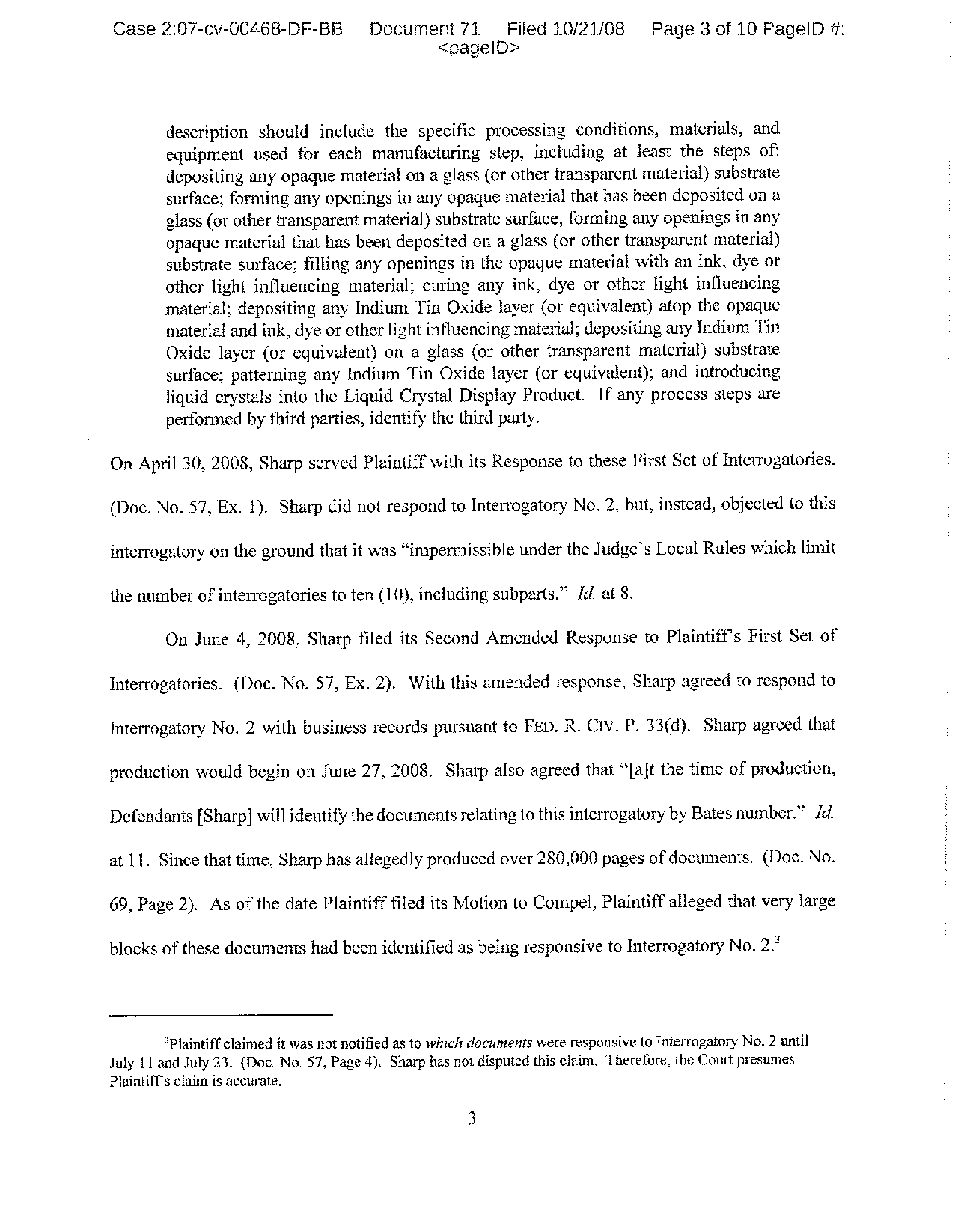
3ption should include the specific processing conditions, materials, and descri
d for each manufacturing step, including at least the steps of: equipment use
iting any opaque material on a glass (or other transparent material) substrate depos
orming any openings in any opaque material that has been deposited on a surface; f glass (or other transparent material) substrate surface, forming any openings in any
ue material that has been deposited on a glass (or other transparent material) opaq
ate surface; filling any openings in the opaque material with an ink, dye or substr
ght influencing material; curing any ink, dye or other light influencing other li
depositing any Indium Tin Oxide layer (or equivalent) atop the opaque material;
rial and ink, dye or other light influencing material; depositing any Indium Tin mate
e layer (or equivalent) on a glass (or other transparent material) substrate Oxid
atterning any Indium Tin Oxide layer (or equivalent); and introducing surface; p
ystals into the Liquid Crystal Display Product. If any process steps are liquid cr performed by third parties, identify the third party.
harp served Plaintiff with its Response to these First Set of Interrogatories. On April 30, 2008, S
1). Sharp did not respond to Interrogatory No. 2, but, instead, objected to this (Doc. No. 57, Ex.
und that it was “impermissible under the Judge’s Local Rules which limit interrogatory on the gro the number of interrogatories to ten (10), including subparts.” Jd. at 8.
ne 4, 2008, Sharp filed its Second Amended Response to Plaintiffs First Set of On Ju
gatories. (Doc. No. 57, Ex. 2). With this amended response, Sharp agreed to respond to Interro
gatory No. 2 with business records pursuant to FED. R. Civ. P. 33(d). Sharp agreed that Interro
would begin on June 27, 2008. Sharp also agreed that “[a]t the time of production, production
nts [Sharp] will identify the documents relating to this interrogatory by Bates number.” Jd. Defenda at 11. Since that time, Sharp has allegedly produced over 280,000 pages of documents. (Doc. No.
e 2). As of the date Plaintiff filed its Motion to Compel, Plaintiff alleged that very large 69, Pag locks of these documents had been identified as being responsive to Interrogatory No. 2.°
b
>Plaintiff claimed it was not notified as to which documents were responsive to Interrogatory No. 2 until and July 23. (Doc. No. 57, Page 4). Sharp has not disputed this claim. Therefore, the Court presumes
July 11 Plaintiff's claim is accurate.
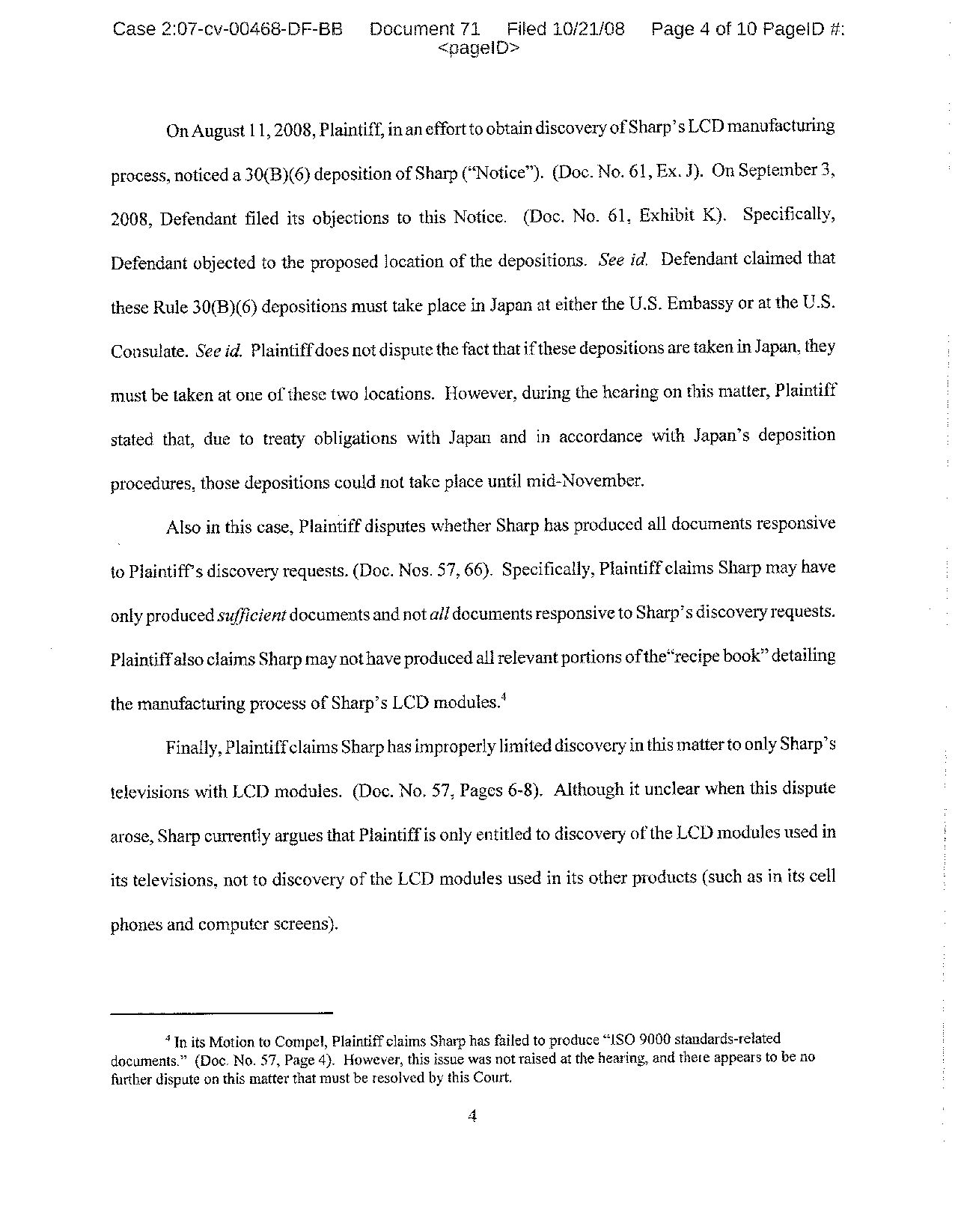
4ort to obtain discovery of Sharp’s LCD manufacturing On August 1 1, 2008, Plaintiff, in an eff
harp (“Notice”). (Doc. No. 61, Ex. J). On September 3, process, noticed a 30(B)(6) deposition of S
to this Notice. (Doc. No. 61, Exhibit K). Specifically, 2008, Defendant filed its objections
ation of the depositions. See id. Defendant claimed that Defendant objected to the proposed loc
ake place in Japan at either the U.S. Embassy or at the USS. these Rule 30(B)(6) depositions must t
pute the fact that if these depositions are taken in Japan, they Consulate. See id. Plaintiff does not dis
ations. However, during the hearing on this matter, Plaintiff must be taken at one of these two loc
gations with Japan and in accordance with Japan’s deposition stated that, due to treaty obli procedures, those depositions could not take place until mid-November.
ff disputes whether Sharp has produced all documents responsive | Also in this case, Plainti
y requests. (Doc. Nos. 57, 66). Specifically, Plaintiff claims Sharp may have to Plaintiff's discover
nt documents and not a// documents responsive to Sharp’s discovery requests. only produced sufficie
p may not have produced all relevant portions of the“recipe book” detailing Plaintiff also claims Shar the manufacturing process of Sharp’s LCD modules.*
ffclaims Sharp has improperly limited discovery in this matter to only Sharp’s Finally, Plainti
D modules. (Doc. No. 57, Pages 6-8). Although it unclear when this dispute televisions with LC
gues that Plaintiff is only entitled to discovery of the LCD modules used in arose, Sharp currently ar
discovery of the LCD modules used in its other products (such as in its cell its televisions, not to phones and computer screens).
on to Compel, Plaintiff claims Sharp has failed to produce “ISO 9000 standards-related ‘Tn its Moti
7, Page 4). However, this issue was not raised at the hearing, and there appears to be no
documents.” (Doc. No. 5 further dispute on this matter that must be resolved by this Court.
5Ill. Discussion
pel, Plaintiff claims the following: (1) the deposition of Sharp’s With this Motion to Com
en in the Eastern District of Texas, not in Japan; (2) Sharp must be 30(B)(6) witnesses should be tak
its responsive, non-privileged documents; and (3) Sharp must be compelled to produce all of
of the documents pertaining to Sharp’s LCD modules in all of its products compelled to produce all
ules used in Sharp’s cell phones and computer screens). This Court will (including the LCD mod address each of these arguments in order.
A. Sharp’s 30(B)(6) Witnesses
ms that the depositions of Sharp’s Rule 30(B)(6) witnesses should be taken in Plaintiff clai
xas, not in Japan. Under the general rule in the Fifth Circuit, the deposition the Eastern District of Te
0(B)(6) witness should be taken at a corporation’s principal place of business. ofa FED. R. Civ. P. 3
., 593 F.2d 649, 651-52 (Sth Cir. 1979) (holding that “[i]t is well settled that See Salter v. Upjohn Co
orporation by its agents and officers should ordinarily be taken at its principal ‘(t)he deposition of a c
ecially when, as in this case, the corporation is the defendant”) (citation place of business,’ esp omitted). However, the determination of where a Rule 30(B)(6) deposition should be taken is
e court’s discretion. See id. A court is permitted to depart from this general rule where subject to th
hows peculiar circumstances or compelling reasons for such a departure. See 7a ilift the plaintiff s
Tailift Co., Ltd., 2004 WL 722244, at *2-4 (N.D. Tex. March 26, 2004) (citing the five USA, Inc. v.
om Resolution Trust Corp. v. Worldwide Ins. Mgmt. Corp., 147 F.R.D. 125, 127 (N.D. Tex. factors fr 1992)).
present action, the parties do not dispute the fact that Japan is Sharp’s principal place In the
s. Accordingly, under the general rule, Sharp is correct in its claim that the depositions of busines
6his Court finds that Plaintiffhas established compelling reasons should be taken in Japan. However, t
ule. First, Plaintiff has been seeking the information needed from for departing from this general r
ch 28, 2008 when it served its First Set of Interrogatories. these 30(B)(6) witnesses since Mar
onsiderable amount of time producing the documents response to Because Sharp has expended a c
aintiff has been waiting nearly five months for the responsive documents to be this interrogatory, Pl produced.
hat producing approximately three hundred thousand documents This Court acknowledges t
wever, this Court finds that Plaintiff has been prejudiced by this delay. is a difficult task. Ho
not automatically entitled to infringement or process discovery at this stage. Arguably, Plaintiff is
Trident Microsystems, Inc., 287 F.3d 1062, 1074 (Fed. Cir. 2002) (holding See Neomagic Corp. v.
at claims may not be construed by reference to the accused device”). However, “Ti}t is well settled th
this discovery is prohibited, and Plaintiff has been seeking this information Sharp has not argued that
ven assuming its delay was not intentional, Sharp cannot delay production for nearly five months. E and then claim Plaintiff is not entitled to discovery at this stage of the case.”
iff should not be further prejudiced by being forced to wait another month to Second, Plaint
in Japan. As admitted by both parties at the hearing in this matter, if these take these depositions
ns were to take place in Japan, they could not proceed until a month following entry of this depositio
after the time Plaintiff would be required to limit the number of asserted Order, which would be
me Plaintiff would be required to file its opening claim construction brief. claims and after the ti
coming deadlines and because Plaintiff has diligently sought the requested Because of these up
ally true since Sharp did not object in its response to Interrogatory No. 2 of Plaintiff's First 5 This is especi
ries on the basis that this requested information was outside the scope of claim construction
Set of Interrogato discovery. (Doc. No. 61, Ex. C).
7Plaintiff would be prejudiced by any further on for nearly five months, the Court finds
informati delay.
esses would be produced in response to this Third, Sharp has indicated that only two witn
Mr. Kobayashi as the person who is most Notice: “In this regard, Sharp has identified
r Mr. Kishimoto will be the second witness, knowledgeable. In addition, either Mr. Takii o
7). Even though these two witnesses may be epending upon availability.” (Doc. No. 61, Page
d
employment and work, only two witnesses are nconvenienced by this travel from their place of i
provided no specific reason for not being able to being required to travel this distance. Sharp has
States, apart from the fact that they would be produce these individuals in the United
apacity might be impacted in some way ifa problem inconvenienced, and that Sharp’s production c arose during the witness's absence for the depositions.
el expenses (including lodging and transportation) Fourth, Plaintiff has offered to pay the trav
Courts in other districts who have ordered Rule associated with deposing these two individuals.
United States have ordered the parties to each pay 30(B)(6) depositions of foreign companies in the
odging those individuals. See Custom Form Mfz., half the costs associated with transporting and l
. 2000) (ordering the parties to share equally the nc. y. Omron Corp., 196 F.R.D. 333, 336 (N.D. Ind I
e travel and lodging” of the Japanese witnesses).
“reasonable costs associated with th
ons, this Court finds the depositions of these Rule Accordingly, based upon these considerati
ct of Texas on or before November 12, 2008. witnesses should be taken in the Eastern Distri
30(B)(6)
location for depositions within the United es are, of course, free to agree to an alternate
The parti
arties. Wherever the location of these depositions, States that might be more convenient for both p
e costs associated with the travel and lodging s are directed to share evenly in the reasonabl
the partie
8of Sharp’s Japanese witnesses during the ordered depositions.
B. Production of Responsive, Non-Privileged Documents
eking the production of all non-privileged, responsive documents. (Doc. No. Plaintiff is se
arp has only produced “sufficient” documents and has not produced “all” 57). Plaintiff claims Sh
- o discovery requests. This dispute extends to the production of the so-called documents responsive t
e production of related documents. The parties should be well aware of their “recipe book” and th
e all documents responsive to discovery requests that are not privileged. See obligations to produc
, 34, 37; Local Court Rule CV-26. Should either party not produce all the FED. R. CIv. P. 26, 30, 33
a timely manner, the requesting party should file a motion to compel and a requested documents in
tions. This Court will then deal with those issues under FED. R. CIv. P. 37.
motion for sanc
C. Scope of Discovery
ms that discovery should not be limited to those Sharp televisions listed in its Plaintiff clai
ent Contentions (“PICs”) and that it should be able to obtain full discovery of Preliminary Infringem
ch as cell phones and computer screens) manufactured using an inkjet all Sharp products (su
. (Doc. No. 57). In response, Sharp claims that the LCD modules in Sharp manufacturing method
p’s other products are not reasonably similar. (Doc. No. 61). Counsel for televisions and in Shar
LCD color filter modules made for use in televisions are not used in other Sharp has stated that “
c. No. 61, Ex. A). Additionally, a representative of Sharp (Mr. Kobayashi) [Sharp] products.” (Do
n stating the following: “In my opinion, televisions with LCD modules are has signed a declaratio
milar to cell phones or computers with LCD modules. Moreover, not the same as or reasonably si
n Sharp’s televisions are quite different from the LCD modules used in the LCD modules used i computers and cell phones.” (Doc. No. 61, Ex. B).
9s, United States District Judge David Folsom has entered orders addressing In two prior case
of discovery in patent infringement cases. See Mosaid Technologies, Inc. v. Micron Te ch., the scope
00302 (Doc. No. 257) (Entered Jan. 29, 2008); Epicrealm Licensing, LLC v. Autoflex Inc., 2:06-cv-
, 5:07-cv-00125 (Doc. No. 385) (Entered Aug. 27, 2007). In those cases, the Court held Leasing, Inc.
gh there is “no bright line rule that discovery can only be obtained ifrelated to an accused that, althou
ntified in a party’s PICs,” there still must be some showing that the products (such as product ide
computers and cell phones) are “reasonably similar” to those accused in the PICs. See Sharp’s Epicrealm Licensing, LLC, 5:07-cv-00125 (Doc. No. 385, Pages 5-6). For instance, in Mosaid, the Court found that the plaintiff established reasonable similarity by going “well beyond the claim language” and by providing “alternative documentation,” such as reverse engineering reports based upon publically available information. See Mosaid Technologies, Inc., 2:06-cv-00302 (Doc. No. 257, Pages 13-14).
However, at this stage of discovery in the instant case, it is difficult, if not impossible, to whether the LCD modules for these Sharp products is “reasonably similar” or not. determine Therefore, the Court will withhold ruling on this issue until after these Rule 30(B)(6) depositions
fter those depositions are taken, and Mr. Kobayashi and other witnesses are fully are taken. A
ned on the issue of “reasonably similar” products, Plaintiff may re-urge its motion that all questio documents for Sharp’s different products (such as cell phones and computer screens) be produced
ms such production is appropriate. At this time, Sharp is not required to produce all if it dee
ts related to its other products (apart from televisions) that may use this inkjet documen manufacturing process.
10IV. Conclusion
g, this Court GRANTS Plaintiffs Motion to Compel IN PART and Based upon the foregoin
on to Compel IN PART. Furthermore, this Court GRANTS Defendant’s DENIES Plaintiff's Moti Motion for Protective Order IN PART and ORDERS the following:
ment of the parties, the depositions of the individuals from Japan noticed Absent an agree
I.
30(B)(6) Notice (dated August 11, 2008) are ORDERED to be taken in the in the Rule
of Texas before November 12, 2008. It is further ordered that Plaintiff will Eastern District
p for half of the reasonable costs associated with the travel and lodging of reimburse Shar Sharp’s Japanese witnesses during the ordered depositions.
ORDERED to produce all responsive, non-privileged documents. Should The parties are
efuse to produce such documents, the requesting party is directed to file a either party r motion to compel and a motion for sanctions pursuant to FED. R. CIv. P. 37.
required to produce any documents related that its other products (apart from Sharp is not
at may use this inkjet manufacturing process until after the Rule 30(B)(6) televisions) th
been completed. After those depositions are completed, Plaintiff may redepositions have urge its motion to compel the production of these documents.
SIGNED this 21st DAY OF OCTOBER, 2008. / ) “