naT
IN THE UNITED STATES DISTRICT COURT
FOR THE EASTERN DISTRICT OF TEXAS
MARSHALL DIVISION
PRODUITS BERGER S.A. §
and LAMPE BERGER USA, INC. § §
Plaintiffs §
§ CIVIL ACTION NO. 2:06cev002
vs. §
| §
DAVID M. SCHEMENAUER and §
THE MARSHALL GROUP, INC. § §
Defendants §
| MEMORANDUM OPINION AND ORDER
The Court issues this claim construction opinion and order to construe terms that the parties
contend are either in dispute or otherwise require construction.
The plaintiffs, Produits Berger S.A. and Lampe Berger USA, Inc. (“Plaintiffs”), claim that
defendants David M. Schemenauer and The Marshall Group, Inc. (“Defendants”) infringe six claims
in the patent-in-suit, U.S. Patent No. 6,537,061 (“the ‘061 patent’).
For the reasons set forth below, the Court construes the identified claims in accordance with
the rulings made in this opinion.
The Patent-In-Suit
The abstract describes an invention concerning a catalytic combustion afterburner made of
porous material, comprising in its lower part a substantially axial cavity for receiving a taper
designed to convey to the burner a combustible liquid, and in its upper part an annular peripheral
zone bearing a catalyst and enclosing a central zone without catalyst forming a vaporizing zone. The
afterburner comprises in its upper part an open duct, communicating the cavity upper part with the
outside air.
2Applicable Law
ock principle’ of patent law that ‘the claims of a patent define the invention to “It is a ‘bedr
tentee is entitled the right to exclude.” Phillips v. AWH Corp., 415 F.3d 1303, 1312 which the pa
2005) (en banc) (quoting Innova/Pure Water Inc. v. Safari Water Filtration Sys., Inc., 381 (Fed. Cir.
111, 1115 (Fed. Cir. 2004)). In claim construction, courts examine the patent’s intrinsic F.3d 1
atented invention’s scope. See id.; C.R. Bard, Ine. v. U.S. Surgical Corp., evidence to define the p
Cir. 2004); Bell Atl. Network Servs., Inc. v.Covad Communications Group, 388 F.3d 858, 861 (Fed.
267 (Fed. Cir. 2001). This intrinsic evidence includes the claims themselves, Inc., 262 F.3d 1258, 1
he prosecution history. See Phillips, 415 F.3d at 1314; C.R. Bard, Inc., 388 the specification, and t
e claim terms their ordinary and accustomed meaning as understood by one F.3d at 861. Courts giv
e art at the time of the invention in the context of the entire patent. Phillips, of ordinary skill in th
13; Alloc, Inc. v. Int’l Trade Comm’n, 342 F.3d 1361, 1368 (Fed. Cir. 2003). 415 F.3d at 1312-
mselves provide substantial guidance in determining the meaning of particular The claims the
415 F.3d at 1314. First, a term’s context in the asserted claim can be very claim terms. Phillips,
asserted or unasserted claims can also aid in determining the claim’s meaning instructive. Jd. Other
ypically used consistently throughout the patent. /d. Differences among because claim terms are t
st in understanding a term’s meaning. Jd. For example, when a the claim terms can also assi
n to an independent claim, it is presumed that the independent claim dependent claim adds a limitatio
does not include the limitation. Jd. at 1314-15.
view of the specification, of which they are a part.” Jd. (quoting Claims “must be read in
w Instruments, Inc., 52 F.3d 967, 978 (Fed. Cir. 1995)). “[T]he specification Markman v. Westvie
vant to the claim construction analysis. Usually, it is dispositive; it is the single ‘is always highly rele
3best guide to the meaning of a disputed term.’” Jd. (quoting Vitronics Corp. v. Conceptronic, Inc.,
90 F.3d 1576, 1582 (Fed. Cir. 1996)); Teleflex, Inc. v. Ficosa N. Am. Corp., 299 F.3d 1313, 1325
(Fed. Cir. 2002). This is true because a patentee may define his own terms, give a claim term a
meaning than the term would otherwise possess, or disclaim or disavow the claim scope. different
Phillips, 415 F.3d at 1316. In these situations, the inventor’s lexicography governs. /d. Also, the
specification may resolve ambiguous claim terms “where the ordinary and accustomed meaning of
ds used in the claims lack sufficient clarity to permit the scope of the claim to be ascertained the wor
from the words alone.” Teleflex, Inc., 299 F.3d at 1325. But, “although the specification may aid
n interpreting the meaning of disputed claim language, particular embodiments and the court i
ppearing in the specification will not generally be read into the claims.” Comark examples a
Communications, Inc. v. Harris Corp., 156 F.3d 1182, 1187 (Fed. Cir. 1998); see also Phillips, 415
3. The prosecution history is another tool to supply the proper context for claim F.3d at 132
n because a patent applicant may also define a term in prosecuting the patent. Home constructio
stics, Inc., v. Lifescan, Inc., 381 F.3d 1352, 1356 (Fed. Cir. 2004) (“As in the case of the Diagno
specification, a patent applicant may define a term in prosecuting a patent.”).
Although extrinsic evidence can be useful, it is “less significant than the intrinsic record in
ng ‘the legally operative meaning of claim language.”” Phillips, 415 F.3d at 1317 (quoting determini
d, Inc., 388 F.3d at 862). Technical dictionaries and treatises may help a court understand C.R. Bar
ology and the manner in which one skilled in the art might use claim terms. the underlying techn
ctionaries and treatises may provide definitions that are too broad or may not However, technical di
term is used in the patent. Jd. at 1318. Similarly, expert testimony may aid be indicative of how the
ding the underlying technology and determining the particular meaning ofa term a court in understan
4but an expert’s conclusory, unsupported assertions as to a term’s definition are in the pertinent field,
a court. Jd. Generally, extrinsic evidence is “less reliable than the patent and entirely unhelpful to
its prosecution history in determining how to read claim terms.” Jd.
The Terms
opts the parties’ construction where agreed. The Court will construe the The Court ad
ms which the parties agree require construction: (1) “With a wick to convey remaining disputed ter
the burner”: (2) the “Separated” Limitation; (3) “Annular Peripheral Zone”; a combustible liquid to
Claim 5; (6) Claim 7; (7) Claim 8; (8) Claim 12; (9) Claim 14 — the (4) “The Open Channel”; (5)
10) Claim 14—the “Annular Peripheral Zone”; and (11) Claim 14 — “Fixed into “Wick” Limitation; (
the Neck of Said Flask” and “Resting on a Base.”
1. With a wick to convey a combustible liquid to the burner
convey a combustible liquid to the burner” is found in phrase 4 The clause “with a wick to
s associated with this phrase, namely: (1) whether the “liquid” is of claim 1. There are two dispute
e claim; and (2) whether Defendant’s proposed language of “This term may arequired limitation of th
a wick that extends through the cavity to the upper surface of the not be construed to encompass
ould be added as a negative limitation. The Court looks at each of catalytic combustion burner” sh
these in turn.
The Combustible Liquid
ustible liquid is not itself part of the claimed invention and Plaintiffs assert that the comb
n relates primarily to the configuration of the catalytic burner stone, contend that the present inventio
ble liquid. Plaintiffs argue this is evident from the claim itself, which not in any way to the combusti
vey” the liquid but does not require presence of the liquid itself. merely calls for a wick “to con
5Plaintiffs, it is clear from the specification that there is nothing new or unique Further, according to
about the combustible liquid mixture in the context of the present invention.
er hand, argue that the combustible liquid prominently referenced in Defendants, on the oth
strued as a required limitation on the claim. Defendants point to the prosecution claim 1 must be con
esponse to an Office Action by the Patent Office dated May 3, 2002, wherein history, including a r
e the ‘061 patent amended certain claims because of substantive the Applicants for what becam
rt. See Doc. No. 58, Ex. 3, at PB0238. Specifically, Defendants cite rejections based upon the prior a
aim 12 has been amended to further define features relating to the the Applicants’ statement that “cl
- o the pores of the burner . . .” as support that features relating to combustible liquid penetrating int
the liquid comprised a patentable distinction over the cited prior art. Id.
Defendants that the Applicants distinguished their invention While the Court disagrees with
uid, the Court does find that the combustible liquid comprises a based upon the combustible liq
French Patent Publication FR 2 530 144 was applied by the examiner required limitation in claim 1.
t which matured into the ‘061 patent. The examiner initially rejected during prosecution of the paten
h became claim 1 of the ‘061 patent, on the basis that the invention claim 12 of the application, whic
of FR 2 530 144 to incorporate the annular groove of EPO 0 277 875 was made to modify the burner
e annular cavity that serves to prevent encrustation of the as the structure of the burner, including th
at PBO252. Inresponse to the office action, the Applicants wick due to carbon particle build-up. Jd.
combustion burner as defined in amended claim 12” was specifically claimed that the “catalytic
ce of at least one open channel located in the upper distinguished from the prior art “by the presen
9. Thus, in accordance with the Applicants’ position during part of the burner...” Jd. at PBO238-3
open channel catalytic combustion burner distinguished the prosecution, the Court finds that the
6pparatus disclosed in FR 2 530 144. Nevertheless, the fact that Applicants invention over the a
- o further define “features relating to the combustible liquid penetrating into the amended claim 12 t
pores of the burner ” lends support to the idea that the liquid is a limitation.
ent references the “combustible liquid” twice within phrase 4: (1) “a Claim 1 of the ‘061 pat
stible liquid;” and (2) “said combustible liquid penetrating into the pores wick to convey a combu
al...” ‘061 patent, claim 1, 5:37-39. While it is true, as Plaintiffs of said burner’s porous materi
thing new or unique about the combustible liquid mixture in the context of the argue, that there is no
s also true that the claim language references the liquid and makes it clear that present invention, it i
tion, i.e., being conveyed by the wick and “penetrating” into the pores the liquid performs some func
er, even though the catalytic combustion burner can burn in the absence of of the stone. Jd. Furth
he burner burns the last quantities of combustible liquid remaining in combustible liquid or when t
e that the combustible liquid is an integral part of the invention, as the the flask, it is undeniabl
rk absent “said combustible liquid penetrating into the pores of said burner’s invention will not wo
porous material.”
at the “liquid” referenced in claim | is itself part of the Accordingly, the Court finds th
claimed invention and is, therefore, a required limitation of the claim
The Wick Limitation
tion, “This term may not be construed to encompass a wick Defendants seek to add the limita
pper surface of the catalytic combustion burner.” Plaintifis that extends through the cavity to the u
ion of the patent or prosecution history supports such a limitation. argue no port
cution history and argue that the Applicants of the 061 patent Defendants point to the prose
nd through the cavity of the burner. Defendants point to the same disavowed a wick extending up a
7nced above and argue that the Applicants expressly distinguished response to the office action refere
prior art wicks, i.e., wicks that extended through the upper part of the cavity the positioning of the
atmosphere. See Doc. No. 58, Ex. 3, at PB0240. According to and were in contact with the
nts expressly disavowed via arguments submitted to the Patent Defendants, because the Applica
g patentability over the prior art, Plaintiffs are now precluded from Office for purposes of establishin
asserting a claim construction without such a limitation.
ve, the Applicants noted that “FR 2 530 144 discloses a In the response referenced abo
cavity filled by a wick which extends up to the upper catalytic combustion burner provided with a
ently in contact with the atmosphere.” Jd. (emphasis added). part of this cavity and which is consequ
at, in FR 2 530 144, the wick extended to a point where it The point made by the patentee was th
However, the prior art did not solve the problem of wick blocked ingress of air to the cavity.
very close to the catalytic combustion zone will burn and burning, noting that “the wick which is
cles.” Jd. As a result, in the absence of oxygen, the char and carbonize and produce carbon parti
h the stone in the device of FR 2 530 144 would carbonize. wick in close contact wit
solve the problem of wick burning through the The patent-in-suit did not attempt to
d. Rather, the novelty of the present invention is the positioning of the wicks, as Defendants conten
d in the upper part of the burner.” See Doc. No. 58, “presence of at least one open channel locate
rovides the open passage that permits air to enter into Ex. 3, at PB0238-39. The present invention p
pplicants stated, the “presence of at least one open the cavity to avoid carbonization. As the A
by, either EP 0 277 875 or FR 2 530 144.” dd. at channel is neither disclosed in, or suggested
PB0239.
provided the inventive step over the prior art, not the The Court finds that the open channel
8e wick. Consequently, the Court will not construe the term as placement or positioning of th
requiring the negative limitation asserted by Defendants.
2. Separated
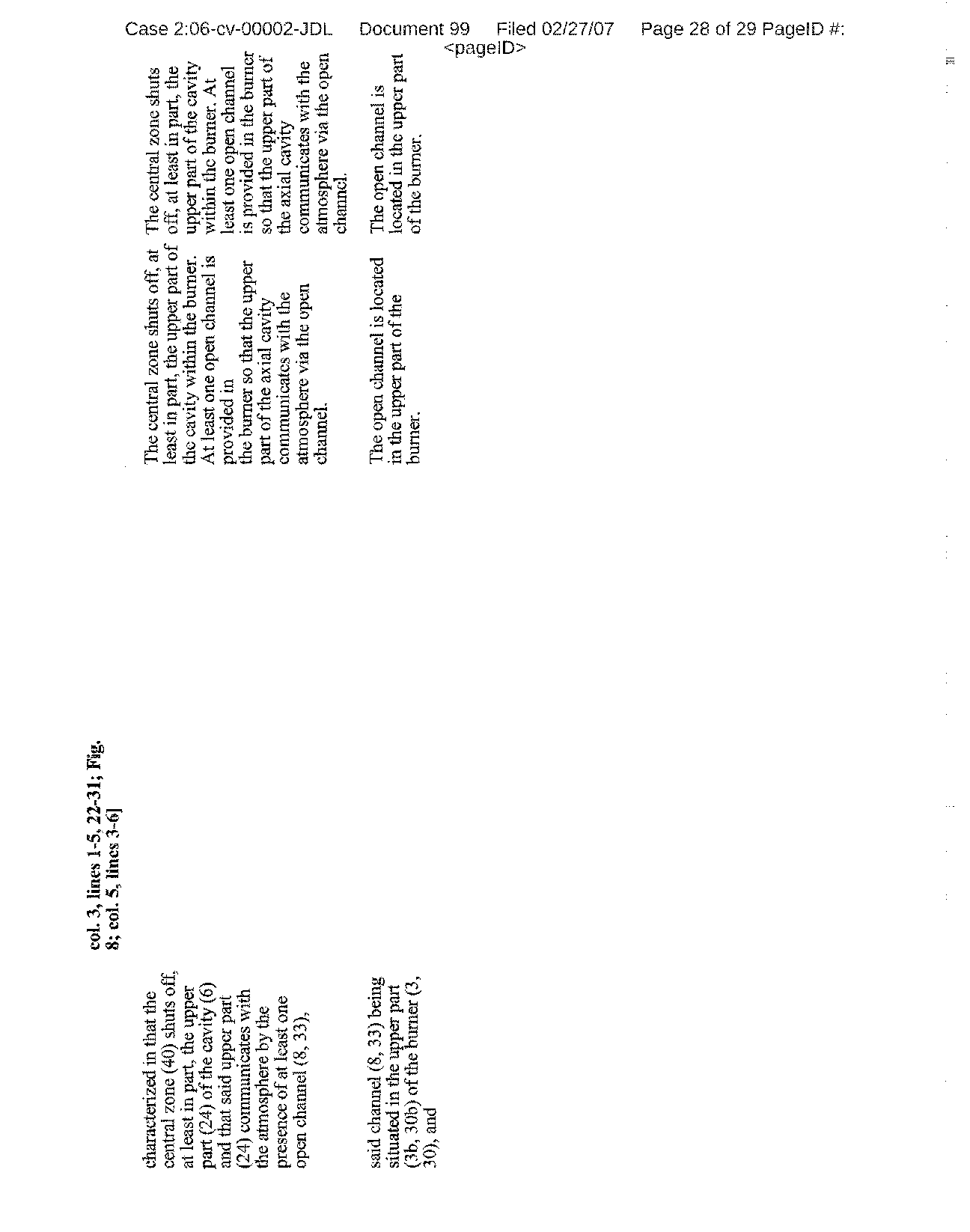
es that the cavity of the catalytic burner comprises an upper The fifth clause of claim 1 recit
burner, the cavity “being separated from the upper surface part and opening at the lower end of the
laintiffs propose that the clause should be construed by its (10) of the burner (3, 30) by a wall.” P
e., that “the cavity is separated from the upper surface by a wall.” plain and ordinary meaning, i.
e an added limitation that “the cavity is completely separated Defendants, on the other hand, propos
wall.” In addition, Defendants propose the limitation that from the burner’s upper surface by a
encompass a cavity that is only partially separated from the “ltlhis term may not be construed to
burner’s upper surface by a partial wall.”
n the fact that, consistent with the doctrine of claim Defendants base their construction o
wall,” while claim 13 only requires a structure which differentiation, claim 1 literally requires “a
art of the cavity.” Claim 13 (an unasserted claim) recites, “shuts off, at least in part, the upper p
off, at least in part, the upper part of the cavity.” See among other things, that “a central zone shuts
ccording to Defendants, the Applicants knew how to ‘061 patent, claim 13 (emphasis added). A
off the upper part of the cavity, as recited in claim 13. claim a “partial” wall, which, in part, shuts
used in claims 1 and 13, Defendants urge, there is Thus, because different words and phrases are
as used in claim 1, and the “shuts off, at least in part” presumed to be a difference between “wall,”
on that the wall completely separates the cavity from language of claim 13, supporting a constructi
the burner’s upper surface.
y communicates with the atmosphere by the presence Indeed, claim 1 requires that the cavit
9nnel (8, 33) being situated in the upper part (3b, 30b) of the burner (3, 30). of at least one open cha
adds the limitation that the invention is characterized in that “said See ‘061 patent, 5:48-51. Claim 2
al.” Id., 5:52-53. Claim 13, as cited by Defendants, requires the open channel (8) is substantially axi
the cavity and the atmosphere to extend radially. /d., 6:38-43. channel communicating between
claims may appear different but have the same scope. This does not However, selected terms in two
ifferentiation because it is the claims as a whole that are presumed to violate the doctrine of claim d
ms of the respective claims. See Tandon Corp. v. U.S. Int'l differ in scope, not merely selected ter
1023 (Fed. Cir. 1987) (citations omitted), In other words, though Trade Comm’n, 831 F.2d 1017,
vary in scope, the term “wall” can have the same meaning. claims 1 and 13 may
of the specification shows that the annular groove 9 As Defendants acknowledge, Fig. 2
han the thickness of the wall separating the cavity 6 from the extends axially over a greater distance t
nt, 3:25-28. As illustrated in Fig. 2, the open passage 8 of upper surface 10 of the burner. ‘061 pate
that separates cavity 6 from upper surface 10. Thus, the invention passes through the wall
completely separate the upper surface from the cavity is Defendants’ assertion that the wall must
contrary to the plain language of the patent.
cution history shows a complete separation is also not Defendants’ argument that the prose
originally filed with the USPTO, did not contain any persuasive. Defendants claim that claim 1, as
ny structure which separated the cavity and the upper surface language which in any way referred to a
3. Defendants argue that in order to make the claims of the burner. Doc. No. 58, Ex. 3, at PB033
cation, originally filed claim 1 was cancelled and “new “conform” with the specification and the appli
pper surface was shut off from the cavity, at least in claim 12" was added, which added that “the u
rejection, the Applicants submitted “amended claim 12,” part.” Id. at PB0270. In response to a
10wall” separating the upper surface of the burner from the cavity,” which which required “a
same as claim 1 in the ‘061 patent. Defendants claim the progression of this Defendants assert is the
of the ‘061 patent shows the Applicants have surrendered any coverage of a limitation in claim 1
partial wall. Defs.’ Br., at 19-20.
h Defendants’ reliance on the prosecution history. In the response The Court disagrees wit
ated May 3, 2002, the Applicants distinguished the present invention on the to the office action d
of at least one open channel located in the upper part of the burner. Doc. No. basis of the presence
9. Nowhere in the response did the Applicants submit that the prior art was 58, Ex. 3, at PB0238-3
of a full or partial wail. This does not amount to an express or distinguished by the presence
endants suggest. Middleton, Inc. v. Minn. Mining & Mfg. Co., 311 unequivocal disclaimer as Def
Because the Court concludes that the prosecution history does not F.3d 1384, 1388 (Fed. Cir. 2002).
term, the Court finds that no construction is necessary. As plainly change the plain meaning of the
onstrues the term separated to mean that the cavity is separated set forth in the claim, the Court c
from the upper surface by a wall and will add no further limitation.
3. Annular Peripheral Zone
im 1 recites “the burner (3, 30) having an annular peripheral zone (7) The sixth clause of cla
ropose that the phrase needs no construction, that the burner has an carrying a catalyst.” Plaintiffs p
udes a catalyst. Defendants assert that the construction be narrowed annular peripheral zone that incl
to “an outer circular zone” which includes a catalyst.
ee that the term periphery and, hence, the term “peripheral” means Both parties appear to agr
er closed curve; also: the perimeter of a polygon.” See Merriam-“the perimeter of a circle or oth
x. 2, at 1-2, Additionally, both parties submit the dictionary Webster Online, Doc. No. 58, E
11definition of “annular,” means “a thing in the form of a ring.” Jd. at 8. Defendants assert that
because “peripheral” has an ordinary meaning of the “perimeter” (of some shape) and “annular” has
meaning of “ring,” logic would dictate that the term “annular peripheral” would have an ordinary
an ordinary meaning of “outer circular.” To not construe the term as “circular,” Defendants argue,
is to ignore the word “annular.”
The exemplary embodiment of the burner stone illustrated in the patent has a round or
pe. See ‘061 patent; Fig. 2; 1:8-10; 3:1-5; Fig. 8; 5:6. The claim is not limited to such circular sha
however. Such structures may include circular or round configurations, but are not a shape,
y limited to such. Accordingly, the Court finds no basis for limiting the claims in such a necessaril
manner.
4. The Open Channel
use of claim 1 recites that the invention is “characterized in that said upper The seventh cla
communicates with the atmosphere by the presence of at least one open part (24) of the cavity
aid channel (8, 33) being situated in the upper part (3B, 30b) of the burner (3, channel (8, 33), and s
arties have agreed that this phrase should be construed to require “At least one open 30).” The p
the upper part of the burner so that the upper part of the cavity communicates channel is provided in
with the atmosphere through the open channel.”
diverge, however, as Defendants seek to impose the limitation that “This term The parties
encompass a cavity that is only partially separated from the burmer’s upper may not be construed to
all.” In other words, Defendants submit that the phrase must be limited in a surface by a partial w
s “completely” separated from the upper part of the burner. Plaintiffs, on the way where the cavity i
hat this portion of the claim does not refer in any way to a “wall” and, thus, other hand, contend t
1]
12provides no basis for asserting such a limitation.
Based upon the above analysis with respect to “wall” in phrase 5, the Court declines to add
the negative limitation proposed by Defendants that the claim requires that a wall completely
separate the upper surface from the cavity.
5. Claim 5
Claim 5 depends from claim 1 and includes all of the limitations of claim 1. Similar to
Phrase 6 from claim 1 discussed above, this claim further recites that the invention comprises “a
substantially axial annular groove” which separates “the annular peripheral zone from the central
zone.” The parties’ dispute centers once more on the word “annular.” Plaintiffs argue that annular
has its ordinary meaning, referring to “a thing in the form of a ring.” Defendants assert, more
particularly, that claim 5 requires a circular groove.
There is nothing in the claim or the disclosure of the patent that indicates that the annular
groove must be circular. As discussed with regard to phrase 6 from claim 1, although the exemplary
embodiment is round or circular, see Fig. 2; 1:8-10; 3:1-5; Fig. 8; 5:6, it is inappropriate to limit the
claim by imposing a limitation found, not in the claim, but only in the specification or drawing, or
only in a preferred embodiment. See Phillips v. AWH Corp., 415 F.3d 103, 1320 (Fed. Cir. 2005).
Accordingly, the Court finds no basis for limiting the claim.
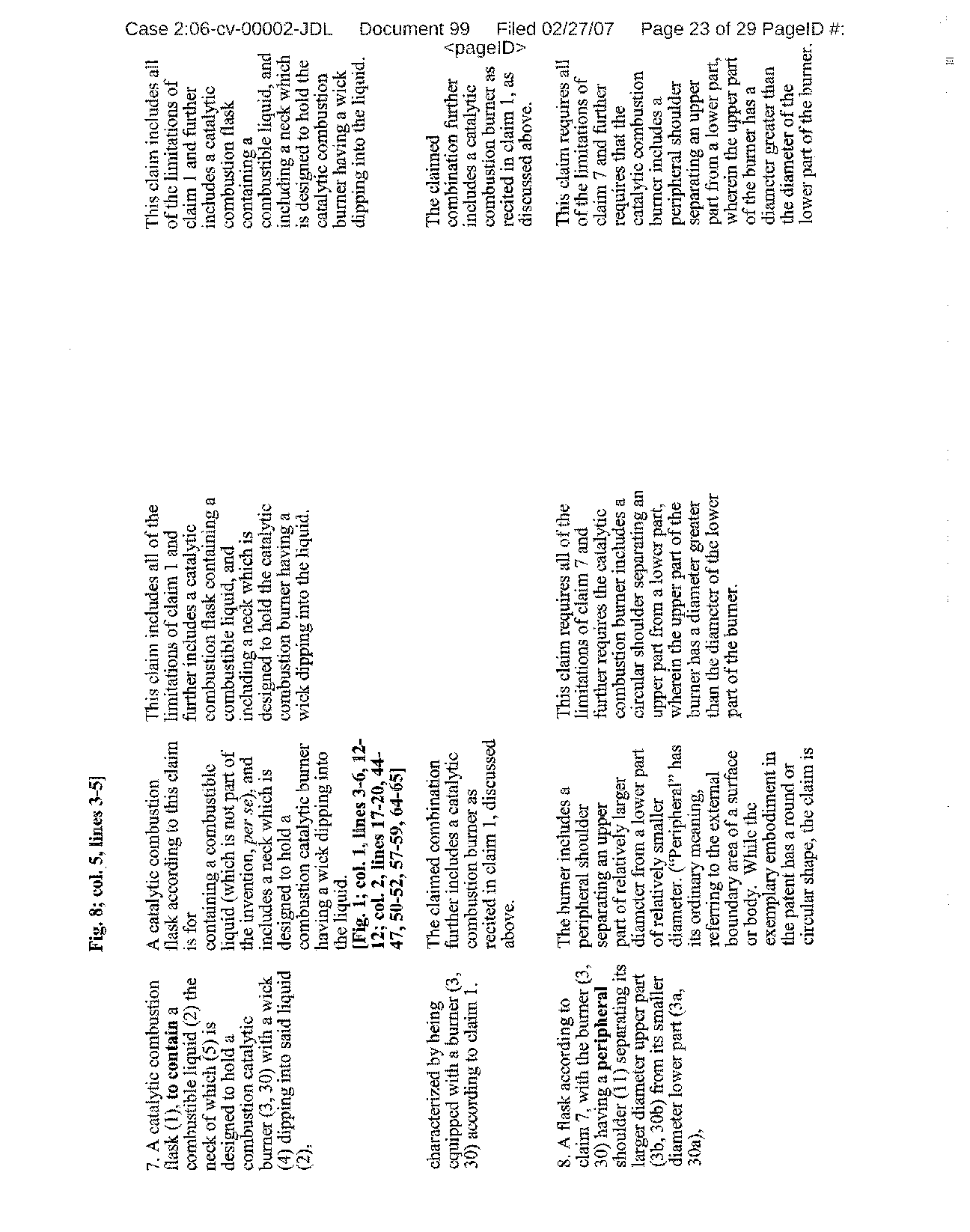
6. Claim 7 - “to contain”
Claim 7 depends from claim 1 and adds to the invention a catalytic combustion flask “to
contain” a combustible liquid. Plaintiffs argue that the present invention, as recited in claim 1, is
a catalytic combustion burner and that claim 7 adds a flask designed to hold the catalytic combustion
burner, the flask being present “to contain a combustible liquid.” However, Plaintiffs contend that
13self a part of the present invention. Defendants, on the other hand, the combustible liquid is not it
d be construed to require a flask containing a combustible liquid. propose that claim 7 shoul
ncludes all of the limitations of claim 1, the Court finds that the Because this claim i
ed limitation of this claim as well. Further, the ordinary language “combustible liquid” is a requir
ick (4) dipping into said liquid. . . See ‘061 patent, claim 7. As of the claim itself requires “a w
not there, how can the wick be “dipping” into the liquid? The claim Defendants posit, if the liquid is
k (4) to dip;” the claim clearly states “a wick dipping into said liquid.” language not only states “a wic
ing the active tense of the verb “dipping” into the liquid Id. This additional language demonstrat
er supports Defendants’ position that the liquid is part of the claim. furth
ourt finds that the “liquid” referenced in claim 7 is itself part Thus, as it did in claim 1, the C
med invention and is, therefore, a required limitation of the claim of the clai
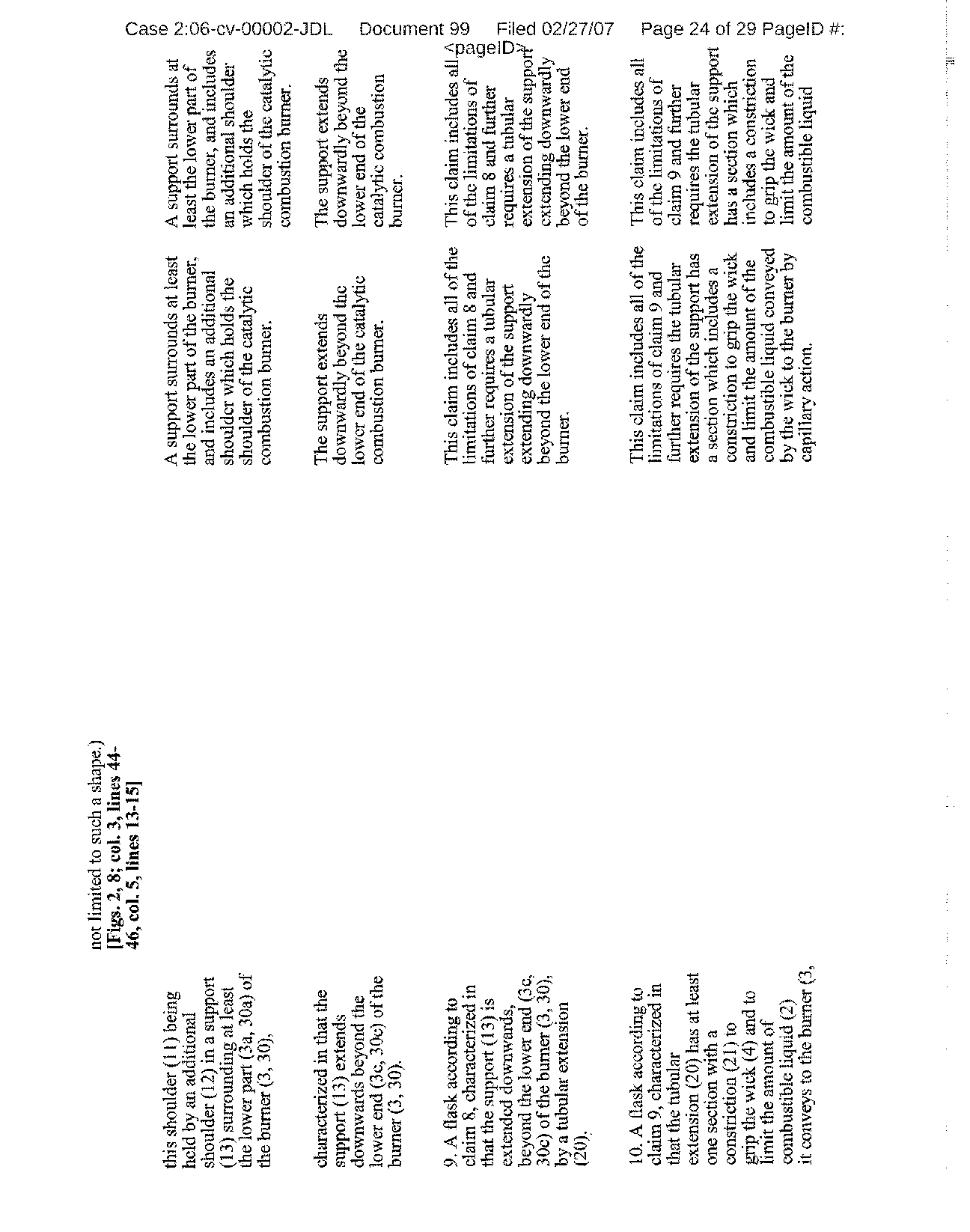
7. Claim 8
reciting that the burner has “a peripheral shoulder” Claim 8 further limits claim 7 by
smaller diameter lower part. Plaintiffs assert that the separating a large diameter upper part from a
ng to the external boundary area of a surface or body. “»yeripheral” has its ordinary meaning, referri
that claim 8 must be limited to a combustion burner Defendants, as in previous arguments, propose
ts advance the same argument with respect to claim which includes a circular shoulder. Defendan
peripheral” means “the perimeter of a circle or other 8 that they asserted as to claims 1 and 5, that “
on.” Further, Defendants note that the claim twice closed curve; also: the perimeter of a polyg
“diameter.” See ‘061 patent, 3:15-17. According to identifies that the additional structure has a
meter” refers to the diameter of a circle and, because Defendants, the ordinary meaning of “dia
it logically flows that a proper construction of “neripheral” means the perimeter of a circle,
14“peripheral shoulder” would be a “circular shoulder.”
The Merriam-Webster Online Dictionary defines “diameter” as “a chord passing through the
center of a figure or body,” and “the length ofa straight line through the center of an object,” without
limiting such figure to a circle. As the Court has previously opined, the claim is not limited to a
round or circular shape as demonstrated in the exemplary embodiment. See Figs. 2, 8; 3:44-46; 5:13-
15. The shoulder may include circular or round configurations, but the Court finds no basis for
limiting the claim only to such.
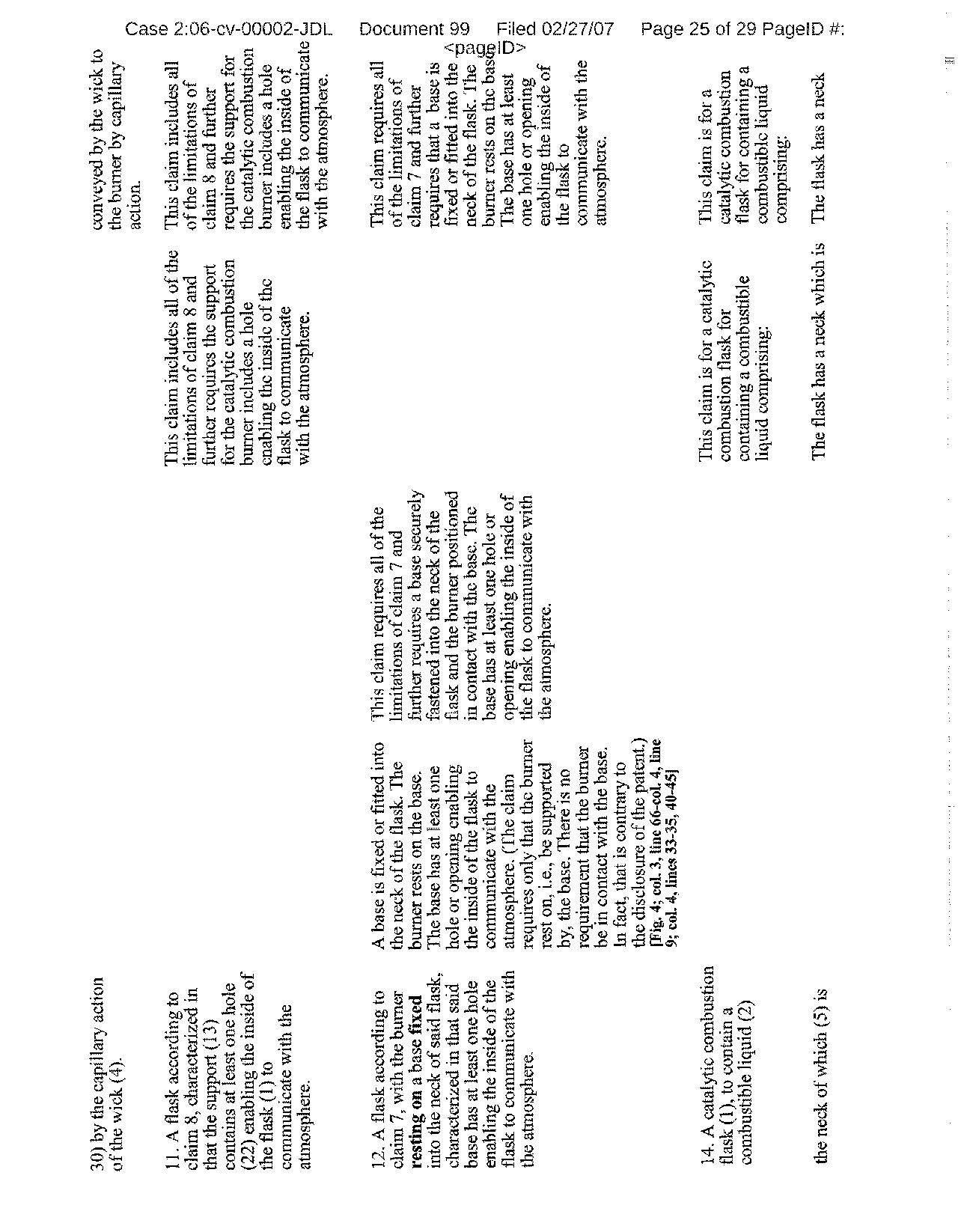
8. Claim 12
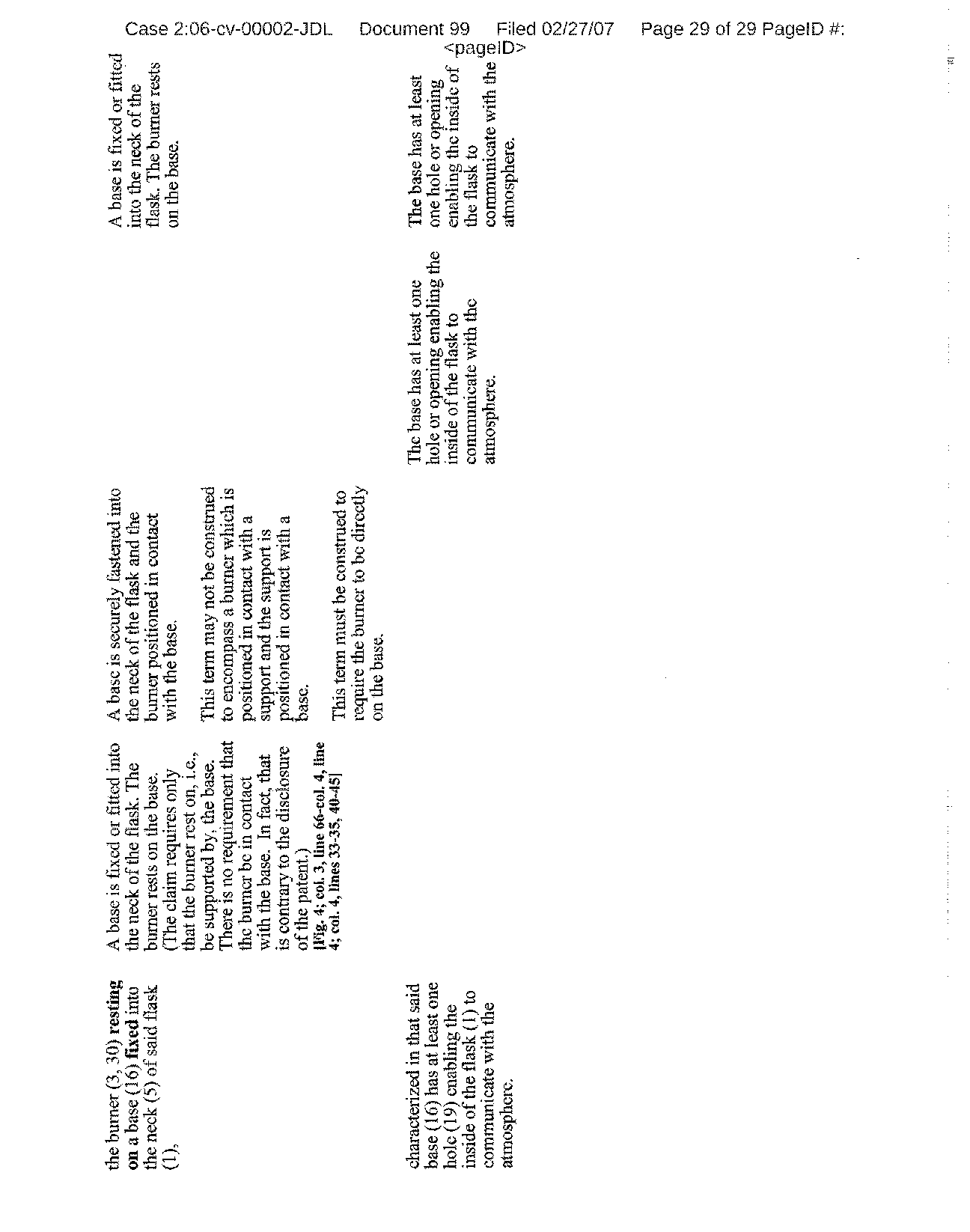
Claim 12 depends from claim 7 and adds the further limitation “with the burner resting on
a base fixed into the neck of said flask.” Two terms within claim 12 are disputed: “fixed” and
“resting on.”
Fixed
Plaintiffs propose a construction that the base “is fixed or ‘fitted’ into the neck of the flask.”
Plaintiffs note this interpretation is directly supported by the language of the specification and its use
of the word “fitted.” See ‘061 patent, 3:66-67.
Defendants seek a stricter construction that the base be “securely fastened” into the neck of
the flask. Defendants note that the word “fixed” only appears in claims 12 and 14 and nowhere else
in the patent. Thus, Defendants argue, the specification cannot provide any guidance as to any
particular meaning intended for the term. Defendants then point to the ordinary meaning of the word
“fix” or “fixed” to supply the necessary construction: “to make firm, stable or stationary” or “to give
a permanent or final form to.” Merriam-Webster Online, Doc. 58, Ex. 2, at 12-13. Thus, Defendants |
submit, based upon the ordinary meaning of the term “fixed,” the term should be construed as15 requiring the base to be “securely fastened” to the neck.
The specification clearly recites that the base be “fitted” inside the neck of said flask. See
‘061 patent, 3:67. The specification suggests that the base “can” be crimped around an annular
enlargement of the neck. Id., 4:2. While it may be possible that the invention may allow for a base
element that is securely fastened into the neck of the flask, if it is crimped around the neck as
described above, it is not a requirement of the invention, and is certainly not required in the recitation
of claim 12.
Resting On
Claim 12 also recites that the burner is “resting on” the base. Plaintiffs submit that this
requires only that the burner be sitting upon or supported by the base. Defendants propose that the
claim should be construed to require that the burner must be positioned in direct contact with the
base.
The ordinary meaning of “on” includes a definition of “used as a function word to indicate
position in contact with and supported by the top surface of.” See Merriam-Webster OnLine, Doc.
No. 58, Ex.2, at 5. Reading this definition, alone, would tend to support Defendant’s position.
However, other definitions attributed to “on” include “used as a function word to indicate position
in close proximity with,” and “used as a function word to indicate a source of attachment or
support,” and do not require the “in contact with” language on which Defendants rely. /d. (emphasis
added).
The plain language of the claim states that the burner must be “resting on” the base, not “in
contact” with the base, as Defendant suggests. Further, each embodiment of the invention disclosed
in the ‘061 patent includes a burner (Fig. 2) held in a support (Fig. 3). The support and the burner
[5
16are placed within the base (Fig. 4) of a flask. The patent discloses that the burner is resting on the
base because it is supported by the base. To require a construction that the burner be in contact with
the base is unsupported and inconsistent with the disclosure of the patent.
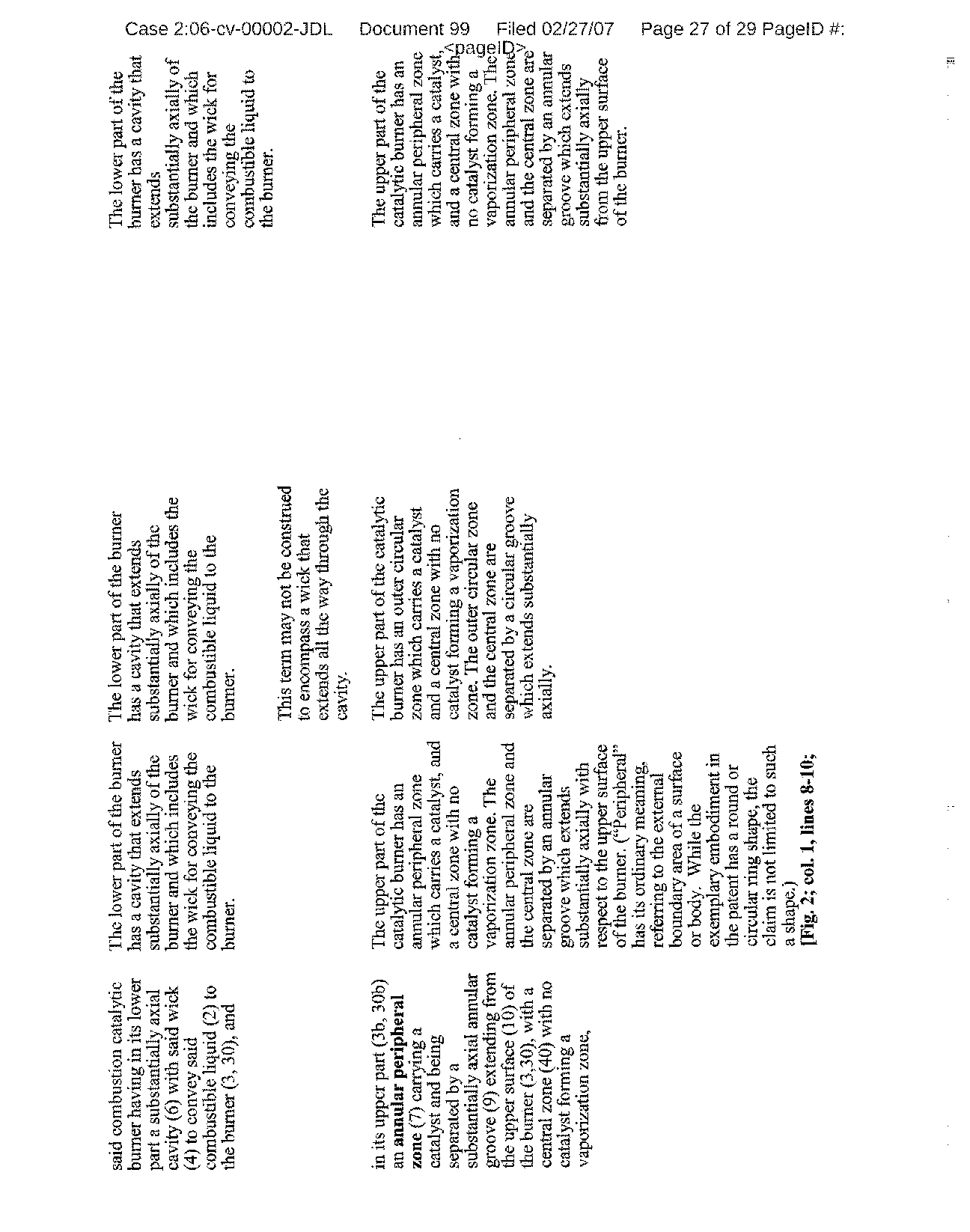
9, Claim 14 - The “Wick” Limitation
The third clause of independent claim 14 recites that the burner of the invention has “in its
lower part a substantially axial cavity (6) with said wick (4) to convey said combustible liquid (2)
to the burner.” The parties agree that this clause should be construed to mean that “The lower part
of the burner has a cavity that extends substantially axially of the burner and which includes the wick
for conveying the combustible liquid to the burner.”
As they did with regard to phrase 4 of claim 1, Defendants propose the additional limitation,
“This term may not be construed to encompass a wick that extends all the way through the cavity.”
However, for the reasons expressed in the section relating to claim 1, the Court declines to construe
the term as requiring the negative limitation asserted by Defendants.
10. Claim 14 - The “Annular Peripheral Zone”
As with respect to phrase 4 of claim 1, the fourth clause of claim 14 discloses “an annular
peripheral zone (7) carrying a catalyst.” Plaintiffs again assert that the term “peripheral” has its
ordinary meaning, referring to an external boundary area of a surface or body which may be circular,
polygonal, or some other shape. Defendants assert this phrase should be construed as “an outer
circular zone.”
The Court agrees, as discussed previously, that Defendants attempt to improperly read into
the claim a limitation from the specification. See ‘061 patent; Fig. 2; 1:8-10; 3:1-5; Fig. 8; 5:6. The
claims are not limited to the exemplary embodiment, however, and the Court will not limit its
17construction to such.
11. Claim 14 - Fixed into the Neck of Said Flask and Resting on a Base
As with respect to claim 12, the parties dispute that this clause should be limited to a base
ecurely fastened” to the flask and a burner that is positioned “in contact with” the base. that is “s
ants first argue that the terms should be construed to require the burner be directly on the Defend
er, Defendants urge a limitation that the term “not be construed to encompass a burner base. Furth
ositioned in contact with a support and the support is positioned in contact with a base.” which is p
r the reasons discussed previously, the Court finds only that the burner should be resting Fo
se, not in direct contact with the base, as Defendants propose. Contrary to Defendants’ on the ba
position, the claim requires only that the burner be supported by the base.
Conclusion
r the foregoing reasons, the Court interprets the claim language in this case in the manner Fo
ase of reference, the Court’s claim interpretations are set forth in a table set forth above. For e
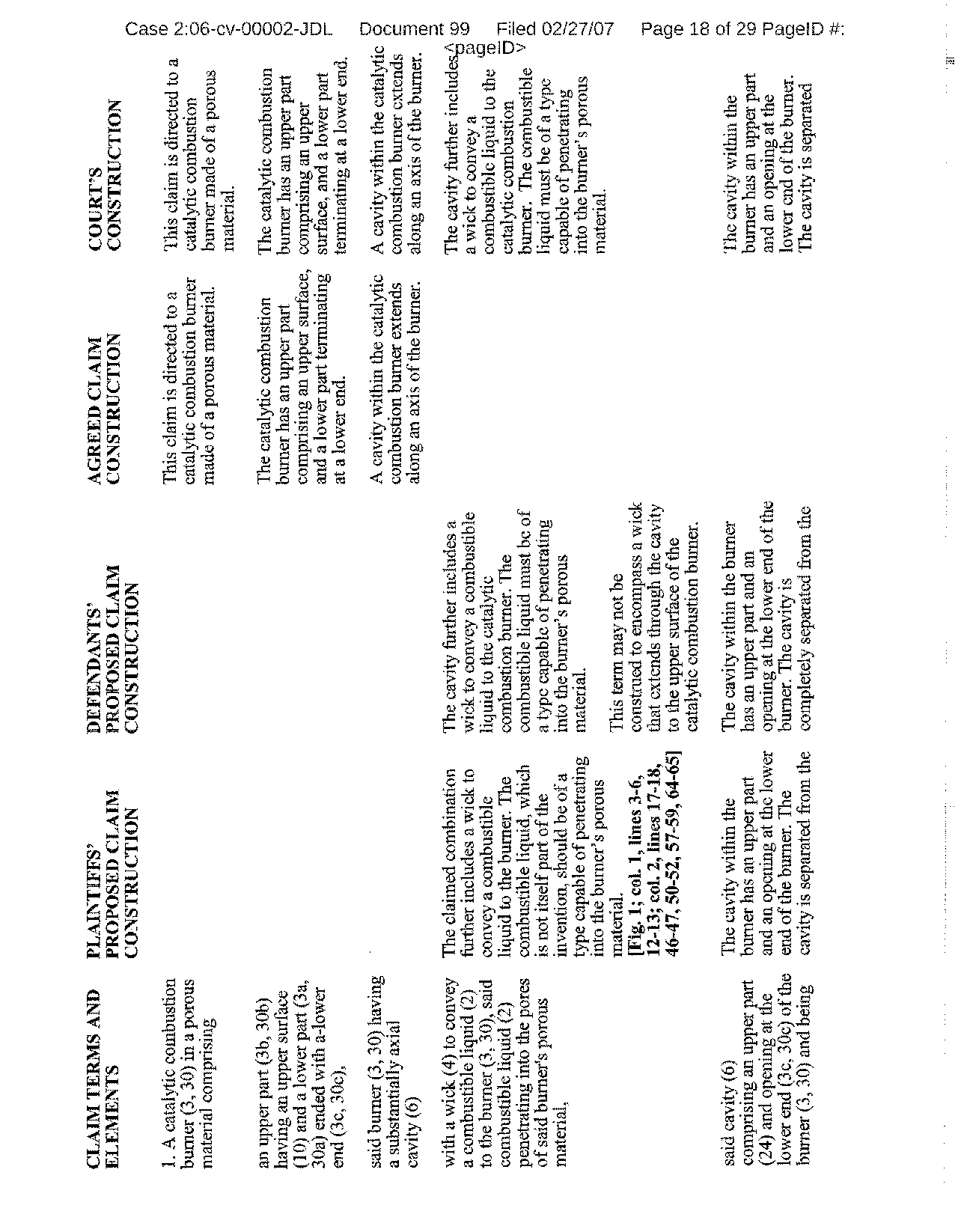
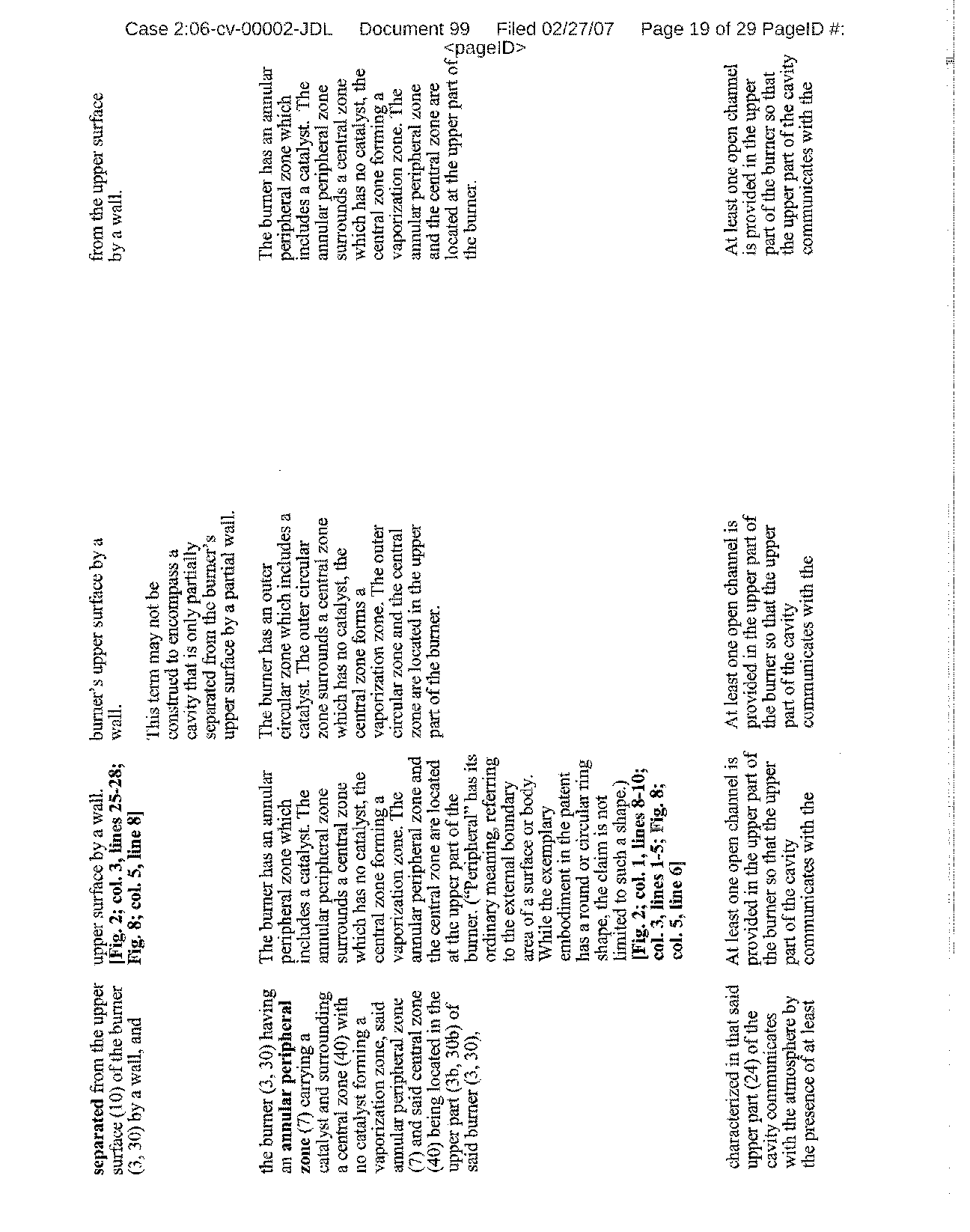
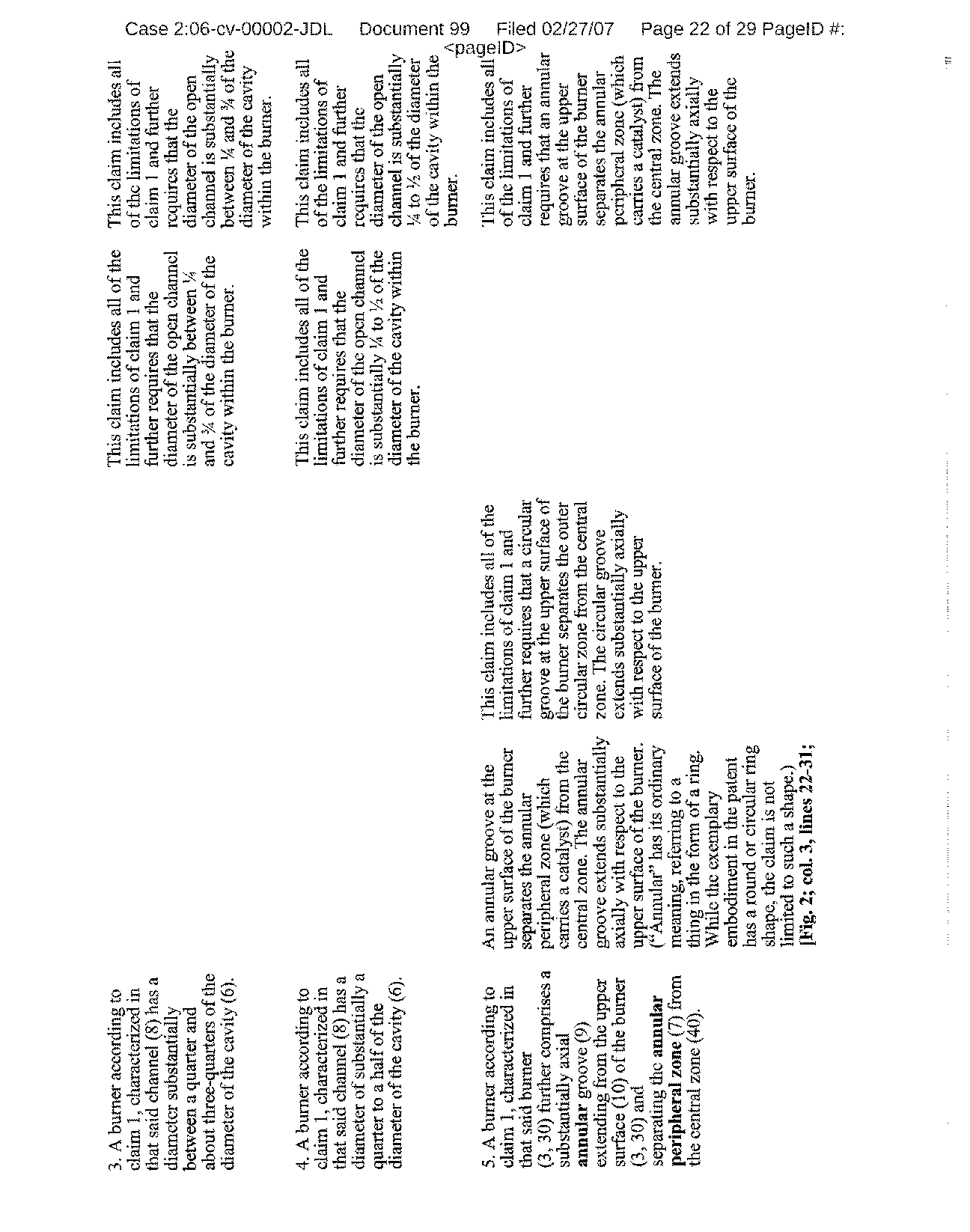
attached to this opinion.
So ORDERED and SIGNED this 27th day of February, 2007.
UNITED STATES MAGISTRATE JUDGE
18F f A sa ®©a
‘ pn
‘ Sp IaU jo l
B pu Ud}xo ING ur s UO s 9 8IG 0 no TSN w e 4 uUSN w
1o qWI quIO o sn “IO } d OS e d } S d o e W p d 4 iod d IN o P I q su G ye A d lje o red N }II WO M 0 sjo as OLLO IP TISN Jo O] WON ue y NUL QUI s d Jo } SNQ d Jo } ISNO OS e d m 9 UIO d D dd n o J y pBDS @ d
n ] o m n n ) Ja y & g yy br J e
M y O $ S J J y U
- o B O J o S
u ur } u 9 In us
e & J q g u do
S sp oT ue e sT e JO s t eu JAT p x stq a t l e u SU UOT e usnOS y y W }ed su r TB |sn quiAU ] sn A T s rsu e UTU quio A osBV , w j s J O e di NI S W A o e P IA u0 O} AR y U R dT y s D } D S JA u 0ST TR ‘s B ]Aj a o ye J ov e} “ tqe y D ou J y VO Io d Jo u n ou in uIN p ev } u e I g in s S g i o in OM
S g u nb g O TU o r ] O
O je O M y o p
], U U O yU u U
T, ], Y L U e ],
B Oje
eLI "T
‘ao
J v SUT on ou jin ICU A ‘ In s TUL ye SP JO g "[B ID] ye US UI
B LIgyew UO o }Xo NG TISN y 0 QuIO } d e d PO
PO UO Jo W NOLL IIP Tsn d ONAL qui io d O I SNO os dd n o I Y V O n y SU } IN ]
sn G oio e J d U O
d G
u “p E
u e ud
S O e SI
TJA x
I Tey Ia uO e WO su M oTs G W s isti oO nq aa IL v e du ] IO ulos ao ] B y too M V S O
- o J T AY U TA o L e ]e Av ye Jo O
- o w
- o mn B S p g U
S ru O IN t O p B Te T, U u
], R
7 V
! W
y A O J o V U o d[QUs o m IAB ] y} B Nqu S “ J IOd JO aU J UI IN O
S 9 NG G W
OPH q o PO & o UL y r
} p s s O u n sed Y s
uoo } J W us o IV'
TD d o S poI TV q Y UOT Y JM yeS NOLE AT SN s JSNQ ) se OOA R} O ov UIO O da ULSN e9 p IY y D ] s OD 1 ] ins
JO n 0 U Yy b U IY IN v ] II B M
AD S
AUOD ABU 94 LAR dd L W Sod ] A oud O s_q 0 sp so
y usn } us d A
quic yx dn A ya A } s o P J joy PA I p A e du, R D an R rooU] S 0 } isu0s OT S S O
JAT uT 0 } ey Ua } EO do pr o Y nb y O r ST } O O M ] U Je I U Y] y L T , } ],
, 0 NG
} WI
“JO
[S JB su 9 M rje -F O| Y do ‘S 9 WOR } o us I-CUIQUIO 0 ry 8 d s ‘g LI D J no -
W O io ¢ I 9 d V'I sTq 4 3 D usn } “ 4
quio o 6 } s M q so S-OI “p u s LS Y in JO r] ou B b r 3
y pj ] 8 no $
ys W y ,1 Su e o 9U tu d IN “ a g ° * do das [ ZS odo P s ay Z -0 dd oU yqri q “f S
Ie snq JO ed o {O uios e o ‘J S ‘ s 0
} Uo 9
eUE nU NS SAU "Te BOP L LIo AS 9 yeu S dA L S ‘ u U0 ) T L e d O E b-
“ 9 U o S 1 F S d O tq -7 p U A U ] 1 u ], } I e
Ny s W t Jo
s A a UOT sn ‘ ur 9A p so y y SNq os e a U0 re io e } s C UIO od ¢ JO ey 9 ( s d d u N S so MO Z o I V ej ) [- s J o ins 8 ) (Z nosod y o q
¢w p “ ) Jo SU 0e [ in (o dd y ISU ad e b o n (O AW ( rx r ¢ p y e S B OD (Q e ] in } E p A 0 b S u RE U Ja ¢ } ry utu r Jo¢)m U “ o ad
I dd o LM ( ¢ y s, o nq] p u Jau u ‘
‘ “ A]ye s ) l in o ( ( ‘( € nU ) [qus g e ¢ Q dN O 0 Rys nqu J A ¢ 0 ) ans ioo ou o ) ¢
Te € Y n yqn IeO d J O g snq S su po ou U uics ule rst
e& p rn M yo idu p “
- * uu us g ( ue ioo u ¢ e 9 d s W ¢ p p ) E ) [eL u “ ) u T ISy r O r ) J eU S ¢ p Jou
a L ul ) A B r J IN n a lt o es OM G g eyn a y O
Y d ( vo Y } ( ]
9d(Q B p I p sL OE pu res M J Z)
) s o o “ e B e | u F
19pagelD>
sey nu ye ue y S }
U ou s L, oz ov jin s O
oz S 9u “W
u ATr [eio Jou e eyo yd IN eOy uo G
ed Ja s dd e n y
oz
J oul 9 ow d ‘Ia in & ljoue UI Y g yd NG } a SO [e u pNy se J ) jou pn o
l uu
e w y o s e y y o d
], d y
ue ue } yd nu ero ej y r @
I
S
§ a
ye "
@ o
} yn dn
y Ja d ssed d 9 a ww uS j oou L ej s OU [
G d PN I , yo } q d N re SO NI @ y] uB y d te UI n EI s } ou a
je Jo ye J y J Ay O
v e
y} } U o q O y O o }L e o e J u A M Te r d y
IY NO A O} z u a S Ay YO Oj ‘Is UI u0 p u R
J UW 9 s IA
S ‘ O AY t ng
0T s o U ou }BU W O ‘J O
A ul U } p Z Z s 4 or Oo s uO } 9 nys ) 9u Y OZ o y u0s u ns B OU o O
e vyi S
} y so o Ng O O[ I J LI K ou U j s J
j Y } d s O A t e m , vo da n 10 yw M O ode IS d J s p
LT A ere d o.1 ATe T US zLI No e e TE p oy od pN WS O ej OTe e~ w [ S A p J Je “ [ V I
I o S j e u LI
} p U y 8
- o S d 8 8 “ e dn SZ q 7- v d - oo] } o d 0 Jo } 87 L, , e y aI p ye U 2 U m “ g e U y] Po a LIF A o O e uu S oz o oz UL ‘ yu O Y y [ yn gu su Bu Yys u} ‘T se o t L ue B O S S ou o
or 18 J J y) “ J e O o O T] dn u y o OII OU d M q a ] u ye TN S so I s n Te F L JE T ) Y A u A O d T y ¢ o ys U oz U ¢- 9 o e g ‘ UT ou e d O ‘ S d j y
y O S ‘ v a O d y ‘ “ e }V Z ui J ] i u 9
s z Te U UO x]A Te s u0 SA O O ul ns re U O s ‘I vo y.i A l B ed ed rlu 0R 09 u 9 dii dio Su a Y [0 9 oy oy “ B } * ] ] O * 0 ei y OZ [el U} y ur ur sU ns 1 [ e OU n O O o 7 o a yI 7 “ S dd N S ov g o O U £ ¢ g s £ g s P
8 IN O J T B “ “
ou UIB T Ng J II } O O] uI
fe u ¥ o
- o js J A O K, ys q] o y] 7 od T e M D de e } pI uIS y e 1 9 d n 1 1 ], dis oU uu Y S iuo uu Y e UI e Oq e d S 0 T V oi } UIOD d S B 1 sy Ny n OI U Nez yn O y Te Bo A STIp S a “ “[ “ ra 9 uNU ed “ “ 3 ei SOp rej Y [e Uo se A JU ‘ T op yeoT J [ p so
ou
- o OZ uo U} z O O
dn B d M s L J ) y yo NG y I e y a UI e Y pl U o e a e ra [B ‘ ys J u u 1U (O ] p s [e O € O e 9 loy O €¢ 3 ) du 0 J y 4 ¢ p od q 9 O O ( o
( d Lns ( oz ‘
O m se no u ¢ J
ydy pu OJ ‘o ) z) y J e ) ao SuI HI o])¢ o T ¢ jer IT eo q p W ‘ SU p oy (
v “ le p Jo‘
Z s ur
) e O ng { q ur W D Q p d UTUO A d e TUN ( r e v OJCO
ep p q w S nu u o ue r ul old ¢ n O S uas 0 u ue }e ao
- o nu A[e p
( avp UA js r
J ( es B ) o es es 7 P) n A y} das s } ye [ od n d T an pn € y e je B U ezu ) O dd od A} o ye o¥ “ s u sA O ory ( so i po s y u

20y) o
yy os sn Y
yo uv ou ‘j
me sou do oyd s s1 u
§ m
Te
o B ‘ ad u
t o g d
q ed n se
ns uI n
a e Jo e
yy j A e
}
u y q o o s j u A ) oUd q or tuo A n sed S s t y U s y
} o
B 0 W
A
uy ns e vji
) y so IA
W
ne s R des ou ], uo LA se n yds T nys W ye dd 1o SI po A po o a J
L
S do ‘ us
} 9 y 6-o
6T ly Z-ou Z s [ M) ¢ om Bn ‘ Y
yy ou 09 S
1 g “ 7 “ $ 09 “1 ne o y] g ou ey I yds uu S * sio To “ ‘
¢ o c ( J
E )
E g U} ‘( ‘ d ¢
0
) l q € g U ( O * ‘(
¢) ) q € “ “
Yo uR ou j d njis e Yo ye w ue po ou s J e u pl o
J
Ju0 q o e e n } d u ul dd q ue p S o S
s

21st
O xe J
? u J e
Su oy e
Uy ‘IO pO Aj[ WI OpA etu NG S Rys
qns
]S
TR
W 9
4 }
JO
L,
T
S
SI
O xe J
B u J e
Su o je
Ur “Jo po Alj UI pN etu NG SO ey
sqn s
TS
TE
WU 9 }
, JO y] st
} L
0 U
i S
) g (
xe
OR et OS ‘j IpI SU
o RY RIey uu iiajo o pez J | “ NG s UI e Jo pr Y
qns
7 e y} es
Wi e Teu “ w AT
22Q
e
- o A
Ajje y y[e l W tu e nue i ejs ysq p O gns T ns r
u J [ u JOW e[n
J o o J ia o IN uu O do O do G e Jo Joy ) yy W j m ny % ‘O Ny (ru su U su jsAo UO IN oTe Tey Te}U d G yUN }e e MT] y s T] 9 9 tx
} p 4} ye y u 4 Aj } r 39 d ur our y o
y ypo np } y z p e J opn p J Op } uo
u O S u o S o u y ? e s 9 e y s J , Y e o s
Jo t ) J9J t oye B jo W j9U ty re
so uRR y oa NTe jo eyu da | rm Ip ou Mj e | Ip uu S or so s
mb ue oq r ey E su v SO o yo UI o o T jN LL o w s YT LO W U s ILO t IM Y i } e } ey } p s y
a
LJ s L od qns J UO bo Y, o ui rjs o mn T yd enu
T u I J ero Ayy S so S y
©
jou jou d uv S uv U yd Y ys } } ¥
p p J u , J u o e O ‘JO e M. Ud U o Y}I
dM IN y IU Jo G ~ U Q JO } %
JO [
| UI u
ua eIp s W d W y d 0 o I e o 1
e[ y} e S O % AB
I YI
Y A
a } so 9 A AT[ rm 4 T[e
y eUR b } yUB } J } IS J os Isg Y o gN U o ns O
s o TY
J y ILM J
o } o O suo su neU o J IT] J Tn J
Jaj o E a}O ou e UW reI RIp p Jo
% A yy
A ny
O
p U u N e p
s ] s UIeI t I oJO
J
U}
O
O s
e Ua e
J u e rx
p [ ye
B | Aj T }
[ U
S
O NG ep O UI Ult W JO ‘ Ur o nfO U} Sop J
s d sqn
Z uey O u0 yje S A J
YS
TB
LU
], N] o xo NS Y eyU n oy RsI S suoT Je spu 99
LL y} I U
UL B
U} o 8 Z
B 7 d NG NG ‘ E-UI } UI O B L eIeO 0 IO pI } U ‘ TnJ ‘ UI 0 O yuu ue e O J ys e nu A t de } ) rey s y} o y m qn I J S C d ru ejs d } ]
- o etu S LD @ ul y Ajj o OA o
- o P[N s t, J I ¢ J s as
ds y O} O “ OIS o e LI s AOo y s U ox I ]O s Sy z OI dw IB n } suo LLIOJ Aze[ MI Yo
SU } 9 Y } 0 s xo M O } 0 *J oy oz ua} y) y erens u sp YI ns o 7 dayi ‘e ypi I o ol ssov sov U pun * UR v NU
Iv
d e ,) L ) A s q] e O 8 rx n UY, BO Y T y ey ty 1 Y dn du US 0I e d U u UI AT e d u S U Jd joy Q A0 Ty od ]N ur O s a po “
- o es [e s A J Je “S S ‘
8 e
B J w jaU o A 0 U so ddIN y T[e sti n
} TUL } du 0 ISqy l ios Av
ns nu e Su poz ue s Ip Lojo (Q
Y} ioo vrey ( e o oe o / P u ) ( 9 ) p g 6 u )
O j d ( e ) 3y
J rx } s
e uo J dA z OU ou 00 WJ OZ in I8 oO O" y g iay y o IO e li u Ip y ng A 3 SU nb J yye (
s re J v J nue O [ sqn oy o ou ysq p ers uey J YO N ns I u B qd Te jet e UR G Su) e un isre U Ay ou ip ere d d
JJ } A us da S oJO 0 p vp }x s UI ‘ re NU o KIp [ s UE so
G ( vy (0 N es o ns uI r W ¢ ¢ Jo p E
Y TS
Y y
eu O } “ “ U p } b ° ¢ ¢ } ¢ ueI oq y en ) * ou uMmj e yr S )
1o)} se y Jo
23® e ] Y} {j UO d [ O B TISN d e O O QUIO e pi
r S Jo S }
- o d ] JyA " U J n N UC
Y pi “ y
y ‘ o Pl )
y ] dn u } o or mo ad
ur o b TE o s hfo o 0 ou O J Op y D s sup & sd S B r IR u Jowa
W e y} y u L ] o oy N
] U U dIJ UIT Ay TeT o T/ ey
E] uO ey eO O AT s e[s ir W W ult w w
po ee
} op 3ps Y is 4 O us O
po
uUl rp y 1 L O d m eIp
Y, O yo t dd os oy WI U pN s r o yt SI e roi OJO ST J BUI Su pa J u J
B
} B 3
U 4
O d 2
e I a o
O S “ S e ry ur J 0I
J u nb }V p ES m p Jo
B | AT ‘p / eo
e T RY ey UL
[ u S A Ay ypO d [ o p UI on OPN j
ye S y} S Mo e ye o TA M U} o 1 O OI } B
B Y O y
a
d [O el y u Ie W br y W IVIP
n G o NG dn WU r u y N o UI ad OJO
T o ‘p o o wI 9 O sr I G OU o Pl Jo J & IN pNJ J y J W gu SO v “I
e O} }
- o r y
- o o y ) OUl ub d e 4 Nyp o e s 9 SOp ip s w
S dd o E{ ur WT S J
, l p ] y m G d LY T] y os ou so OS n UN n UIOS dn y N e T TWI IN qui Nj si quI u epT oy sNq d oio UI w T TRI yL usn Ip ou TISN o uon s OT| 1a ur OT S suO Jo oyq Su p UO y s U J
I T Z y Ul S “ e | b d s 1 S r T b e O
u S “ p p ng €
um - pu Ja 9 ns no ]
‘ p vji l e s 9 dsI o Ur a P ssN e] s ( 9- Po i v ‘ T [S [ os O] } BM -L J M 9 y
OC ‘ O a}X o y O l “ J tI O u pY u B [e o dlo o dn J e ay s d v ICS 4 eo T Jo ow NQu ey uv Y} s nS AT ‘ ur O eguis Q d1y LS ,,) BS ypO v u ly S- e od ‘ SUI
oo ou 6 TS u O ydii re q, JU 0Y S “ I eso } wo ys
Z W W ,[ 0 ay v }B 9 I u de 0 ° T PO sy o p 1 ATL e ‘ au “ U O d st y AP so p F ‘sa o
UI y] 9 0S oq O DA by 9 - g J pI q TU n 1 7S e uUI o UO pi " “ w p JSOI} S ‘ s ‘ AI Aa
“ s ] as d Os og yax o OS } l S u y T b 1 ed eTp elp j OJ un ]du ot e}U 1 ou UIO 1 Z L 99 yer e UT oul s LLI p o e,; pn UT ny SNq o S * oyt ur w OjO o} U Are J Ar se uI 9 op UOT| “ “ p s J “ S
) t
) ¢ s ¢ [ “ “ "
ry ) nb } c r 0 e p ‘
UIS g T[E g p rn JO B s la g e u
e u mn Wr Jo d r B ou I e p J os y p
q & 1 } ed S
0 y ed yer
A o iaz Sur
CO oyd
y ey} ea ]
- o AT u N j pl dy y O & (
- o PI ) O
M UI O]
} WI S M 1 W M
0 JO
Y
L
y * E # e y O p so s av Q di pi0 ur ( rd Sur S u V S
- o E ¢ ¢) ¢ op S ) ) yo nb 8 O O ys eIp O ts UIO + 2 oese di O te no G OUI e us Nq uoy od ‘ wn ( opr “ o} ‘( po OTs ( ( pez p ( J J U
24©Oo © ol y So ST o od pnp A Y A dn o
y ou TE } [pz @ s WOT y e J t S em JIOL } O um p [ YSUO
U op u [ S sp p WOT j s J p un uo SNq o o re u F om W ‘I9 d uIod Jo pn e O s UI aq y qn e NG ] y d s Je Ja su uoT nn m oy JU
e}IU ) o eTU o y NO II] ] ] u o J p O } m OM u Y O e } “JO ur T U po J
A[p ING pn s o J WO rem So p
- o TSsN uUM 9 u y “s quUI Op 4 e } B o
ji u OS & Su uo u od in lp ) lsu } d g J us arx S O ns Y op oT s yx se a Op y U yn yA ar o 6 rm N
oys TEy m pu s b oU } ] eo bo o ey e I d
- o s sa 9 uld 1 u
g U u wW d u ir TU S } } } elo ed T] ] o ,J
u F JO ySyo 0 y } O t }
pe } s YO Ad A
ys ‘JO U} d Y e au e U U o re y M d oo q o] IN S } TH y G [eu p p gQ } or O Ou Ou ty Ja Ipp Tp JeT J e UI e d Aye e Ng yz O J jlo J N
oT ye J ny o d O G jAy y d dd A dn O
y ey } ns [pre B s e e9 e m y
Tg uM p T6 } [ op u [ yU s S p d NO pun u U U We ou Y od ‘Jo I ITe s d p ns } sg UI E TO y u in
NG ] } b d
e JA s r y J M y } O O a O o ‘u u t s y ] se y o e O } orm sm } te n ) b 0 0 p Y J be J ea ] e ) urlo r uro s o } s A JO po J nfo J sj d op Tp pn o op o UO y qus Y ny J rem UO So S TOL ) nqu O ou O uM TIsN 9 su IYsU ios M l op qW su 4 one OS
y p OS o u SU }UN U od 1 u T oT Ip ) TT OIs P A d aM J s sus ud ua U re ns O ap yxo }x }x NT [p yT rno o ] id
ys S s pu ]S Ja eo
T 9y o Te yy a J U y.I Aa WU in y
- o e Ng q y. y m o] y p p a u M u A t e T e
y } STY,] SL G
U T
h P
“ ys de Co & r u so ¢ €T
T-“ [S ns yo 7 o 0 o r [ u g so ¢ g 7 ‘ “ u] 99 po 1
"
y] p u oT o o “s j ‘
“ ‘ y ¢ yl o O O ‘( sv ) od U o U o dn J } U ¢ g 0 l
s s L ) L JO u } UI t 0 S NG 9 JO p UO po q a] } ezia t ‘SpI p “ TSU SU zLoy v g joeI BM U d}X IpI oRIV y
ys g S eyo ( UM d € 9 Oso Yo e e UIP ¢ OP ) Oe j e ( (O IONN 1) s 8 o y Q R do e
( e ¢ JO ur y 1 ) M ng Y JuN S 1 ¢ O I oW Y ) u “e Wo T Jep M R }
l dd Nq ( ‘O ‘( ns n Q ( O ) Z
Je 7 ¢ € ) 0 ppno 1) d ) IBp W ) ys e O a NQ Ys OT
u U ny e }DO SA
p “ Y r yE WO S SAU U € s p ) p Isu IOD Ja d e op s}xK 9 pr ) y “ ud} “ S Y no g o xo p J 6 9 } us uns y uo o y
ow o } dd } pun JO u w sa V W Sur o] M r g U W m O ey ( Te U
- o T V S 9 B D y O T
s J ye 0 e ] t u ¢ “O U U y ) } A 2) } } ] } ° T H
¢ 9 6 q 0 ( ( I
25SVO © Q>
TUN
} UIO
0 I D 4
o
@ } J JO B
[ O
[ ‘qro J J y yd O , SU O ro so J U] O IUI JO dd O uye O O p LJU m n pr Y y IsU OS u ru Y s isu o L o yo S l SUO e O
UOT TIET s Y EVU UNT & MT V T e
} I u N p J o y e
oul s o
q pnp o p u ‘qro Y
So p 9 y y yd E A u y } 0 u e ) sou S
e j e } s ne } y
- o S I Su Y uT O se rlj se o [Q } g sm qe p y / o vu y eO be us y ) q s ey N arz 4 W J e s US W i os s Y Y ITR } te e } T y yo y O yI .
- o M
o F u JO u , U], uo ,O } o u] O oa I] o o od S y p
I S f}
- o ylo
dd
O ns O
U
J e } M u p O 2 g g[ J Y [ O O
Y
9 O
y pI u } su Oo B l
Y R] & soI sOp wioo rmW Ny nq nbe oUr a/qns our x o v pnp o y Se J y e
} rye s sou
UOD ayd UNUI ‘qs
S PVOT
ul O jqe
]S Js u } } pE Te y JoW s 0 y e W yn I o Ys y Ng
uoS y M rey u. y, NTY] ] Tu o Tq RTIU Se I sur S uOT Y Y
s
po uo rpi sod
M
U} , II
UL U
s I S oe
e mn O u Aja p J , / q
Se
qJow O einu ‘ asg o
O
v Y }
T
S S
e] } UlI y
d D
- o ATUIO
- o TUNT
J y M OJCO
} JI
T Y }
F 0
er O mbp ou se
y]
y se se OS Y y R]W
JO
AT] ng svy T u} E}IU uy usj U uOT o po o s J
O
FU
! t] au
} p q 0
P } SE d “ O L, 0 U O e H U O O ng “ ay } S U uI ya
q S I Ja (‘ e S } m OS ]S U h-0 ‘ Ie } S ] [s
us ]J U y oj 9 J ] qe Se ns o -9 O f } d lj Y d 09
e U e su od y D O [ S d S oy a UO
) p a M BIJ J p e ) Y ) I AX E ox J 9 q u YI T ul -e l ) O o y a e y 4 U a S ‘S
9 O E
Y ‘
- o L J l
S do a' } T J us q U U S I ur “ se E O S T so Ss o J J p
S3 “ D "
a JO y “ s q o OV e e l O ) J SIp t q ou OS J su U u I . Op
- o pr o U R ANS y S O s 09
“ “1 uye q bas G } t 6 V y G ], y } so l A IN y y S W o JIN TL jo y ‘yd o USs q U o “ 5
OU S s aJa s ‘ Uo 9
O
l J } U JO} U
UI0 s d
Y NG e O r B ) df p O Z
J ( l xly su oe pi p y]
O a e S U y QUIO 9 O SN
Y l WOT } } U b] " y q l n ( o e su OS y Ne s pI eJU p ) T UON o S UT O IIPI &
v ASU } S
Y y) 0 orn oRIEYo e o ozaj J O S
gp e Y U e TE)“1
“ey A “ us 7s O (
[q V ny W u ur TUTS ‘s1sou
S Te ayd V y ) N uS pl y u0s J o OD Z ZI sa reyo Qe u} e nqu o e] S]U (Z UT pjyoe T[ “ ys qus
WI UTe “ B azua SU o ey

26SU a T y AR }
Y
] o ‘p UO y in P TJSN u b OU quU t y SI IOD y So p JO
UI Su NG l dd ip sT
qusn quu 09
S OI
T AT
BY
B eO yo YO u M n P lo y
e &
Jau in o g y u r
‘p Su in id b SH di y A p Te ye B d p lo eTq y usn qui0
yo s ru m 0 UOT sNq } uOS po e us v Iso p Su
rv ey
o y }
(
27& Cpp
uoo
g ‘ys z l Je
y j uo A] e jnu e o z eIV u y} O e Sp 0 8 ], U o JO oy d t A } MO } } y } S UO A ye U Z W rx pi [ y F A e n er T eso R Y b oy ; yd O O O I] di ua x M ed d u 9 xe
B [ e er
w ozB yj e ouUS Y A d SO ‘S OT ‘Jo A LL A YM UI
B yye 9 sy IV NG
rju qus D g eys 4 nqu S qns } r0s yS I9 AT
M e eY pa OT y LO ye S sed
S opn I re as pu yo ep yno d J d} ur nu uuY A OU xO ue YO e] 00 o IN IU I Y
G M }
O p U u s J , O dese sqn O
U uo uey
nez per uo Ay
o
d u o S U } rA 9AO
ye O
} ye IS Y o A
s jjey no uej
SO s O Z sgn pnp y} U UO s oU y Q l e
y}
d JI U M Ie[
No
} o IIO
Y y O
S M A }
9 UIA e 9}X SA m SU IIO PU Y OD J Z NO
S O o JB[
M I
&
- o w B sp
y) t e us e ssed } d zx y uio [e A s
ous yU o SO on q
p [ J u ] ra e e dd pa s n ye L IO , sed A sp Y as PI Z ua B A Jo yxe y
UI B o & NG r
YO
U s N y p
O ] u G , e
Y 0 A Z
L } AV U0
S ‘ ‘9
.fe YO O so n
e yd Ns U u uie } p
BU u M s IAD S n }O AU e PU U vji y OD d}X go o} z O
uo PI s o }W e i UT y e e u ] g 9}X o
S U1
U e,n [B Jo TU x,d T ys ui IO er)od T e ng F qj J } O d YO A‘Jo U ‘a
M ur O ng} , J JO y A O
- o } LU } ed 0 A U
iuo 7 oyd S Y o [eJ 0 S IM 1A y
jey sA d t eo TR AO
VO OI a W
S q g UT
} o eT s Ap S ey
“ od O nsJ I ( U e sqoor JO ID } uu uey ds UA 0 MOI e
yn yer oo UL 1 eT se Ay y S J
Jej nu
0 ue
O
1 g
- o J
M( q
e Z ( rx O) ) [e T eo O ey p ¢) ( ‘Q Ay in [e UO o sb q x Z
ei] ‘ e pr
es pr ed
d dir e xsy H [e AT[ UO
Msyq eyu ns TEZ Iusn eys vji LIO Wquios qns ao dBA
s ) an 9 d eis U0 n jeu ( A d OS Ay Ad od NqIU v s n OTS } e dd U 0 y uu o
vjn r
s s
d vo ) t y es e A p u e y pr jr Ay ( u a
28V ©. ©mo ® = A
Jo u w ui j o
A ng o S d e
o V j Y o d S} A ou N y RS uv } ys } V yo w e
d U S io
“ JE o I dd u M y n e ‘Ja 9 ] Jau d UI uR su o N y so Yy oZ y G } d S dn A e
) YL t
u A soyo a
u ad u BD TUN s ‘ J o UTO y TO
t o l D WI } NG
[e s p o1o U e sp yds SO o w S ra a ou u ] e Y oid u ne U
d } su ) [ ed l
- o BI ‘To o
XB uu p
eyo oy
U ye eo
y J IG y oy a e od UM } 4 dn js ] o e o y ‘y 9] O Y ], o U , J o o
s s }
t
J= —
1 o = B -J S p au Jo ay
p IN I d eo JZ e g d n 0] O d [aU
UR
YO uo
d
- o o 3
s Jo AJ Y 4
d IA ) } dn o B N a y O Y y } S S } Y T J
IM o o
y J
U y } ou
o U d e Ue w uO o T do y Yo z M ) [e e
y T B d } xe soyeoTU IA
NUT
- o TCS
‘r U s Jo [ e O u ara d eIy d yd dn US l Jo a sou O A W y ne u
jA p IN y e v o G ‘ d
- o s pr Tou o
u O ao uR
id J yo ‘Jo
r ] o uI y ng s e j S a w o Y ] o o e u ], u T Y d ],
) V } u
t
[9 -¢
so ur ]
“ ¢ " Jo o
¢ g
‘J
JO d
( ut €
ra 9 e p O d Y q re
dn ) w IM 3 d )
Y s e UO so ] jn d o u
y A sN s ja y g J z ) s Y o ( od } J Soy j ¢ dn ay odn VoTUIOS A sv]
d NUTU d ¢
( } q Q
U p “ a L ) ‘y o sroyd g 4} a j so J ) o po ed un e y ztua p e } jovr o r jou F eyo uOz J es Jo URYo O
- o u
u
t (
t (P y souds p GE p
Z e aId ay u
T ys ) y enq r e e } is n ay s.
w (P p “ “
p re q (0
e u Z a s ¢ d e ) y ) ¢
y y e
29p o n $1 J y 89 O
1 j
Sv S
- o ut ] us op
do ts
Io ur
JO
UI
NG p Je o x s
e o ‘o
"9 y 1 y roy s 0 } 0 dso eq } ury S e s IL
Los s S y t , e j uly se q o q y a y eu y se S e qg t “s }
e o y Y s
] uo o
U , y V O }
s y }
Q Su UO rjq eu
s
S
U
j } se O d] } Y
Y IL
Se M ]y
S
J ur e us do
oyeo
S rUNU B o TUO ‘q Y Y D uo } yds
oun
e
- o JO se q
Io Sp
rs
a ul
O jo I] u ,
O po S AP J nsu 0 O U od I } SI L s Ip
Y
Or PO
S yO yM B B Nsj Y R]U sUO po } OS S ud Y U jse I s J y M t IM p u p 9 e od Jo dn q
um s
- o g J J q OR ORy 0
Y U IUO UO se D D } y I A JO o JO Ta po U q U IN UO IN
Ie T}I G s sod
e a IS o A v y N y ‘ P } } Se L sseduio U U
q ous L ‘ J l p as o u 9 e
pe e pou 4 q
U uo O W S LI TIs oTI I9 ) y D] od sod } I o S o U yo a s u s ] d s e ou dn IN 9 g IN s be Y g ‘S r }
Y S e SI IM IU q A o ] L, u , U V } 0 O
W }
O au JU QIM l L “ y SOJO ] a e SIP O 1 y U A “
P , [u p [Sh-o o “ OF y W “ [09 O JO -9
“ 9 YS R e so ] sm 4
nb Sa “ IO ol 1 SE
U 9 -E
T Y E
} a
p tt o o JO ] xl y UI “ y ) NG as 0 eg
} “ SO
J ¢ U o wi AT T
re V.I “{ yo ZU 0 s OD 9 t yo o ou s y “ as y } p e ) f q p “ o U J0
I “ 9
] ye IM S1 o ,) U q y y } V } s *
t p
BU p Q II O YS l UO SI U P e A T I} s O
U
ys }
p ye e o p y d] x l } U e II ( s M O
E U J
J e
o l (Q o * poz s yeoT ¢ T Lay e UNU ) oere y TUOS ‘q ) ( yo 1oy ¢ ds O ouy W ) e IN a ( G se Y Q q o ] ou )
B oS ( eq o H o 1 u O y } } )