NOTE: This disposition is nonprecedential. United States Court of Appeals
for the Federal Circuit
KIDS2, LLC, F.K.A. SUMMER INFANT (USA), INC.,
Plaintiff-Appellee
v.
TOMY INTERNATIONAL, INC.,
Defendant-Appellant
2023-1524
Appeal from the United States District Court for the District of Rhode Island in No. 1:17-cv-00549-MSM-PAS, Judge Mary S. McElroy.
Decided: January 14, 2025
RUBEN JOSE RODRIGUES, Foley & Lardner LLP, Boston, MA, argued for plaintiff-appellee. Also represented by SARAH E. RIEGER, Milwaukee, WI; JEFFREY TECHENTIN, Ad-ler Pollock & Sheehan, PC, Providence, RI.
JOSEPH KUO, Saul Ewing Arnstein & Lehr LLP, Chicago, IL, argued for defendant-appellant. Also represented by ELIZABETH A. THOMPSON.
2Before CHEN, CUNNINGHAM, and STARK, Circuit Judges.
Opinion for the court filed by Circuit Judge STARK. Opinion dissenting-in-part filed by Circuit Judge CHEN.
TOMY International, Inc. (“TOMY”) appeals from a grant of summary judgment of non-infringement. See Summer Infant (USA), Inc. v. TOMY Int’l, Inc., 2023 WL 313959 (D.R.I. Jan. 19, 2023). Because there is a genuine dispute of material fact as to whether the Summer Infant (USA) Inc. (“Kids2”)1 accused product infringes, we reverse and remand.
I
A
TOMY owns U.S. Patent No. 6,578,209 (“’209 patent”), entitled “Tubs for Bathing Infants and Toddlers.” As its name suggests, the ’209 patent is directed to a multistage tub for bathing an infant and, as the child develops, a toddler. The claimed tub “is configured with opposing back rests and associated seating surfaces, for bathing an infant reclining against one of the back rests, or a toddler seated against the other back rest,” potentially eliminating the need to replace the tub when an infant becomes a toddler. ’209 patent at Abstract, 1:17-28.
Specifically, “[a] first of the opposing side walls extends at a first incline angle with respect to the rim” of the tub to form a reclining backrest for an infant, and “a3 second, opposite one of the opposing side walls extends at a second incline angle with respect to the rim” of the tub to form an upright backrest for a toddler. Id. at 1:36-40. “[T]he first and second inclined side walls form[] back rests for children seated in the tub in different orientations.” Id. at 1:40-42. This configuration renders the tub “useful for bathing at one time an infant reclined against the first back rest, and then, at another time, bathing a child [(i.e., a toddler)] seated erect against the second back rest.” Id. at 1:42-45. The tub also has a bottom surface that preferably “has two seating surface[s] disposed at differing inclinations and extending from respective back rests to distal edges joined at a bottom surface apex spaced from either end of the basin, each seating surface forming, together with a respective one of the back rests, an inclined seat.” Id. at 1:46-51.
Annotated Figure 13, reproduced below, depicts a cross-sectional view of the seating surfaces in an embodiment of the tub disclosed in the ’209 patent.
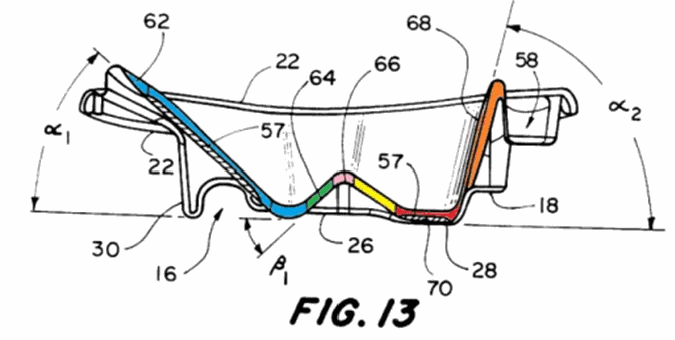
’209 patent at Fig. 13, 5:41-42. In this embodiment, “[a]t the lower end of surface 62 [(shown in blue, on the infant side)], a tub bottom surface 64 [(green)] extends upward generally at an angle [] of about 45 degrees and forms a seating surface associated with back rest 62, with apex 664 [(pink)] received behind the knees of the infant.” Id. at 5:47-51. “At the other end of the tub (the right end, as shown), an opposing back rest 68 [(orange)] extends generally at the angle [] of about 77.5 degrees and serve[s] as a back rest for a toddle[r] seated on generally horizontal seating surface 70 [(red)] . . . .” Id. at 5:51-54.
The ’209 patent has 31 claims. Independent claim 1 is illustrative:
A tub for bathing children, the tub comprising a molded plastic body having an upper rim and defining a bathing basin sized for bathing a young child and having a bottom surface and opposing side walls forming opposite ends of the basin,
a first of the opposing side walls extending at a first incline angle with respect to the rim, and a second, opposite one of the opposing side walls extending at a second incline angle with respect to the rim, the first and second inclined side walls forming first and second back rests for children seated in the tub in different orientations;
the bottom surface having two seating surfaces disposed at differing inclinations and extending from respective back rests to distal edges joined at a bottom surface apex spaced from either end of the basin, each seating surface forming, together with a respective one of the back rests, an inclined seat;
wherein the body has a nominal thickness and upper and lower surfaces having matching shape across an overall extent of the tub so as to enable the tub to nest within an identical tub with a nesting space differential of less than about two inches (five centimeters).
5Id. at 6:29-51 (emphasis added). The “bottom surface” limitation, emphasized above, is central to the issues raised in this appeal.
B
TOMY sells a baby bathtub, called the “Sure Comfort Deluxe,” which it asserts is an embodiment of the ’209 patent’s claims. In September 2017, Kids2 began selling a competing baby bathtub, called the “Comfy Clean Deluxe.” Less than a month later, TOMY sent Kids2 a cease-and-desist letter, accusing Kids2’s Comfy Clean Deluxe of infringing one or more claims of TOMY’s ’209 patent. Shortly after receiving TOMY’s letter, Kids2 filed a declaratory judgment action in the United States District Court for the District of Rhode Island, seeking a determination that its product did not infringe the ’209 patent. TOMY answered Kids2’s complaint and filed counterclaims alleging that Kids2’s product infringes the ’209 patent.
In May 2019, TOMY filed a motion for a claim construction order. After briefing and oral argument, the magistrate judge to whom the case was referred issued a report and recommendation (“R&R”) on claim construction. Relevant to this appeal, the magistrate judge construed a portion of the “bottom surface” limitation – specifically, the term “distal edges joined at a bottom surface apex” – as “edges of the seating surfaces situated farthest away from their respective back rests joined to each other at the area of a high point of the bottom surface of the body between the seating surfaces.” J.A. 79 (emphasis added). The magistrate judge further concluded that the meaning of “seating surface(s)” “is clear and does not require further construction,” adding that “‘seating surfaces’ plainly mean the inclined (for the infant side) and generally horizontal (for the toddler side) portions of the bottom surface that extend from the respective back rests to the central apex of the bottom surface.” J.A. 71 (citing ’209 patent at 6:45-46). Both parties objected to the R&R. After considering the6 parties’ written objections and hearing oral argument, the presiding district judge adopted the claim construction R&R “in its entirety.” J.A. 11.
Subsequently, the parties filed cross-motions for summary judgment of infringement and non-infringement, as well as motions to exclude expert testimony. The motions were referred to the same magistrate judge who had conducted claim construction. In another R&R, the magistrate judge, among other things, granted-in-part and denied-in-part Kids2’s motion to preclude TOMY’s expert, Mr. Mauro, from testifying, and recommended that the district court: (i) grant Kids2’s motion for summary judgment of non-infringement, (ii) deny TOMY’s motion for summary judgment of infringement, and (iii) enter final judgment. Over TOMY’s objections, the district court adopted the R&R “in its entirety,” J.A. 8, and entered final judgment.2
TOMY timely appealed. We have jurisdiction under 28 U.S.C. § 1295(a)(1).
II
“We decide the proper claim construction and address the intrinsic-evidence aspects of a claim-construction analysis de novo, while we review for clear error any subsidiary factual determinations based on extrinsic evidence made by the district court.” Inline Plastics Corp. v. Lacerta Grp., LLC, 97 F.4th 889, 901 (Fed. Cir. 2024). Claim terms “are generally given their ordinary and customary meaning,” which is the meaning understood by one of ordinary skill in the art when read in the context of the claims, specification, and prosecution history. Phillips v. AWH Corp., 415 F.3d 1303, 1313-14 (Fed. Cir. 2005) (en banc).
7“We review the district court’s grant or denial of summary judgment under the law of the regional circuit,” here the First Circuit. Halo Elecs., Inc. v. Pulse Elecs., Inc., 831 F.3d 1369, 1376 (Fed. Cir. 2016). The First Circuit reviews a grant of summary judgment de novo, evaluating the “record in the light most flattering to the nonmovant” and drawing “all reasonable inferences in that party’s favor.” Alston v. Town of Brookline, 997 F.3d 23, 35 (1st Cir. 2021). “Summary judgment is appropriate only when the record, read as required, demonstrates that there is no genuine issue as to any material fact and that the moving party is entitled to judgment as a matter of law.” Id.
We also “apply regional circuit law when reviewing a district court’s evidentiary rulings.” Omega Pats., LLC v. CalAmp Corp., 13 F.4th 1361, 1368 (Fed. Cir. 2021). Under First Circuit law, “we review a district court’s ruling on the admissibility of expert testimony under Rule 702 for abuse of discretion.” Rodríguez v. Hosp. San Cristobal, Inc., 91 F.4th 59, 71 (1st Cir. 2024).
III
On appeal, TOMY contends that the district court adopted an incorrect claim construction for the “bottom surface” claim limitation, and, as a result, also wrongly excluded testimony of TOMY’s infringement expert, granted Kids2’s motion for summary judgment of noninfringement, and denied TOMY’s motion for summary judgment of infringement. We address each issue in turn.
A
TOMY first challenges the district court’s construction of the “bottom surface” claim term – “the bottom surface having two seating surfaces disposed at differing inclinations and extending from respective back rests to distal edges joined at a bottom surface apex” – which appears in independent claims 1, 23, and 30 of the ’209 patent. TOMY raises three issues in relation to different8 parts of the court’s construction of the “bottom surface” limitation: (i) “distal edges joined at a bottom surface apex,” (ii) “apex,” and (iii) “seating surfaces.” While we agree with TOMY that the district court erred by limiting “distal edges joined at a bottom surface apex” solely to direct connections, we are not persuaded by TOMY that the court committed any further claim construction error.
1
The parties’ dispute with respect to “distal edges joined at a bottom surface apex” is, as the district court explained, “whether the patent claims that the distal edges of each seating surface are connected directly, that is, edge-to-edge, or whether the patent also claims indirect joinder, that is, with edges meeting on either side of an intervening structure.” J.A. 73. The district court resolved this dispute in favor of Kids2, adopting the narrower view that the claim requires the “edges of the seating surfaces situated farthest away from their respective back rests [be] joined to each other at the area of a high point of the bottom surface of the body between the seating surfaces.” J.A. 79 (emphasis added). To reach this holding, the district court distinguished dependent claim 18’s disclosure – “wherein the seating surfaces are joined by a central bottom surface portion that rises from the distal edge of one of the seating surfaces to the distal edge of the other of the seating surfaces” – from independent claim 1’s disclosure – that the “distal edges [are] joined at a bottom surface apex” – stating that it found “it impossible to avoid the force of [Kids2’s] argument that ‘joined at,’ as the term appears unadorned by further definition in Claims 1, 23 and 30, describes clearly the joinder of the two distal edges to each other at the apex; it does not encompass indirect joinder of the two seating surfaces to a third intervening structure, as claimed by dependent Claim 18.” J.A. 74-75 (emphasis added). Hence, the district court agreed with Kids2 that claims 1, 23, and 30 of the ’209 patent do “not encompass9 indirect joinder of the two seating surfaces to a third intervening structure.” J.A. 75. We disagree.
Claim 1 recites, in pertinent part, “two seating surfaces . . . extending from respective back rests to distal edges joined at a bottom surface apex.” ’209 patent at 6:41-44. There is no indication in this claim language that “joined at” takes on anything other than its plain and ordinary meaning, which would include any type of joining, direct or indirect. See generally Deere & Co. v. Bush Hog, LLC, 703 F.3d 1349, 1355 (Fed. Cir. 2012) (noting “joined,” in context of upper and lower deck walls in rotary cutter, does “not necessitate direct contact”); Genentech, Inc. v. Chiron Corp., 112 F.3d 495, 501 (Fed. Cir. 1997) (explaining, in context of DNA sequences, that “[t]o be joined or connected does not necessitate a direct joining or connection.”). To read the limitation “joined at a bottom surface apex” to require that the distal edges of the seating surfaces be “joined to each other at a bottom surface apex,” as the district court did, imports language into the claim that is not there. The term “at a bottom surface apex” indicates where the distal edges of the two seating surfaces join but does not limit how those distal edges must be joined.
Additional support for this conclusion is found in claim 18, which depends from claim 1, and would be understood by a skilled artisan as including indirect joinder. Claim 18 recites:
The tub of claim 1 wherein the seating surfaces are joined by a central bottom surface portion that rises from the distal edge of one of the seating surfaces to the distal edge of the other of the seating surfaces.
’209 patent at 7:44-47.
Claim 18’s requirement that the seating surfaces “are joined by a central bottom surface portion,” that rises from the distal edges of the seating surfaces, can only be met by10 embodiments in which those distal edges of the two seating surfaces do not directly touch one another and are, instead, joined only indirectly – by their respective connections to the intervening central bottom surface portion. The ’290 patent’s specification expressly discloses this embodiment, stating: “The seating surfaces may be joined by a central bottom surface portion that rises from the distal edge of one of the seating surfaces to the distal edge of the other of the seating surfaces.” ’290 patent at 2:64-67.
Independent claim 1 must be broad enough to contain the full scope of its dependent claims, including claim 18. See Littelfuse, Inc. v. Mersen USA EP Corp., 29 F.4th 1376, 1380 (Fed. Cir. 2022) (“By definition, an independent claim is broader than a claim that depends from it, so if a dependent claim reads on a particular embodiment of the claimed invention, the corresponding independent claim must cover that embodiment as well.”); Intellectual Ventures I LLC v. T-Mobile USA, Inc., 902 F.3d 1372, 1378 (Fed. Cir. 2018) (stating that claim constructions rendering “dependent claims meaningless” are generally “disfavored”). Claim 18, then, provides substantial support for TOMY’s position.3
We find still further support for TOMY’s proposed construction in the specification and prosecution history.11 Recall Figure 13, which we reproduced above. In the embodiment depicted in Figure 13, the distal edge of the infant seating surface 64 (annotated in green) and the distal edge of the toddler seating surface 70 (annotated in red) are not directly joined. Kids2, citing the prosecution history, argues that the unlabeled portion extending from 70 (annotated in yellow) is also part of the toddler seating surface 70 (annotated in red).4 Whether or not the unlabeled structure extending from 70 is considered part of the toddler seating surface or an intervening structure, it is indisputable that elements 64 (green) and 70 (red) do not directly join one another. Instead, they only indirectly join either at the central bottom surface portion (yellow) or at the apex 66 (pink). The district court’s construction, precluding indirect joinder, would read the embodiment of Figure 13 out of claim 1, a result contrary to our “strong presumption against a claim construction that excludes a disclosed embodiment.” In re Katz Interactive Call Processing Pat. Litigation, 639 F.3d 1303, 1324 (Fed. Cir. 2011).
Our review of the intrinsic evidence, therefore,12 persuades us that the correct construction of the claimed “distal edges joined at a bottom surface apex” encompasses both direct and indirect joinder. Because the claim construction dispute is resolved on the intrinsic evidence, and “[e]xtrinsic evidence may not be used to contradict claim meaning that is unambiguous in light of the intrinsic evidence,” Profectus Tech. LLC v. Huawei Techs. Co., 823 F.3d 1375, 1380 (Fed. Cir. 2016) (internal quotation marks omitted), it is unnecessary for us to consider the extrinsic evidence, Phillips, 415 F.3d at 1319 (explaining that courts may exercise discretion in determining whether extrinsic evidence is useful).
Thus, we construe “distal edges joined at a bottom surface apex” as meaning the “areas of the seating surfaces situated furthest away from their respective back rests are connected directly or indirectly by an intervening structure at a high point of the bottom surface of the body between the seating surfaces,” as TOMY proposes. J.A. 71-72 (emphasis added). The district court must apply this construction on remand.
2
We reject TOMY’s contention that the district court committed two other claim construction errors.
TOMY insists that the claimed “apex” need not “span[] the width of the tub bottom.” While we agree with TOMY on this point, so, too, did the district court. Its construction of “apex” – “a surface that is higher than the other portions of the tub’s bottom surface, located between the seating surfaces” – does not require that the “apex” must “span[] the width of the tub bottom.” J.A. 76. At most, the district court suggested that in the embodiment depicted in Figure 14 the apex is shown as “stretching across most of the tub’s width,” id., but we do not read this description of this embodiment as an explication of claim scope. Since there is no error, there is nothing for us to correct.
13TOMY also faults the district court for implicitly construing “seating surfaces” based on their function instead of limiting them to particular structures. It insists “the district court effectively added requirements to the construction of ‘seating surface’ including that it must support a child, that the child’s legs cannot straddle the seating surface, and that a ‘seating surface’ excluded near vertical structures.” Appellant’s Br. 34. We do not see where the district court imported any such limitations into the construction of “seating surface.” During claim construction, the district court concluded that the meaning of the term “seating surface” is “clear and does not require further construction.” J.A. 71 (“‘Seating surfaces’ plainly mean the inclined (for the infant side) and generally horizontal (for the toddler side) portions of the bottom surface that extend from the respective back rests to the central apex of the bottom surface. Together with their respective back rests, each seating surface forms ‘an inclined seat.’”). The court later explained, at summary judgment, that it “did not reject the core concept that a seat functions as the part on which one rests in [when] sitting,” and that this “concept is embedded” in its plain meaning construction. J.A. 23 (internal quotation marks omitted). TOMY provides no persuasive reason for us to add anything further to the construction of “bottom surface” or “seating surfaces.”
B
The district court denied-in-part and granted-in-part Kids2’s motion to exclude Mr. Mauro’s expert testimony. Relevant here, the district court excluded Mr. Mauro from offering infringement opinions built on his “illogical construct,” which “clash[ed] with the [district court’s] claim construction,” as he would have opined that the “two seating surfaces” could be indirectly “joined at a bottom surface apex.” J.A. 33-35. Now that we have reversed the district court’s construction, and the court on14 remand will have to apply our broader construction, the premise for the exclusion ruling has been eliminated. See generally Chamberlain Grp., Inc. v. Lear Corp., 516 F.3d 1331, 1339 (Fed. Cir. 2008) (explaining that where district court “relies on an erroneous claim construction” in connection with other rulings, “this legal error may well constitute an abuse of discretion” that must be reversed).
Mr. Mauro’s opinion – that the “seating surface for the infant is shown as the substantially vertical portion for the central protrusion extending upwards from the bottom of the tub,” and that the seating surface for the toddler side includes the “flat portion and upwardly curved portion,” J.A. 1805 – as shown in the figures below, is not inconsistent with the correct claim construction, which permits direct or indirect joinder of the seating surfaces.
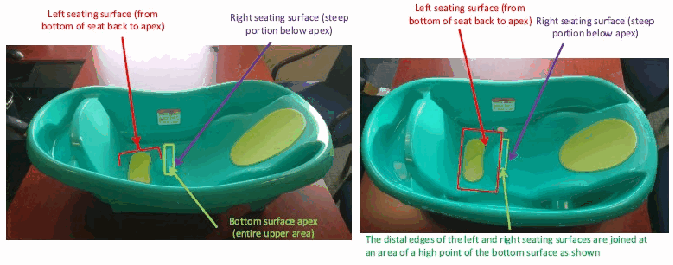
J.A. 1836.
Our dissenting colleague, in critiquing Mr. Mauro for espousing a theory of infringement that supposedly “eviscerates all meaning of ‘seating’ from the term ‘seating surface,’” Dissent at 1-2, relies on a combination of TOMY’s appellate briefing (not Mr. Mauro’s own words) and a reading of excerpts from Kids2’s internal documents that is something other than a reading in the light most favorable to TOMY, see id. at 3-4. None of this, in our view, provides a persuasive basis for excluding Mr. Mauro’s actual15 opinion.5
Accordingly, we reverse the district court’s exclusion of portions of Mr. Mauro’s testimony.
C
The district court’s grant of Kids2’s motion for summary judgment of non-infringement was, like its ruling on the exclusion of Mr. Mauro’s testimony, predicated on its rejection of TOMY’s construction of “distal edges joined at a bottom surface.” Because we have now determined that TOMY is correct that this term must be construed to include both direct and indirect connections, and we have decided that Mr. Mauro’s testimony is not excludable based on application of an erroneous claim construction, it follows that we must reverse the judgment of non-infringement. TOMY has pointed to other evidence, in addition to Mr. Mauro’s opinion, that, taken in the light most favorable to TOMY, might support a reasonable finding that Kids2’s accused tub infringes. For example, at least one of Kids2’s own product documents, which describes the raised portion of the bottom surface of the Comfy Clean Deluxe tub as a “[c]ontoured seat,” could support a finding that the side surface of the raised portion of the bottom surface constitutes a “seating surface.” J.A. 1443; see also J.A. 1436. A reasonable factfinder, taking the evidence in the light most flattering to TOMY, might also find that the sliding-prevention function of the raised hump of the bottom surface additionally supports a finding that the side surface of the raised hump is a “seating surface.” J.A. 1293 (Kids2 engineer describing “how this little bump . . . prevents [a child] from sliding down”).
16In granting summary judgment of non-infringement, the district court also stated that Kids2’s accused tub “has a relatively flat bottom surface comprised of two seating surfaces that flow into each other, around and past the convex central hump that goes between the legs of the infant or toddler and serves as a stop to prevent either the infant or the toddler from slipping.” J.A. 47. Kids2 argues that, in this portion of its order, the district court was explaining that it was granting summary judgment because the accused product does not have two seating surfaces disposed at differing inclinations. While it is not entirely clear to us which claim limitation the district court was holding the Comfy Clean Deluxe did not meet, if Kids2’s reading is correct, we disagree with the district court. A reasonable factfinder could find that the accused product has a “bottom surface having two seating surfaces disposed at differing inclinations” because the basically horizontal inclination of the toddler seating surface and the steeper inclination of the infant seating surface could reasonably be found to differ. J.A. 1497 (Mr. Mauro testifying that “one of ordinary skill in the art just looks at” the “inclination” language of the claim as “simply” requiring “different inclinations”).
Our conclusion relies on the view that the claimed “differing inclinations” include a zero-degree incline, i.e., that one seating surface is horizontal. The Dissent faults that conclusion as being both forfeited and wrong on the merits. We disagree.
The Dissent contends that “TOMY never argues in its briefing to us that the claim includes ‘zero incline,’” Dissent at 6, which is not quite right. In its initial brief to us, TOMY argued that in the accused tub “the seating surface for the toddler has a relatively horizontal portion and a modest incline portion, and the seating surface for the infant has an incline relatively steeper than the toddler side.” Appellant’s Br. 45; see also id. at 37 (“[T]he toddler seating17 surface is the portion of the bottom surface that extends from the left seatback to the apex, and the infant seating surface is the portion of the bottom surface extending from the right seatback to the apex. The slopes of these two seating surfaces are different. This is all that the claim requires.”). Although TOMY did not use the phrase “zero incline” in its brief, it is clear to us that TOMY was contending that its claim includes seating surfaces of various inclinations, including a zero-degree incline.6 The limitation requires “seating surfaces disposed at differing inclinations,” and TOMY’s position before us has consistently included potentially all inclinations, including a zero-degree incline, as long as the two seating surfaces have different inclinations.
On the merits, we agree with TOMY that different inclinations, whatever they may be (including a zero-degree incline), “is all that the claim requires.” Appellant Br. 37. We see nothing in the claim language or specification, and the Dissent points to nothing, to support a conclusion that a person of ordinary skill in the art would exclude a zero angle from her understanding of “inclination.”7 To the18 contrary, one claim, claim 17, actually requires “the seating surface associated with the first inclined wall is disposed generally horizontally,” meaning it requires a seating surface with an incline at or near zero. Other claims, specifically claims 12-16, require that an “inclined wall” extend either at a specific angle (“about 41 degrees,” “about 45 degrees,” “about 77 degrees”) or at a specific range of angles (“between about 35 and 45 degrees,” “between about 70 and 85 degrees”), further indicating that claims not specifying any particular inclination do not exclude any inclination.
The Dissent’s contention that the prosecution history provides “quite clear” support for its conclusion is, in our view, likewise unavailing. Dissent at 8. It wrongly suggests that TOMY told the U.S. Patent and Trademark Office that “the toddler seating surface must include both horizontal surface 70 [red] and the inclined extension of surface 70 [yellow]” to meet the “disposed at differing inclinations” limitation. Dissent at 8 (emphasis added). It is true that during prosecution the applicant responded to an examiner’s antecedent basis objection of two seating surfaces “disposed at differing inclinations” (in connection with unasserted claim 22) by stating that the toddler seating surface of the Figure 13 embodiment “is formed by surface 70 and the extension of surface 70 that meets surface 64 at apex 66,” J.A. 695, but the applicant never said that the differing inclinations are not also satisfied even without considering the yellow extension. That is, contrary to the Dissent, the applicant did not tell the Patent Office that the “generally horizontal seating surface 70 on its own” was “insufficient.” Dissent at 7-8 (internal quotation marks omitted).
Accordingly, we reverse the district court’s grant of summary judgment of non-infringement and remand for further proceedings.
19D
Finally, we affirm the district court’s denial of TOMY’s motion for summary judgment of infringement. While we have set out above a portion of the evidence from which a reasonable factfinder, taking the evidence in the light most flattering to TOMY, could find that Kids2’s Comfy Clean Deluxe tub infringes the ’209 patent, nothing we have said should be taken to mean that such a factfinder would be compelled to make such a finding. Viewing the evidence in the light most favorable to Kids2, as the party opposing TOMY’s motion, a reasonable factfinder is clearly free to reject Mr. Mauro’s opinion and the other evidence we have highlighted and, consequently, find no infringement. Thus, TOMY is not entitled to summary judgment.
IV
We have considered the parties’ remaining arguments and find them unpersuasive. For the foregoing reasons, we (i) reverse the district court’s (a) “bottom surface” claim construction, (b) its exclusion of portions of Mr. Mauro’s testimony, and (c) its grant of summary judgment of noninfringement, and (ii) affirm the court’s denial of summary judgment of infringement. We remand for further proceedings consistent with this opinion.
REVERSED-IN-PART, AFFIRMED-IN-PART,
AND REMANDED
COSTS
Costs awarded to TOMY.
20NOTE: This disposition is nonprecedential. United States Court of Appeals
for the Federal Circuit
KIDS2, LLC, F.K.A. SUMMER INFANT (USA), INC.,
Plaintiff-Appellee
v.
TOMY INTERNATIONAL, INC.,
Defendant-Appellant
2023-1524
Appeal from the United States District Court for the District of Rhode Island in No. 1:17-cv-00549-MSM-PAS, Judge Mary S. McElroy.
CHEN, Circuit Judge dissenting-in-part.
Both on appeal and before the district court, TOMY has offered “evolving theories of infringement.” J.A. 27. As the magistrate judge aptly observed, “TOMY has struggled to explain how [the Accused Tub] also meets the ’209 Patent’s ubiquitous limitation of ‘two seating surfaces disposed at differing inclinations and extending from respective back rests to distal edges joined at a bottom surface apex.’” Id. TOMY advances two infringement theories, but both are fatally flawed. The first theory, which contends a near-vertical wall in the Accused Tub is a seating surface, eviscerates all meaning of “seating” from the term “seating21 surface.” The second theory, which claims a flat horizontal surface is the seating surface, similarly eviscerates the “differing inclinations” limitation from the claim.
TOMY’s infringement theories fail regardless of how the disputed claim limitation is construed. If we affirm the district court’s construction, then TOMY must rely on its first infringement theory, which requires an unreasonable understanding of what a “seating surface” may encompass. If we adopt TOMY’s proposed construction, TOMY’s second infringement theory failed to argue or explain how the Accused Tub’s horizontal seating surface has an “inclination.” And, regardless, it doesn’t. In my view, the district court correctly handled the issues presented to it based on the arguments made. I join the court’s opinion at parts III.A.2 and III.D, but I would affirm the district court’s claim construction, exclusion of TOMY’s expert opinions on infringement, and grant of summary judgment of noninfringement. Accordingly, I respectfully dissent.
I
Under its first infringement theory, TOMY argues the near-vertical sidewall of the Accused Tub’s central hump is part of the toddler seating surface. I am not persuaded that this is an issue that merits a trial. Under its plain and ordinary meaning, a “seating surface” is something that one sits on, not something that one sits against.
Mr. Mauro’s infringement opinions require an illogical and unreasonable understanding of the plain and ordinary meaning of “seating surface.” When a toddler is sitting in the Accused Tub, the central hump (the vertical sidewall of which Mr. Mauro contends is a seating surface) sticks up and is located between the toddler’s legs. It is thus appropriate to exclude Mr. Mauro’s infringement opinions because he reads “seating” out of the term “seating surface.” Mr. Mauro is not arguing that a toddler actually sits on the hump sidewall because they can squirm such that their bottom slides up against the sidewall. Mr. Mauro instead22 argues, without meaningful explanation, that the hump sidewall is part of the toddler seating surface. J.A. 1416; see also Appellant’s Br. 39 (arguing the hump sidewall “is clearly a seat because the child necessarily rests against it”).1 However, resting against something is not the same as sitting on it—a footrest would necessarily support part of a toddler’s weight but would not be considered a seating surface. 2 Likewise, no one would suggest a backrest of a chair or the Accused Tub is a seating surface just because someone can rest part of their weight against it when23 sitting on the true seating surface, which in this case is the flat surface in Accused Tub where the toddler actually sits.
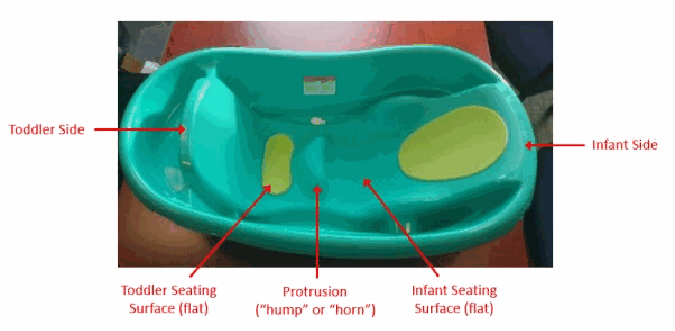
Appellee’s Br. 3.
Based on Kids2’s internal documents, the Accused Tub’s central hump is not a seating surface but rather a restraint for how far forward a sitting toddler can move within the tub. J.A. 1435 (“built-in contoured support keeps baby from sliding in the tub”); J.A. 1441 (“Horn reshaped to prevent slipping”). That kind of contoured support is no different in principle than, say, a contoured, concave-shaped backrest that would help maintain and confine the location of where the toddler sits. Such features help further define the sitting location, but they don’t serve as the sitting location itself. Because a restraint is something one, at most, rests against, not something that one sits on, I do not agree that “the sliding-prevention function of the raised hump of the bottom surface additionally supports a finding that the side surface of the raised hump is a ‘seating surface.’” Maj. at 15. Contrary to the majority’s assertions, reading Kids2’s internal documents “in the light most favorable to TOMY” does not require expanding “seating surface” to include mechanisms that restrain movement, as doing so would eviscerate the term’s plain and ordinary meaning. Id. at 14.
24II
Under its second infringement theory, TOMY argues the near-vertical sidewall of the central hump is an “intervening structure,” leaving only a “horizontal seating surface” as the toddler seating surface. Appellant’s Reply Br. 23; see also Appellant’s Br. 20–21, 25–27. This theory benefits from not having to rely on a wall as counting as part of the “seating surface,” but the district court correctly spotted defects here as well.
As a threshold matter, I believe the district court correctly construed the claim to exclude indirect joinder of the claimed two seating surfaces. Under its plain and ordinary meaning, “distal edges [of the two seating surfaces] joined at a bottom surface apex” means the seating surfaces’s distal edges are directly joined to each other through the apex. In other words, the distal edges cannot be indirectly joined at the apex through an intervening structure.
Dependent claim 18 does not clearly contemplate indirect joinder by a “central bottom surface portion” (i.e., intervening structure). The sole description of this term in the specification refers to an embodiment of the apex, as it necessarily encompasses the apex, and does not, as the majority asserts, refer to an intervening structure that indirectly joins the two seating surfaces. Maj. at 10 (quoting ’209 patent at col. 2, ll. 64–67 (“The seating surfaces may be joined by a central bottom surface portion that rises from the distal edge of one of the seating surfaces to the distal edge of the other of the seating surfaces.”)). This understanding of “central bottom surface portion” is fully consistent with the district court’s construction of “apex,” which no party disputes: “an area of a high point of the bottom surface between the seating surfaces.” J.A. 76–77, 79 (emphasis added).
Although the majority asserts the apex itself is an intervening structure that indirectly joins the distal edges, Maj. at 11–12, TOMY never argued the case that way.25 Rather, TOMY argues the unlabeled portion (yellow) is the “central bottom surface portion” that indirectly joins the seating surfaces’s distal edges at the apex 66 (pink). Appellant’s Br. 20–21 (see annotated Figure 13 below), 25–26; Appellant’s Reply Br. 10–11. Thus, TOMY clearly considers the apex as distinct from any alleged intervening structure. The majority, in my view, engages in its own independent inquiry untethered from TOMY’s arguments.
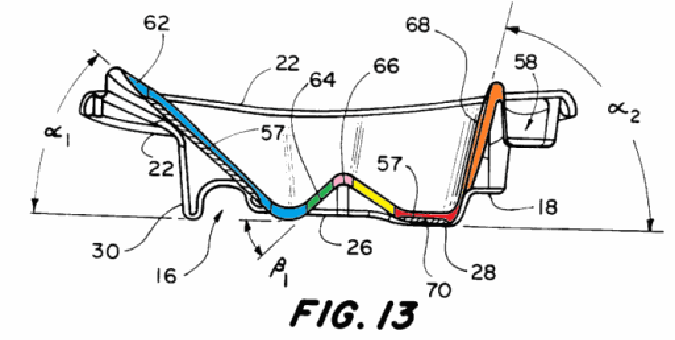
Regardless, even if the claim is construed to include indirect joinder, TOMY’s infringement theory still fails because the Accused Tub would not meet the “two seating surfaces disposed at differing inclinations” limitation. TOMY admits that the Accused Tub’s toddler seat under this theory is “a horizontal seating surface.” Appellant’s Reply Br. 23. The majority asserts that the claim language does not exclude a horizontal angle of zero degrees to the bottom surface from the required “inclinations,” Maj. at 17–18, but under its plain and ordinary meaning, an “inclination” is “a deviation from the true vertical or horizontal” (i.e., “slant”). Inclination, Merriam-Webster, available at https://www.merriam-webster.com/dictionary/inclination. In other words, to say an inclination can be no inclination means this limitation is really no claim limitation at all.
More importantly, TOMY never argues in its briefing to us that the claim includes “zero incline.” When asked26 about this at oral argument, TOMY argues what the majority argues now. Oral Arg. at 4:37–51 (arguing that the ’209 patent contemplates “completely flat” seating surfaces because “an incline of zero is still something that is measurable”), 7:54–8:37 (arguing that “differing inclinations” is met because one seating surface is “horizontal” and the other seating surface is “pitched somewhat”), 9:18–44 (arguing that, “in the context of this patent,” all surfaces, even a “flat” surface with “zero” incline, is “inclined”). But it is too late for TOMY to correct the defect from its briefs. See, e.g., Hannon v. Dep’t of Just., 234 F.3d 674, 680 (Fed. Cir. 2000) (arguments made after the opening appeal brief that are not in the opening brief come too late to be considered). Although the majority contends TOMY did argue that the claims include a zero-degree incline, Maj. at 16–17 (quoting Appellant’s Br. 37, 45), those quotes were made in the context of the first infringement theory—in arguing that the near-vertical sidewall of the Accused Tub’s central hump is part of a seating surface—and were not asserted for alleging that a flat surface with no incline meets the “inclinations” limitation. That TOMY argued the claim includes a 90-degree incline does not mean TOMY affirmatively argued the claim also includes a zero-degree incline.
In addition to the plain and ordinary meaning, the prosecution history reinforces my view that the ’209 patent claims require the two seating surfaces to be inclined at different angles. During prosecution, when the patent examiner “objected to the specification as failing to provide antecedent basis” for the “disposed at differing inclinations” limitation, TOMY pointed to Figure 13 and then explained the limitation was met because “surface 64 forms one seating surface, extending at inclination angle β1, and the other seating surface is formed by surface 70 and the extension of surface 70 that meets surface 64 at apex 66.” J.A. 695 (emphasis added). In other words, “generally horizontal seating surface 70” on its own was, in TOMY’s view, insufficient to meet the limitation because, otherwise,27 TOMY need not have included the inclined extension of surface 70 as part of the toddler seating surface to overcome the examiner’s objection. ’209 patent at col. 5, l. 54. The majority contends that TOMY did not tell the U.S. Patent and Trademark Office the “generally horizontal” portion alone was insufficient, Maj. at 18, but in my view, it is quite clear that TOMY was explaining to the Patent Office that the toddler seating surface must include both horizontal surface 70 and the inclined extension of surface 70 to be “disposed at differing inclinations.” The specification does not present a contrary, or any, explanation of the extension of surface 70 depicted in yellow in annotated Figure 13.3 See ’209 patent col. 5 ll. 40–55. TOMY should not be allowed to tell the courts one thing about what can be a seating surface with an inclination when it told the Patent Office something very different during prosecution.
For TOMY to prevail under its second infringement theory, the inclined limitation would have to be met by non-inclined surfaces. But that conflicts with the claim language and is neither supported by the record nor how this case was litigated. It was thus appropriate and correct for the district court to conclude that the claim “calls for two seating surfaces that rise at different angles” and such a limitation cannot be met by a “flat bottom surface,” J.A. 8, or, in TOMY’s own words, “a horizontal seating surface,” Appellant’s Reply Br. 23.
28CONCLUSION
For the foregoing reasons, I respectfully dissent. Although a party should have its right to trial when there are genuine issues of material fact, I see none here. I would affirm the district court on all issues.
Footnotes
- ↩ 1 During the pendency of this appeal, Summer Infant was dissolved and, after a series of transactions, became Kids2, LLC. We granted an unopposed motion to substitute Kids2 as the appellee. For simplicity, we use Kids2 throughout this opinion.
- ↩ 2 For simplicity, from this point forward we refer to the decisions of both the district judge and the magistrate judge as decisions of the “district court.”
- ↩ 3 We do not agree with the district court that “dependent Claim 18 materially alters the words chosen for independent Claims 1, 23 and 30, in that it omits the references to ‘edges’ and recites that the ‘seating surfaces are joined by a central bottom surface portion.’” J.A. 75 (quoting claim 18). Claim 18 plainly requires that “a central bottom surface portion” be situated between the distal edge of one seating surface and the distal edge of the other seating surface, indicating, as we have explained, that these “edges” are joined indirectly.
- ↩ 4 During prosecution, the applicant described the embodiment shown in Figure 13 as follows: “surface 64 forms one seating surface [(i.e., the infant seating surface)], extending at inclination angle β1, and the other [(i.e., toddler)] seating surface is formed by surface 70 and the extension of surface 70 that meets surface 64 at apex 66.” J.A. 695. In briefing to us, TOMY seeks to distance itself from this interpretation, emphasizing instead that the unlabeled portion (yellow) is an intervening structure indirectly joining the distal edges of the two seating surfaces at the apex (pink). Both views have support in the intrinsic evidence, making it proper to consider both in carrying out our obligation to construe the disputed claim term as a matter of law.
- ↩ 5 There may be other grounds on which, on remand, the district court might determine it must exclude some or all of Mr. Mauro’s opinions.
- ↩ 6 As the Dissent acknowledges, TOMY made this point even more clearly during oral argument. See Dissent at 6-7 (quoting oral argument).
- ↩ 7 The parties did not present a claim construction dispute over the meaning of “inclination.” Even if we were to say we have such a dispute before us now, we see no reason to conclude that a person of ordinary skill would ignore the intrinsic evidence and understand this term based solely on the definition from an online general use dictionary relied upon by the Dissent. See Dissent at 6. Moreover, even under the Dissent’s definition, it does not necessarily follow that the amount of “deviation from the true vertical or horizontal” cannot be zero degrees.
- ↩ 1 Mr. Mauro identified only the sidewall of the central hump as the infant seating surface (see J.A. 1836–37), but, at a minimum, part of the flat portion on the infant side should also be the seating surface because an infant would, as TOMY argues, necessarily rest their weight against part of the flat portion. It is questionable whether this sidewall on the infant side is part of the seating surface for the same reasons that the sidewall on the toddler side should not be part of the seating surface.
- ↩ 2 During oral argument, TOMY’s counsel rather nonsensically argued a footrest would be “a seat for your feet” and therefore a seating surface. Oral Arg. at 43:06–23, available at https://oralarguments.cafc.uscourts.gov/default.aspx?fl=23-1524_06072024.mp3.
- ↩ 3 The prosecution history is clear that the extension of surface 70 is a portion of the seating surface itself, rather than a separate intervening structure. J.A. 695. This undermines TOMY’s proposed construction, which argues the claim allows for indirect joinder of the seating surfaces’s distal edges because the extension of surface 70 is supposedly an “intervening structure.” Appellant’s Br. 20–21.