NOTE: This disposition is nonprecedential. United States Court of Appeals
for the Federal Circuit
ALLYSON WALLACE,
Plaintiff-Appellant
v.
IDEAVILLAGE PRODUCTS CORPORATION,
Defendant-Appellee
2015-1077
Appeal from the United States District Court for the District of New Jersey in No. 2:06-cv-05673-JAD, Magistrate Judge Joseph A. Dickson.
Decided: March 3, 2016
ALLYSON WALLACE, Newark, NJ, pro se. KEVIN JOSEPH O’CONNOR, Lum, Drasco & Positan LLC, Roseland, NJ, for defendant-appellee.
Before NEWMAN, DYK, and WALLACH, Circuit Judges.
2Ms. Allyson Wallace owns U.S. Design Patent No. D485,990 (the D’990 patent), for an “ornamental design for a body washing brush, as shown and described” in six drawings. Ms. Wallace, proceeding pro se, sued Ideavillage Products Corporation for patent infringement in the United States District Court for the District of New Jersey, based on the Ideavillage product called the “Spin Spa.” Ideavillage moved for summary judgment of noninfringement. Ms. Wallace, acting through appointed counsel, submitted a brief and expert report in opposition. The district court, reviewing the record and receiving argument, granted summary judgment to Ideavillage. For the reasons set forth below, we affirm the district court’s judgment.
DISCUSSION
We review issues not unique to patent law under the law of the regional circuit, here the Third Circuit. Classen Immunotherapies, Inc. v. Elan Pharm., Inc., 786 F.3d 892, 896 (Fed. Cir. 2015). Summary judgment may be granted “only if ‘drawing all reasonable inferences in favor of the nonmoving party, there is no genuine issue as to any material fact and the moving party is entitled to judgment as a matter of law’” Young v. Martin, 801 F.3d 172, 177 (3d Cir. 2015) (internal citations and modifications omitted). In the Third Circuit, the court reviews the grant of summary judgment de novo. See Al–Sharif v. U.S. Citizenship & Immigration Servs., 734 F.3d 207, 210 n. 2 (3d Cir. 2013) (en banc).
We review issues unique to patent law under the law of our circuit. The standard for design patent infringement is summarized in Egyptian Goddess, Inc. v. Swisa, Inc., 543 F.3d 665 (Fed. Cir. 2008) (en banc), applying the “ordinary observer” test of Gorham Manufacturing Co. v. White, 81 U.S. 511 (1871):
[T]he “ordinary observer” test should be the sole test for determining whether a design patent has
3been infringed. Under that test, as this court has sometimes described it, infringement will not be found unless the accused article “embod[ies] the patented design or any colorable imitation thereof.”
Egyptian Goddess, 543 F.3d at 678. The ordinary observer test proceeds in two stages. “In some instances, the claimed design and the accused design will be sufficiently distinct that it will be clear without more that the patentee has not met its burden of proving the two designs would appear ‘substantially the same’ to the ordinary observer . . . .” Id. “In other instances, when the claimed and accused designs are not plainly dissimilar, resolution of the question whether the ordinary observer would consider the two designs to be substantially the same will benefit from a comparison of the claimed and accused designs with the prior art . . . .” Id.
The district court applied both stages and determined under both tests that an ordinary observer would not consider Ms. Wallace’s patented design and the Ideavillage design to be substantially the same.
A
With respect to the first stage, the district court highlighted six differences between the Ideavillage design and the claimed design:
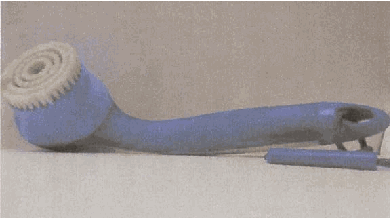
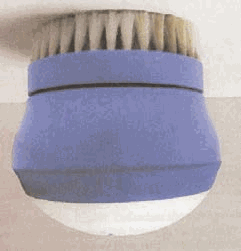
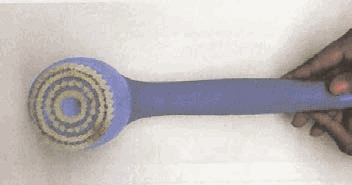
(1) ’990 patent has a straight handle, while the Ideavillage product has a bent or curved handle; (2) ’990 patent has a finger grip with a hill and valley design, while the Ideavillage product has no such finger grip; (3) ’990 patent has a flat threaded opening at the base of the handle, while the Ideavillage product has a closed pointed end with an aperture where a rope can be attached;
4(4) ’990 patent has a round head with a two tiered brush, while the Ideavillage product has an oblong head without a two tier brush; (5) ’990 patent has a protrusion at the back of the head, while Ideavillage product has a smooth back without any protrusion; and finally, (6) ’990 patent has no decoration on the back of the handle, while Ideavillage product has an oval at the neck of the handle and an oval group in the back of the handle.
Wallace v. Ideavillage Products Corp., No. 06-CV-5673-JAD, 2014 WL 4637216, at *3 (D.N.J. Sept. 15, 2014) (“Dist. Ct. Op.”). In granting summary judgment, the district court
acknowledge[d] manifest differences in the overall appearance of the ’990 patent and the [Ideavillage] product. Indeed, a comparison supports a finding that these two designs are sufficiently distinct and Ms. Wallace cannot, as a matter of law, prove that the designs appear substantially the same. To the ordinary observer, in other words, the two designs do not look substantially the same.
Id. at *4.
We have compared the D’990 patent’s drawings to the photographs of the accused product in Ms. Wallace’s expert report and agree with the district court that no reasonable fact-finder would find them to be substantially the same under the first stage of the ordinary observer test. The district court compared the following designs:

5D’990 Patent, Ideavillage’s Fig. 1 Accused
Product

D’990 Patent, Ideavillage’s Fig. 2 Accused
Product


6D’990 Patent, Ideavillage’s Fig. 3 Accused
Product

D’990 Patent, Ideavillage’s Fig. 5 Accused
Product


7D’990 Patent, Ideavillage’s Fig. 6 Accused
Product
The district court properly found that the D’990 patent’s design and the accused product are plainly dissimilar. Bath brushes with a generally rounded head and roughly cylindrical handle were shown in the prior art, and the curved shape of the handle, the angled connection between the handle and brush, the ovoid design of the head, and the surface details are such that an ordinary observer viewing both designs would not confuse one product for the other.
B
“In an effort to assure a fair and complete decision on this record,” the district court proceeded to the second stage of the ordinary observer test. Dist. Ct. Op. at *4. Comparing the claimed design with figures from the prior art, U.S. Patent No. 4,417,826 (the ‘826 Patent), reinforces the district court’s findings under the first stage of the test:

8D’990
Fig. 1

Prior Art ’826 Patent, Fig. 1
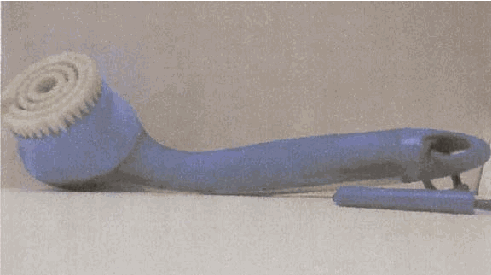
Ideavillage’s Accused Product
9Other prior art views also show the known characteristics of the design.

D’990 Patent, Fig. 5

Prior Art ’826 Patent, Fig. 3
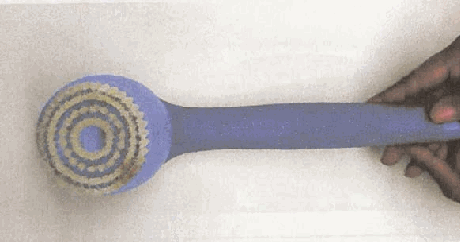
Ideavillage’s Accused Product
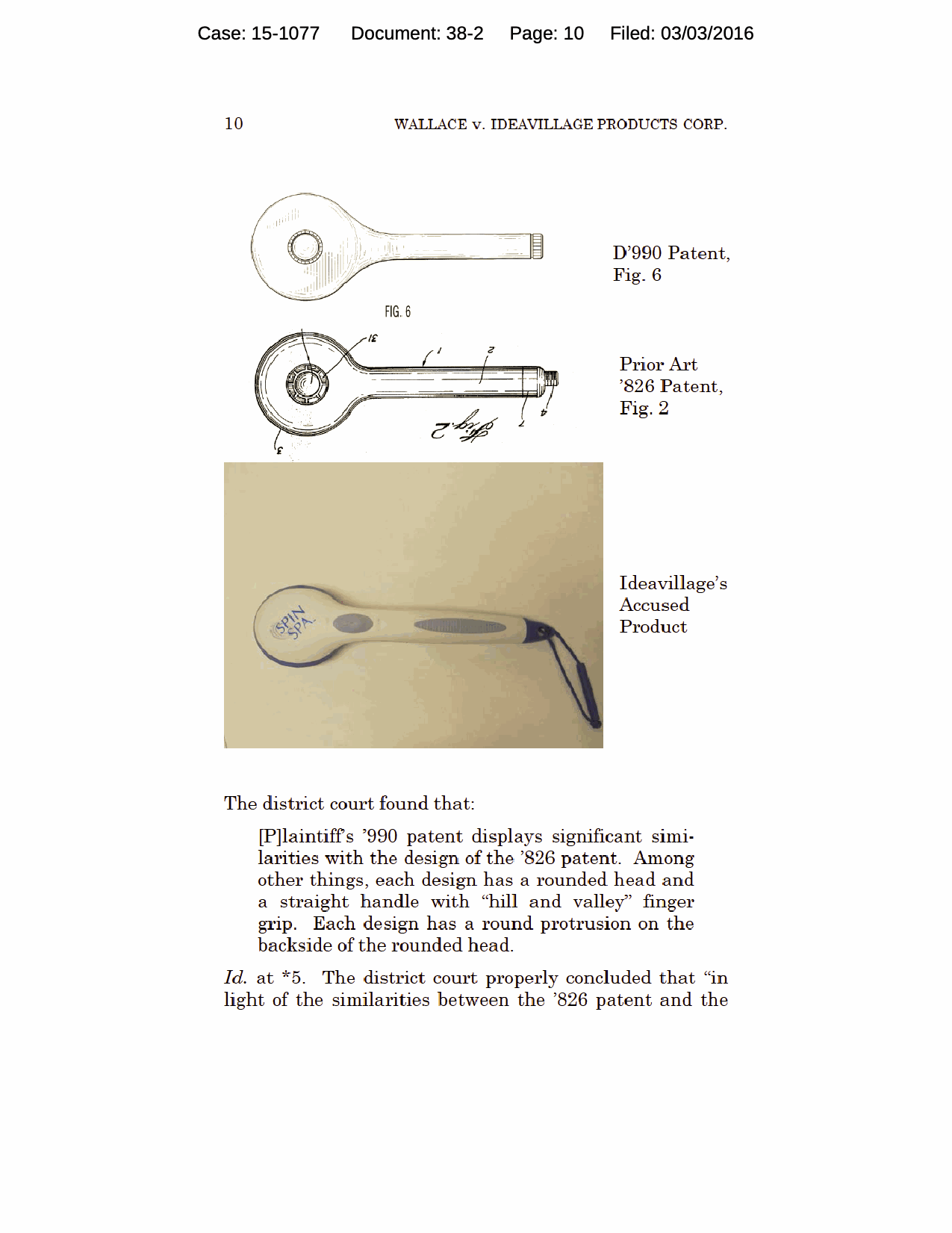
11’990 patent, . . . no reasonable ordinary observer, familiar with the prior art, would be deceived into believing the [Ideavillage] [p]roduct is the same as the design depicted in the ’990 patent.” Id. at 10.
The district court correctly applied the law, that “differences between the claimed and accused designs that might not be noticeable in the abstract can become significant to the hypothetical ordinary observer who is conversant with the prior art.” Egyptian Goddess, 543 F.3d at 678.
The judgment of non-infringement is affirmed. Each party shall bear its costs.