NOTE: This disposition is nonprecedential. United States Court of Appeals
for the Federal Circuit
O'REILLY WINSHIP LLC, DBA OWL,
Plaintiff-Appellee
v.
SNAPRAYS LLC, DBA SNAPPOWER,
Defendant-Appellant
2025-1422
Appeal from the United States District Court for the Northern District of Texas in No. 3:21-cv-02719-N, Judge David C. Godbey.
Decided: October 5, 2026
MATTHEW CONNER HUTCHISSON, Winston Taylor LLP, Dallas, TX, argued for plaintiff-appellee. Also represented by DAVID W. CARSTENS, THEODORE G. BAROODY, Carstens, Allen, & Gourley, LLP, Plano, TX.
NATHAN C. BRUNETTE, Stoel Rives LLP, Portland, OR, argued for defendant-appellant. Also represented by ELLIOTT J. WILLIAMS.
2Before CHEN, HUGHES, and CUNNINGHAM, Circuit Judges.
SnapRays, LLC appeals the grant of O’Reilly Winship LLC’s motion for summary judgment of non-infringement and denial of its own partial motion for summary judgment of infringement. For the reasons outlined below, we reverse-in-part, affirm-in-part, vacate-in-part, and remand for further proceedings consistent with this opinion.
I
This case concerns cover plates: the thin, frequently plastic plates that cover interior electrical outlets or light switch wall receptacles. SnapRays, LLC, dba SnapPower (SnapPower) owns a series of patents directed to specific types of active, or powered, cover plates, including the patents at issue: U.S. Patent Nos. 9,871,324 and 9,035,180 (collectively, the Asserted Patents). The Asserted Patents are in the same patent family, and, while they do not share a common specification, the specifications substantially overlap.
The Asserted Patents relate to powered cover plates “where the cover is configured to make an electrical connection with the device in the [electrical] box, and the electricity can then be used to power electrical loads built into the cover, such as a night light.” J.A. 25. Lighted cover plates are not new, but the ’324 patent’s three independent claims and the ’180 patent’s two independent claims concern certain powered cover plate embodiments with allegedly improved features, such as those improving functionality, performance, and safety. See, e.g., ’324 Patent 5:47–64, 9:54–67, 30:25–32:33; ’180 Patent 4:39–56, 16:10–17:23.
A
SnapPower and O’Reilly Winship LLC (OWL) are competitors in the lighted cover plate industry. OWL also owns3 a series of patents directed to lighted cover plates and began selling its BriteOWL active cover plates (the Accused Products) in 2019. The Accused Products are lighted cover plates that offer night and emergency lighting. Shortly after OWL began selling the Accused Products, SnapPower sent several demand letters to OWL and submitted infringement notifications against the Accused Products listed on Amazon. The parties were unable to come to a resolution.
On November 2, 2021, OWL filed an action in the United States District Court for the Northern District of Texas seeking, in relevant part, a declaration of non-infringement of all claims of the Asserted Patents. SnapPower filed a counterclaim for patent infringement, alleging that OWL infringed independent claims 1 and 13 and certain dependent claims of the ’324 patent, and independent claims 1 and 11 and certain dependent claims of the ’180 patent.
Following briefing, the district court issued a claim construction opinion without holding a claim construction hearing. See J.A. 25–44. The district court considered 26 disputed claim terms for the ’324 patent and 13 disputed claim terms for the ’180 patent. J.A. 28–44. Based on the court’s claim constructions, on July 9, 2024, SnapPower moved for partial summary judgment of infringement as to claims 1, 2, 8, 13, 14, and 15 of the ’324 patent and claims 1, 2, 5, 11, 12, 13, and 15 of the ’180 patent, while OWL moved for summary judgment of non-infringement as to all claims. On November 18, 2024, relevant to this appeal, the district court granted OWL’s motion for summary judgment of non-infringement and denied SnapPower’s motion for partial summary judgment of infringement. O’Reilly Winship, LLC v. Snaprays, LLC, No. 21-CV-02719, 2024 WL 4847377, at *1, *9 (N.D. Tex. Nov. 18, 2024) (Decision).
4SnapPower timely appeals. We have jurisdiction under 28 U.S.C. § 1295(a)(1).
II
We review a district court’s grant of summary judgment under the law of the regional circuit. IQRIS Techs. LLC v. Point Blank Enters., Inc., 130 F.4th 998, 1003 (Fed. Cir. 2025). The Fifth Circuit reviews a grant of summary judgment de novo. In re La. Crawfish Producers, 852 F.3d 456, 462 (5th Cir. 2017). Issues unique to patent law, such as claim construction and infringement, are reviewed under Federal Circuit law. See AbbVie Deutschland GmbH & Co. v. Janssen Biotech, Inc., 759 F.3d 1285, 1295 (Fed. Cir. 2014). “We review a district court’s claim construction de novo and its underlying factual determinations for clear error.” Genuine Enabling Tech. LLC v. Nintendo Co., 29 F.4th 1365, 1372 (Fed. Cir. 2022). “Summary judgment of noninfringement is proper when no reasonable jury could find that every limitation recited in a properly construed claim is found in the accused device. . . .” Advanced Steel Recovery, LLC v. X-Body Equip., Inc., 808 F.3d 1313, 1317 (Fed. Cir. 2015).
III
SnapPower raises numerous challenges on appeal. We begin with SnapPower’s argument that the district court misconstrued the term “joined” in claim 1 of the ’324 patent. Then we turn to its argument that the district court improperly resolved triable factual disputes in granting summary judgment of non-infringement as to claim 11 of the ’180 patent. Finally, we consider the remainder of SnapPower’s arguments.
A
We begin with SnapPower’s claim construction arguments for claim 1 of the ’324 patent. Claim 1 recites:
51. An active cover plate comprising: a face plate; an
electrical load; at least one clip extending rearward from the faceplate, the clip comprising: a contact; a resilient strip supporting a front side of the contact, wherein the contact is joined to the resilient strip and extends through an aperture in the resilient strip; and a rear insulator covering a rear side of the contact; and an electrical connection between the clip and the electrical load.
’324 Patent 30:25–32 (emphasis added).
During claim construction, the district court rejected OWL’s proposed construction of “joined” 1 and “agree[d] with SnapPower that no construction [was] necessary.” J.A. 33. At summary judgment, the district court found that “the Accused Products’ contact is not ‘joined to’ the resilient strip” and thus did not infringe claim 1. Decision, 2024 WL 4847377, at *6. It explained that the Accused Products have an electrical contact resting inside a hole in6 the spring clip, which is then “held in place” by a separate rear cover attached to the resilient strip, as shown below:
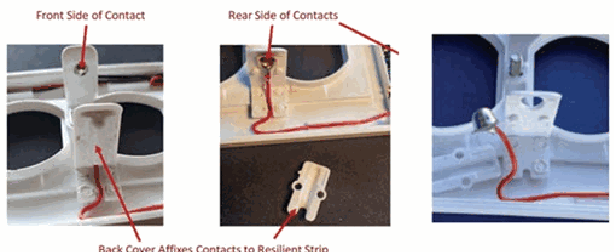
Id. (annotations added by SnapPower). But “[a]s visible in [the above] images, once the back cover is removed, the contact can freely slide out of the hole in the resilient strip.” Id. Thus, the district court agreed with OWL that a skilled artisan “would know that being ‘joined’ to something requires more than just being inserted through a hole and supported from behind.” Id.
SnapPower now contends that the district court applied a new, unduly narrow construction of “joined” at summary judgment. And SnapPower argues that, under a proper construction of “joined” that accounts for the broad scope of its ordinary meaning, the limitation is met and claim 1 is infringed. We agree.
The language of claim 1 and the specification of the ’324 patent lead us to conclude that claim 1 is not as limited as the district court determined. The claim language does not specify the mechanism or means by which the contact is “joined to” the resilient strip; it simply provides that “the contact is joined to the resilient strip.” See ’324 Patent, 30:28–29. The specification also discloses that “a number of other techniques can be used to attach the non-conductive portion (922). For example, the non-conductive portion (922) may be joined to the conductive portion (918) by adhesive, heat welding, press fit, snap fit, induction welding (for specific types of materials), ultrasonic welding/staking,7 and other suitable techniques.” ’324 Patent, 18:56–62 (emphases added); see also id., 18:62–63 (“These techniques can be used separately or in combination.”). The specification’s broad range of examples of how the portions may be “attach[ed],” or “joined,” supports a meaning of the claim term that is broad in its scope. See Prima Tek II, L.L.C. v. Polypap, S.A.R.L., 318 F.3d 1143, 1151 (Fed. Cir. 2003) (noting that varied use of a term “demonstrates the breadth of the term rather than providing a limited definition”).
In granting OWL’s motion for summary judgment, the district court relied on the specification’s purported distinction between the meaning of “support” and “joined.” Decision, 2024 WL 4847377, at *6–7. The district court found that, since “the specification discusses ‘joining’ as being some form of mechanical fastening” and “uses the word ‘supporting’ when describing something being held in place,” “joined” must require “more than just being inserted through a hole and supported from behind.” Id. But this observation does not compel the conclusion that “joined” requires some unknown “more.” There is nothing in the ’324 patent that suggests that “joined” and “support” are so distinct. See, e.g., 3M Innovative Props. Co. v. Tredegar Corp., 725 F.3d 1315, 1333 (Fed. Cir. 2013) (declining to narrow a claim term “unless there is support for the limitation in the words of the claim, the specification, or the prosecution history”).
The district court also relied on extrinsic evidence, citing dictionary definitions, to support its understanding that “‘joining’ requires more than just holding something in place.” Decision, 2024 WL 4847377, at *7 (noting definition of “joined” as “to put or bring together so as to form a unit” and of “support” as “to hold up or serve as a foundation or prop for” (citations omitted)). But again, this extrinsic evidence does not support limiting the scope of the claim language when nothing in the specification suggests this is necessary. See Phillips v. AWH Corp., 415 F.3d 1303, 13188 (Fed. Cir. 2005) (explaining that extrinsic evidence is “less reliable than the patent and its prosecution history in determining how to read claim terms”).
Under a construction that is not incorrectly limited, consistent with the plain and ordinary meaning of “joined,” there is no question that the only claim limitation in dispute is met by the Accused Products. The Accused Products have an electrical contact that “rests inside a hole in the spring clip and is held in place by a separate rear cover attached to the resilient strip.” Decision, 2024 WL 4847377, at *6 (emphasis added). In other words, the contact is “joined to” the resilient strip. We therefore reverse the district court’s grant of summary judgment of non-infringement as to independent claim 1 and dependent claims 2, 4, 8, 9, and 10; remand with instructions to grant partial summary judgment of infringement as to claims 1, 2, and 8; and remand for further proceedings as necessary as to claims 4, 9, and 10, which were not part of SnapPower’s motion for partial summary judgment of the ’324 patent. J.A. 2614– 18.
B
We next turn to SnapPower’s argument that the district court’s summary judgment of non-infringement as to claim 11 of the ’180 patent should be vacated. Claim 11 recites:
11. An active cover plate comprising: a faceplate; an electrical load; and a spring clip comprising an electrical contact on the
spring clip to contact a side screw terminal on the receptacle body and wherein a portion of the spring clip is configured to contact a wall of a receptacle box surrounding the receptacle body.
9’180 Patent 16:60–67 (emphasis added). SnapPower argues that material questions of fact exist as to whether the Accused Products meet the “configured to” limitation such that summary judgment was improper. We are unpersuaded.
During claim construction, the district court concluded that “configured to” did not require construction. See J.A. 42–43. At summary judgment, the district court applied an ordinary meaning of “configured to” that it found both parties’ experts had agreed on—that “configured to” means “designed to.” See Decision, 2024 WL 4847377, at *5. The district court then noted that the Accused Products’ spring clips, which are “approximately 2 to 2.15 inches wide,” do not contact the wall of the standard 2.25-inch receptacle box and that there was evidence of “at least one receptacle box that was narrower than 2.15 inches.” Id. (cleaned up). But the district court found that this “shows mere capability to touch the wall” and not that the Accused Products’ spring clips were “designed to” contact the walls of a receptacle box. Id.
Given the parties’ agreed-upon and unchallenged construction of “configured to,” we agree with the district court that “[a] product that is ‘designed to’ touch the wall would do so for more than the narrowest outlier receptacle box.”2 Decision, 2024 WL 4847377, at *5–6. SnapPower’s argument—that there is evidence of some infringing uses with narrow receptacle boxes—does not create a genuine dispute of material fact that precludes summary judgment.310 Therefore, given that it is not genuinely disputed that the Accused Products’ spring clips (1) do not touch the wall of most receptacle boxes, and (2) could be damaged if used in a narrow receptacle box, see J.A. 3369–70, the district court did not err in finding that the Accused Products do not meet the “configured to” limitation. We affirm the district court’s grant of summary judgment of non-infringement for claims 11, 12, 13, and 15 of the ’180 patent.
C
SnapPower also raises a series of additional challenges to the district court’s grant of summary judgment of noninfringement for other claims of the Asserted Patents. We briefly discuss each below but find SnapPower’s arguments unpersuasive, and, as such, we affirm the district court’s grant of summary judgment of non-infringement for claims 13, 14, 15, 17, 19, 20, 23, and 25 of the ’324 patent and claims 1, 2, 3, 5, and 6 of the ’180 patent.
1
First, we consider SnapPower’s argument that the district court misconstrued the claim term “sandwiched” and thus erred in granting summary judgment of non-infringement as to claims 13, 14, and 15 of the ’324 patent. Claim 13, which is representative, recites:
13. An active cover plate comprising: a face plate;
an electrical load; a clip extending rearward
11from the face plate to interface with screw terminals of a receptacle body, wherein the clip comprises: a contact; a conductor connected to the contact; a front insulator; and a rear insulator, wherein the conductor is sandwiched between the front insulator and the rear insulator; an electrical connection between the contact and the electrical load.
’324 Patent 30:65–31:5 (emphasis added). The district court construed “sandwiched between” to mean “a third element placed between and in contact with a first and second element.” J.A. 32.
SnapPower argues that the district court erred by implicitly construing “sandwiched” to require simultaneous, direct contact with both the front and rear insulators. According to SnapPower, “sandwiched” simply means “insert[ed] between two other things,” which would not exclude air. Appellant Br. 49–50. SnapPower relies upon Figure 4B, which it contends depicts an air gap layer between the conductor and the top insulator. See Appellant Br. 47–48 (citing J.A. 387–88 (expert report annotating Figure 4B)); id. at 48 (arguing that a construction that excludes an embodiment “is necessarily incorrect” (citing Vitronics Corp. v. Conceptronic, Inc., 90 F.3d 1576, 1583 (Fed. Cir. 1996)).
We see no error in the district court’s construction, which allows for some air but requires that both insulators come into some direct contact with the conductor. SnapPower’s arguments do not convince us otherwise. For example, the ’324 patent does not state that Figure 4B is drawn to scale, so it is unclear from the drawing whether there is a complete air gap as SnapPower contends or whether there may be some points of direct contact. Given this ambiguity, we are unconvinced that Figure 4B compels the conclusion that the district court’s construction12 was erroneous or that SnapPower’s more extreme construction is correct. See Nystrom v. TREX Co., 424 F.3d 1136, 1149 (Fed. Cir. 2005) (“[A]rguments based on drawings not explicitly made to scale in issued patents are unavailing.”). We also disagree that, even under the district court’s construction, vacatur is warranted, as we disagree that the district court impermissibly resolved triable issues of fact. The district court rejected SnapPower’s expert testimony because it “directly contravene[d] the physical reality of the Accused Products.” Decision, 2024 WL 4847377, at *8. We find no error in the district court’s decision to disregard SnapPower’s expert testimony and to find the testimony did not raise a genuine issue of material fact. See Scott v. Harris, 550 U.S. 372, 380 (2007) (noting that facts should not be credited at summary judgment when they are “blatantly contradicted by the record”). We therefore affirm.
2
We next turn to SnapPower’s assertion that the district court erred in granting summary judgment of non-infringement as to claims 17, 19, 20, 23, and 25 of the ’324 patent based on findings about the “three spaced apertures” limitation of claim 17. Claim 17 recites, in relevant part, “[a]n active cover plate comprising: a faceplate comprising: three spaced apertures along one edge . . . .” ’324 Patent 31:13– 14 (emphasis added). The district court construed “aperture” as an “opening.” J.A. 34. SnapPower argues that the district court erred in applying a construction that limited the “opening” to a physical opening that allowed airflow, therefore excluding an opening for only light—i.e., an opening with a translucent cover blocking the physical hole.
We are unpersuaded by SnapPower’s arguments and agree with the district court’s construction of aperture as a physical opening, which is consistent with the term’s ordinary meaning and the specification. See ’324 Patent 12:54– 60 (explaining that “one or more apertures (524) can provide access to the switch,” which would not be possible if13 the aperture was covered), figs. 5A & 5B (depicting a light switch and an “aperture” that the switch is inserted through to be accessed). The Accused Products contain a single opening along the edge of the faceplate, which is covered by a translucent plastic piece with three ridged areas corresponding to LED locations. See Decision, 2024 WL 4847377, at *8. Therefore, we agree with the district court’s finding that the “three spaced apertures” limitation was not met. And given our agreement with the district court’s claim construction, we are also unpersuaded by SnapPower’s arguments that the district court erred in its doctrine of equivalents analysis.
3
Finally, we consider SnapPower’s argument that the district court erred in granting OWL’s motion for summary judgment of non-infringement for claims 1, 2, 3, 5, and 6 of the ’180 patent because a reasonable jury could have found that two disputed limitations, emphasized below, were present in the Accused Products. Claim 1 is representative and recites:
1. An active cover plate comprising: a faceplate; a load; and a spring clip extending rearward from the faceplate
to interface with a receptacle body, wherein the spring clip comprises: a flexible conductive portion connected to
the face plate by a first end; and
a non-conductive portion connected to an
opposite end of the flexible conductive portion;
wherein an electrical contact on the spring
clip contacts a side screw terminal on
14the receptacle body to extract electrical power from the receptacle body to energize the load.
’180 Patent 16:10–23 (emphases added). Relevant here, the Accused Products contain flexible wires that are connected to an electrical contact on one end and a printed circuit board on the other, as shown below:
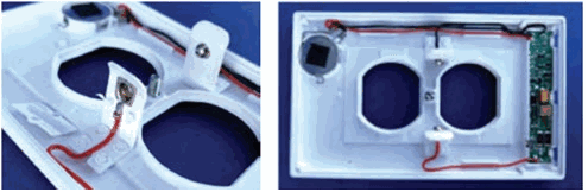
See Decision, 2024 WL 4847377, at *3.
SnapPower faults the district court for considering whether the ends of the Accused Products’ wires were connected as described by the claims, when the analysis, it argues, should have been whether “a first end of the flexible conductive portion of the spring clip is connected to the face plate.” Appellant Br. 60 (emphasis omitted). It was SnapPower, however, who directed the district court to consider the wire in the Accused Product as the flexible conductive portion. See J.A. 3367–68. We see no error in the district court’s analysis that followed SnapPower’s own claim mapping. We affirm.
IV
We have considered the parties’ remaining arguments and find them unpersuasive. For these reasons, we reverse-in-part, affirm-in-part, vacate-in-part, and remand for further proceedings.
REVERSED-IN-PART, AFFIRMED-IN-PART,
VACATED-IN-PART, AND REMANDED
15COSTS
No costs.
Footnotes
- ↩ 1 OWL sought to construe “joined” to mean “[e]lectrically and/or mechanically coupled with a material.” J.A. 33. This construction was rejected partly because the district court found that an electrical limitation is “not inherent in the concept of ‘joined.’” J.A. 33.
- ↩ 2 Given the parties’ agreed upon construction of “configured to” as “designed to,” our line of cases discussing apparatus claims and suggesting actual performance may not be required are inapplicable.
- ↩ 3 SnapPower also argues that OWL’s expert “apparently modified the outlet receptacle used in his analysis,” and that this raises “a material question of fact as to the reliability of [OWL’s expert’s] testimony and Owl’s evidence.” Appellant Br. 74. Mere speculation in the form of attorney argument, however, is insufficient to establish a genuine issue of material fact. See Taurus IP, LLC v. DaimlerChrysler Corp., 726 F.3d 1306, 1324–25 (Fed. Cir. 2013) (citing Enzo Biochem, Inc. v. Gen–Probe, Inc., 424 F.3d 1276, 1284 (Fed. Cir. 2005)).