NOTE: This disposition is nonprecedential. United States Court of Appeals
for the Federal Circuit
DS ADVANCED ENTERPRISES, LTD.,
Plaintiff-Appellant
v.
LOWE’S HOME CENTERS, LLC,
Defendant-Cross-Appellant
2025-1072, 2025-1581
Appeals from the United States District Court for the Southern District of California in No. 3:23-cv-01335-CAB-JLB, Judge Cathy Ann Bencivengo.
Decided: November 23, 2026
PATRICK DEAN CUMMINS, Cummins IP Law PLLC, Lexington, KY, argued for plaintiff-appellant.
KATHERINE M. LIEB, Sills Cummis & Gross PC, New York, NY, argued for defendant-cross-appellant. Also represented by SCOTT STIMPSON.
Before CHEN, CUNNINGHAM, and STARK, Circuit Judges.
DS Advanced Enterprises, Ltd. (“DS Advanced”) owns U.S. Patent No. 11,054,118 (“’118 patent”), which relates generally to a light-emitting diode (“LED”) light fixture that attaches either to a ceiling or to a recessed light fixture. DS Advanced sued Lowe’s Home Centers, LLC (“Lowe’s”) for infringement of the ’118 patent.
The district court granted summary judgment of noninfringement and denied DS Advanced’s motion to alter or amend the judgment. The district court also sanctioned DS Advanced’s attorney for violating a stipulated protective order. Later, the district court denied the motion for attorneys’ fees and costs filed by Lowe’s.
DS Advanced appeals the judgment of noninfringement and the denial of its motion to alter or amend. DS Advanced’s attorney appeals the sanctions order. Lowe’s cross-appeals the denial of fees. We affirm the district court in all respects.
I
A
The ’118 patent explains that consumers and electricians historically had to purchase different LED recessed light fixtures depending on whether they were performing a “new construction” installation, typically into a ceiling, or a “retrofit” installation into an existing recessed light fixture. J.A. 8 at 1:21-26. The patent addresses that problem by using different mounting methods for each type of use, allowing sellers and installers to reduce necessary inventory.
Claim 1 is representative:
An apparatus to detachably attach an LED light fixture to at least one of a ceiling, and a recessed lighting fixture housing, the apparatus comprises:
3a plurality of retrofit clips (102) adaptable to at-
tach with a body of the LED light fixture by screwing them into a plurality of screw holes (110);
a plurality of new construction clips (104); a plurality of connecting posts (106) to hold the
new construction clips (104);
a metal housing (108) to embody a complete fix-
ture (112);
a junction box (116) to hold a plurality of connec-
tion wirings, wherein the junction box (116) comprises a plurality of output wires; and a twist connector (118) to attach the output wires
of the junction box (116) to the metal housing (108), wherein the retrofit clips (102) make a friction fit inside the recessed lighting fixture housing to secure the complete fixture (112) inside, wherein the new construction clips (104) are attached to the connecting posts (106) if the recessed lighting fixture housing is not present.
J.A. 10 at 6:9-28 (emphasis added).
As the district court observed, claim 1 uses an “unusual format” of incorporating the specification’s reference numerals into each limitation. J.A. 14. Figures 8A and 6, reproduced below, depict embodiments of the claimed invention that include several of the numbered elements of the claim. J.A. 6–7.
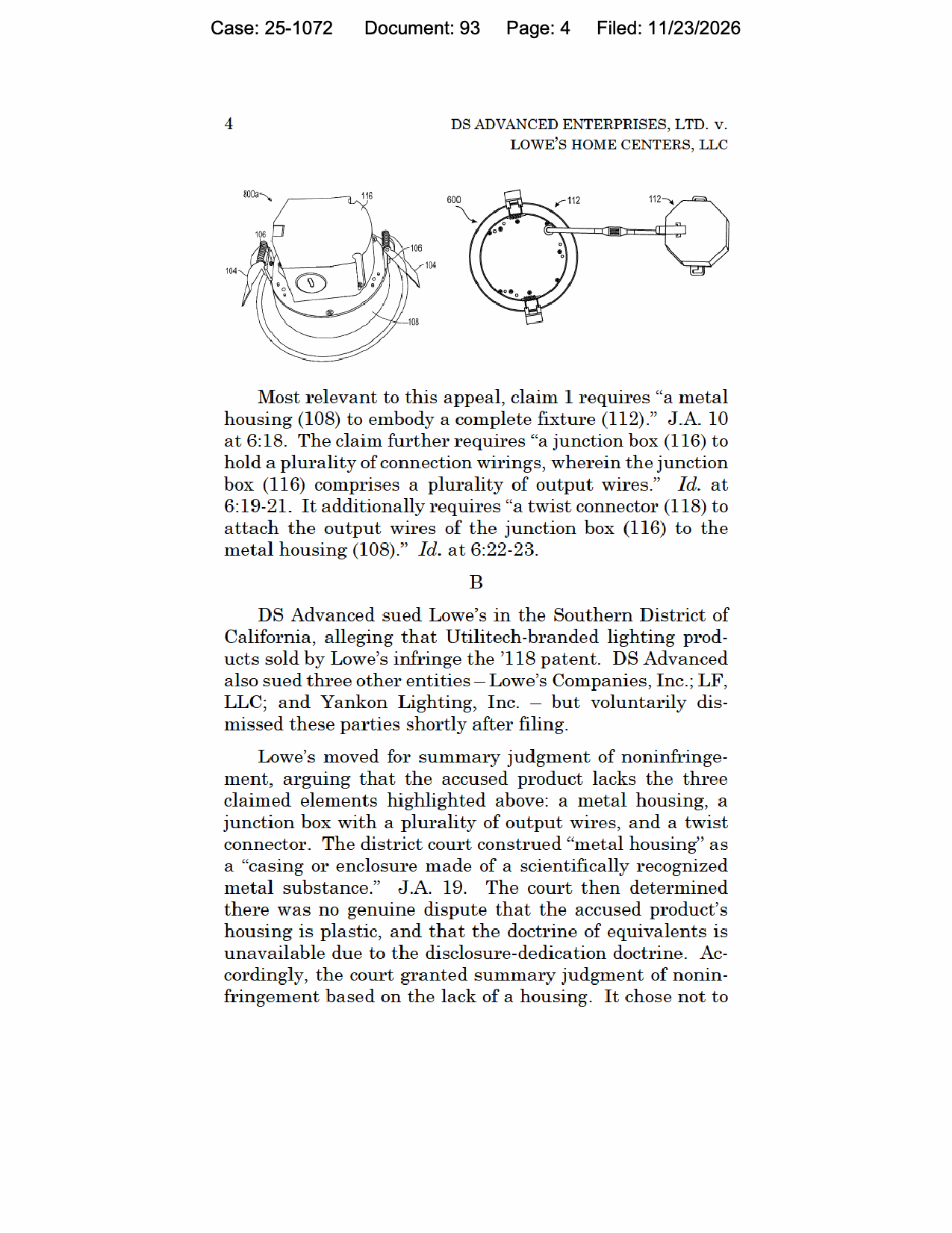
5evaluate whether the accused product might also lack the junction box or twist connector limitations.
DS Advanced then moved to alter or amend the judgment under Federal Rules of Civil Procedure 52(b) and 59(e), arguing that an internal metal disc in the accused product is the claimed metal housing. The district court denied the motion.
During discovery, Lowe’s had produced commercially sensitive sales, cost, and profit data, as well as product-proposal presentations, all of which it designated as “confidential” and “for counsel only” under the governing protective order. After learning that DS Advanced’s counsel, Patrick Cummins, had twice disclosed some of this information to DS Advanced’s president, Lowe’s moved for sanctions. The magistrate judge to whom the motion was referred found that Mr. Cummins had, in fact, violated the protective order and recommended imposing sanctions on Mr. Cummins, but not also on DS Advanced. The district judge adopted the recommendation in full.
At the conclusion of the case, Lowe’s moved for attorneys’ fees and costs under 35 U.S.C. § 285 and 28 U.S.C. § 1927. The district court denied the motion. While the court had been “highly skeptical” of DS Advanced’s proposed claim construction for the “metal housing” element, calling it “almost frivolous” and based on a strained reading of the claim, it found, nonetheless, under the totality of the circumstances, that DS Advanced had not knowingly asserted a meritless position in bad faith or for an improper purpose. J.A. 46. The court also declined to award fees under § 1927. Counsel’s litigation style was “overly aggressive” and at times “condescending” toward the court, but there was no evidence counsel had intentionally or in bad faith unreasonably multiplied the proceedings.
II
We turn first to DS Advanced’s and its attorney’s appeal, addressing their challenges to the district court’s rulings in two parts. First, we consider noninfringement, which is the subject of the order granting summary judgment of noninfringement as well as the order denying the motion to alter or amend that judgment. Second, we discuss the magistrate judge’s recommendation that sanctions be imposed on DS Advanced’s counsel and the district court’s order adopting that recommendation. Because we agree with the district court that there is no genuine dispute that the accused product lacks the claimed “metal housing,” and because Mr. Cummins violated the protective order without substantial justification, we find no merit to either aspect of the appeal.
A
In challenging the noninfringement orders, DS Advanced argues that the district court: (1) erred in holding that the accused product does not have a “metal housing,” (2) misapplied the summary judgment standard, and (3) abused its discretion in refusing to alter or amend the judgment. We apply regional circuit law to procedural issues not unique to patent law and our own law to patent issues. See Ingevity Corp. v. BASF Corp., 166 F.4th 1324, 1332 (Fed. Cir. 2026). We review the district court’s grant of summary judgment de novo, see Brown v. Alaska Airlines, Inc., 179 F.4th 707, 717 (9th Cir. 2026), and its denial of the motion to alter or amend the judgment for abuse of discretion, see State of Idaho Potato Comm’n v. G & T Terminal Packaging, Inc., 425 F.3d 708, 718 (9th Cir. 2005).
1
To prove infringement, a patentee must show that the accused product meets each limitation of the claim as properly construed, literally or by equivalents. See Catalina Mktg. Int’l, Inc. v. Coolsavings.com, Inc., 289 F.3d 801,7 812 (Fed. Cir. 2002). The district court construed “metal housing (108)” as a “casing or enclosure made of a scientifically recognized metal substance,” and DS Advanced does not challenge that construction. See Open. Br. at 33 n.8; see also Oral Arg. at 7:30-:40. Instead, DS Advanced contends that a reasonable jury, viewing the evidence in the light most favorable to DS Advanced, could find this limitation met by a frisbee-shaped metal disc in the accused product (shown in the photos below), to which the LED strip, the diffuser lens, and various electrical components attach. J.A. 253 (showing accused product, including metal disc and white plastic portions).
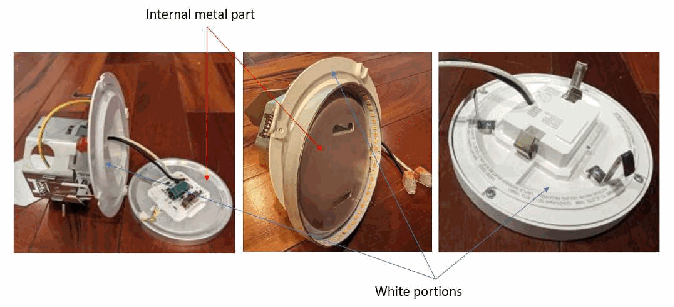
We are not persuaded. The disc identified by DS Advanced is not a casing or enclosure. The LED strip and other components are attached to it and, as DS Advanced’s own photographs show, remain exposed on at least one side. DS Advanced responds that because the LED strip is mounted on the inner rim of the disc, it is therefore enclosed by the disc. But no reasonable jury, even drawing all reasonable inferences in favor of DS Advanced, could find that parts mounted on a surface and left exposed, are encased or enclosed by that surface. That is particularly so because the only structure in the accused product that encases anything is the white plastic portion, consisting of an outer rim and “wafer” top, J.A. 51 & n.1, that surrounds8 both the disc and the components attached to it.1 It is undisputed that the disc sits inside that plastic portion and cannot be seen until the plastic “wafer” top is removed. J.A. 51 n.1.
In sum, the accused product’s housing is plastic, not metal. Because no reasonable jury could find that the accused product has a “metal housing,” the district court correctly concluded that there is no genuine dispute of material fact as to infringement.
2
DS Advanced’s procedural challenges do not change this result. DS Advanced argues that the district court should not have granted summary judgment because Lowe’s failed to carry its initial burden. A party moving for summary judgment of noninfringement must identify “the specific ways in which [the] accused [products] did not meet the claim limitations.” Exigent Tech., Inc. v. Atrana Sols., Inc., 442 F.3d 1301, 1308-09 (Fed. Cir. 2006). Lowe’s met this standard by contending that DS Advanced had no evidence that the accused product, whose housing is plastic, meets the “metal housing” limitation.
DS Advanced also argues that the district court improperly resolved fact disputes, which it may not do at summary judgment. Here, too, we see no error. The district court compared the properly construed claim to the accused product, considering all of DS Advanced’s evidence in the light most favorable to DS Advanced, and found that no reasonable factfinder could find that the accused product contains a metal housing. The district court correctly determined that DS Advanced’s evidence and arguments9 failed to create a genuine dispute of material fact on this point.
3
Nor did the district court abuse its discretion by denying DS Advanced’s motion to alter or amend the judgment. In the Ninth Circuit, reconsideration is appropriate only for newly discovered evidence, clear error or manifest injustice, or an intervening change in controlling law. See Sch. Dist. No. 1J, Multnomah Cnty., Or. v. ACandS, Inc., 5 F.3d 1255, 1263 (9th Cir. 1993). DS Advanced showed none of these. Its motion clarified its earlier positions and put new focus on its contention that the metal disc is the housing. The district court considered the arguments and rejected them. It did not abuse its discretion.
B
We next turn to the sanctions orders, beginning with whether we have jurisdiction over this portion of the appeal. The amended notice of appeal does not include Mr. Cummins as a party, in either the caption or the body of the notice, as is required by Federal Rule of Appellate Procedure 3(c)(1)(A) (“The notice of appeal must . . . specify the party or parties taking the appeal by naming each one in the caption or body of the notice . . . .”). Failing to timely file a proper notice of appeal is a jurisdictional defect that cannot be waived. See VDPP, LLC v. Volkswagen Grp. of Am., Inc., 186 F.4th 1372, 1380 (Fed. Cir. 2026). Even so, “this rule is to be liberally construed,” id., and an appeal must not be dismissed “for failure to name a party whose intent to appeal is otherwise clear from the notice.” Fed. R. App. P. 3(c)(7).
10It is clear from the notice of appeal here that Mr. Cummins intended to appeal the sanctions orders.2 Although the notice was filed only in the name of DS Advanced – which is the only party listed in the caption and body – it identified the specific orders being appealed, which include the magistrate judge’s and district judge’s orders imposing sanctions. J.A. 1962 (listing district court ECF Nos. 97, 107); see also J.A. 1973-74 (district court docket sheet). Because the appeal unambiguously includes the sanctions orders, and the sanctions were imposed solely on Mr. Cummins, “there [i]s no confusion as to whether the client, the attorney, or both [a]re appealing from the judgment.” Agee v. Paramount Commc’ns Inc., 114 F.3d 395, 399 (2d Cir. 1997); see also Garcia v. Wash, 20 F.3d 608, 610 (5th Cir. 1994) (attorney’s intent to appeal was clear from notice where sanctions were imposed only on attorney). Thus, we have jurisdiction over Mr. Cummins’ appeal.
Mr. Cummins challenges both the finding that he violated the protective order and the amount he has been ordered to pay as a sanction.3 We review discovery sanctions for abuse of discretion, see Key v. Qualcomm Inc., 129 F.4th 1129, 1138 (9th Cir. 2025), and the underlying factual 11findings for clear error, see Anheuser-Busch, Inc. v. Nat. Beverage Distribs., 69 F.3d 337, 348 (9th Cir. 1995). Mr. Cummins has shown no error in the court’s decisions.
It is undisputed that Mr. Cummins disclosed confidential Lowe’s sales data and product images to his client “on not one, but two, separate occasions, despite having been advised of the violation after the first occasion.” J.A. 30-31. There is also no dispute the disclosure of the confidential sales data violated the protective order. Oral Arg. at 11:03-:44 (Mr. Cummins conceding this point). Even if, as Mr. Cummins insists, the data and images he disclosed were improperly designated confidential, Mr. Cummins failed to follow the protective order’s procedures for challenging a designation. Under the protective order, Mr. Cummins was not permitted to disclose Lowe’s confidential information to anyone other than counsel, unless and until he made a successful challenge to the designation. As the magistrate judge explained, a party “may not unilaterally decide not to comply with the protective order because that party has decided the material was improvidently designated as confidential.” J.A. 30-31. The district court did not err in finding a violation of the protective order.
There having been a failure to comply with the protective order, Federal Rule of Civil Procedure 37(b)(2)(C) required the court to “order the disobedient party, the attorney advising that party, or both to pay the reasonable expenses, including attorney’s fees, caused by the failure, unless the failure was substantially justified or other circumstances make an award of expenses unjust.” The magistrate judge found that the violation was “not substantially justified.” J.A. 31. Instead, Mr. Cummins was “careless with . . . sensitive information” and divulged confidential information a second time after being on notice of the first violation. Those findings, which are not clearly erroneous, support the imposition of sanctions. See generally Evon v. Law Offs. of Sidney Mickell, 688 F.3d 1015,12 1035 (9th Cir. 2012) (“A district court’s findings in a sanctions case are given great deference.”) (internal quotation marks omitted).
Nor did the district court abuse its discretion in setting the amount of sanctions. Mr. Cummins argues that Lowe’s suffered no harm and that the amount of hours it devoted to dealing with his violation are unreasonable. But the magistrate judge accounted for both points by excluding a large portion of the hours Lowe’s attorneys worked on the matter. Specifically, after weighing “the relative financial positions of the parties, the lack of evidence of intentionality, the remediation efforts undertaken by Plaintiff’s counsel, and the lack of persuasive evidence of harm to [Lowe’s],” the magistrate judge determined “that an appropriate sanction under these circumstances should not exceed $25,000,” well below the $41,448 Lowe’s had requested. J.A. 34, 38. The district court adopted those well-supported findings, and the resulting award was within its broad discretion.
III
Finally, we address the cross-appeal of Lowe’s from the district court’s denial of attorneys’ fees under 35 U.S.C. § 285 and sanctions under 28 U.S.C. § 1927. Finding no abuse of discretion, we affirm. See Highmark Inc. v. Allcare Health Mgmt. Sys., Inc., 572 U.S. 559, 564 (2014) (review of § 285 determination is for abuse of discretion); Havensight Cap. LLC v. Nike, Inc., 891 F.3d 1167, 1171 (9th Cir. 2018) (same for review of § 1927 ruling).
Section 285 authorizes a district court to award attorneys’ fees to the prevailing party in “exceptional” patent cases. An exceptional case is one that “stands out from others” with respect to “the substantive strength of a party’s litigating position” or “the unreasonable manner in which the case was litigated.” Octane Fitness, LLC v. Icon Health & Fitness, Inc., 572 U.S. 545, 554 (2014). A case may be exceptional even if it is not objectively baseless. See id. at13 554-55. District courts make the exceptionality determination on a case-by-case basis, considering the totality of the circumstances. See Univ. of Utah v. Max-Planck-Gesellschaft zur Foerderung der Wissenschaften e.V., 851 F.3d 1317, 1322 (Fed. Cir. 2017). Federal Circuit law governs this issue. See Blackbird Tech LLC v. Health In Motion LLC, 944 F.3d 910, 914 (Fed. Cir. 2019).
Lowe’s contends this case is exceptional because DS Advanced’s infringement positions on all three limitations at issue on summary judgment – “metal housing,” “twist connector,” and “plurality of output wires” – were frivolous. The district court’s rejection of this contention was not an abuse of discretion.
As to the metal housing, the district court reviewed the history of the case and DS Advanced’s litigating positions. Although the court was “highly skeptical” of what it described as DS Advanced’s “almost frivolous” housing arguments, it was “not convinced that DS Advanced knowingly and intentionally asserted a meritless position for improper purposes.” J.A. 46. Instead, the district court found DS Advanced’s position “just wrong,” and not in a way that made this case stand out from others. J.A. 46. We perceive no basis to deem this evaluation an abuse of discretion. See SFA Sys., LLC v. Newegg Inc., 793 F.3d 1344, 1348 (Fed. Cir. 2015) (affirming determination that “litigating position was not so meritless as to ‘stand out’ from the norm”).
Nor did the district court abuse its discretion by declining to further analyze DS Advanced’s showing with respect to the twist-connector and output-wire limitations. “A district court need not, as [Lowe’s] seems to urge, litigate to resolution every issue mooted by summary judgment to rule on a motion for attorney fees. And we need not, as [Lowe’s] requests, get into the weeds on issues the district court never reached.” Spineology, Inc. v. Wright Med. Tech., Inc., 910 F.3d 1227, 1230 (Fed. Cir. 2018). District courts have “wide latitude” to assess whether to expend14 scarce judicial resources by “opening up” previously nonlitigated issues solely in aid of informing an attorneys’ fees motion. ThermoLife Int’l LLC v. GNC Corp., 922 F.3d 1347, 1357 (Fed. Cir. 2019).
Lowe’s also argues that other lawsuits brought by DS Advanced, including its initial allegations against three other parties in this very case, make this case exceptional. The district court rejected this contention, limiting itself to “the matters before it.” J.A. 45. District courts presented with a § 285 motion may need to consider a patent owner’s other litigation when “adequate evidence of an abusive pattern is presented.” SFA Sys., 793 F.3d at 1352. Here, however, Lowe’s merely lists other suits involving the ’118 patent asserted against Lowe’s; it offers no evidence about their merits or the purpose of those suits, much less evidence of a bad faith motive for bringing them (such as an abusive pattern of settlements). Lowe’s insists that DS Advanced attempted “to force a settlement by harassing Lowe’s with three different cases, in two different jurisdictions, against four different Lowe’s entities, all asserting this same [’118] patent,” Ans. Br. at 4, but it provides no evidence that any of this was harassment. The “mere existence of these other suits does not mandate negative inferences about the merits or purpose of this suit.” SFA Sys., 793 F.3d at 1351; see also ThermoLife, 922 F.3d at 1363 (filing dozens of suits does “not, by itself, justify an inference of . . . an improper motive”). Again, the district court did not abuse its discretion.
We reach the same conclusion with respect to the district court’s denial of the request for sanctions under § 1927. Section 1927 permits sanctions against an attorney who “multiplies the proceedings in any case unreasonably and vexatiously.” In the Ninth Circuit, § 1927 sanctions require a finding of subjective bad faith, which “is present when an attorney knowingly or recklessly raises a frivolous argument or argues a meritorious claim for the purpose of harassing an opponent.” Blixseth v. Yellowstone15 Mountain Club, LLC, 796 F.3d 1004, 1007 (9th Cir. 2015). Whether an attorney acted recklessly or in bad faith is a factual finding reviewed for clear error. See Lake v. Gates, 130 F.4th 1064, 1070 (9th Cir. 2025).
The district court found that Mr. Cummins neither acted in bad faith nor unreasonably multiplied the proceedings. Although the court described counsel’s litigation style as “perhaps overly aggressive” and “at times . . . somewhat condescending,” it found he did not act in an “intentionally harassing” manner, nor were his positions “advanced in bad faith.” J.A. 47. Lowe’s fails to show that this finding was clearly erroneous.
In sum, the district judge “was in the best position to understand and weigh these issues,” and we “will not second guess her determination[s].” Univ. of Utah, 851 F.3d at 1323. We affirm the denial of the motion for fees and sanctions.4
IV
We have considered the parties’ remaining arguments and find them unpersuasive.5 Accordingly, for the reasons given above, we affirm the district court.
AFFIRMED
COSTS
All parties to bear their own costs.
Footnotes
- ↩ 1 The white plastic portion is also the only component of the accused product that resembles element “108” depicted in Figure 8 of the specification.
- ↩ 2 Mr. Cummins confirmed this intent at oral argument. Oral Arg. at 10:10-:50.
- ↩ 3 To the extent DS Advanced is challenging the magistrate judge’s order sealing non-public financial and competitive information produced in discovery by Lowe’s, which is part of the same order imposing sanctions on Mr. Cummins (ECF No. 97 in the district court docket), we find no abuse of discretion in sealing this sensitive commercial information. See Uniloc 2017 LLC v. Apple, Inc., 964 F.3d 1351, 1357 (Fed. Cir. 2020) (applying Ninth Circuit law).
- ↩ 4 During this appeal, DS Advanced filed a motion for sanctions against Lowe’s pursuant to Federal Rule of Appellate Procedure 38 and 28 U.S.C. § 1927, arguing that the cross-appeal is frivolous, both as filed and as argued. ECF No. 46 (Case No. 25-1072). While Lowe’s has not prevailed on its cross-appeal, it is not frivolous in any respect. We deny the motion.
- ↩ 5 DS Advanced’s request for reassignment is moot.