United States Court of Appeals
for the Federal Circuit
NCS MULTISTAGE INC., NCS MULTISTAGE, LLC,
Plaintiffs-Appellees
v.
NINE ENERGY SERVICE, INC.,
Defendant-Appellant
2025-1000
Appeal from the United States District Court for the Western District of Texas in No. 6:20-cv-00277-ADA, Judge Alan D. Albright.
Decided: September 14, 2026
DOMINGO M. LLAGOSTERA, Blank Rome LLP, Houston, TX, argued for plaintiffs-appellees. Also represented by RUSSELL T. WONG; ANDREW K. FLETCHER, Philadelphia, PA; MEGAN R. WOOD, Washington, DC.
HILARY L. PRESTON, Vinson & Elkins LLP, Austin, TX, argued for defendant-appellant. Also represented by CORBIN CESSNA, JEFFREY TA-HWA HAN, ETHAN JAMES NUTTER, ERIK SHALLMAN.
Before REYNA, HUGHES, and CUNNINGHAM, Circuit Judges.
Nine Energy Service, Inc. (“Nine”) appeals the United States District Court for the Western District of Texas’s amended final judgment ordering that (1) Nine had directly infringed claims 28 and 29 of U.S. Patent No. 10,465,445 (the “’445 patent”); (2) Nine had induced infringement of claims 36, 39, 50–52, and 55–57 of the ’445 patent; (3) claims 28, 29, 36, 39, 50–52, and 55–57 (the “asserted claims”) of the ’445 patent were not invalid; and (4) NCS Multistage Inc. and NCS Multistage LLC (collectively, “NCS”) were entitled to damages. See J.A. 1–2. For the reasons below, we vacate and remand for further proceedings consistent with this opinion.
I. BACKGROUND
NCS sued Nine for infringing certain claims of the ’445 patent by making, using, offering for sale, and/or selling the BreakThru Casing Flotation Device. J.A. 354. The ’445 patent claims priority to a provisional patent application filed on February 5, 2013. ’445 patent. The ’445 patent relates to a tool used in the oil and gas industry to assist with inserting a long strip of pipe (the “casing” or “casing string”) to the bottom of a wellbore. See J.A. 3115; ’445 patent col. 1 ll. 22–67; see id. col. 16 ll. 1–20. The ’445 patent explains that “it may be difficult to run the casing to great depths because friction between the wellbore and the casing often results in a substantial amount of drag,” especially in “horizontal and/or deviated wells.” Id. col. 1 ll. 22–25. The ’445 patent further explains that, in the past, “[t]echniques to lighten or ‘float’ the casing have been used to extend the depth of well. For example, there exist[ ] techniques in which the ends of a casing string portion are plugged[, and] the plugged portion is filled with . . . fluid to provide a buoyant force,” reducing friction. Id. col. 1 ll. 34–39. In such techniques, once the plugged casing string has been “placed in the wellbore, the plugs must be drilled out, and the low density miscible fluid is forced out3 of the wellbore,” which “increases completion time.” Id. col. 1 ll. 39–42. The ’445 patent purports to solve this problem by using a “rupture disc” that “can be ruptured by engagement with an impact surface . . . once a rupturing force is applied to the disc.” Id. col. 2 ll. 3–7; see id. col. 16 ll. 1–20.
Claim 28 is illustrative of the issues on appeal and recites:
28. A float tool configured for use in positioning a casing string in a wellbore containing a well fluid, the casing string having an internal diameter that defines a fluid passageway between an upper portion of the casing string and a lower portion of the casing string, the float tool comprising:
a rupture disc assembly comprising (i) a tubular member having an upper end and a lower end, the upper and lower ends configured for connection in-line with the casing string and (ii) a rupture disc having a rupture burst pressure and in sealing engagement with a region of the tubular member within the upper and lower ends, wherein the rupture disc is configured to disengage from sealing engagement when exposed to a pressure greater than a hydraulic pressure in the casing string after the casing string has been positioned in the wellbore and the region of the tubular member where the rupture disc is attached has a larger internal diameter than the internal diameter of the casing string and is parallel to the internal diameter of the casing string.
Id. col. 16 ll. 1–20 (emphases added).
Figure 2 of the patent illustrates an embodiment of the claimed invention:

4Id. Fig. 2, col. 3, ll. 41–43.
The parties disputed the construction of “internal diameter.” See J.A. 33; see also J.A. 34. The annotated version of Figure 2 provided by Nine is helpful for understanding the parties’ dispute:

Appellant’s Br. 31. At the district court, NCS contended that the plain and ordinary meaning of an “internal diameter” could be both a measured diameter across the width of the pipe and a diameter along the length of the pipe (specifically when the claim refers to “the region of the tubular member where the rupture disc is attached” that “has a larger internal diameter than the internal diameter of the casing string”). J.A. 33–34 (quoting ’445 patent col. 16, ll. 17–20); NCS Multistage Inc.’s Reply in Support of its Opening Claim Construction Brief at 1–3, NCS Multistage Inc. v. Nine Energy Serv., Inc., No. 20-cv-00277-ADA,5 (W.D. Tex. Dec. 11, 2020), Dkt. No. 48. Nine contended that an “internal diameter” should be construed as “the diameter of a fluid channel measured perpendicularly from the inner wall of the fluid channel through the center of the fluid channel, to the opposite inner wall”—a measured diameter. J.A. 33. The district court agreed with NCS that “internal diameter” should be given its plain and ordinary meaning and added the clarification that “the plain and ordinary meaning can refer to both an inner surface and a measured diameter.” J.A. 33.
Before trial, NCS filed a supplemental claim construction brief, contending that “casing string” was limited to pipe of greater than or equal to 4.5 inches in outer diameter. J.A. 4763, see J.A. 4754–67. Nine contended that “casing string” had no size limitation. J.A. 4778–79; see J.A. 4769–80. The district court construed “casing string” to mean “pipe that is customarily ≥ 4.5 inches in outer diameter, which is intended to line the walls of a drilled well so that a downhole tool can be deployed without restriction.” J.A. 29.
At trial, Nine argued that TCO Group AS (“TCO”)1 sold a TDP-PO tool embodying the asserted claims of the ’445 patent to Eversolve in August 2011 and Apache in August 20122 prior to the alleged February 2013 priority date of the ’445 patent. J.A. 3839–53 (testimony of Mr. Brandsdal); J.A. 4493–97 (purchase orders). NCS argued that its prior sale to Tundra in July 2012 was a public disclosure that caused TCO’s sale to Apache to no longer qualify as6 prior art under 35 U.S.C. § 102(b)(1)(B). J.A. 4035 at 675:4–10; J.A. 4275–76 at 915:12–916:10; J.A. 4279–81 at 919:24–921:14. NCS also argued that the TDP-PO tool sold to Apache was a tubing tool, not a casing tool, because it had a diameter of less than 4.5 inches and that it failed to meet several other limitations. See J.A. 4132–42.
The jury returned a verdict in favor of NCS on both infringement and no invalidity. J.A. 19–25. The district court denied Nine’s renewed motion for judgment as a matter of law and its motion for a new trial, J.A. 3, and entered final judgment, including entering judgment that Nine directly infringed claims 28 and 29, that Nine induced infringement of claims 36, 39, 50–52, and 55–57, and that the asserted claims of the ’445 patent are not invalid. J.A. 1–2.
Nine timely appealed. We have jurisdiction under 28 U.S.C. § 1295(a)(1).
II. STANDARD OF REVIEW
“In reviewing district court judgments, we apply the law of the circuit in which the district court sits with respect to nonpatent issues, but we apply our own law to issues of substantive patent law.” In re Spalding Sports Worldwide, Inc., 203 F.3d 800, 803 (Fed. Cir. 2000). We review a district court’s denial of a motion for judgment as a matter of law or for a new trial, along with its discovery rulings, under the law of the regional circuit. Verizon Servs. Corp. v. Cox Fibernet Va., Inc., 602 F.3d 1325, 1331 (Fed. Cir. 2010) (discussing the applicable law for review of denials of judgment as a matter of law or for a new trial); Commissariat à l’Energie Atomique v. Chi Mei Optoelectronics Corp., 395 F.3d 1315, 1322–23 (Fed. Cir. 2005) (discussing the applicable law for review of discovery rulings); see MLC Intell. Prop., LLC v. Micron Tech., Inc., 10 F.4th 1358, 1367 (Fed. Cir. 2021) (discussing the applicable law and standard of review for imposition of discovery sanctions). The Fifth Circuit reviews the denial of a motion for7 judgment as a matter of law de novo, applying the same legal standard as the district court: “consider[ing] all of the evidence, drawing all reasonable inferences and resolving all credibility determinations in the light most favorable to the non-moving party,” then affirming “unless the jury’s factual findings are not supported by substantial evidence, or if the legal conclusions implied from the jury’s verdict cannot in law be supported by those findings.” Baisden v. I’m Ready Prods., Inc., 693 F.3d 491, 498–99 (5th Cir. 2012) (internal quotation omitted). The denial of a motion for a new trial is reviewed for abuse of discretion and is affirmed “unless the evidence—viewed in the light most favorable to the jury’s verdict—points so strongly and overwhelmingly in favor of one party that the court believes that reasonable [people] could not arrive at a contrary conclusion.” Id. at 504 (cleaned up). Discovery orders are also reviewed for abuse of discretion. EEOC v. BDO USA, L.L.P., 876 F.3d 690, 697 (5th Cir. 2017).
Federal Circuit law applies to claim construction. Magnolia Med. Techs., Inc. v. Kurin, Inc., 169 F.4th 1094, 1100 (Fed. Cir. 2026). We review claim construction de novo, with any underlying findings of fact based on extrinsic evidence reviewed for clear error. Id. at 1101. “Clear error exists when ‘we are left with a definite and firm conviction that a mistake has been committed.’” Id. (quoting Advanced Ground Info. Sys., Inc. v. Life360, Inc., 830 F.3d 1341, 1347 (Fed. Cir. 2016)).
III. DISCUSSION
Nine argues that the district court erred by incorrectly construing “internal diameter,” Appellant’s Br. 29–47; “disengage . . . from sealing engagement,” id. at 48–53; and “casing string,” id. at 54–62. Nine further argues that the district court erred by failing to grant judgment as a matter of law that TCO’s August 2012 sale of the TDP-PO tool to Apache, and Apache’s subsequent use of that device, were8 prior art as a matter of law, id. at 63–68; striking documents and testimony regarding the TCO-Maersk Qatar (“Maersk”) communications, id. at 69–73; and declining to exclude testimony of NCS’s damages expert because he failed to apportion portfolio licenses, id. at 73–75.3 We address each argument in turn.
A.
Nine argues that the district court erred by construing “internal diameter” to “refer to both an inner surface and a measured diameter.” Id. at 29–47; see J.A. 33–34. We agree.
There is a “presumption that the same terms appearing in different portions of the claims should be given the same meaning unless it is clear from the specification and prosecution history that the terms have different meanings at different portions of the claims.” Fin Control Sys. Pty, Ltd. v. OAM, Inc., 265 F.3d 1311, 1318 (Fed. Cir. 2001); see also Digit.-Vending Servs. Int’l, LLC v. Univ. of Phx., Inc., 672 F.3d 1270, 1275 (Fed. Cir. 2012). NCS makes two arguments to defend the district court’s construction, despite this presumption: (1) Nine has waived or forfeited4 its9 challenge to the district court’s construction, Appellees’ Br. 8–10; and (2) the specification and prosecution history, along with extrinsic evidence, support interpreting “internal diameter” as having different meanings across the claims, id. at 28–35. We disagree with both arguments.
i.
Nine has not forfeited its challenge to the district court’s claim construction. At the district court, Nine advanced a construction of “internal diameter” as “the diameter of a fluid channel measured perpendicularly from the inner wall of the fluid channel through the center of the fluid channel, to the opposite inner wall.” J.A. 33. It also contended that “the region of the tubular member where the rupture disc is attached has a larger internal diameter than the internal diameter of the casing string and is parallel to the internal diameter of the casing string” is either indefinite or alternatively means “a flat surface of the tubular member where the rupture disc is fastened, affixed, joined, or connected to the tubular member is circular and has a diameter larger than the internal diameter of the casing string, and defines a plane that is parallel to a plane defined by the set of internal diameters at a location in the casing string.” J.A. 34. On appeal, it contends that internal diameter has a plain and ordinary meaning of “measured diameter,” and that the parallel term has a plain and ordinary meaning where internal diameter refers to a10 measured diameter.5 Appellant’s Br. 32. While Nine’s proposed construction at the district court uses more words than its construction on appeal, the gravamen is the same: In both fora, it has contended that an “internal diameter” is a measured diameter across the width of a casing string and cannot also mean a diameter parallel to the surface of the casing string.6 “While the two formulations employ somewhat different language, they embody the same concept.” Gaus v. Conair Corp., 363 F.3d 1284, 1288 (Fed. Cir. 2004); see also Vectura Ltd. v. Glaxosmithkline LLC, 981 F.3d 1030, 1037–38 (Fed. Cir. 2020). Accordingly, Nine neither changed its position on this issue between the trial and appellate levels nor forfeited its argument that “internal diameter” is a measured diameter.
On the merits, it is not clear from the intrinsic evidence that an “internal diameter” was meant to have a different meaning in different portions of the claims. “We apply a presumption that the same terms appearing in different portions of the claims should be given the same meaning unless it is clear from the specification and prosecution history that the terms have different meanings at different portions of the claims.” Paragon Sols., LLC v. Timex Corp., 566 F.3d 1075, 1087 (Fed. Cir. 2009) (cleaned up) (quoting PODS, Inc. v. Porta Stor, Inc., 484 F.3d 1359, 1366 (Fed. Cir. 2007)). NCS contends that it is clear that the “internal diameter that defines a fluid passageway” must be “referring to the casing string’s inner surface to define11 the passageway,” because a measured diameter is a scalar property, which cannot define a passageway. Appellees’ Br. 30 (emphasis omitted) (internal quotation omitted). NCS makes substantially the same argument regarding the specification, citing parts of the specification where the “fluid passageway defined by the inner diameter is fully restored.” Id. at 31 (citing ’445 patent col. 1 ll. 47–49, 62–67, col. 2 ll. 40–44, col. 6 ll. 62–66, col. 7 ll. 3–10, col. 10 ll. 47–53). However, Nine contends that the internal diameter is across the width of the casing string, rather than along the length of the casing string. See Appellant’s Br. 32 (“To be clear, the measured diameter is not a numerical value, but rather the line representing the diameter that one measures.”); J.A. 4693–96 (Nine making similar arguments regarding internal diameter at the district court). Despite NCS’s argument, Nine’s proposed construction allows for a line across the casing string to define a fluid passageway. Accordingly, the intrinsic evidence does not clearly require “internal diameter” to have two different meanings.
Additionally, the prosecution history is not sufficiently clear to override the presumption that claim terms carry the same meaning throughout the patent. During prosecution, NCS amended its claims to clarify that the rupture disc was attached to a surface parallel to an internal diameter of the casing string. J.A. 124–26. It distinguished a prior art reference Gano7 as having a disc “in sealing engagement with and attached to a region of a tubular member that is not parallel to the internal diameter of the casing string but is instead sloped.” J.A. 125. Figure 3 of Gano is illustrative:

12J.A. 4530. NCS contends that Gano shows that the region of the tubular member parallel to the internal diameter was along the surface of the internal diameter by comparing annotated Figure 3 of Gano to annotated Figure 2 of the ’445 patent:
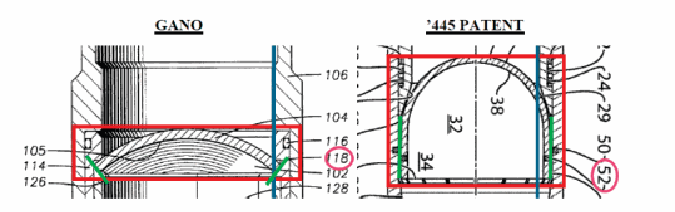
Appellees’ Br. 33.8 According to NCS, NCS distinguishing Gano as lacking a region parallel to the internal diameter clearly shows that it intended internal diameter to mean a diameter across the width of the casing string in one portion of the claim and a diameter along the length of the13 casing string in another portion of the claim. See id. at 32–34.
The problem for NCS is that because Gano’s region of attachment is neither parallel to a measured diameter nor the inner surface of the casing string, the prosecution history statement is consistent with the internal diameter being a measured diameter. Figure 3 of Gano and Figure 2 of the ’445 patent could be re-annotated as follows:

Appellant’s Br. 41, 43.9 As the annotations show, under either construction, the patentee’s statement that Gano lacks a disc “parallel to the internal diameter of the casing string,” J.A. 125, is still true and a way to distinguish Gano from the ’445 patent. As these alternative annotations show, the prosecution history statements, like the specification and claim language, are consistent with a definition of “internal diameter” that includes only a measured diameter. Because the intrinsic record was not clear that “internal diameter” should carry different meanings in different portions of the claims of the ’445 patent, the district court erred by holding that the term “can refer to both an inner surface and a measured diameter.” J.A. 33. Instead, we conclude that the plain meaning of “internal14 diameter” is a “measured diameter” across the width of the casing string.
ii.
Nine argues that, because we agree that the district court’s claim construction was erroneous, we can reverse the district court’s judgment of infringement. Appellant’s Br. 46–47. Nine also argues that, like Gano, the BreakThru devices contained a rupture disc attached to the casing string at an angle, rather than parallel to the measured diameter of the casing string:
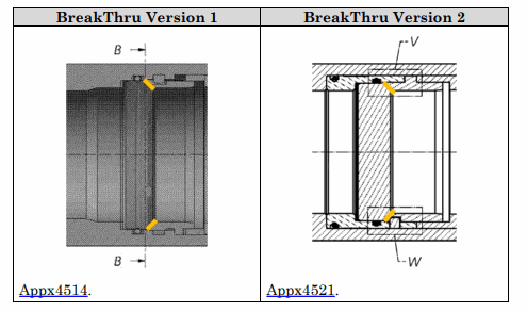
Id. at 47. We disagree and conclude that there remains a fact dispute for the jury.
Nine’s orange annotations to the sloped portions of the BreakThru devices are one possible location a jury could find that the rupture disc attaches. Nine has not explained why a jury could not find that the rupture disc attaches along the purple annotations below:
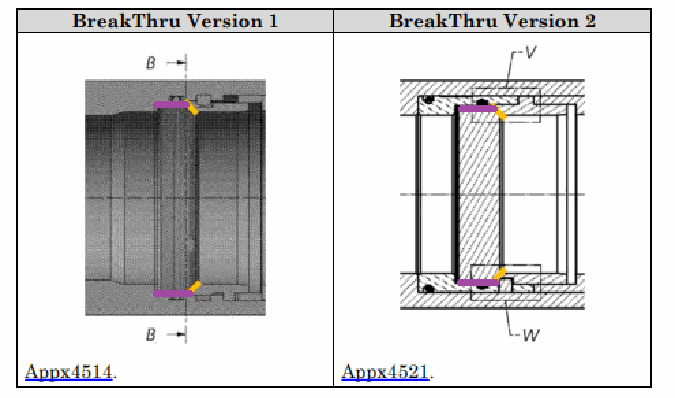
15Id. (purple annotations added by the court). These purple annotations are consistent with Nine’s arguments raised with respect to Gano:

Id. at 43; see also J.A. 4694–95. In each instance, a small portion of the surface that is not sloped appears to be parallel to a measured diameter. Accordingly, we vacate the district court’s judgment of infringement and remand for a new trial under the proper claim construction.
16B.
Nine next argues that the district court erred by construing “casing string” to mean “pipe that is customarily ≥ 4.5 inches in outer diameter, which is intended to line the walls of a drilled well so that a downhole tool can be deployed without restriction.” Appellant’s Br. 54–62; see J.A. 29. We agree.
As an initial matter, we reject NCS’s contention that Nine forfeited its challenge to the district court’s construction by failing to object to it. See Appellees’ Br. 10–12. “[A] party does not [forfeit] a claim construction argument by failing to object during trial when the construction proposed on appeal is the same as the construction proposed in a Markman hearing,” so long as the “issues were fully litigated and decided” before trial. Power Integrations, Inc. v. Fairchild Semiconductor Int’l, Inc., 904 F.3d 965, 973 (Fed. Cir. 2018) (quoting O2 Micro Int’l Ltd. v. Beyond In-nov. Tech. Co., 521 F.3d 1351, 1359 (Fed. Cir. 2008)). The parties presented competing claim constructions to the district court, J.A. 29; J.A. 3206–07 at 22:5–23:10, and the district court adopted a construction using some elements proposed by each party, J.A. 29. Nine proposes the same construction here as it did to the district court. Compare J.A. 29, with Appellant’s Br. 56. Because the issue was fully litigated at the district court, Nine has preserved its challenge to the district court’s construction on appeal.
We similarly reject NCS’s argument that Nine failed to explain the prejudice associated with the district court’s construction of “casing string.” Appellees’ Br. 12–17. NCS contends that (1) the district court’s construction did not technically exclude casing string of < 4.5 inches and that the jury heard testimony to that effect, id. at 13–15; and (2) other evidence in the record supported the jury’s verdict of no invalidity, primarily that the disclosures to Apache were not prior art, id. at 15–17. With respect to the first17 argument, the district court’s construction put a thumb on the scale. At trial, NCS argued that the TDP-PO tool prior art was not “configured for connection in-line with the casing string” because the tools were “not 4.5 inches or greater.” J.A. 4133 at 773:6–25. NCS was able to make this argument at least in part because of the district court’s construction. At a minimum, the jury could have been confused about the effect of the size limitation and its importance. See Appellant’s Br. 55–56. NCS’s second argument fails for a simpler reason: As explained below, we hold that the disclosures to Apache were prior art as a matter of law. See Section III.C, infra. Thus, we reject NCS’s contention that Nine failed to demonstrate prejudice from the size limitation being included in the construction of casing string.10
On the merits, nothing in the intrinsic record requires a size limitation on casing string. The specification repeatedly refers to a casing string without any size limitation, instead describing it by its function. See ’445 patent Fig. 1, col. 1 ll. 22–24, col. 2 ll. 31–48, col. 4 ll. 55–58, col. 5 ll. 62–63, col. 6 ll. 9–12. In the few places that the specification mentions size, the language is permissive. See, e.g., id. col. 8 ll. 22–26 (“The diameter of constricted opening 27 of lower tubular member 18 may be 4.5 inches (which is a common [internal diameter] for a casing, although other dimensions . . . are possible[.)]” (emphasis added)), col. 12 ll. 10–13 (“For example, the side walls of the rupture disc may be about 2.0 to 2.5 inches in height, when the rupture18 disc is installed in 4.5 or 5.5 inch casing.” (emphasis added)). This language is insufficient to support lexicography or disavowal. Thorner v. Sony Comput. Ent. Am. LLC, 669 F.3d 1362, 1365–67 (Fed. Cir. 2012) (“To act as its own lexicographer, a patentee must ‘clearly set forth a definition of the disputed claim term’ other than its plain and ordinary meaning. . . . To constitute disclaimer, there must be a clear and unmistakable disclaimer.” (quoting CCS Fitness, Inc. v. Brunswick Corp., 288 F.3d 1359, 1366 (Fed. Cir. 2002)).
NCS argues that the extrinsic evidence demonstrates that persons of ordinary skill in the art would understand “casing string” to have a size of ≥ 4.5 inches in diameter, “because wellbores that are lined with casing string have a standard size, and tubing tools for completing well operations have to fit inside of the casing string so they can be run downhole.” Appellees’ Br. 44–45; see id. at 44–48. In support of its argument, NCS primarily relies on industry catalogs that disclose many more casing offerings that are ≥ 4.5 inches in diameter than < 4.5 inches in diameter. See id. at 45–47.
The problem with NCS’s position is that, even if those catalogs were evidence of definitional plain meaning rather than mere commonality, any such definition is explicitly contradicted by the specification. Phillips v. AWH Corp., 415 F.3d 1303, 1319 (Fed. Cir. 2005) (en banc) (“[E]xtrinsic evidence may be useful to the court, but it is unlikely to result in a reliable interpretation of patent claim scope unless considered in the context of the intrinsic evidence.”); see id. at 1319–24 (criticizing “a methodology for claim interpretation in which the specification should be consulted only after a determination is made, whether based on a dictionary, treatise, or other source, as to the ordinary meaning or meanings of the claim term in dispute.”). While it is undisputed that, as a factual matter, 4.5 inches is a common size for casing string, the ’445 patent explicitly states19 that it is not limited to any particular size of casing string. See ’445 patent col. 8 ll. 22–26. In these circumstances, the district court erred by instructing the jury that, as a matter of claim construction, the ’445 patent defines “casing string” as being “customarily ≥ 4.5 inches in outer diameter.” See Union Carbide Chems. & Plastics Tech. Corp. v. Shell Oil Co., 425 F.3d 1366, 1377 (Fed. Cir. 2005), overruled in other part by Cardiac Pacemakers, Inc. v. St. Jude Med., Inc., 576 F.3d 1348, 1365 (Fed. Cir. 2009). The district court’s claim construction did not define the scope of the ’445 patent but instead hinted to the jury how to resolve the factual question of whether the TDP-PO tool was “configured for connection in-line with the casing string” that was itself “intended to line the walls of a drilled well.” ’445 patent col. 16 ll. 8–9; J.A. 29.
C.
Nine next argues, also with respect to the TDP-PO tool, that no reasonable jury could have found that NCS’s first sale of the AirLock device to Tundra was a public disclosure under 35 U.S.C. § 102(b)(1)(B).11 Nine further contends20 that the subsequent 2012 sale of the TDP-PO tool to Apache, and Apache’s subsequent use of that device, constituted prior art to the ’445 patent. Appellant’s Br. 63–68.
35 U.S.C. § 102(b)(1)(B) states that “[a] disclosure made 1 year or less before the effective filing date of a claimed invention shall not be prior art to the claimed invention under subsection (a)(1)” if “the subject matter disclosed had, before such disclosure, been publicly disclosed by the inventor or a joint inventor or another who obtained the subject matter disclosed directly or indirectly from the inventor or a joint inventor.” At trial, NCS argued that its first sale of the AirLock device to Tundra in July 2012 prevented TCO’s sale of the TDP-PO tool to Apache later in 2012 from constituting prior art. See, e.g., J.A. 4275–81. Nine contends that our decision in Sanho Corp. v. Kaijet Technology International Ltd., 108 F.4th 1376, 1385 (Fed. Cir. 2024), issued after the jury verdict in this case, is controlling, and that under Sanho, no reasonable jury could have found that the AirLock sale was a public disclosure. Appellant’s Br. 63–68. We agree.
Sanho interpreted 35 U.S.C. § 102(b)(2)(B), which applies to disclosures in patents and contains a safe harbor identically referring to subject matter that was “publicly disclosed by the inventor or a joint inventor or another who obtained the subject matter disclosed directly or indirectly from the inventor or a joint inventor.” 35 U.S.C. § 102(b)(2)(B); see Sanho, 108 F.4th at 1381 (explaining that the relevant language from the “subject matter disclosed” provisions is the same between 35 U.S.C. § 102(b)(1)(B) and 35 U.S.C. § 102(b)(2)(B)). In Sanho, we rejected the argument that “placing something ‘on sale’ in section 102(a)(1) means that the invention embodied by the21 device sold is necessarily ‘publicly disclosed’ for purposes of section 102(b)(2)(B).” Sanho, 108 F.4th at 1381–82. Instead, we held that the section 102(b)(2)(B) provision “applies only to ‘disclosures’ that result in the subject matter of the invention being ‘publicly disclosed.’” Id. at 1382. Although we did not state the exact boundaries of this exception, we explained that “‘publicly disclosed by the inventor’ must mean that it is reasonable to conclude that the invention was made available to the public.” Id. We also highlighted that “there is a difference between a commercial public use and a disclosure that puts the public in possession of the invention,” and that “[w]hile public disclosure of the features of the invention under section 102(b)(2)(B) could be accomplished through a public disclosure involving a public use, there is no requirement that such a public use necessarily ‘publicly disclose[s]’ the invention.” Id. at 1383–84 (alteration in original). Commercial public use, we explained, can include mere “commercial exploitation,” that does not resolve the relevant question of “whether the public has learned the relevant aspects of the invention.” Id. at 1384.
The factual circumstances of Sanho are particularly instructive in this case. Prior to the filing date, the inventor testified that he “sent to Sanho via private courier a finished version of the [HyperDrive]” and alleged a prior public disclosure. Id. He further testified that “Sanho placed an order” for 15,000 HyperDrives. Id. at 1384–85 (internal citation omitted). “There was no testimony concerning whether the order was fulfilled, or what became of the 15,000 HyperDrive devices (if they were ever manufactured). Although there was no confidentiality or nondisclosure agreement, there was no teaching of the features of the invention to others beyond Sanho.” Id. at 1385. “On these facts, we [did] not think it [was] a close question . . . . [T]he sale of the HyperDrive here did not publicly disclose the subject matter[.]” Id. In Sanho, we did22 “not decide exactly what is necessary for demonstrating that a sale publicly disclosed the relevant subject matter, or whether to apply the prevailing standard for when a printed publication is sufficiently publicly accessible to qualify as prior art.” Id.
We need not go further than Sanho to determine that no reasonable jury could have found that the sale of the AirLock to Tundra was a public disclosure. As in Sanho, the AirLock was privately sold to a single party (Tundra). See J.A. 3417–20. As in Sanho, there is no evidence that AirLocks were widely distributed or placed where the public could examine them. Instead, NCS’s CEO testified that, even when sold to Tundra, the AirLock was delivered in a sealed black tube that would have to be cut open. J.A. 3452–53 at 92:19–93:15; see also J.A. 4674; J.A. 4280 at 920:15–17 (NCS’s counsel arguing, during closing, that “[y]ou can take it apart and cut it apart” to examine it). Moreover, there is no evidence that receipt of one of these black tubes would allow members of the public to determine the “relevant aspects of the invention.” Sanho, 108 F.4th at 1385. NCS has not identified any record evidence that, for example, the public would be able to understand from the black tube that there was a “rupture disc [ ] configured to disengage from sealing engagement when exposed to a pressure greater than a hydraulic pressure in the casing string after the casing string has been positioned in the wellbore and the region of the tubular member where the rupture disc is attached has a larger internal diameter than the internal diameter of the casing string.” ’445 patent col. 16 ll. 12–19. Thus, as in Sanho, while there was no non-disclosure agreement,12 there was no teaching23 of the relevant aspects of the invention to “others beyond [Tundra].” Sanho, 108 F.4th at 1385. Accordingly, the TDP-PO tool from TCO’s August 2012 sale to Apache, and Apache’s use of that device, are prior art to the ’445 patent.
Because of the new construction of “casing string” and our holding that the TDP-PO tool from TCO’s sale to Apache was prior art as a matter of law, we vacate the judgment of no invalidity and remand for a new trial. In the Fifth Circuit, judgment as a matter of law is appropriate if “a reasonable jury would not have a legally sufficient evidentiary basis to find” for that party on an issue. Warner v. Talos ERT, L.L.C., 133 F.4th 412, 424 (5th Cir. 2025). On the other hand, when “it is unclear from the verdict which theory . . . persuaded the jury, a new trial is necessary if the evidence is insufficient on at least one theory but not on all” unless a court is “totally satisfied or reasonably certain based on the focus of the evidence at trial that the jury’s verdict was not based on the theory with insufficient evidence.” Id. (internal citations and quotation marks omitted). NCS has remaining arguments against invalidity, see Appellees’ Br. 14–20; Nine has not argued those theories are legally insufficient, see generally Appellant’s Br. 29–75; and we are not persuaded based on the focus of the evidence at trial that the jury’s verdict was premised solely on these alternative theories. Accordingly, we vacate the judgment of no invalidity, J.A. 1–2, and remand for a new trial consistent with this opinion.
D.
Nine contends that a new trial on invalidity is necessary for an additional reason: It contends that the district court abused its discretion by striking documents and testimony relating to potential sales of the TDP-PO tool by TCO to Maersk that were disclosed two days before the close of fact discovery. Appellant’s Br. 69–73. Nine makes two main arguments that: (1) Because it produced the24 relevant documents prior to the close of fact discovery, the district court could not strike the documents, id. at 70–71; and (2) it was diligent in seeking the documents and that the circumstances delaying the document production were beyond its control, id. at 69–71. We disagree with both arguments.
First, Nine identifies no authority from either the Fifth Circuit or the Federal Circuit in support of the proposition that the district court cannot require diligence beyond requiring documents to be disclosed by the end of fact discovery. See id. at 69–71. On the contrary, we have affirmed the exclusion of a patent from trial (although under 35 U.S.C. § 282) when the “disclosure of the . . . patent as an anticipatory prior art reference on the very last day of discovery meant [the opposing party] was stripped of any meaningful opportunity to prepare an adequate cross-examination of the reference.” Innogenetics, N.V. v. Abbott Lab’ys, 512 F.3d 1363, 1376 (Fed. Cir. 2008). In doing so, we expressly analogized to the Federal Rules of Civil Procedure, noting that the purposes of both section 282 and the Federal Rules of Civil Procedure are to prevent unfair surprise, rather than to facilitate production of evidence. Id. So too here: We do not conclude that a district court, as a matter of law, abuses its discretion when it strikes as untimely documents disclosed during the fact discovery period but only shortly before the close of that period such that it prevents any meaningful opportunity for the opposing party to prepare how to respond to that newly disclosed discovery. J.A. 27; J.A. 1189; J.A. 412 (TCO producing documents two days before the close of fact discovery); BDO USA, 876 F.3d at 698 (“A trial court enjoys wide discretion in determining the scope and effect of discovery, and it is therefore unusual to find an abuse of discretion in discovery matters.” (internal quotation omitted)).
Second, we reject Nine’s arguments that it was timely in disclosing the TCO-Maersk communications. Nine25 primarily contends that it promptly sought discovery from TCO after “NCS deposed Viggo Brandsdal, who described TCO’s efforts to sell the TDP-PO Plug in 2011 and 2012 to Maersk Qatar.” Appellant’s Br. 69. However, Mr. Brandsdal is Nine’s Norwegian CEO, and Nine identified him as a relevant witness at the beginning of the lawsuit. J.A. 3813 at 453:6–11, 3814 at 454:12–13. Similarly, Nine was aware from early in the lawsuit that TCO’s TDP-PO device would be important. See, e.g., J.A. 2564 at 7:8–15 (Nine’s counsel conceding that the original preliminary invalidity contentions identified the TDP-PO tool). It then waited for years, until weeks before fact discovery closed, to serve a subpoena on TCO to obtain more information on these sales. J.A. 1156–65. Any further delay from that point, resulting in the documents being disclosed only two days before the end of fact discovery, was incidental to Nine’s own previous lack of diligence. The district court did not abuse its discretion in striking the TCO-Maersk communications because of Nine’s lack of diligence.
IV. CONCLUSION
We have considered the parties’ remaining arguments and find them unpersuasive. We vacate the district court’s judgment of infringement and no invalidity. Because we vacate the district court’s judgment of infringement, we also vacate the judgment of damages. We remand for a new trial consistent with this opinion.
VACATED AND REMANDED
COSTS
Costs to Nine.
Footnotes
- ↩ 1 TCO is the Defendant-Appellant in NCS Multi-stage, Inc. v. TCO Group AS, No. 2024-2379 (Fed. Cir. Sep. 14, 2026), which has been resolved by a separate opinion issued concurrently.
- ↩ 2 Apache used the TDP-PO tool in well operation by January 2013. J.A. 4505; see J.A. 3883–87.
- ↩ 3 There is no dispute involving the TDP-PO reference and the sealing engagement term; instead, Nine contends that the district court’s construction “forced Nine to drop prior art that it otherwise could have presented at trial.” Appellant’s Br. 49; see Appellees’ Br. 17–18. Because we vacate the district court’s judgment of no invalidity and remand for a new trial consistent with this opinion, we do not reach Nine’s argument that the sealing engagement term was incorrectly construed. Similarly, because we vacate the judgment of infringement, we do not reach Nine’s arguments directed at the damages award.
- ↩ 4 NCS argues that “Nine waived its new constructions proposed on appeal for ‘internal diameter’ and the parallel term.” Appellees’ Br. 8. In this context, we use forfeiture rather than waiver. See, e.g., In re Google Tech. Holdings LLC, 980 F.3d 858, 862 (Fed. Cir. 2020) (“‘[W]aiver is different from forfeiture. Whereas forfeiture is the failure to make the timely assertion of a right, waiver is the intentional relinquishment or abandonment of a known right.” (cleaned up) (citing United States v. Olano, 507 U.S. 725, 733 (1993))).
- ↩ 5 We do not reach Nine’s alternative argument that if “internal diameter” has two meanings, then the claims of the ’445 patent are indefinite. Appellant’s Br. 43–46.
- ↩ 6 To the extent that Nine’s construction raised other issues than whether an internal diameter was a measured diameter or a diameter parallel to the surface of the casing string, it has waived its position on those issues. See Appellant’s Br. 32 n.2.
- ↩ 7 U.S. Patent No. 5,479,986 (“Gano”).
- ↩ 8 “The red box identifies the region of the tubular member[;] the green line identifies the surface where there is sealing engagement[;] and the blue line identifies the casing wall” parallel to what NCS contends is the internal diameter in this portion of the claim. Appellees’ Br. 33.
- ↩ 9 The orange lines indicate the region of attachment, and the blue line indicates the measured diameter. Appellant’s Br. 40–41.
- ↩ 10 NCS also argues that Nine did not identify any prejudice from the portion of the district court’s claim construction referring to “a downhole tool . . . deployed without restriction.” See Appellees’ Br. 14. We agree, but because we disagree with other portions of the claim construction, on remand, the district court should apply a claim construction in accordance with this opinion.
- ↩ 11 The post-America Invents Act (“AIA”) 35 U.S.C. § 102(b) applies to patents that contain at least one claim with an effective filing date on or after March 16, 2013. America Invents Act of 2011, Pub. L. No. 112–29, § 3(n)(1), 125 Stat. 284, 293; see SNIPR Techs. Ltd. v. Rockefeller Univ., 72 F.4th 1372, 1376 (Fed. Cir. 2023); Monsanto Tech. LLC v. E.I. DuPont de Nemours & Co., 878 F.3d 1336, 1342 n.10 (Fed. Cir. 2018). The Board agreed, and we do as well, that certain claims lack support in the February 5, 2013 provisional application, and thus the ’445 patent is subject to post-AIA 35 U.S.C. § 102(b). See, e.g., TCO AS v. NCS Multistage Inc., PGR2020-00077, 2021 WL 662165, at *2–3 (P.T.A.B. Feb. 18, 2021) (post-grant review proceeding). The parties do not dispute that the AIA applies in this case. See Appellant’s Br. 63–68 (applying AIA provisions); Appellees’ Br. 18–20 (same).
- ↩ 12 Although, further demonstrating the lack of public disclosure, the technical documents provided by NCS were marked confidential. See J.A. 4582–83.