NOTE: This disposition is nonprecedential. United States Court of Appeals
for the Federal Circuit
JACKI EASLICK, LLC, JE CORPORATE LLC,
Plaintiffs-Appellants
v.
ACCENCYC US
Defendant-Appellee
CJ EMERALD, ET AL.
Defendants
2024-1538, 2024-1826
Appeals from the United States District Court for the Western District of Pennsylvania in No. 2:23-cv-02000-WSS, Judge William S. Stickman, IV.
Decided: August 14, 2026
STANLEY DONALD FERENCE, III, Ference & Associates LLC, Pittsburgh, PA, argued for plaintiffs-appellants. Also represented by BRIAN SAMUEL MALKIN, Rosenbaum & Segall, PC, Long Beach, NY.
TIMOTHY A. DUFFY, Law Office Of Timothy A. Duffy, PC, Lake Forest, IL, argued for defendant-appellee.
2Before DYK, SCHALL, and PROST, Circuit Judges.
Jacki Easlick, LLC and JE Corporate LLC (collectively, “Jacki Easlick”) appeal two decisions of the United States District Court for the Western District of Pennsylvania denying their motions for a preliminary injunction and reconsideration of the denial of the motion for preliminary injunction. For the reasons below, we affirm.
BACKGROUND
This appeal concerns Jacki Easlick’s TOTE HANGER® brand handbag hanger hook (“Tote Hanger”), associated with U.S. Design Patent No. D 695,526 (“the D’526 patent”). The D’526 patent is a design patent for a hook for hanging handbags on closet rods. Jacki Easlick, LLC v. CJ Emerald, No. 2:23-cv-2000, 2024 WL 310125, at *2 (W.D. Pa. Jan. 26, 2024) (“Jacki Easlick I”).
On November 20, 2023, Jacki Easlick filed suit against 67 online sellers in the Western District of Pennsylvania, alleging that the sellers infringed the D’526 patent by selling hooks for hanging handbags. Id. AccEncyc US (“AccEncyc”), a Chinese company that sold a handbag hanger hook on Amazon (among many other products), was one of those online sellers.
In its complaint and in an ex parte motion, Jacki Easlick requested “(1) a temporary restraining order; (2) an order restraining assets and merchant storefronts; (3) an order to show cause why a preliminary injunction should not issue; and (4) an order authorizing expedited discovery.” Id. That same day, the district court granted Jacki Easlick’s motion for an ex parte temporary restraining order against all defendants. Id.; Amicus Br. 2 (explaining that “[t]his case is a typical ‘Schedule A’ case, where a plaintiff joins together a large number of unrelated online3 merchants in a single infringement complaint.” and, as is also “typical” of “Schedule A plaintiffs,” Jacki Easlick obtained an ex parte temporary restraining order “before Appellee had notice or could contest Appellants’ allegations”).1
Jacki Easlick subsequently moved for a preliminary injunction. The district court denied the motion as to AccEncyc, finding that Jacki Easlick had failed to establish a likelihood of success on the merits and irreparable harm. Jacki Easlick I, 2024 WL 310125, at *7, 9. The remaining defendants either entered a consent order or faced default judgment. J.A. 20–21. Jacki Easlick then filed a motion for reconsideration of the district court’s denial of the preliminary-injunction motion. See Jacki Easlick, LLC v. CJ Emerald, No. 2:23-cv-2000, 2024 WL 1657843 (W.D. Pa. Apr. 17, 2024) (“Jacki Easlick II”). The district court denied that motion. Id. at *6.
Jacki Easlick timely appealed both denials to this court. We have jurisdiction under 28 U.S.C. § 1292(a)(1) and (c)(1).
DISCUSSION
“The court considers the following four factors in evaluating a motion for a preliminary injunction: (1) whether the moving party has shown a reasonable likelihood of success on the merits; (2) whether the moving party will suffer irreparable harm in the absence of a preliminary injunction; (3) whether the balance of hardships tips in the moving party’s favor; and (4) the impact of a preliminary injunction on the public interest.” DexCom, Inc. v. Abbott Diabetes Care, Inc., 89 F.4th 1370, 1375 (Fed. Cir. 2024) (cleaned up). “We review the grant or denial of a4 preliminary injunction under the law of the regional circuit, here the Third Circuit.” FMC Corp. v. Sharda USA, LLC, 145 F.4th 1326, 1330 (Fed. Cir. 2025).
The Federal Circuit has, however, “itself built a body of precedent applying the general preliminary injunction considerations to a large number of factually variant patent cases, and gives dominant effect to Federal Circuit precedent insofar as it reflects considerations specific to patent issues.” Natera, Inc. v. NeoGenomics Lab’ys., Inc., 106 F.4th 1369, 1375 (Fed. Cir. 2024) (cleaned up). “Both the Third Circuit and the Federal Circuit review the district court’s decision to grant or deny a preliminary injunction for an abuse of discretion.” FMC, 145 F.4th at 1330 (citing Natera, 106 F.4th at 1375, and Ferring Pharms., Inc. v. Watson Pharms., Inc., 765 F.3d 205, 210 (3d Cir. 2014)). “An abuse of discretion may arise when the district court made a clear error of judgment in weighing relevant factors, exercised its discretion based upon an error of law, or exercised its discretion based upon clearly erroneous factual findings.” Id. at 1330 (citing Natera, 106 F.4th at 1375).
Separately, “[a]pplying Third Circuit law, we review a district court’s grant or denial of a motion for reconsideration for an abuse of discretion.” Golden Bridge Tech., Inc. v. Apple Inc., 758 F.3d 1362, 1367 (Fed. Cir. 2014).
Jacki Easlick argues that the district court abused its discretion by applying the wrong standard when evaluating the likelihood of success on the merits and by incorrectly concluding that Jacki Easlick had not shown irreparable harm. We address each of those arguments in turn and conclude by addressing the motion for reconsideration.
I
Jacki Easlick’s position that the district court erred in finding no likelihood of success on the merits rests on two5 arguments: that the district court (1) improperly focused on individual design details in assessing design-patent infringement and (2) failed to consider the prior art. Appellants’ Br. 14–23.
To determine “whether a design patent has been infringed . . . the court first construes the claim to determine its meaning and scope” and “the fact finder then compares the properly construed claim to the accused design.” Range of Motion Prods., LLC v. Armaid Co., 166 F.4th 981, 988 (Fed. Cir. 2026). “Design patent infringement is a question of fact, which a patentee must prove by a preponderance of the evidence.” Columbia Sportswear N. Am., Inc. v. Seirus Innovative Accessories, Inc., 942 F.3d 1119, 1129 (Fed. Cir. 2019). “A design patent only protects the novel, ornamental features of the patented design.” OddzOn Prods., Inc. v. Just Toys, Inc., 122 F.3d 1396, 1405 (Fed. Cir. 1997).
Courts employ the “ordinary observer” test to compare the patented and accused designs. Egyptian Goddess, Inc. v. Swisa, Inc., 543 F.3d 665, 678 (Fed. Cir. 2008) (en banc). The “ordinary observer” test provides that
if, in the eye of an ordinary observer, giving such attention as a purchaser usually gives, two designs are substantially the same, if the resemblance is such as to deceive such an observer, inducing him to purchase one supposing it to be the other, the first one patented is infringed by the other.
Gorham Co. v. White, 81 U.S. 511, 528 (1871). If “the claimed and accused designs are not plainly dissimilar, resolution of the question whether the ordinary observer would consider the two designs to be substantially the same will benefit from a comparison of the claimed and accused designs with the prior art.” Egyptian Goddess, 543 F.3d at 678. And “[w]here, as here, the claimed design includes several elements, the fact finder must apply the ordinary observer test by comparing similarities in overall designs, not similarities of ornamental features in6 isolation.” Ethicon Endo-Surgery Inc. v. Covidien, Inc., 796 F.3d 1312, 1335 (Fed. Cir. 2015); see Crocs, Inc. v. ITC, 598 F.3d 1294, 1303–04 (Fed. Cir. 2010).
A.
Jacki Easlick argues that the district court improperly focused on individual design details in conducting its design patent infringement analysis. Appellants’ Br. 15. We disagree.
“Where a design contains both functional and non-functional elements, the scope of the claim must be construed in order to identify the non-functional aspects of the design as shown in the patent.” OddzOn, 122 F.3d at 1405. That is precisely how the district court began its analysis. Below is a reproduction of a side-by-side comparison of the patented design of the Tote Hanger (on the left) and the accused product (on the right) from the district court’s preliminary injunction opinion.
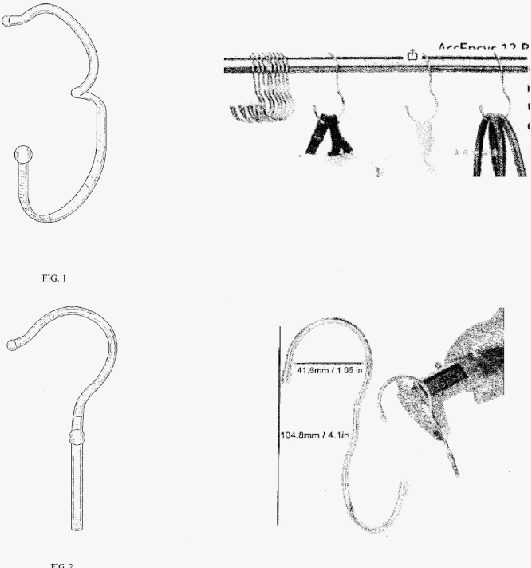
7Jacki Easlick I, 2024 WL 310125, at *7
The district court determined that the Tote Hanger’s two attached hooks and vertical configuration are functional elements that must be “excluded from the scope of the claimed design.” Id. at *5. The district court further determined that the design patent protects the Tote Hanger’s ornamental features, including “among other non-functional features, the shape of the hooks, the flare out of the top hook’s tip, the 90-degree offset2 at the top and bottom hooks, and the spheres on the end of each hook.” Id.
Having separated the Tote Hanger’s functional and ornamental elements, the district court proceeded to its infringement analysis. It concluded that the “side-by-side comparisons of the claimed and accused designs do not suggest to the [c]ourt that an ordinary observer would be deceived into believing the accused design is the same as the one claimed by” Jacki Easlick. Id. at *7. The district court noted that the “most obvious difference lies with the center of each handbag hook,” contrasting the “corkscrew-like center of the Tote Hanger against the laterally bent center of the [a]ccused [p]roduct.” Id. It also identified the shape of the bottom hooks and the hooks’ finished ends as additional dissimilarities between the parties’ products. Id. The district court thus properly “recited the significant differences between the ornamental features of the two designs” and “in determining infringement, it mainly focused on whether an ordinary observer would be deceived into8 thinking that any of the [AccEncyc] designs were the same as [Jacki Easlick’s] patented design.” Richardson v. Stanley Works, Inc., 597 F.3d 1288, 1295 (Fed. Cir. 2010).
Jacki Easlick contends that “the district court in this case was led astray” by AccEncyc’s “exclusive[]” focus on the Tote Hanger’s “‘corkscrew’ twist” and “different shapes on the end of the hooks in the two products, ignoring altogether the ‘overall impression’ of the two products.” Appellants’ Br. 18–19. But the district court explicitly stated that it was “comparing the overall visual effect of the two products.” Jacki Easlick I, 2024 WL 310125, at *7. This is not—as Jacki Easlick argues—a situation where the district court’s “concentration on small differences in isolation distracted from the overall impression of the claimed ornamental features.” Crocs, 598 F.3d at 1303–04. Instead, the district court correctly considered “the ornamental features and analyze[d] how they impact the overall design.” Lanard Toys Ltd. v. DolgenCorp LLC, 958 F.3d 1337, 1343 (Fed. Cir. 2020); see Ethicon, 796 F.3d at 1335–37. Indeed, the district court noted that “[e]ven if the pictures of the Tote Hanger and the [a]ccused [p]roduct were mixed randomly, an ordinary observer could quickly restore them to their original order upon viewing the center of the parties’ handbag hooks.” Jacki Easlick I, 2024 WL 310125, at *7. Considering distinguishing features—as the district court did here—is not legal error. And it is hard to imagine how a court could reasonably conduct this analysis without pointing such features out. See Int’l Seaway Trading Corp. v. Walgreens Corp., 589 F.3d 1233, 1243 (Fed. Cir. 2009) (“The mandated overall comparison is a comparison taking into account significant differences between the two designs . . . .”).
B.
Jacki Easlick next argues that the district court improperly failed to consider the prior art. Appellants’ Br. 23. But “[c]omparing the claimed and accused designs with the9 prior art is beneficial only when the claimed and accused designs are not plainly dissimilar.” Ethicon, 796 F.3d at 1337. Regardless, as the district court explained in deciding Jacki Easlick’s motion for reconsideration, a prior art analysis would not have changed the outcome of the district court’s preliminary injunction ruling. Jacki Easlick II, 2024 WL 1657843, at *5. We agree with the district court’s assessment that the prior art submitted by Jacki Easlick differs from the claimed design in several respects. Thus, as the district court correctly concluded, “[w]ith the attention of the hypothetical ordinary observer still drawn to these significant differences . . . re-application of the ordinary observer test would not have changed the overall visual effect of the two designs.” Id. at *6. The district court did not abuse its discretion in determining that Jacki Easlick failed to demonstrate a likelihood of success on the merits of its design patent infringement claim.
II
The district court also determined that Jacki Easlick failed to show irreparable harm. Jacki Easlick I, 2024 WL 310125, at *9. Jacki Easlick urges us to reach the opposite conclusion. We cannot do so.
Jacki Easlick must establish “that absent an injunction, it will suffer irreparable harm,” and “that a sufficiently strong causal nexus relates the alleged harm to the alleged infringement.” Apple Inc. v. Samsung Elecs. Co., 695 F.3d 1370, 1374 (Fed. Cir. 2012). “[C]onclusory statements and theoretical arguments” are insufficient to demonstrate irreparable harm. Apple, Inc. v. Samsung Elecs. Co., 678 F.3d 1314, 1325 (Fed. Cir. 2012).
Jacki Easlick makes three primary arguments to support its position that it will suffer irreparable harm absent injunctive relief. First, it argues that the district court should have remained consistent with its temporary restraining order ruling. Appellants’ Br. 25. Second, it implies that AccEncyc’s failure to brief the irreparable harm10 issue bears significance. Appellants’ Br. 25. Third, and alternatively, Jacki Easlick contends that the evidence it submitted was sufficient to establish irreparable harm. Appellants’ Br. 26. Each argument fails.
Jacki Easlick’s first argument rests on the notion that the district court should have found the offered irreparable-harm evidence sufficient because it had already done so in issuing the temporary restraining order. And its second argument appears to be that the district court should have considered AccEncyc’s decision to not contest irreparable harm in its responsive preliminary injunction brief. See Appellants’ Br. 25. Jacki Easlick cites no law supporting these positions. Indeed, it cannot, because—regardless of whether AccEncyc responded on the issue—Jacki Easlick bears the burden of demonstrating irreparable harm. See Altana Pharma AG v. Teva Pharms. USA, Inc., 566 F.3d 999, 1010 (Fed. Cir. 2009). And “[t]he grant or denial of a preliminary injunction . . . is within the sound discretion of the district court.” Abbott Lab’ys. v. Andrx Pharms., Inc., 452 F.3d 1331, 1334 (Fed. Cir. 2006). The decision to grant an ex parte temporary restraining order against 67 defendants does not restrain the district court’s separate analysis of a motion for a preliminary injunction.
In any case, the district court properly concluded that Jacki Easlick failed to demonstrate irreparable harm. The district court assessed the evidence Jacki Easlick submitted (declarations made by Ms. Jacklyn Easlick and Mr. Stanley Ference as to each type of harm, and an overview of how foreign counterfeiting companies operate, respectively). See Jacki Easlick I, 2024 WL 310125, at *8–9. It determined that the allegations of harm to “profits, consumer relationships, brand value, goodwill, and quality reputation are nothing more than conclusory and theoretical.” Id. at *8. The district court further assessed Jacki Easlick’s arguments regarding customer confusion, market loss, competition, and price erosion, and again emphasized that Jacki Easlick offered no evidence as to each. Id. at 8–11 9. We agree. Mere citations to case law recognizing the existence of each type of alleged harm accompanied by conclusory statements that those harms are occurring are inadequate to meet the requisite burden. The district court did not abuse its discretion in carrying out its irreparable-harm analysis.
III
Having affirmed the district court’s denial of Jacki Easlick’s motion for a preliminary injunction, we turn to the denial of Jacki Easlick’s motion for reconsideration. “The purpose of a motion for reconsideration is to correct manifest errors of law or fact or to present newly discovered evidence.” Howard Hess Dental Labs. Inc. v. Dentsply Int’l, Inc., 602 F.3d 237, 251 (3d Cir. 2010) (cleaned up). Courts do, however, avoid granting motions for reconsideration absent “extraordinary circumstances,” such as preventing a “clearly erroneous” prior decision from resulting in a “manifest injustice,” assessing newly available evidence, or accounting for “supervening new law.” In re Pharmacy Benefit Managers Antitrust Litig., 582 F.3d 432, 439 (3d Cir. 2009) (citations omitted). The district court correctly determined that none of those extraordinary circumstances are present here.
Jacki Easlick sought the district court’s consideration of “new” evidence in the form of the physical hooks at issue and Ms. Easlick’s testimony regarding irreparable harm. As the district court stated, there appears to be “no reason why [Jacki Easlick] could not provide the physical evidence or testimony” either before filing its preliminary injunction motion or before the preliminary injunction hearing. Jacki Easlick II, 2024 WL 1657843, at *3; see also id. at *1 (citing Blystone v. Horn, 664 F.3d 397, 415 (3d Cir. 2011) (“[N]ew evidence, for reconsideration purposes, does not refer to evidence that a party . . . submits to the court after an adverse ruling. Rather, new evidence in this context means12 evidence that a party could not earlier submit to the court because that evidence was not previously available.”)).
Jacki Easlick’s motion for reconsideration also argued that the district court erred in application of the ordinary observer test. Jacki Easlick II, 2024 WL 1657843, at *4. For the reasons set forth above, we disagree. We thus find no abuse of discretion in the district court’s denial of the motion for reconsideration.
CONCLUSION
We have considered Jacki Easlick’s remaining arguments and find them unpersuasive. For the foregoing reasons, we affirm the district court’s denials of Jacki Easlick’s motion for a preliminary injunction and motion for reconsideration.
AFFIRMED
Footnotes
- ↩ 1 We received an Amicus brief from several law professors arguing that so-called “Schedule A” cases are legally permissible. The propriety of the “Schedule A” practice is not before us.
- ↩ 2 AccEncyc argues that (contrary to the district court’s conclusion on this matter) the 90-degree orientation is functional. Appellee’s Br. 18. Jacki Easlick disagrees. Reply Br. 3. But the parties also dispute whether AccEncyc has preserved that argument. Reply Br. 3; Appellee’s Br. 19. The resolution of this issue does not affect our analysis. Thus, we do not reach it.