United States Court of Appeals
for the Federal Circuit
BISSELL, INC., BISSELL HOMECARE, INC.,
Appellants
v.
INTERNATIONAL TRADE COMMISSION,
Appellee
TINECO INTELLIGENT TECHNOLOGY CO., LTD., TINECO INTELLIGENT, INC., TEK (HONG KONG)
SCIENCE & TECHNOLOGY LTD.,
Intervenors
TINECO INTELLIGENT TECHNOLOGY CO., LTD., TINECO INTELLIGENT, INC., TEK (HONG KONG)
SCIENCE & TECHNOLOGY LTD.,
Appellants
v.
INTERNATIONAL TRADE COMMISSION,
Appellee
BISSELL, INC., BISSELL HOMECARE, INC.,
Intervenors
2024-1509, 2024-1709
2Appeals from the United States International Trade Commission in Investigation No. 337-TA-1304.
Decided: May 11, 2026
MICHAEL HAWES, Baker Botts LLP, Houston, TX, argued for appellants. Also represented by LORI DING; LISA M. KATTAN, THOMAS CHISMAN MARTIN, Washington, DC; KEVIN P.B. JOHNSON, Quinn Emanuel Urquhart & Sullivan, LLP, Redwood Shores, CA; SCOTT ALEX LASHER, BRIAN L. SAUNDERS, Washington, DC; SAM STEPHEN STAKE, San Francisco, CA.
LYNDE FAUN HERZBACH, Office of the General Counsel, United States International Trade Commission, Washington, DC, argued for appellee. Also represented by MICHELLE W. KLANCNIK.
GREGORY A. CASTANIAS, Jones Day, Washington, DC, argued for intervenors. Also represented by MARC BLACKMAN, MATTHEW J. HERTKO, Chicago, IL; DAVID MICHAEL MAIORANA, Cleveland, OH; KEVIN VINCENT MCCARTHY, New York, NY.
Before MOORE, Chief Judge, TARANTO and STOLL, Circuit
Judges.
Bissell, Inc. and Bissell Homecare, Inc. filed a complaint at the United States International Trade Commission alleging that Tineco Intelligent Technology Co., Ltd.; TEK (Hong Kong) Science & Technology Ltd.; and Tineco Intelligent, Inc. violated Section 337 of the Tariff Act of 1930, as amended, 19 U.S.C. § 1337, through the importation and sale of wet dry surface cleaning devices that3 infringe certain claims of U.S. Patent Nos. 11,076,735 and 11,071,428. After conducting an investigation, the Commission barred Tineco from importing certain of its accused products that were found to infringe claims of the ’735 and ’428 patents. But, after the complaint was filed, Tineco redesigned the accused products; the Commission determined that Tineco’s redesigned products did not infringe certain claims of the asserted patents, and thus no exclusion order was entered for them. Bissell appeals the no violation finding as to Tineco’s redesigned products, challenging the Commission’s finding of no infringement. Tineco cross-appeals, challenging the Commission’s finding that Bissell has a technical domestic industry, as well as certain infringement findings relevant to both Tineco’s original and redesigned accused products. For the reasons set forth below, we affirm the Commission’s Final Determination in full.
BACKGROUND
I
The ’735 and ’428 patents are titled “Surface Cleaning Apparatus” and share a specification. U.S. Patent No. 11,076,735 Title; U.S. Patent No. 11,071,428 Title.1 One embodiment of the invention has “a storage tray that can be used during a self-cleaning mode” and “can also recharge a battery of the apparatus,” where “during the cleanout cycle, battery charging can be disabled.” See, e.g., ’735 patent col. 1 ll. 45–56. The specification explains that “the battery [] does not recharge during the self-cleaning mode” and that this “operational behavior is beneficial because if the battery charging circuit [] is not disabled and power not supplied by the battery [] during the self-4cleaning mode, the capacity of the wall charger [] can be exceeded.” Id. at col. 25 ll. 34–42.
Claim 1 of the ’735 patent is illustrative and recites in relevant part:
1. A floor cleaning system, comprising: a surface cleaning apparatus comprising:
. . . a recovery system comprising a recovery pathway, a recovery tank, a suction nozzle, and a vacuum motor; a brushroll within the recovery pathway of the recovery system; a brushroll motor operably coupled to the brushroll for rotating the brushroll, wherein the suction nozzle is configured to extract fluid and debris from the brushroll; a rechargeable battery selectively powering the pump, the vacuum motor, and the brushroll motor; . . . a self-cleaning mode input control disposed on the upright body and configured to initiate an unattended automatic cleanout cycle for a self-cleaning mode of operation during which the pump, the brushroll motor, and the vacuum motor are energized, . . . wherein the surface cleaning apparatus comprises a battery charging circuit controlling the recharging of the rechargeable battery, wherein the battery charging circuit is disabled by the actuation of the self-cleaning mode input control and remains disabled during the unattended automatic cleanout cycle.
5Id. at col. 27 l. 26–col. 28 l. 17 (emphases added to highlight the limitations at issue on appeal).
II
Bissell filed a complaint against Tineco at the Commission alleging violations of Section 337 because certain of Tineco’s wet dry surface cleaning devices infringe claims 1, 13, and 15 of the ’735 patent and claim 1 of the ’428 patent, along with claims in three other patents that are not relevant to this appeal. The parties identified as representative for Tineco’s original accused products Tineco’s Floor One S3 and Floor One S5 Pro. After institution of the Investigation, Tineco also introduced redesigned accused products with altered source code. Bissell identified domestic industry products as well.
Following an evidentiary hearing, the Administrative Law Judge issued its Initial Determination finding that Tineco’s original accused products infringed the asserted claims but the redesigned accused products did not because they failed to meet the limitation “the battery charging circuit is disabled by the actuation of the self-cleaning mode input control and remains disabled during the unattended automatic cleanout cycle.” For the disabled battery limitation, the parties did not dispute that the original accused products met this limitation. For the redesigned accused products, the Administrative Law Judge found that (1) those products have a self-cleaning button on the handle, (2) when a user presses the self-cleaning button, the devices audibly announce “start self-cleaning,” and (3) the devices then perform what Tineco’s product manuals refer to as a “self-cleaning cycle” for a period of 120 seconds. J.A. 204 (citations omitted).2 The parties agreed that the
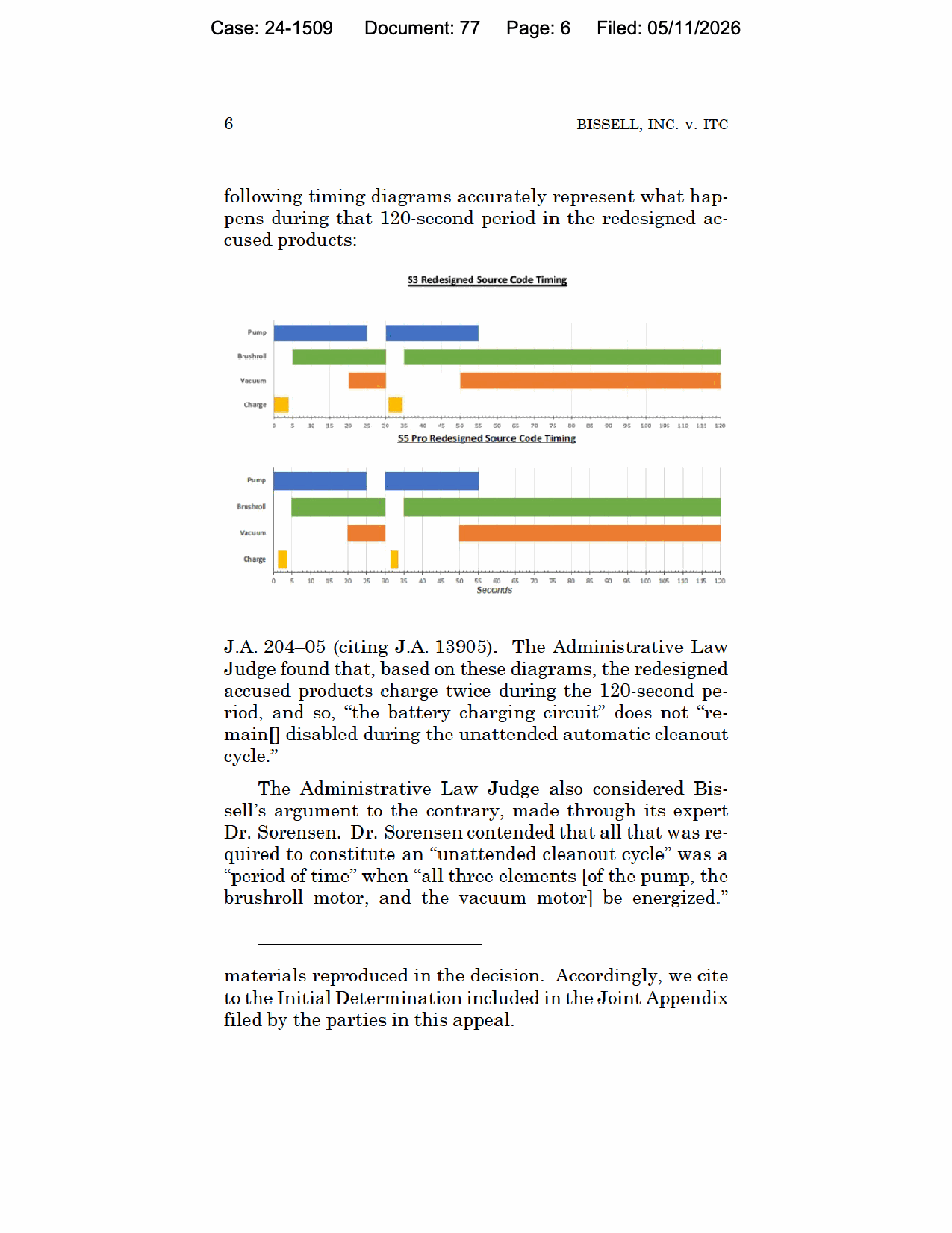
7J.A. 205–06 (citations omitted). Thus, according to Dr. Sorensen, as long as there was a period of time that the pump, the brushroll motor, and the vacuum motor are energized and the battery charging circuit remains off, Tineco’s redesigned accused products still practiced the disabled battery limitation—like from the time period of 4 to 20 seconds shown in the diagrams above. The Administrative Law Judge, however, found Dr. Sorensen’s theories not “credible or persuasive.” J.A. 206–08.
The Administrative Law Judge also found that Tineco’s redesigned accused products did not meet the disabled battery limitation under the doctrine of equivalents. The Administrative Law Judge again found Dr. Sorensen not persuasive in opining “that a battery circuit that does the opposite [of what the claim requires] (i.e., a battery circuit that charges during an automatic cleanout cycle) is insubstantially different from the claim.” J.A. 209.
The Administrative Law Judge further found that Tineco’s accused products met the limitation “a brushroll within the recovery pathway of the recovery system.” Bissell contended that this limitation was met because the recovery pathway is “essentially all the[] places that the fluid flows in the course of being recovered,” which encompasses the entire brushroll. J.A. 192 (citation omitted). Tineco contended that the recovery pathway was more limited, with the brushroll being “behind” or “adjacent” to Bissell’s alleged recovery pathway. J.A. 192–93 (citation omitted). The Administrative Law Judge found Bissell’s theory more persuasive, but also alternatively found that, even under Tineco’s theory, the brushroll in the accused products is still within the recovery pathway. J.A. 194. The Administrative Law Judge reasoned that Tineco’s expert, Mr. Smith, conceded that a brushroll that was at least 50 percent “enclosed by” or “inside of” the recovery pathway was “within” the recovery pathway, and there was no material difference between a brushroll that was 50 percent “inside of” the recovery pathway and the brushroll of8 the accused products as illustrated in Tineco’s own demonstratives. J.A. 194–95.
The Administrative Law Judge also determined that Tineco’s accused products met the limitation “the suction nozzle is configured to extract fluid and debris from the brushroll.” The Administrative Law Judge found that, even if the metal blade found in the accused products is the primary means of removing fluid and debris from the brushroll, it is not the exclusive means of doing so. The Administrative Law Judge considered evidence from Tineco’s expert that the suction nozzle in the accused products had enough power to suction fluid and debris “directly off of the floor,” J.A. 13287 (Hearing Tr. 881:18–24), from which the Administrative Law Judge found “it more likely than not that the suction nozzle is powerful enough to suction at least some fluid and debris directly from the brushroll, which is located closer to the suction inlet.” J.A. 198. The Administrative Law Judge pointed to additional evidence to “further confirm[] that the metal blade is not the exclusive means of extracting fluid and debris from the brushroll.” J.A. 199 (citing J.A. 30583; J.A. 12669–70 (Hearing Tr. 265:19–266:15)).
The Administrative Law Judge also found that Bissell supported a technical domestic industry, including that Bissell’s domestic industry products practice the limitation “wherein the battery charging circuit is disabled by the actuation of the self-cleaning mode input control and remains disabled during the unattended automatic cleanout cycle.” J.A. 323. In so finding, the Administrative Law Judge relied on testimony from Bissell’s expert that the source code for the domestic industry products showed that the battery charging circuit was disabled by the actuation of the self-cleaning mode input control and remained disabled during the unattended cleanout cycle. See J.A. 12714 (Hearing Tr. 310:16–24).
9III
Both parties petitioned for Commission review of the Initial Determination, and while the Commission reviewed certain parts of the decision, it did not review any of the issues subject to this appeal. See Certain Wet Dry Surface Cleaning Devices, USITC Inv. No. 337-TA-1304, 2023 WL 8869119, at *3 (Dec. 18, 2023). Instead, the Commission adopted the Administrative Law Judge’s findings as its own. See id. The Commission then entered a limited exclusion order preventing Tineco from importing into the United States the original accused products that infringe the asserted claims of the ’735 and ’428 patents. See id. at *4.
Bissell appeals and Tineco cross-appeals. We have jurisdiction under 28 U.S.C. § 1295(a)(6).
DISCUSSION
Bissell appeals the Commission’s findings that Tineco’s redesigned accused products do not meet the limitation “wherein the battery charging circuit is disabled by the actuation of the self-cleaning mode input control and remains disabled during the unattended automatic cleanout cycle” either literally or under the doctrine of equivalents. Tineco cross-appeals the Commission’s findings that (1) Bissell’s domestic industry products satisfy the same limitation, i.e., “wherein the battery charging circuit is disabled by the actuation of the self-cleaning mode input control and remains disabled during the unattended automatic cleanout cycle”; (2) all of Tineco’s accused products meet the limitation “a brushroll within the recovery pathway of the recovery system”; and (3) all of Tineco’s accused products satisfy the limitation “wherein the suction nozzle is configured to extract fluid and debris from the brushroll.”
“We review the Commission’s final determinations under the standards of the Administrative Procedure Act.” Guangdong Alison Hi-Tech Co. v. Int’l Trade Comm’n, 936 F.3d 1353, 1358 (Fed. Cir. 2019) (citation omitted).10 “We review the Commission’s factual findings for substantial evidence and its legal determinations de novo.” Id. (citation omitted). “A finding is supported by substantial evidence if a reasonable mind might accept a particular evidentiary record as adequate to support a conclusion.” Id. (internal quotation marks omitted) (quoting Dickinson v. Zurko, 527 U.S. 150, 162 (1999)).
DIRECT APPEAL
We address Bissell’s challenges to the Commission’s determinations on literal and equivalents infringement together because they suffer the same problem: Bissell challenges the Commission’s fact findings only as legal conclusions. Specifically, Bissell argues that the Administrative Law Judge relied on an implicit error in claim construction to find that the redesigned accused products do not literally meet the disabled battery limitation. Likewise, Bissell argues that the Administrative Law Judge’s analysis for why those same products do not meet the same limitation under the doctrine of equivalents improperly relies on the doctrine of claim vitiation instead of the insubstantial differences test.
First, we are not persuaded by Bissell’s assertion that the Administrative Law Judge construed the disabled battery limitation—“the battery charging circuit is disabled by the actuation of the self-cleaning mode input control and remains disabled during the unattended automatic cleanout cycle”—for the first time in the Initial Determination. Review of the Initial Determination shows that, contrary to Bissell’s assertion, the Administrative Law Judge merely applied the plain and ordinary meaning of the claim language, made credibility determinations finding Bissell’s expert’s testimony on his theory of infringement neither “credible or persuasive,” J.A. 207, and found that the redesigned accused products do not complete a cleanout cycle during which the battery charging circuit does not operate. See J.A. 204–08. This is not a case like Google LLC v. EcoFactor, Inc., relied on by Bissell, where the analysis of the11 tribunal “established the scope of [a] limitation” when “there [was] nothing on the face of the claim to discern the scope and boundaries” imposed by the tribunal. See 92 F.4th 1049, 1056 (Fed. Cir. 2024). As Bissell’s only challenge relates to an alleged claim construction, and Bissell does not challenge whether substantial evidence supports the Commission’s finding, we affirm the Commission’s finding of no literal infringement as to Tineco’s redesigned accused products. See Oral Arg. at 4:25–4:48, https://www.cafc.uscourts.gov/oral-arguments/24-1509_02 042026.mp3 (Bissell’s counsel conceding that Bissell only challenged literal infringement as a matter of claim construction); see generally Appellants’ Br. 26–41.
Second, as to infringement under the doctrine of equivalents, we are not persuaded by Bissell’s argument that the Administrative Law Judge relied on the legal doctrine of claim vitiation instead of making fact findings under the insubstantial differences test. The Administrative Law Judge held that it “did not find persuasive [Bissell’s expert’s] testimony that a battery circuit that does the opposite [of what the claim requires] (i.e., a battery circuit that charges during an automatic cleanout cycle) is insubstantially different from the claim.” J.A. 209. While the Administrative Law Judge also stated that the expert’s “opinion renders meaningless the ‘remains disabled’ requirement,” id., we do not read this sentence in context to mean that the Administrative Law Judge did not make fact findings. We also do not view the Administrative Law Judge’s analysis—which summarized the parties’ positions, considered Bissell’s expert’s opinion, and explained that that opinion was unpersuasive—as legally inadequate. See J.A. 209–10. Because Bissell does not dispute that the Administrative Law Judge’s fact findings are supported by substantial evidence in its opening brief, see generally Appellants’ Br. 41–44, we affirm the Commission’s finding of no infringement under the doctrine of equivalents as to Tineco’s redesigned accused products.
12CROSS-APPEAL
I
We now turn to the cross-appeal, beginning with Tineco’s challenge to the Commission’s finding on domestic industry. Tineco challenges the Commission’s finding that Bissell’s domestic industry products satisfy the disabled battery limitation. Specifically, Tineco argues that the Administrative Law Judge erred by relying on Dr. Sorensen’s testimony that Bissell’s products satisfy this limitation because he relied on source code that was produced during discovery but not introduced as evidence at trial. According to Tineco, Bissell’s expert could not rely on the source code in forming his opinion because Bissell failed to introduce it as an exhibit. We disagree.
Expert testimony may be more extensive than the exhibits that are introduced into an evidentiary record. For example, under Rule 703 of the Federal Rules of Evidence:
An expert may base an opinion on facts or data in the case that the expert has been made aware of or personally observed. If experts in the particular field would reasonably rely on those kinds of facts or data in forming an opinion on the subject, they need not be admissible for the opinion to be admitted.
Fed. R. Evid. 703. Tineco does not cite any law, nor are we aware of any, that holds otherwise.
Here, there is no dispute that (1) Bissell’s source code was produced in discovery, (2) Bissell’s expert relied on his review of the source code to conclude that Bissell’s domestic industry products satisfied the disabled battery limitation, (3) experts in this field would reasonably rely on source code to understand the operation of the domestic industry products, and (4) Tineco never provided expert opinions or theories contrary to Dr. Sorensen’s opinions on the issue. Indeed, in its prehearing brief, Tineco did not even assert13 that Bissell’s domestic industry products did not practice the disabled battery limitation. See J.A. 8447–55. Then, at the evidentiary hearing, Tineco did not cross-examine Dr. Sorenson on his testimony that the domestic industry products practiced this limitation. And while Dr. Sorenson’s testimony on this limitation is short, see J.A. 12714 (Hearing Tr. 310:16–24), it was not conclusory, as he testified that his opinion was based on his review of the source code. Moreover, had Bissell known that Tineco was challenging the limitation, it could have asked Dr. Sorenson for further explanation or introduced the source code as an exhibit.
Under the circumstances presented in this case, we hold that an expert can rely on source code without a party introducing that source code into the evidentiary record at trial. And to the extent Tineco makes a substantial evidence challenge, Dr. Sorenson’s unrebutted expert testimony relying on his review of the source code provides non-conclusory, substantial evidence to support the Administrative Law Judge’s finding that the domestic industry products met this claim limitation. Additionally, in so finding, the Administrative Law Judge also relied on an internal Bissell document that states that “[c]harging starts [in Bissell’s product] once the machine is placed onto the plugged-in dock. Charging stops once the Clean Out Cycle runs, then resumes once the cycle completes.” See J.A. 323 (citing JX-0041); J.A. 26545 (JX-0041). For all these reasons, we hold that substantial evidence supports the Commission’s finding that the claim limitation is met by the domestic industry products.
II
Finally, we turn to Tineco’s last two issues raised on cross-appeal, both of which involve challenges to the Commission’s fact findings comparing Tineco’s accused products to certain limitations of the asserted patents. We are unpersuaded by Tineco’s arguments that substantial evidence does not support the Commission’s finding that14 Tineco’s accused products meet the “brushroll within the recovery pathway” limitation or the “suction nozzle” limitation.
First, substantial evidence supports the Administrative Law Judge’s alternative finding that, even under Tineco’s more narrow view of the “recovery pathway,” the accused products satisfy the claim requirement that the brushroll be within the recovery pathway. See J.A. 195 & n.26 (citing J.A. 30195) (explaining that Tineco’s own demonstrative, based on corresponding expert testimony, shows “no material difference[] . . . between a brushroll that is 50% ‘inside of’ the recovery pathway and the brushrolls of the accused products”). Tineco, through its expert, agreed that if at least 50 percent of the brushroll is inside of the recovery pathway, then the limitation is met. See J.A. 13369 (Hearing Tr. 963:12–17). The substantial evidence standard merely asks whether “a reasonable mind might accept a particular evidentiary record as adequate to support” a fact finding. Guangdong, 936 F.3d at 1358 (internal quotation marks omitted) (quoting Dickinson, 527 U.S. at 162); see also Medtronic, Inc. v. Teleflex Innovations S.à.r.l., 69 F.4th 1341, 1348 (Fed. Cir. 2023) (explaining that even “[i]f the evidence will support several reasonable but contradictory conclusions, we will not find [a tribunal]’s decision unsupported by substantial evidence simply because [it] chose one conclusion over another plausible alternative.” (citation omitted)). Because a reasonable fact finder could have relied on Tineco’s own demonstrative (i.e., J.A. 30195), and its expert testimony, (i.e., J.A. 13369 (Hearing Tr. 963:12–17)), to conclude that Tineco’s brushrolls are not materially different from a brushroll 50 percent inside of the recovery pathway that concededly practices the claim limitation, we see no error in the Commission’s finding that Tineco’s accused products meet this limitation.
Second, substantial evidence also supports the Commission’s finding that Tineco’s products meet the “suction15 nozzle” limitation. Tineco’s expert conceded that the suction nozzle of the accused products suctions fluid and debris off the metal blade, as well as off the floor. See J.A. 13287 (Hearing Tr. 881:18–24). Based on this, the Administrative Law Judge reasonably concluded that it was more probable than not that the suction nozzle could also suction fluid and debris off the brushroll, which is between the suction nozzle and the floor. See J.A. 198. In addition, Bissell’s expert testified about an experiment he performed, which demonstrated that the suction nozzle in the accused products is strong enough to extract fluid and debris from the brushroll when the metal blade is removed from the accused products. See J.A. 199 (citing J.A. 12669– 70 (Hearing Tr. 265:19–266:15)). Substantial evidence thus supports the finding that a Tineco suction nozzle during normal operation of an accused device extracts fluid and debris from the brushroll, and therefore is configured to do so. We conclude that, contrary to Tineco’s assertions, the Administrative Law Judge’s fact finding on this limitation was not based on mere speculation but rather on substantial evidence. See Guangdong, 936 F.3d at 1358.
CONCLUSION
We have considered Appellants’ and Cross-Appellants’ remaining arguments and find them unpersuasive. For the foregoing reasons, we affirm the Commission’s Final Determination.
AFFIRMED
COSTS
Costs to Appellee.
Footnotes
- ↩ 1 We cite to the specification for the ’735 patent throughout the remainder of this opinion.
- ↩ 2 The Initial Determination is available at Certain Wet Dry Surface Cleaning Devices, USITC Inv. No. 337-TA-1304, 2023 WL 2824398 (Mar. 24, 2023), however, the version reported in Westlaw does not include the graphic