United States Court of Appeals
for the Federal Circuit
RANGE OF MOTION PRODUCTS, LLC,
Plaintiff-Appellant
v.
ARMAID COMPANY INC.,
Defendant-Appellee
2023-2427
Appeal from the United States District Court for the District of Maine in No. 1:22-cv-00091-JDL, Chief Judge Jon D. Levy.
ON PETITION FOR REHEARING EN BANC
E. JOSHUA ROSENKRANZ, Orrick, Herrington & Sutcliffe LLP, New York, NY filed a petition for rehearing en banc for plaintiff-appellant. Also represented by ALEXANDRA BURSAK, SAMANTHA MICHELLE LEFF; KATHERINE M. KOPP, ROBERT MANHAS, Washington, DC; DAVID CONNAUGHTON, BRENDAN M. SHORTELL, JUSTIN TINGER, Lambert Shortell and Connaughton, Boston, MA.
JOSHUA JOHN FOUGERE, Sidley Austin LLP, Washington, DC, filed a response to the petition for defendant-appellee. Also represented by CLAIRE HOMSHER, SUSAN K.
2WHALEY; PETER J. BRANN, STACY O. STITHAM, DAVID SWETNAM-BURLAND, Brann & Isaacson, Lewiston, ME.
Before MOORE, Chief Judge, LOURIE, DYK, PROST, REYNA,
TARANTO, CHEN, HUGHES, STOLL, CUNNINGHAM, and
STARK, Circuit Judges.1
Judge, joins, concurs in the denial of the petition for re-
hearing en banc.
MOORE, Chief Judge, with whom REYNA, Circuit Judge,
joins, dissents from the denial of the petition for rehearing
en banc.
STOLL and STARK, Circuit Judges, dissent without opinion
from the denial of the petition for rehearing en banc.
PER CURIAM.
O R D E R
Range of Motion Products, LLC filed a petition for rehearing en banc. A response to the petition was invited by the court and filed by Armaid Company Inc. Industrial Designers Society of America, Inc., Institute for Design Science and Public Policy, Oake Law Office, PLLC, American Intellectual Property Law Association, and Perry Saidman requested leave to file briefs as amici curiae, which the court granted.
The petition was referred to the panel that heard the appeal, and thereafter the petition was referred to the circuit judges who are in regular active service. The court conducted a poll on request, and the poll failed.
Upon consideration thereof,
3IT IS ORDERED THAT:
The petition for panel rehearing is denied.
The petition for rehearing en banc is denied.
FOR THE COURT

August 11, 2026
Date
4United States Court of Appeals
for the Federal Circuit
RANGE OF MOTION PRODUCTS, LLC,
Plaintiff-Appellant
v.
ARMAID COMPANY INC.,
Defendant-Appellee
2023-2427
Appeal from the United States District Court for the District of Maine in No. 1:22-cv-00091-JDL, Chief Judge Jon D. Levy.
CUNNINGHAM, Circuit Judge, with whom HUGHES, Circuit Judge, joins, concurring in the denial of the petition for rehearing en banc.
The panel decision is consistent with longstanding Supreme Court and Federal Circuit precedent. There is no need to overrule a prior holding of this court. None of the other rationales for rehearing en banc apply. We thus agree that en banc review is not warranted.
The dissent presents two principal complaints: (1) a sentence in Egyptian Goddess, Inc. v. Swisa, Inc., 543 F.3d 665, 678 (Fed. Cir. 2008) (en banc), has purportedly improperly focused the design patent infringement inquiry on differences and allowed district courts to resolve infringement at summary judgment without an examination of5 prior art; and (2) this court’s use of “claim construction” in design patent infringement involves factual questions of functionality that should be decided by the jury. Neither holds water, nor demonstrates why this case is a good vehicle for en banc review. We address each complaint in turn.
I.
The pertinent sentence from Egyptian Goddess states that “[i]n some instances, the claimed design and the accused design will be sufficiently distinct that it will be clear without more that the patentee has not met its burden of proving the two designs would appear ‘substantially the same’ to the ordinary observer, as required by Gorham.” 543 F.3d at 678 (discussing Gorham Co. v. White, 81 U.S. 511 (1872)). The dissent argues that this sentence “changed the frame of reference” from focusing on whether two designs are “substantially the same” to focusing on dissimilarity. Dissent at 2, 13–16. The dissent’s concern with the alleged reframing is inapposite. Assessing whether two designs are “substantially the same” necessarily involves accounting for the ways in which they are similar and different. As the Supreme Court explained in Gorham: “We do not say that in determining whether two designs are substantially the same, differences in the lines, the configuration, or the modes by which the aspects they exhibit are not to be considered; but we think the controlling consideration is the resultant effect.” 81 U.S. at 526 (emphasis added); see also Smith v. Whitman Saddle Co., 148 U.S. 674, 682 (1893) (concluding that “the design of the patent had two features of difference as compared with the [prior art] saddle” (emphasis added)). In this case, the district court properly considered both similarities and differences when assessing overall similarity of the claimed and accused designs. See Range of Motion Prods., LLC v. Armaid Co., 166 F.4th 981, 990 n.3 (Fed. Cir. 2026).
6The sentence from Egyptian Goddess follows Supreme Court precedent and merely points out a particular situation in which it is clear, even without comparison to the prior art, that no ordinary observer would be “deceive[d]” or “induc[ed] [ ] to purchase one [design] supposing it to be the other.” Gorham, 81 U.S. at 528. The dissent even recognizes that this “shortcut” may be properly applied in “truly easy-to-decide design patent cases.” Dissent at 15 (citing PS Prods. Inc. v. Panther Trading Co., 122 F.4th 893 (Fed. Cir. 2024)). At bottom, the dissent’s disagreement is one of line-drawing: How easy is “truly easy-to-decide”? If district courts have been determining that designs are “plainly dissimilar” or not “substantially the same” as a matter of law when a genuine dispute of material fact remains, the remedy is not to throw out years of well-settled design patent law but to reverse the decisions of those courts when they are appealed.
Moreover, considerations of judicial economy favor denying en banc consideration and allowing district courts to resolve design patent cases at summary judgment when no reasonable jury could find the patent infringed. In the past, our court has affirmed the grant of summary judgment of non-infringement in design patent cases when there is no genuine dispute of material fact that the claimed design and accused product were plainly dissimilar. See, e.g., Ethicon Endo-Surgery, Inc. v. Covidien, Inc., 796 F.3d 1312, 1336–37 (Fed. Cir. 2015). Likewise, in this case, the majority agreed that the district court did not commit reversible error and affirmed the district court’s grant of summary judgment of non-infringement. Range of Motion, 166 F.4th at 993.
Regardless, this case is not the proper vehicle to address the dissent’s complaints. Specifically, the dissent urges that “[t]he factfinder should always compare the claimed and accused designs in light of the prior art.” Dissent at 14 (cleaned up). The district court in Range of Motion heeded that precise advice. It assessed the similarities7 and differences and conducted a three-way comparison to the prior art in its analysis, as described by Egyptian Goddess, determining under both analyses that no reasonable jury could find infringement. This court affirmed on both grounds. Range of Motion, 166 F.4th at 993. An en banc revision of the test as explained in Egyptian Goddess would have no impact on the ultimate outcome of Range of Motion.
II.
The remainder of the dissent sets its sights on a wholly new target by focusing on the assessment of functionality in design patent claim construction, despite having previously expressed no specific concerns about claim construction when this case was before the panel. See generally, Range of Motion, 166 F.4th at 993–1001 (Moore, C.J., dissenting). In so doing, the dissent echoes Range of Motion’s en banc petition, ECF No. 52, which argues that the functional-versus-ornamental inquiry in claim construction should go to the jury as a question of fact. Dissent at 1–2, 5–12; see ECF No. 52, at 15–23. This argument must be rejected.
Like with utility patents, claim construction is both a proper and necessary component of the design patent infringement analysis.1 “Determining whether a design8 patent [claim] has been infringed is a two-part test,” requiring that “the court first construe[ ] the claim to determine its meaning and scope.” Lanard Toys Ltd. v. Dolgencorp LLC, 958 F.3d 1337, 1341 (Fed. Cir. 2020) (citing Elmer v. ICC Fabricating, Inc., 67 F.3d 1571, 1577 (Fed. Cir. 1995)); see Egyptian Goddess, 543 F.3d at 679. And the Supreme Court has unequivocally held that, in the context of utility patents, claim construction is a question of law for the court to decide. Markman v. Westview Instruments, Inc., 517 U.S. 370, 372 (1996); Teva Pharms. USA, Inc. v. Sandoz, Inc., 574 U.S. 318, 321 (2015) (citing Markman, 517 U.S. at 372). The “ultimate issue of the proper construction of a claim” remains a question of law even if “subsidiary factfinding is sometimes necessary.” See Teva, 574 U.S. at 326.
Furthermore, district courts should continue to decide claim construction and to define claim scope, including subsidiary factual determinations involving functionality.29 When previously faced with determining whether the right decision maker for claim construction should be the court or the jury, after evaluating precedent and history, the Supreme Court indicated that “when an issue ‘falls somewhere between a pristine legal standard and a simple historical fact, the fact/law distinction at times has turned on a determination that, as a matter of the sound administration of justice, one judicial actor is better positioned than another to decide the issue in question.’” Markman, 517 U.S. at 388 (quoting Miller v. Fenton, 474 U.S. 104, 114 (1985)). In Markman, the Court also acknowledged “the importance of uniformity in the treatment of a given patent as an independent reason to allocate all issues of construction to the court”—a consideration that applies equally to both design patents and utility patents. Id. at 390.
It is true that the design patent here presents a single claim in pictures,3 see Dissent at 5, but determining the proper scope of a design patent claim, like a utility patent claim, involves the interpretation of a legal document and determining the bounds of a property right. And even for design patents, other factors go into determining the proper scope of a claim beyond merely looking at a picture.10 Indeed, the infringement inquiry cannot be as simple as presenting images of the claimed design and the accused product to the jury and asking whether they are substantially the same. To do so without first construing the patent’s claim invites the jury to decide infringement without regard for which aspects of the claimed design’s illustration have legal effect.
In Egyptian Goddess, this court en banc squarely addressed the question of “whether trial courts should conduct claim construction in design patent cases.” 543 F.3d at 679. We acknowledged that:
Apart from attempting to provide a verbal description of the design, a trial court can usefully guide the finder of fact by addressing a number of other issues that bear on the scope of the claim. Those include such matters as describing the role of particular conventions in design patent drafting, such as the role of broken lines; assessing and describing the effect of any representations that may have been made in the course of the prosecution history; and distinguishing between those features of the claimed design that are ornamental and those that are purely functional.
Id. at 680 (internal citations omitted); see also Top Brand LLC v. Cozy Comfort Co., 143 F.4th 1349, 1357–58 (Fed. Cir. 2025) (concluding that a design patent patentee may surrender claim scope in its representations to the Patent Office during prosecution).4 “Providing an appropriate11 measure of guidance to a jury without crossing the line and unduly invading the jury’s fact-finding process is a task that trial courts are very much accustomed to[.]” Egyptian Goddess, 543 F.3d at 680. Evaluating functionality is one factor among several that plays into determining the scope of a design patent claim. We see no reason to hamstring district courts in their provision of this guidance to juries in their deliberations on infringement.
Design patents protect the “ornamental” design of an article of manufacture. 35 U.S.C. § 171. We agree that, in cases where a reasonable jury could find that two designs are substantially the same, the jury is properly the fact finder to decide whether a product infringes a design patent claim. But to engage in that inquiry, a fact finder must first know the metes and bounds of that claim. Just like a landowner cannot sue for trespass on a parcel he does not own, a patentee cannot enforce a design patent beyond its proper scope. See Teva, 574 U.S. at 325 (“[P]atent claims are ‘aptly likened to the description in a deed, which sets the bounds to the grant which it contains[.]’” (quoting Motion Picture Pats. Co. v. Universal Film Mfg. Co., 243 U.S. 502, 510 (1917))). And “[d]esign patents are given narrow scope.” Top Brand, 143 F.4th at 1358. In defining the scope of a claim, or claim construction, the court guides the jury like a trail guide, placing flags and signposts to delineate the boundaries of the claimed design. Differentiating between the functional and ornamental aspects is one of those signposts. Delineating those boundaries of the claimed design does not usurp the jury’s fact-finding process, but rather is properly tasked to the court in the context of claim construction. In sum, the panel followed Federal Circuit and Supreme Court precedent in affirming the district court’s grant of summary judgment of 12noninfringement. The dissent’s arguments about claim construction going to the jury are contrary to Supreme Court precedent. For the above reasons, we agree with the court’s denial of rehearing en banc.
13United States Court of Appeals
for the Federal Circuit
RANGE OF MOTION PRODUCTS, LLC,
Plaintiff-Appellant
v.
ARMAID COMPANY INC.,
Defendant-Appellee
2023-2427
Appeal from the United States District Court for the District of Maine in No. 1:22-cv-00091-JDL, Chief Judge Jon D. Levy.
MOORE, Chief Judge, with whom REYNA, Circuit Judge, joins, dissenting from the denial of the petition for rehearing en banc.
We have messed up design patent infringement and essentially eliminated any role for the jury over what are quintessential jury-type fact questions. We have done so in two ways, each diverting to the judge to decide as a matter of law essential fact questions of the type juries routinely answer.
First, we declared that claim construction includes determining which aspects of a design are functional versus ornamental. Sport Dimension, Inc. v. Colemon Co., 820 F.3d 1316, 1322 (Fed. Cir. 2016). The entirety of a design patent is a series of pictures. Determining design patent14 infringement is not a task rooted in documentary interpretation of legal text, but rather a side-eye glance by an ordinary observer at two designs to determine substantial similarity. How is a judge better equipped than a jury to hear evidence on how aspects of a design are functional versus ornamental?1 Once the judge determines an aspect of a design has functional attributes, it is entirely unclear what happens next—should the functional aspects be excluded from the comparison of the overall appearance of the two designs? That would run up against our precedent. Sport Dimension, 820 F.3d at 1322. Should the functional aspects be discounted somehow, as in the district court’s analysis below? Range of Motion Prods. LLC v. Armaid Co., No. 22-cv-91, 2023 WL 5530768, at *8 (D. Me. Aug. 28, 2023) (“Order”). What is the standard? For me, the answer is simple: the question of functionality is inextricably intertwined with the ultimate patent infringement question for the jury—“if in the eye of the ordinary observer . . . two designs are substantially the same.” Gorham Mfg. Co. v. White, 81 U.S. 511, 528 (1871).
Here arrives the second flaw—we inadvertently inverted the Supreme Court’s infringement test in a single unnecessary sentence in Egyptian Goddess, Inc. v. Swisa, Inc., 543 F.3d 665 (Fed. Cir. 2008). Without realizing it, we changed the frame of reference from whether two designs are substantially similar in overall appearance to whether two designs are “sufficiently distinct” or “plainly dissimilar.” Egyptian Goddess, 543 F.3d at 678. All it takes is one look at the relevant design patent infringement comparisons in several recent Federal Circuit cases to appreciate how far afield we have gotten. It defies belief15 to conclude no reasonable jury could find the following patented and accused designs substantially similar in overall appearance:
D’155 Patent Armaid2 (Claimed Design) (Accused Design)


Order, at *10.
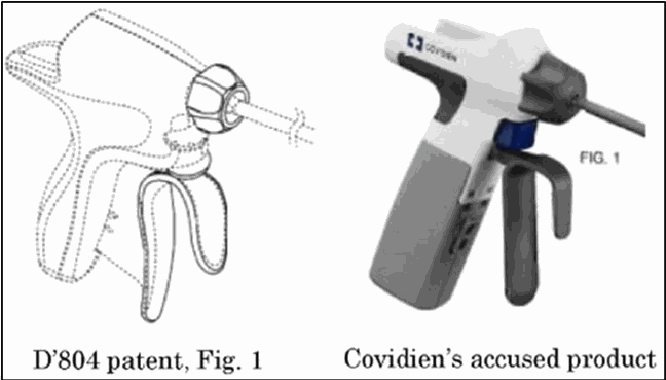
16Ethicon Endo-Surgery, Inc. v. Covidien, Inc., 796 F.3d 1312, 1334–37 (Fed. Cir. 2015).
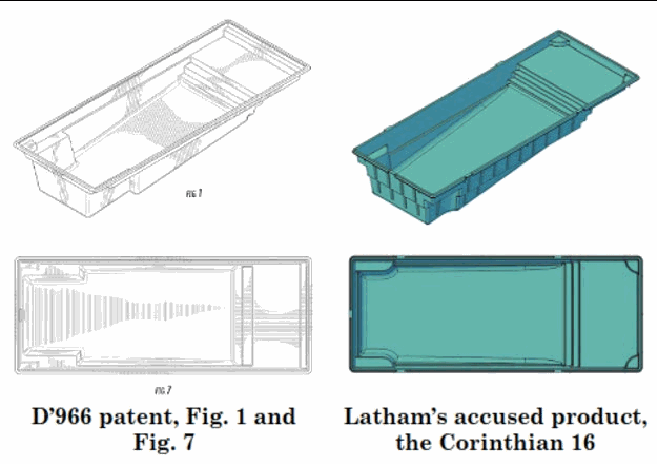
North Star Tech. Int’l Ltd. v. Latham Pool Prods., Inc., No. 23-2138, 2025 WL 1189919, at *1–2 (Fed. Cir. Apr. 24, 2025) (non-precedential).
We have erred in our allocation of responsibility between judge and jury in a significant way. The error is so17 obvious and the fix so easy: return us to Gorham, where the test for design patent infringement is whether an ordinary observer would find the two designs are substantially similar in overall appearance. Allocate to the jury questions of ornamentality and substantial similarity, inextricable parts of the infringement assessment.
I. Questions of Functionality and Orna-
mentality Belong with the Jury Because “[t]he construction of written instruments is one of those things that judges often do and are likely to do better than jurors unburdened by training in exegesis,” Markman v. Westview Instruments, Inc., 517 U.S. 370, 388 (1996) (emphases added), the Markman Court held utility patent claim construction “is better matched to a judge’s skills” than to a juror’s, Teva Pharms. USA, Inc. v. Sandoz, Inc., 574 U.S. 318, 325 (2015). The entirety of a design patent, however, is a series of pictures.2 Here is one at issue in this case:

18D’155 patent, Fig. 3.
Questions occurring within a design patent infringement trial, like the functional-ornamental fact finding, bear none of the hallmark indicia of judge advantage. For example, design patents are not “written instruments” upon which a judge can bring his interpretative “training and discipline” to bear. Markman, 517 U.S. at 389–90; Teva Pharms., 574 U.S. at 325. Quite the opposite. Verbal descriptions frustrate, rather than aid, design patent claim construction. Egyptian Goddess, 543 F.3d at 679; see also Dobson v. Dornan, 118 U.S. 10, 14 (1886) (claimed design “is better represented by the photographic illustration than it could be by any description, and a description would probably not be intelligible without the illustration”), superseded by statute on other grounds, as recognized in Samsung Elecs. Co. v. Apple Inc., 580 U.S. 53, 56–57 (2016). And a judge is no better suited than a lay juror, cf. Hana Financial, Inc. v. Hana Bank, 574 U.S. 418, 425 n.2 (2015)19 (allocating tacking question in trademark cases to juries because “the tacking inquiry . . . involves a factual judgment about whether two marks give the same impression to consumers”), to regard two designs and say if he would be induced “to purchase one supposing it to be the other.” Gorham, 81 U.S. at 528. This factual judgment about a visual impression is a fact finding for a jury. Bound up with that factual determination is whether aspects of a design choice are functional versus ornamental.
This court has provided a multi-factor test to determine whether an aspect of a design is functional:
[W]hether the protected design represents the best design; whether alternative designs would adversely affect the utility of the specified article; whether there are any concomitant utility patents; whether the advertising touts particular features of the design as having specific utility; and whether there are any elements in the design or an overall appearance clearly not dictated by function.
PHG Techs., LLC v. St John Cos., 469 F.3d 1361, 1366 (Fed. Cir. 2006) (emphasis removed) (citation omitted). “[W]e introduced these factors to assist courts in determining whether a claimed design was dictated by function and thus invalid.” Sport Dimension, 820 F.3d at 1322. That validity assessment, we have held, is a fact question for the jury to which we afford substantial deference. See Nordock, Inc. v. Sys. Inc., 803 F.3d 1344, 1360–61 (Fed. Cir. 2015) (holding substantial evidence supported jury finding that “claimed design is not dictated by function”), vacated on other grounds, 580 U.S. 1028 (2016); see also Hupp v. Siroflex of Am., Inc., 122 F.3d 1456, 1461 (Fed. Cir. 1997) (reviewing for substantial evidence jury finding that “design was ‘not ornamental’” but functional); PHG, 469 F.3d at 1365 (whether a design patent is functional is a fact question). We later explained that these same factors “may20 serve as a useful guide for claim construction functionality as well.” Sport Dimension, 820 F.3d at 1322 (emphasis added). It makes no sense that the functionality inquiry in the validity context is a fact question for the jury, but the identical question answered by the identical factors is a question of law for the judge when it is part of the infringement determination simply because we place it under the claim construction umbrella.
Nor would it make sense to give this quintessential jury question to the court. No answer to the questions underlying the functionality assessment is rooted in interpretation of legal text. Rather, each question demands a factual assessment that can only be made based on evidence outside of the patent. American juries are equipped to answer these questions. They assess functionality as a matter of fact all the time in analogous areas of law. For example, the functionality assessment in the design patent context was derived from trade dress infringement, see Jason J. Du Mont & Mark D. Janis, Functionality in Design Protection Systems, 19 J. INTELL. PROP. L. 261, 281–82, 282 n.106 (2012) (Du Mont), which all agree is a question of fact for the jury, see, e.g., McArlaids, Inc. v. Kimberly-Clark Corp., 756 F.3d 307, 310 (4th Cir. 2014) (“Functionality—the only issue presented by this case—is a question of fact that, like other factual questions, is generally put to a jury.”); Elmer v. ICC Fabricating, Inc., 67 F.3d 1571, 1578 (Fed. Cir. 1995); In re Morton-Norwich Prods., Inc., 671 F.2d 1332, 1340 (CCPA 1982) (“‘Functionality’ is a question of fact”). Functionality is likewise assessed as a part of trademark infringement, where it is also treated as a question of fact. See In re Becton, Dickinson & Co., 675 F.3d 1368, 1372 (Fed. Cir. 2012). And whether a patented invention serves any useful purpose is also a question of fact21 for the jury. See Brooktree Corp. v. Advanced Micro Devices, Inc., 977 F.2d 1555, 1571 (Fed. Cir. 1992).3
Further, since the Markman Court was satisfied that Supreme Court “precedent supports classifying the [utility claim construction] question as one for the court,” it did not reach (1) “the extent to which the Seventh Amendment can be said to have crystallized a law/fact distinction,” nor (2) “whether post-1791 precedent classifying an issue as one of fact would trigger the protections of the Seventh Amendment if . . . there were no more specific reason for decision.” Markman, 517 U.S. at 384 n.10 (collecting cases). But the concerns espoused in Markman, why construing written patent claims is properly the court’s job, are absent for design patents. And the answers to both unreached questions in Markman dictate the opposite result for factual questions subsidiary to design patent infringement, like the functional versus ornamental question. Certainly, juries by the founding were tasked with assessing the differences between articles of manufacture that bore some degree of utility. See Sayre v. Moore, 102 Eng. Rep. 138, 140 (KB 1785); cf. Ex Parte Peterson, 253 U.S. 300, 310 (1920) (“The limitation imposed by the [Seventh] [A]mendment is . . . the ultimate determination of issues of fact by the jury be not interfered with.”). And post-1791 precedent strongly indicates the character of the task at hand is primarily factual. “The sole question is one of fact. Has there been an infringement?” Gorham, 81 U.S. at 524 (1871) (emphasis added). That question belongs to the jury. As does the assessment of whether an element of a design is22 functional such that it should have diminished weight in assessing the overall similarity of two designs.
The balance struck in Markman and Teva is thus fitting where construction of the patent terms is dominated by construction of the legal document. In that context, as the concurrence explains, the “ultimate issue of the proper construction of a claim” remains a question of law even if “subsidiary factfinding is sometimes necessary.” Concurrence at 5 (quoting Teva, 574 U.S. at 326) (emphasis added). Extrinsic evidence upon which the judge must make a fact finding is the exception. See C.R. Bard, Inc. v. U.S. Surgical Corp., 388 F.3d 858, 861–62 (Fed. Cir. 2004) (“A long line of cases indicates that the intrinsic record is the primary source for determining claim meaning.”) (collecting cases). Most of the time utility patent claim construction is based upon the intrinsic record—a clean construction of legal documents. Cf. Markman, 517 U.S. at 389 (“In the main, we expect, any credibility determinations will be subsumed within the necessarily sophisticated analysis of the whole document . . . .”). The opposite is true in design patent claim construction. Nearly every single design patent case turns upon the factual issue of functionality—which dictates how the design should be compared to the prior art and the accused design. Du Mont, at 264–71 (“In most modern design patent cases, courts invoke the ornamentality requirement but analyze the issue by referring to non-functionality, treating it as the converse of ornamentality”); see also OddzOn Prods. v. Just Toys Inc., 122 F.3d 1396, 1404 (Fed. Cir. 1997) (“Where a design contains both functional and non-functional elements, the scope of the claim must be construed in order to identify the non-functional aspects of the design as shown in the23 patent.”). Almost nothing in the way of legal analysis undergirds the claim construction of a picture.4 It is this factual analysis—i.e., determining which aspects of the design are ornamental versus functional and weighing each when assessing similarity—that dictates the outcome of the infringement inquiry. The concurrence ignores the realities of design patent law and never meaningfully engages with the analyses in Markman and Teva, which brought the Court to its conclusion that in contexts where the analysis primarily comprises construction of a legal text, the judge, not the jury, should decide the few fact issues that arise. See Markman, 517 U.S. at 389. Design patent claim construction is nearly all fact. We should allocate the responsibility between judge and jury based on the reality of the analysis that takes place—just as the Supreme Court did in Markman and Teva.
Just one look at the district court’s claim construction in this case bears out the fact-heavy, jury-type nature of this inquiry. First, the court “rel[ied] on [the D’155 patent’s] illustrations and d[id] not write a detailed, feature-by-feature description to define the scope of the claimed design.” Order, at *6. A jury can do that too.
Next, the court conducted the fact-based Sport Dimension / PHG “[f]unctional vs. [o]rnamental analysis.” Order, at *7 (listing Sport Dimension / PHG factors). The court’s findings “[we]re based primarily on a concomitant utility24 patent, [the named inventor’s] affidavit, and [Range of Motion] marketing materials.” Id. at *7–8. None of the questions Sport Dimension and PHG ask, nor any of the answers the district court sought, can be found in the asserted design patent itself. This inquiry is entirely one where the court must receive and consider outside evidence regarding how an ordinary purchaser would understand the design in the picture to operate and which portions of that operation are dictated by function.5 See Rosco, Inc. v. Mirror Lite Co., 304 F.3d 1373, 1378–79 (Fed. Cir. 2002) (functional assessment requires comparison with alternative designs). See generally PHG, 469 F.3d at 1366–69 (reviewing district court’s functionality assessment based on witness testimony). Here, the district court weighed evidence and witness testimony—plainly dissimilar from the “sophisticated analysis” of legal text. Cf. Markman, 517 U.S. at 389.
Design patent law does not have to be this complicated. Judges should not be performing these essential fact findings roles under the guise of claim construction. An easy solution already exists in our legal system. Let the jury do its job.
25II. Infringement Belongs with the Jury
In Gorham, the Supreme Court, discussing the testimony of several ordinary purchasers, held the test for design patent infringement is whether “in the eye of an ordinary observer, giving such attention as a purchaser usually gives, two designs are substantially the same.” 81 U.S. at 513–18, 528. The Court was motivated by several concerns, chief among which was the purpose motivating design patent law, “secur[ing] for a limited time to the in-genious producer of [new and original appearances to a manufactured article] the advantages flowing from them.” Id. at 525. The Court explained that purpose could not be effected
if, while the general appearance of the design is preserved, minor differences of detail in the manner in which the appearance is produced, observable by experts, but not noticed by ordinary observers, by those who buy and use, are sufficient to relieve an imitating design from condemnation as an infringement.
Id. at 528.
Nearly 20 years ago, sitting en banc, we acknowledged Gorham’s ordinary observer test as the “sole test” for determining whether a design patent has been infringed and noted resolution of this test can often “benefit from a comparison of the claimed and accused designs with the prior art.” Egyptian Goddess, 543 F.3d at 678. Yet, in the same opinion, we inadvertently inverted Gorham. We held that, in some cases, if a claimed design and accused design are “plainly dissimilar” or “sufficiently distinct,” a finding of noninfringement could be made—even at summary judgment—without an examination of the prior art. Id.
This reframing of the design infringement test from “substantial similarity” to a focus on differences cannot stand. It is inconsistent with Supreme Court precedent.26 See Gorham, 81 U.S. at 528 (rejecting as a test for infringement “a comparison of the features which make up the two designs” because “[s]uch a test would destroy all the protection which the act of Congress intended to give”). And it skips what I believe is a crucial part of the substantial similarity analysis. The factfinder should always “compar[e] the claimed and accused designs in light of the prior art.” Egyptian Goddess, 543 F.3d at 677.6 A quick look at the prior art in this case demonstrates why:
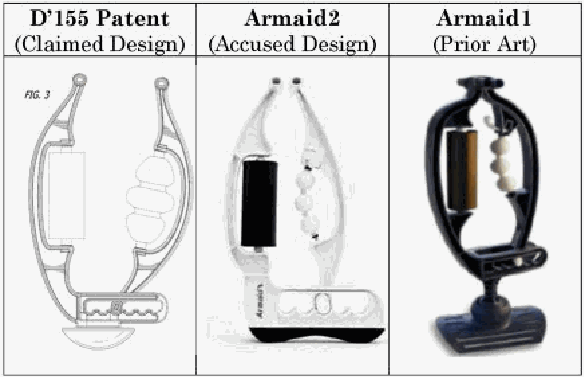
The district court began by acknowledging that the claimed design and the accused Armaid2 “at a conceptual27 level [] look quite similar.” Order, at *10. It went on, however, to point out each minute difference between them and conclude that “[t]hese features contribute to the stylized impression conveyed by the Armaid2 . . . in contrast to the robust and workman like impression conveyed by the D’155 patent.” Id. at *11. Respectfully, how is this fact finding— not only affirmed but expressly endorsed in our court’s opinion—not the province of the jury?
More than a mere semantic distinction, empirical research suggests the “plainly dissimilar”/“sufficiently distinct” reframing biases the way individuals evaluate the infringement question. See Dkt. 80 at 2–4 (Inst. for Design Sci. & Pub. Pol’y Am. Br.); see also Range of Motion Prods., LLC v. Armaid Co., 166 F.4th 981, 995–96 (Fed. Cir. 2026) (Moore, C.J., dissenting). In the absence of clear standards about what constitutes plainly dissimilar designs, a disturbing pattern has arisen in which district court judges routinely invoke this shortcut to single-handedly decide the factual issue of infringement at summary judgment often without any consideration of the prior art. In other words, what began as a well-intentioned, narrow exception for disposing of near-frivolous design patent cases has morphed into the very thing the Gorham Court rejected: a vehicle that not only extinguishes the protections granted design patentees but usurps the jury’s role of “bringing to the examination of the article upon which the design has been placed that degree of observation which men of ordinary intelligence give.” Gorham, 81 U.S. at 528.
Egyptian Goddess’s “plainly dissimilar”/“sufficiently distinct” language was intended to provide a shortcut for disposing of truly easy-to-decide design patent cases, such as PS Prods. Inc. v. Panther Trading Co., 122 F.4th 893 (Fed. Cir. 2024) (claimed and accused designs reproduced below).
28D’188 Patent Panther’s Product (Claimed Design) (Accused Design)


The concurrence chalks all of this up to a question of “line-drawing: How easy is ‘truly easy-to-decide’?” Concurrence at 3. If district courts are overlooking genuine issues of fact, we should just set them straight on appeal, not fix the law. See id. The trouble is, we are not setting the courts straight, because we are applying bad law. Otherwise, cases like this one, North Star, and Ethicon Endo-Surgery would all go to juries. Because the exception has swallowed the rule, it is this court’s responsibility to revisit and address what has proved to be an unworkable standard.
The solution is simple. Questions of aesthetic appearance, ornamentality, and functionality all belong to the jury as part of the infringement determination. To be sure, this proposal would not eliminate the consideration of differences between two designs when evaluating whether they are substantially the same in the eye of an ordinary observer. Nor would it prevent courts from ever deciding the question of infringement at summary judgment as a matter of law. Rather, it would be a simple—but important—change to put the court and jury back in their proper roles.
I respectfully dissent from this court’s denial of en banc rehearing.
Footnotes
- ↩ 1 Circuit Judge Newman did not participate.
- ↩ 1 The dissent minimizes the importance of subsidiary factual findings in the construction of claims in utility patents. See Dissent at 10 (“Extrinsic evidence upon which the judge must make a fact finding is the exception.”). Although “[i]n some instances, a factual finding will play only a small role in a judge’s ultimate legal conclusion about the meaning of the patent term,” in other instances “a factual finding may be close to dispositive of the ultimate legal question of the proper meaning of the term in the context of the patent.” Teva, 574 U.S. at 333. “Nonetheless, the ultimate question of construction will remain a legal question” for the court. See id.
- ↩ 2 That functionality may also be considered by a jury in assessing invalidity, see Dissent at 7–8, does not affect this conclusion. In design patent law, functionality plays different roles in invalidity and claim construction. “For purposes of validity . . . a design patent is invalid if its overall appearance is dictated by function, and therefore primarily functional.” Ethicon, 796 F.3d at 1333. This inquiry is a distinct inquiry from functionality as assessed during claim construction, which involves identifying the design’s functional elements in an effort to guide the jury as to the scope of the claim. Where elements of a design serve a functional purpose but together do not result in a design that is invalid because it is “dictated by function,” such individual functional elements nonetheless still limit the scope of the claim. See id.; OddzOn Prods., Inc. v. Just Toys, Inc., 122 F.3d 1396, 1405 (Fed. Cir. 1997).
- ↩ 3 Although the claim of U.S. Patent No. D802,155 contains only pictures, we have held that in some instances “claim language can limit the scope of a design patent.” Curver Lux., SARL v. Home Expressions Inc., 938 F.3d 1334, 1340 (Fed. Cir. 2019). On the other side of the coin, patent drawings can be highly relevant in construing the claims of a utility patent. See, e.g., Paragon Sols., LLC v. Timex Corp., 566 F.3d 1075, 1084–85 (Fed. Cir. 2009); CVI/Beta Ventures, Inc. v. Tura LP, 112 F.3d 1146, 1153– 54 (Fed. Cir. 1997).
- ↩ 4 The dissent suggests that juries could interpret the prosecution history to properly construe the scope of a claim if provided with a “simple jury instruction.” Dissent at 11 n.4. But the “[p]rosecution history is part of the intrinsic evidence” and “the intrinsic-evidence aspects of the court’s claim construction analysis” are legal, not factual questions for the jury. See VLSI Tech. LLC v. Intel Corp., 172 F.4th 1348, 1354 (Fed. Cir. 2026).
- ↩ 1 Questions of functionality abound in other areas of law, and they are consistently treated as factual questions for a jury to resolve. See infra § I.
- ↩ 2 The concurrence claims in some instances design patent claims can include words. Concurrence at 6 n.3. Not meaningfully, no. The vast majority of design patents contain no limiting words. Occasionally design patent claims will use words to specify the useful article to which the design is applied. See In re SurgiSil, L.L.P., 14 F.4th 1380, 1382 (Fed. Cir. 2021); see also Curver Luxembourg, SARL v. Home Expressions Inc, 938 F.3d. 1334, 1339–40 (Fed. Cir. 2019) (holding the preambulatory language “ornamental design for a pattern for a chair” limited the design to the pattern as applied to a chair); see also 37 C.F.R. § 1.153(a) (“No description, other than a reference to the drawing, is ordinarily required.”).
- ↩ 3 Outside of intellectual property law, functionality plays a role, for example, in product liability cases where juries determine the intended use and function of products as a matter of fact. See, e.g., Tincher v. Omega Flex, 628 Pa. 296, 309 (2014); Barclay v. Techno-Design, Inc., 129 A.D.3d 1177, 1181 (N.Y. App. Div. 2015).
- ↩ 4 The concurrence points out other considerations it contends bear on the scope of design patent claims, including the role of broken lines in design patent drafting and the effect of representations made during prosecution. Concurrence at 7. There is no reason—and the concurrence provides none—why considerations like these, which can be addressed with a simple jury instruction, otherwise require taking substantially the entire infringement question away from the jury.
- ↩ 5 Certain questions of design patent validity are determined through the lens of the ordinary designer of relevant designs, see LKQ Corp. v. GM Glob. Tech. Ops. LLC, 102 F.4th 1280, 1298–99 (Fed. Cir. 2024) (en banc), but infringement is determined by asking whether an ordinary purchaser of relevant products would find two designs substantially the same, Egyptian Goddess, 543 F.3d at 670– 71. The infringement question here is whether a purchaser of handheld massage devices would think the two massage designs are substantially similar.
- ↩ 6 The concurrence says this case is not the right vehicle to harmonize our cases with Gorham because the district court alternatively analyzed the differences between the asserted patent and accused design in view of the prior art, Order, at *11; so, the concurrence contends, the outcome would be no different. Concurrence at 3–4. The concurrence misses the point entirely: all of that analysis— under the correct test—is for the jury. It is deeply factual and determinative of the infringement issue in nearly all cases.