NOTE: This order is nonprecedential.
United States Court of Appeals for the Federal Circuit
Miscellaneous Docket No. 913
IN RE AFFYMETRIX, INC.,
Petitioner. On Petition for Writ of Mandamus to the United States District Court for the Western District of Wisconsin in case no. 09-CV-277, Judge Barbara B. Crabb.
ON PETITION FOR WRIT OF MANDAMUS
Before MICHEL, Chief Judge, FRIEDMAN and LINN, Circuit Judges.
QRDER
Affymetrix, Inc. petitions for a writ of mandamus to direct the United States District Court for the Western District of Wisconsin to vacate its order denying Affymetrix’s motion to transfer venue and to direct the Wisconsin district court to transfer the case to the United States District Court for the Northern District of California. Illumina, Inc. opposes. Affymetrix replies.
Illumina brought this suit in the District Court for the Western District of Wisconsin, charging Affymetrix with infringement of its method patent relating to genetic analysis technology. Illumina alleges that Affymetrix has infringed its patent by making sales of infringing products and by offering infringing products for sale, with these sales and offers to sell occurring in the Western District of Wisconsin. Affymetrix asked the district court to transfer the case to the District Court for the Northern District of California pursuant to § 1404(a), which authorizes transfer “for the convenience of parties and witnesses, in the interest of justice.” The district court denied the motion,2 finding that the convenience factors weighed only modestly in favor of transfer and were outweighed by the factors relating to the interests of justice, particularly the ability of the Western District of Wisconsin to try this case more quickly than would likely be possible in the Northern District of California.
Mandamus is reserved for extraordinary causes and is generally unavailable unless the petitioner can demonstrate that the district court “so far exceeded the proper bounds of judicial discretion as to be legitimately considered usurpative in character or in violation of a clear and indisputable legal right, or at the very least, patently erroneous.” In re Nat'l Presto Indus., Inc., 347 F.3d 662, 663 (7th Cir. 2003). Because Illumina is not litigating in its home forum, its choice of venue receives less deference than would otherwise be the case. Piper Aircraft Co. v. Reyno, 454 U.S. 235, 255-56 (1981). Still, for transfer of venue to be appropriate, Affymetrix must make a clear and indisputable showing that, on balance, the convenience and interest of justice considerations strongly favor transfer. Nat'l Presto, 347 F.3d at 663-64; see also Coffey v. Van Dorn Iron Works, 796 F. 2d 217, 219-20 (7th Cir. 1986) (“The movant... has the burden of establishing, by reference to particular circumstances, that the transferee forum is clearly more convenient.”).
The interests of justice present Affymetrix with a particularly high burden in this case. Illumina chose to file suit in the Western District of Wisconsin because it sought a speedy resolution of this patent case, because the plaintiff and defendants are direct competitors, and because the defendant was introducing a new product into the Wisconsin market. The district court explained, “[w]hen a patent infringement case centers on competing products in a dynamic market, the factor of speed takes on more3 importance ... . Without a speedy resolution, it will become increasingly difÏcult for plaintiff to capture market share and recoup lost profits.” Illumina, Inc. v. Affymetrix, Inc., No. 09-cv-277-bbc, 2009 WL 3062786, at *5 (W.D. Wisc. Sept. 21, 2009). At least in the absence of any clear holding by the relevant regional circuit that speed of trial in the transferor and transferee forums may not be considered or is entitled only to low weight, and in a proper case such as this one, where the emergence of a new allegedly infringing product threatens the patentee’s market for its own products, we agree that the district court may properly consider the speed of trial in its transfer analysis. “[A] trial judge weighing the interests of justice could legitimately consider the condition of his court’s docket an important factor.” Parsons v. The Chesapeake & Ohio Railway Co., 375 U.S. 71, 73 (1963). We take no issue with—and neither party challenges—the district court’s assertion that this case would be resolved more quickly in the Western District of Wisconsin than in the Northern District of California. And we agree with the district court that the entry of a new allegedly infringing product into a given market in which the patentee sells or hopes to sell its own products provides a reason to seek to resolve the patent litigation quickly.
Of course, the relative speeds with which the Western District of Wisconsin and the Northern District of California could resolve this case would be irrelevant if this litigation had no legitimate connection to the Western District of Wisconsin, Illumina’s chosen forum, And Affymetrix urges that this cause of action has everything to do with the Northern District of California and nothing to do with the Western District of Wisconsin. This is something of an exaggeration. As the district court pointed out, Affymetrix does not dispute that it has entered into an ongoing contract with the
4University of Wisconsin-Madison under which the allegedly infringing product may be purchased at discounted rates by researchers afÏliated with the University. The sale of products within the Western District of Wisconsin provides a suitable connection to the district for the litigation to be resolved there.’ Thus, we agree with the district court that the interests of justice, particularly the speed with which this litigation may be resolved, stand in opposition to transfer. These interests must be weighed against the convenience of the parties and witnesses.
The convenience of the parties in litigating in a given forum is related to the parties’ access to sources of proof, such as documents and allegedly infringing products. Affymetrix argues that the relevant documents, as well as the allegedly infringing product, are all located in California, weighing heavily in favor of transferring this litigation there. This is particularly the case, argues Affymetrix, because the allegedly infringing product weighs 300 pounds, making its transportation to Wisconsin for trial difÏcult. But the Seventh Circuit has rejected this as a basis for transferring cases, holding that “[eJasy air transportation, the rapid transmission of documents, and the abundance of law firms with nationwide practices, make it easy these days for cases to be litigated with little extra burden in any of the major metropolitan areas.” Board of Trustees, Sheet Metal Workers Nat'l Pension Fund v. Elite Erectors, Inc., 212
' The mere sale of allegedly infringing products within the boundaries of the transferor forum might be insufÏcient to avoid transfer of venue if the products were sold within the boundaries of every United States judicial district, or a large number of them. But where, as here, the products appear to be sold under discrete contracts with individual distributors located in only one district, or only a relative few districts, and where, as here, one of those districts is the chosen venue, the connection to the chosen venue is stronger. Cf, Beverly Hills Fan Co. v. Royal Sovereign Corp., 21 F.3d 1558, 1571 (Fed. Cir. 1994) (holding that, for choice-of-law purposes, the injury to a patentee occurs in the location where an infringing product is sold).
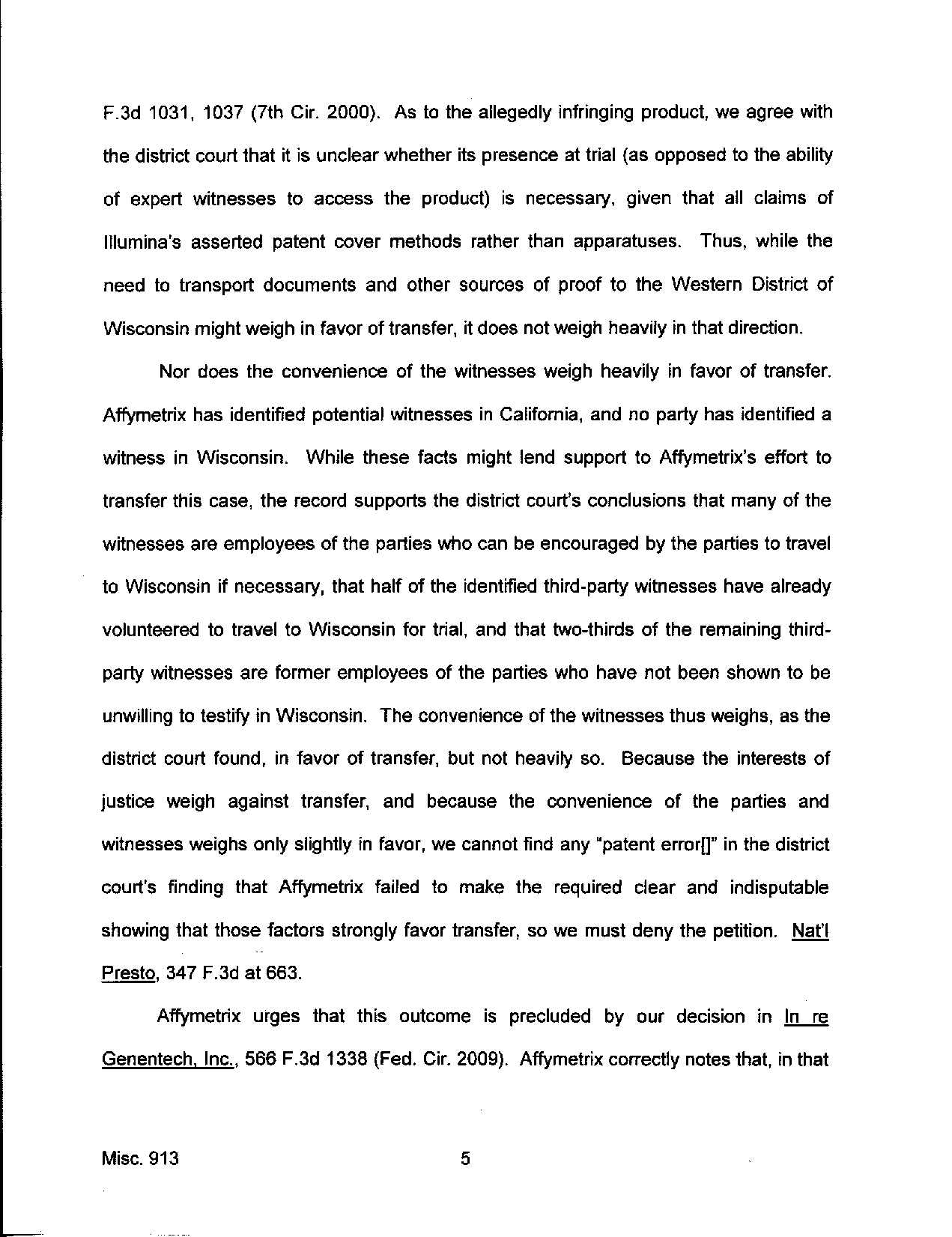
5F.3d 1031, 1037 (7th Cir. 2000). As to the allegedly infringing product, we agree with the district court that it is unclear whether its presence at trial (as opposed to the ability of expert witnesses to access the product) is necessary, given that all claims of Illumina'’s asserted patent cover methods rather than apparatuses. Thus, while the need to transport documents and other sources of proof to the Western District of Wisconsin might weigh in favor of transfer, it does not weigh heavily in that direction.
Nor does the convenience of the witnesses weigh heavily in favor of transfer. Affymetrix has identified potential witnesses in California, and no party has identified a witness in Wisconsin. While these facts might lend support to Affymetrix’s effort to transfer this case, the record supports the district court’s conclusions that many of the witnesses are employees of the parties who can be encouraged by the parties to travel to Wisconsin if necessary, that half of the identified third-party witnesses have already volunteered to travel to Wisconsin for trial, and that two-thirds of the remaining third-party witnesses are former employees of the parties who have not been shown to be unwilling to testify in Wisconsin. The convenience of the witnesses thus weighs, as the district court found, in favor of transfer, but not heavily so. Because the interests of justice weigh against transfer, and because the convenience of the parties and witnesses weighs only slightly in favor, we cannot find any “patent error[]” in the district court's finding that Affymetrix failed to make the required clear and indisputable showing that those factors strongly favor transfer, so we must deny the petition. Nat'l Presto, 347 F.3d at 663.
Affymetrix urges that this outcome is precluded by our decision in In_re Genentech, Inc., 566 F.3d 1338 (Fed. Cir. 2009). Affymetrix correctly notes that, in that6 case, we” explained that the fact that the case could likely be resolved more quickly in the plaintiffs chosen venue cannot by itself justify maintaining the case in the chosen venue if all other relevant factors clearly demonstrate the convenience and fairness of the transferee venue. Id. at 1347. But In re Genentech does not apply here. For the reasons explained above, we cannot say that Affymetrix has made a clear and indisputable showing that all the other factors clearly favor transfer, as required to implicate the rule of In re Genentech? The district court clearly understood our precedent, properly explaining that “docket speed alone is not sufÏcient to defeat a motion to transfer when other factors establish that another forum is clearly more convenient{.]” Illumina, 2009 WL 3062786, at *5. But, given the district court's correct consideration of the other factors, which do not strongly favor transfer to the Northern District of California, we cannot find fault with the district court’s determination that trial speed weighed in favor of keeping this litigation in the Western District of Wisconsin. Certainly, the district court’s decision was not so patently erroneous as to give rise to a right to mandamus relief. We therefore deny this petition.
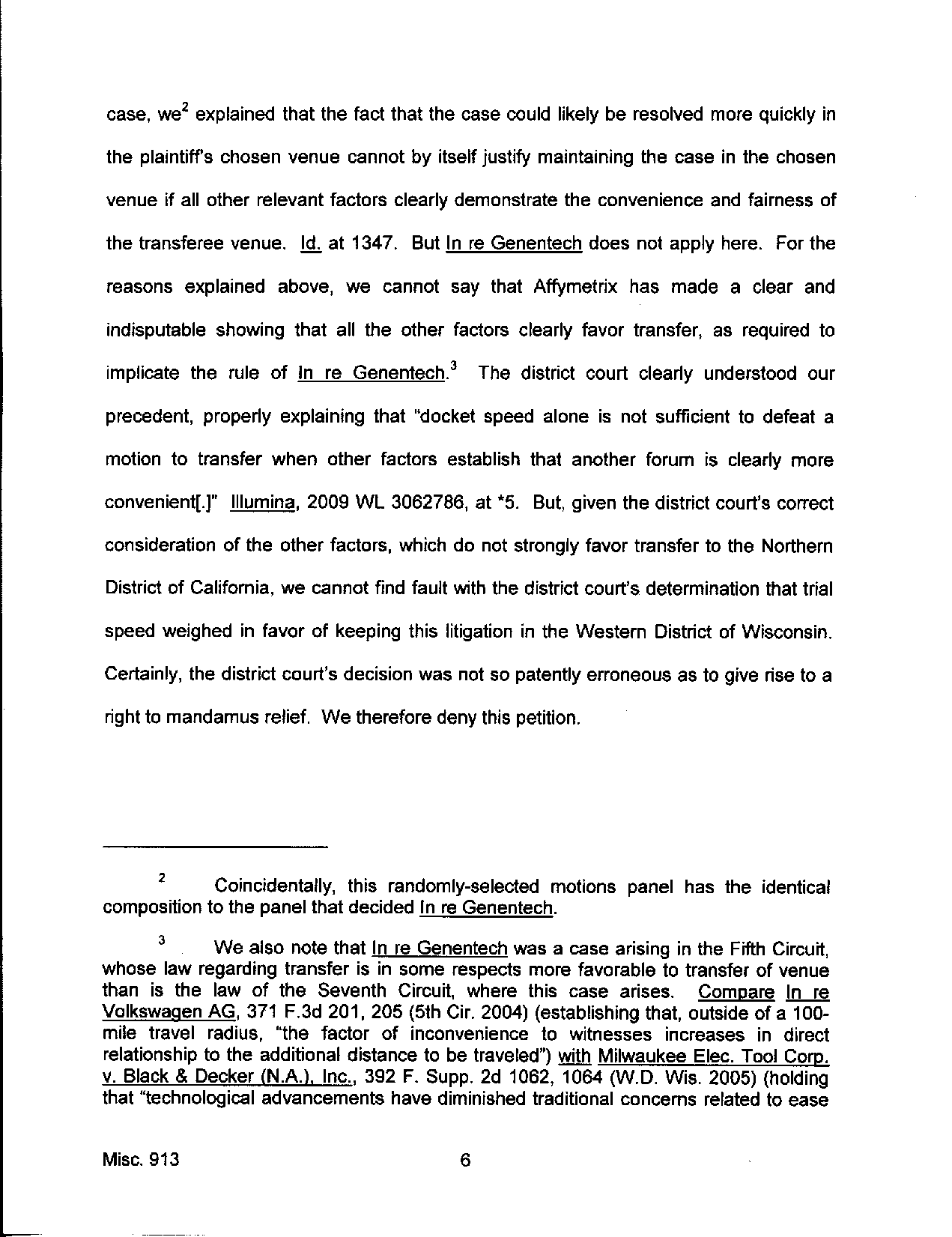
2 Coincidentally, this randomly-selected motions panel has the identical composition to the panel that decided In re Genentech.
3 We also note that In re Genentech was a case arising in the Fifth Circuit, whose law regarding transfer is in some respects more favorable to transfer of venue than is the law of the Seventh Circuit, where this case arises. Compare In re Volkswagen AG, 371 F.3d 201, 205 (5th Cir. 2004) (establishing that, outside of a 100-mile travel radius, “the factor of inconvenience to witnesses increases in direct relationship to the additional distance to be traveled”) with Milwaukee Elec. Tool Corp. v, Black & Decker (N.A.), Inc., 392 F. Supp. 2d 1062, 1064 (W.D. Wis. 2005) (holding that “technological advancements have diminished traditional concerns related to ease

7Accordingly, IT IS ORDERED THAT:
The petition is denied.
FOR THE COURT
APR 13 2010 Is/ Jan Horbaly
Date Jan Horbaly
Clerk
ce: Ron &. Shuiman, Esq.
Jeffrey N. Costakos, Esq. Clerk, United States District Court for the Western District of Wisconsin
$19
U.S, COURTF IHEED eats FOR
THE FEDERAL CIRCUIT
APR 13 2010
JAN HORBALY
CLERK
of access to sources of proof and the cost of obtaining attendance of witnesses’).